What Is a Nylon Abrasive Wheel Brush?
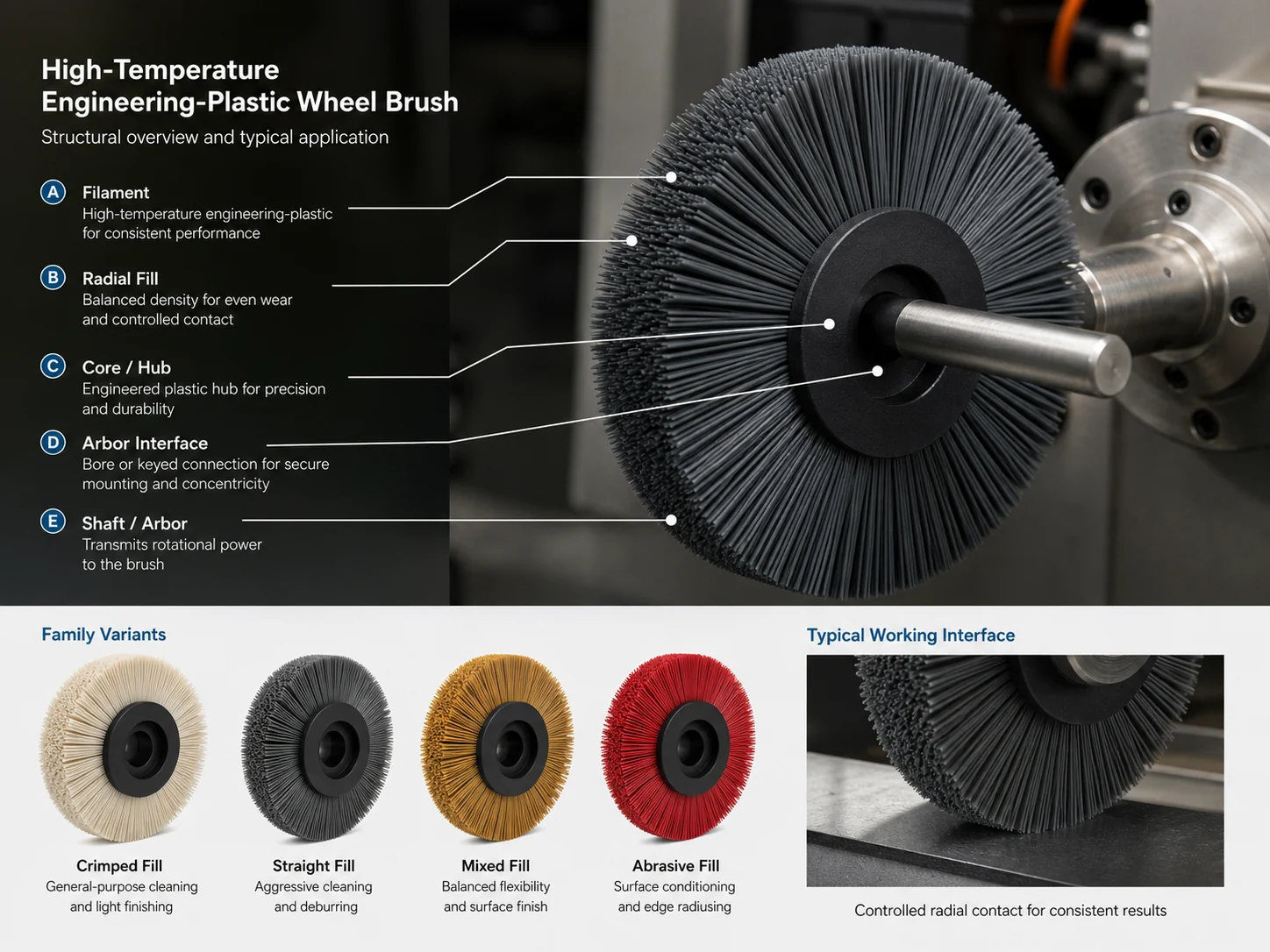
A nylon abrasive wheel brush is a rotary power tool accessory in which individual nylon bristles are impregnated with abrasive grains such as aluminum oxide, silicon carbide, or ceramic. The bristles are arranged radially around a central hub to form a wheel that mounts on bench grinders, angle grinders, or dedicated finishing machines. As the wheel spins, the flexible bristles conform to contours while the abrasive edges cut, smooth, or clean the workpiece surface.
For the safety point in this section, the relevant OSHA reference is OSHA — 1910.242 Hand and Portable Powered Tools.
For the safety point in this section, the relevant OSHA reference is OSHA — 1910.215 Abrasive Wheel Machinery.
For the safety point in this section, the relevant OSHA reference is OSHA — Personal Protective Equipment.
For brush terminology and construction language, this section references ABMA — ANSI B165.1 Power Brush Safety Slips.
For material-selection language, this section is supported by British Plastics Federation — Thermoplastics.
Because the abrasive is embedded inside the filament, the brush continuously exposes fresh cutting particles as the bristles wear, delivering consistent performance over the life of the brush. This design distinguishes nylon abrasive brushes from wire brushes (which rely on mechanical impact) and from non‑abrasive nylon brushes (which remove contaminants through friction alone).
Common Types of Nylon Abrasive Wheel Brushes
Buyers encounter several configurations, each suited to different tasks:
- Full‑wheel (radial) brushes: Bristles extend outward from the center for general‑purpose face or edge work on flat surfaces, weld seams, and large parts.
- Cup‑style brushes: Bristles are set in an angled cup shape for more aggressive corner and fillet cleaning, often used on angle grinders for tight spaces.
- Mini‑wheel brushes: Small‑diameter wheels (often with 3 mm shank) for detail work on rotary tools, ideal for intricate parts, molds, or wood carving clean‑up.
- Non‑abrasive nylon wheel brushes: No grit is added; these rely on bristle stiffness alone for light cleaning, dust removal, or burnishing without changing surface dimensions.
- Anti‑static nylon brushes: Formulated with conductive additives to dissipate static charges, used for cleaning electronic assemblies, computer components, and ESD‑sensitive machinery.
Nylon Abrasive vs. Wire Brush vs. Non‑Abrasive Nylon
The table below compares key operational characteristics to help you decide which brush technology fits your process.
| Characteristic | Nylon Abrasive Wheel Brush | Wire Brush | Non‑Abrasive Nylon Brush |
|---|---|---|---|
| Material removal | Controlled, gradual | Aggressive, can gouge | Minimal, friction only |
| Surface safety | Low risk of scratching soft metals | High risk of scratching; leaves wire debris | Very safe, non‑damaging |
| Heat buildup | Moderate; higher speeds require heat‑resistant grades | Moderate to high | Low |
| Static generation | Possible; anti‑static variants available | Low static risk | Possible; anti‑static variants available |
| Wet operation | Compatible with water or light coolants | Prone to rust if not stainless | Compatible; unaffected by moisture |
| Typical uses | Deburring, edge blending, rust removal, surface prep | Heavy rust, thick scale, weld slag | Dusting, polishing, light cleaning |
How to Choose the Right Nylon Abrasive Wheel Brush
Rather than defaulting to “the strongest grit,” evaluate these five factors to match the brush to your application.
1. Contact Surface Material
Aluminum, brass, or delicate alloys need a brush with finer grit and softer filament to avoid galling. Steel or iron castings can tolerate more aggressive grit sizes. Always check that the abrasive type (aluminum oxide, silicon carbide, ceramic) is compatible with the workpiece hardness.
2. Residue or Coating Type
Light oxidation, shop dirt, or powder coat remnants may only require a medium‑grit brush. Heavy rust, burrs after machining, or thick mill scale demand coarser grit or a more aggressive cup‑style configuration. If the goal is simply stain removal without dimensional change, a non‑abrasive nylon brush may suffice.
3. Machine Speed and Power
Nylon abrasive brushes are speed‑rated. A brush designed for a bench grinder at 3,600 RPM may not survive a high‑speed angle grinder at 10,000 RPM. Exceeding the maximum safe speed can cause bristle loss or wheel failure. Match the brush’s RPM rating to the tool, and consider heat‑stable nylon grades if the operation is continuous or dry.
4. Dry vs. Wet Operation
Nylon absorbs some moisture, but long‑term soaking can soften fillers and reduce abrasive bond strength. If the process uses coolant or water, confirm the brush material is rated for wet environments. Wet operation often reduces dust and heat, but may also alter cutting action.
5. Static Control Requirements
In electronics assembly, cleanroom maintenance, or painting prep, static discharge can attract dust or damage components. Anti‑static nylon brushes incorporate conductive compounds to safely dissipate charges. Standard nylon abrasive brushes can generate static under dry, high‑speed conditions, so evaluate the risk if plastic housings or sensitive circuitry are present.
6. Documentation and Traceability
For regulated industries (food processing, pharmaceutical, aerospace), you may need material certification or test reports confirming no metal contamination, specific grit type, or filament composition. Engage suppliers early and request data sheets that verify the brush meets your documentation standards.
Common Selection Mistakes
- Choosing by grit size alone: A finer grit does not automatically mean a safer brush. Filament stiffness, wheel diameter, and speed all influence aggressiveness.
- Ignoring speed ratings: Running a brush beyond its recommended RPM can lead to rapid wear, imbalance, and safety hazards.
- Using dry brushes on heat‑sensitive parts: Continuous dry operation can build frictional heat that warps thin sheet metal or softens adhesives.
- Assuming all nylon brushes are anti‑static: Most standard nylon is non‑conductive; anti‑static properties require a specific material grade.
- Mixing wet and dry brushes on the same wheel without cleaning: Residual abrasive slurry can harden between bristles, altering performance the next time the brush is used dry.
- Overlooking shank or arbor compatibility: A 3‑mm shank mini‑brush will not fit a ¼‑inch collet; double‑check mounting dimensions before ordering.
When a Standard Nylon Abrasive Wheel Brush Is Not Enough
Off‑the‑shelf brushes may reach their limit in several scenarios:
- Highly abrasive environments: Sand casting cleanup or continuous oxide scale removal might wear standard nylon too quickly. Here, a staged approach (first wire, then nylon) or a ceramic‑grit nylon brush may last longer.
- Extreme temperatures: Applications near ovens, engines, or hot molds can soften nylon filaments. Verify the brush’s heat deflection temperature and consider specialty heat‑stabilized nylon grades.
- Chemical exposure: Solvent cleaning or exposure to acids/alkalis can degrade nylon. If the cleaning chemical is aggressive, ask for chemical compatibility data or a custom filament blend.
- Unique contour profiles: Deep grooves or complex 3D surfaces might require a custom‑diameter wheel, a tapered profile, or a special bristle density. In these cases, sample testing with the supplier is the most reliable path.
When the application pushes these boundaries, request sample brushes for on‑site trials. Document the results against your criteria—surface finish, cycle time, brush life—and work with the manufacturer to adjust grit, filament type, or wheel configuration.
Final Takeaway
Selecting a nylon abrasive wheel brush is less about finding one “best” product and more about balancing five factors: the material you are cleaning, the residue you need to remove, the tool you are mounting it on, the environment (wet/dry, static, heat), and any industry documentation requirements. Start with a standard medium‑grit radial brush for general‑purpose work, then adjust filament stiffness, grit type, and wheel shape based on actual trial results. When standard options fall short, anti‑static or custom blended nylon brushes often bridge the gap without switching to a completely different brush technology.
Frequently Asked Questions
What is the difference between an abrasive nylon wheel brush and a wire wheel?
A nylon abrasive brush removes material and coatings through abrasive grit embedded in flexible filaments, producing a more uniform finish with less gouging. A wire wheel relies on hard metal bristles that impact the surface, making it faster for heavy rust but riskier on delicate metals.
Can I use a nylon abrasive wheel brush on wood?
Yes, abrasive wheel brushes designed for wood can remove old finishes, texture grain, or clean carvings without the deep scratching that wire wheels can cause. Select a finer grit and test on a scrap piece first.
How do I know if I need an anti‑static nylon brush?
If you work with electronics, cleanroom equipment, or components where static discharge could cause damage or attract dust, choose an anti‑static nylon brush. Standard brushes can generate static under dry, high‑speed operation.
Are nylon abrasive brushes safe for food‑contact surfaces?
Some nylon materials and abrasive grains can meet FDA or EU food‑contact standards, but you must verify with the brush manufacturer and obtain the necessary certifications. Never assume a standard industrial brush is food‑safe without documentation.
What happens if I exceed the maximum RPM rating?
Excessive speed can cause the bristles to fly off, the wheel to become unbalanced, or the hub to crack. This creates a safety risk and drastically shortens brush life. Always match the brush’s RPM rating to the tool’s maximum no‑load speed.
Can I run a nylon abrasive brush wet?
Yes, many are compatible with water or light coolants, but prolonged soaking may affect bristle stiffness and abrasive retention. Check with the supplier if the brush will be used in a flooded or submerged application.
How do I choose between a cup brush and a radial wheel brush?
A cup brush concentrates abrasive action on a smaller contact area, making it better for corners, fillets, and tight spots. A radial wheel brush covers a wider path and works well on flat surfaces, edges, and large parts.
Is a sample test really necessary before a large order?
For repetitive production work where surface finish, cycle time, or brush life is critical, a sample test can prevent costly mismatches. It lets you confirm the brush’s performance on your actual parts with your exact tool and environment.