
Custom Cleaning Brush
Condenser Tube Brush
Custom condenser tube brushes with brass wire, stainless steel, nylon, or abrasive fill for removing scale, rust, and deposits from 6–60 mm ID tubes.
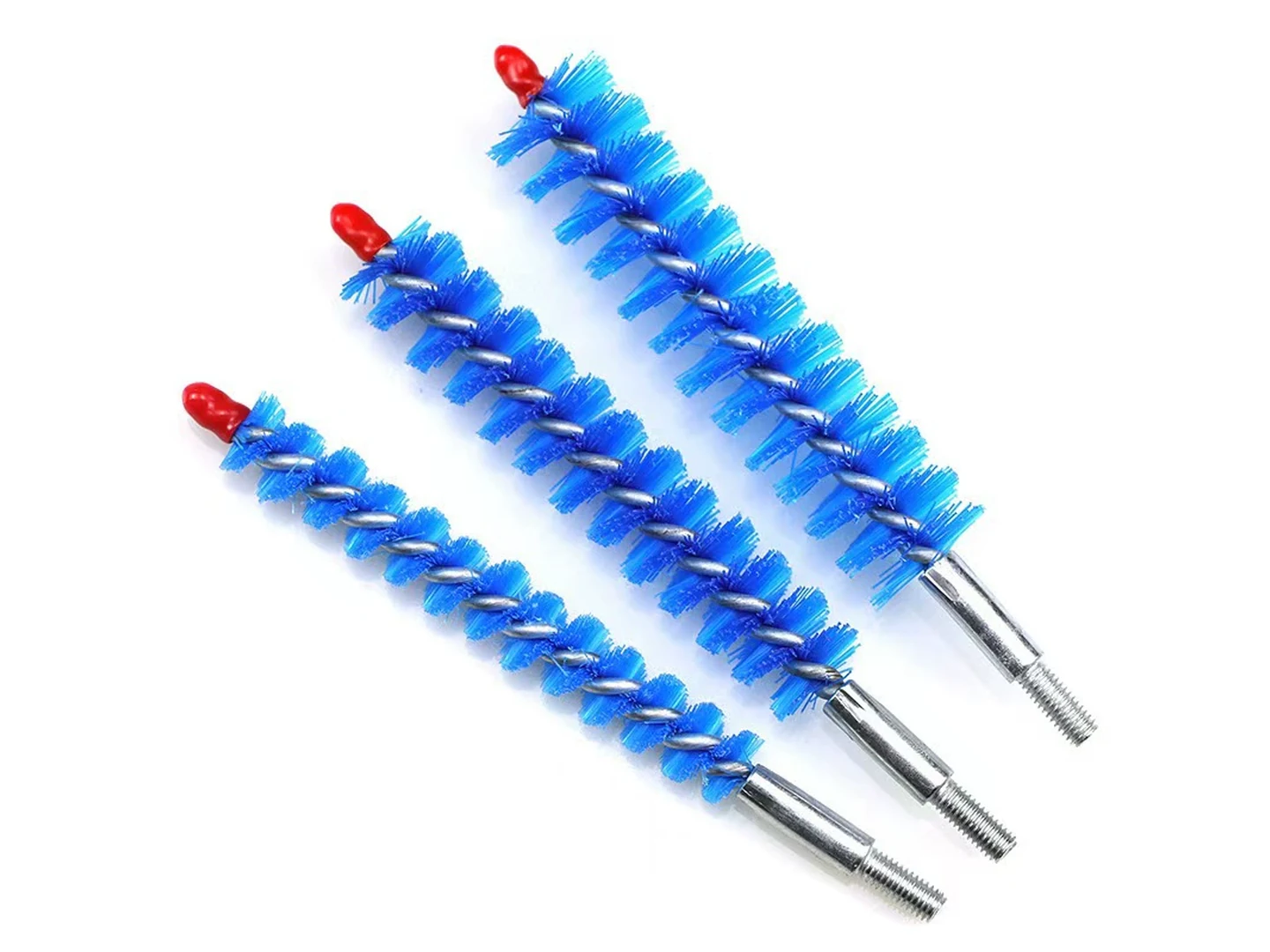
Small brush
500 pcs
Minimum order
Held in one hand: tube, bottle, detail and swab brushes — including long-handled ones with a small head.
Production lead time, once the specification is confirmed
- Up to 500 pcsWithin 7 days
- 501–50,000 pcsWithin 14 days
- Over 50,000 pcsWithin 21 days
Peak season can extend these times; the shipping date is confirmed in writing with your quotation. Sampling and shipping are quoted separately.
A twisted-in-wire condenser tube brush designed to remove scale, rust, sludge, and process deposits from the internal walls of condenser, heat exchanger, and boiler tubes. Available with brass wire, stainless steel, nylon, or abrasive fill for manual or powered rotary cleaning on tube IDs from 6 mm to 60 mm.
This brush combines a rigid twisted wire stem with a dense radial filament fill to reach full tube length while clearing the most common fouling found in chiller, power plant, and process condenser tubes.
What can this brush do for you?
Full-length contact inside straight and gently curved tubes
The twisted wire stem holds the fill securely and can be fed into the tube with push-pull or rotary motion. Because the fill is crimped along the entire brush section, there is no dead zone at the tip or base. This lets you clean the entire condenser tube length, not just the first few centimeters.
Cleans around threads, cross holes, and tube-sheet transitions
The flexible wire stem follows slight bends, and the filament tips reach into recesses and around internal features where a straight rod would stop. Brush section length can be positioned to match the tube sheet thickness or the entire tube length, so you can target deposits at the entry, middle, or far end of the tube.
Removes scale, rust, and carbon with controlled aggressiveness
Choose brass wire for softer deposits on copper, brass, or soft-metal condenser tubes; stainless steel wire for harder scale on steel tubes; nylon or abrasive nylon for lighter wiping and polishing. The filament diameter can be tuned from 0.08 to 0.55 mm to control cutting action and surface finish, so you can match the brush to the deposit without risking tube wall damage.
Threads onto standard rotary cleaning equipment
The threaded coupling or quick-connect shaft adapts to manual rods, drill adapters, or powered tube cleaning machines. This means the same brush can be used in a maintenance shop or field service without special tools, reducing changeover time between tube bundles.
Holds up under repeated use in wet, chemical-laden environments
The stem and fill can be specified in corrosion-resistant materials. Brass wire resists sparking and is gentle on softer tube metals, while stainless steel handles aggressive deposits and survives exposure to water, oils, and mild cleaning chemicals. Properly sized and maintained, the brush delivers consistent performance over many cleaning cycles.
What is a Condenser Tube Brush?
A condenser tube brush is a cylindrical cleaning tool built around a central twisted wire stem that holds a radial fill of wire or polymer filaments. It is inserted into condenser, heat exchanger, or boiler tubes to break up and remove scale, rust, biological fouling, and process deposits from the tube inner wall. The brush works by mechanical abrasion: as you push, pull, or rotate it inside the tube, the filament tips scrape and wipe the surface, loosening deposits that are then flushed out by water, air, or solvent.
The brush is used two ways. In manual cleaning, you attach it to a rod or handle and work it back and forth through the tube. In powered rotary cleaning, the brush threads onto a drive shaft or quick-connect adapter and spins inside the tube, often while water is flushed through to carry debris away. The twisted wire construction resists unraveling under normal rotation and keeps the fill in place even when the brush encounters tough deposits.
This is a mechanical surface-cleaning tool. It is not a substitute for chemical descaling or high-pressure water jetting when the tube is completely blocked or the scale is extremely hard. However, for routine condenser maintenance, partial fouling, and final surface conditioning, the condenser tube brush is the fastest and most controlled option.
Technical Specifications
All dimensions can be adjusted to the tube ID, tube length, and cleaning machine requirements. The table below shows typical ranges for standard configurations; custom values outside these ranges are often possible.
| Parameter | Value / Options |
|---|---|
| Tube inner diameter (nominal) | 6–60 mm (0.24–2.36 in) |
| Brush section length | 25–115 mm (1–4.5 in) |
| Overall length | 100–250 mm (3.9–9.8 in) |
| Stem construction | Twisted wire, galvanized steel, stainless steel, or brass stem (project-dependent) |
| Filament material | Nylon PA, brass wire, stainless steel wire, carbon steel wire, abrasive nylon |
| Filament diameter | 0.08–0.55 mm (0.003–0.022 in); range depends on fill type and target residue |
| Connection | Threaded coupling (metric or imperial) or quick-connect shaft |
| Recommended contact / interference | Near-size (0 to +2%) for wiping and polishing; 5–20% oversize for flexible polymer scrubbing; lower interference (0–5%) for wire fill to avoid over-aggression and stem breakage |
| Operating use | Manual push-pull, handheld rod, or powered rotary tube cleaner (typical 100–3000 rpm depending on fill and tube ID) |
| Brush type | Custom Tube & Pipe Bore Brushes |
| How it is driven | Hand-driven on rods or a flexible shaft |
| Cleaning target | condenser and heat exchanger tube, boiler tube maintenance, and evaporator and cooler tube bundle cleaning |
| Surface or part | tubes, walls, thread, cross holes, internal walls, passages, bores, and cylinders |
| Residue or debris | scale, rust, process deposits, oil, sludge, carbon, dried residue, and chips |
| Mounting / connection | Threaded coupling (metric or imperial) or quick-connect shaft |
The brush OD is set relative to the tube ID. For wiping and light cleaning, the brush should be near the tube ID so it just contacts the wall. For scrubbing with polymer fill, an oversize of 5–20% maintains contact as the fill flexes and wears. For wire fill, keep oversize minimal to prevent wire fracture and unnecessary tube wall wear.
Where does this brush work best?
- Condenser and heat exchanger tube cleaning in power plants, petrochemical facilities, and HVAC chiller systems, where scale and biological fouling restrict heat transfer.
- Boiler tube maintenance during shutdowns, removing light rust, soot, and scale from internal tube surfaces.
- Evaporator and cooler tube bundles where process fluids leave deposits that reduce efficiency and require periodic mechanical removal.
- Hydraulic and pneumatic ports on valve bodies, manifolds, and cylinders, where cross holes, threads, and blind passages collect chips, oil, and dried residue.
- General tube, pipe, and bore cleaning in manufacturing, automotive, and equipment maintenance, including powder coating lines, heat treat quench systems, and coolant passages.
How do I choose the right one?
Start with the tube ID and length you need to clean. The brush section should cover the deposit zone—whether that is the entire tube, the inlet/outlet area, or a specific band. For tubes longer than the overall brush length, you must feed the brush progressively, clean in sections, or order a longer custom brush with a stiffer stem. Measure the ID with a caliper or go/no-go gauge; nominal tube sizes are not always exact.
Select the fill material based on the tube metal and the deposit you need to remove:
- Nylon PA — soft wiping, light dust and oil removal, polishing; safe on soft metals and coated tubes; low risk of scratching.
- Brass wire — moderate scrubbing of soft scale, rust, carbon, and biological film; non-sparking; gentle on copper, brass, and aluminum tubes.
- Stainless steel wire — aggressive removal of hard scale, rust, and baked deposits on steel or stainless tubes; not recommended for soft metal tubes because it can scratch or gouge.
- Carbon steel wire — economical for general rust and scale on steel tubes where surface finish is not critical.
- Abrasive nylon — nylon impregnated with silicon carbide or aluminum oxide; removes stubborn residues and lightly conditions the surface with less risk of metal shaving than wire.
Choose filament diameter by residue and tube condition. Thinner filaments (0.08–0.15 mm) give finer cleaning and reduce wire breakage in small IDs or around threads. Thicker filaments (0.20–0.55 mm) provide more cutting force for heavier deposits. For wire fill, keeping the oversize low (0–5%) prolongs filament life and protects the tube wall.
Match the connection to your cleaning equipment. Threaded couplings fit existing rods, drill chucks, and tube cleaning machines. Quick-connect shafts allow fast swap-outs in field service. If you are using a powered rotary cleaner, specify the drive type, rotation direction, and speed so the brush can be built with the correct thread orientation and stem stiffness.
When to use a different brush or method: If the tube is completely blocked or scale is extremely hard, chemical descaling or high-pressure water jetting may be required first. For very long tubes, consider sectional brushes or a flexible shaft with multiple brushes. For tubes under 6 mm ID, miniature tube brushes or needle brushes are more appropriate. For aggressive abrasion where a wire brush is too aggressive, switch to an abrasive nylon tube brush. The condenser tube brush is ideal for regular mechanical cleaning of accessible internal surfaces—not for clearing solid blockages or replacing chemical processes.
Can I customize this brush?
Every condenser tube brush can be built to your tube dimensions, deposit type, and cleaning equipment. To define the configuration, provide the tube ID, tube length, tube material, deposit description, cleaning method (manual or powered), connection type, and any chemical exposure or operating speed. A sample tube, drawing, or photo speeds up the specification process.
We can adjust:
- Dimensions — brush OD, brush section length, overall length, stem diameter
- Fill material and filament diameter — nylon PA, brass wire, stainless steel wire, carbon steel wire, abrasive nylon; filament diameter from 0.08 to 0.55 mm
- Stem material — galvanized steel, stainless steel, brass, or other project-suitable alloy
- Connection — threaded coupling (metric or imperial), quick-connect, plain shaft, loop handle, or drill shank
- Fill density and pattern — standard dense fill, sparse fill for self-flushing, or spiral fill for better debris evacuation
- Color coding — filament color, stem marking, or identification bands for inventory or application separation
- Packaging — bulk, individual tubes, kits, or project-specific packing
If your project requires material certifications, documentation, inspection reports, or third-party testing, we can support those requirements during the customization process.
What size should a condenser tube brush be, and how long does it last?
How do I know if the brush is the right size for my condenser tube?
Measure the tube ID accurately with a caliper or go/no-go gauge. The brush OD should be near-size for wiping or the specified oversize for polymer fill. Insert the brush into a clean tube; it should pass with moderate resistance and the fill tips should contact the full circumference. If it binds heavily, the brush is too large. If it slides through with gaps and no contact on one side, the brush is too small or the tube is out of round.
Can I use this brush on copper or brass condenser tubes?
Yes, but select brass wire or nylon fill. Brass wire is softer than the tube metal and non-sparking, so it removes deposits without gouging the tube wall. Avoid stainless steel wire on copper, brass, or aluminum tubes, as it can scratch the surface and embed particles that lead to further corrosion.
Do I need to run the brush dry or with water?
For most scale and rust removal, wet the tube or flush with water while brushing. Water lubricates the contact, flushes loosened debris, cools the brush, and extends filament life. For oil and grease removal, apply a solvent or degreaser. Dry brushing increases heat build-up, can embed particles in the fill, and accelerates wear.
How often should I replace the brush?
Inspect the brush section after each use or at scheduled maintenance intervals. Look for missing, flattened, or broken filaments. If filament loss exceeds 20% of the fill, or the stem shows kinks, corrosion, or signs of unraveling, replace the brush. In production environments, track cleaning cycles per brush and replace based on visual wear or a predetermined cycle count.
Can this brush clean the entire length of a long condenser tube in one pass?
The brush section length is limited by the stem stiffness and overall length. For tubes longer than the brush section, you must feed the brush progressively, cleaning one section at a time. Powered rotary machines often use multiple short brushes mounted on a flexible shaft to cover long tube bundles. If you need a single-pass brush for a specific tube length, we can build a longer custom brush with a reinforced stem.
Is it suitable for removing thick mineral scale like calcium carbonate?
Wire fill can break surface scale, but thick, hard mineral deposits often require chemical descaling or high-pressure water jetting first. The condenser tube brush works best for soft to moderate deposits, biological fouling, and final surface conditioning after chemical treatment. For thick scale, use a stainless steel wire brush and consider combining brushing with a descaling agent. If the tube is fully blocked, the brush cannot pass at all.
Guides that go deeper on this
Condenser Tube Brush: Material and Size for Heat Exchangers
Read this guideGuideCondenser Tube Brush: Material and Size for Small Bores
Read this guideGuideCondenser Tube Brush: Material, Size and Common Mistakes
Read this guideGuideHow to Choose Condenser Tube Brush
Read this guideGuideHow to Maintain Chimney and Boiler Tube Brushes in Production
Read this guideGuideHow to Maintain Tube Brushes for Plastic Processing Lines
Read this guideCustom Manufacturing RFQ
Describe Your Application
To quote this brush accurately, send the size, material, cleaning target, residue, quantity, and any available drawing or sample photo.
Drawing or photo optional — it speeds things up, it does not gate the enquiry.
Custom Brush RFQ
Send Your Brush Project
Upload a drawing, product photo, or sample photo and provide the core dimensions and cleaning conditions.
“We need a brush to remove wet residue from a stainless steel conveyor, about 800mm wide. The current brush wears quickly. We can send photos.”
“We sell drinkware and need a cleaning brush to include with the product. Quantity around 5,000 pieces.”