
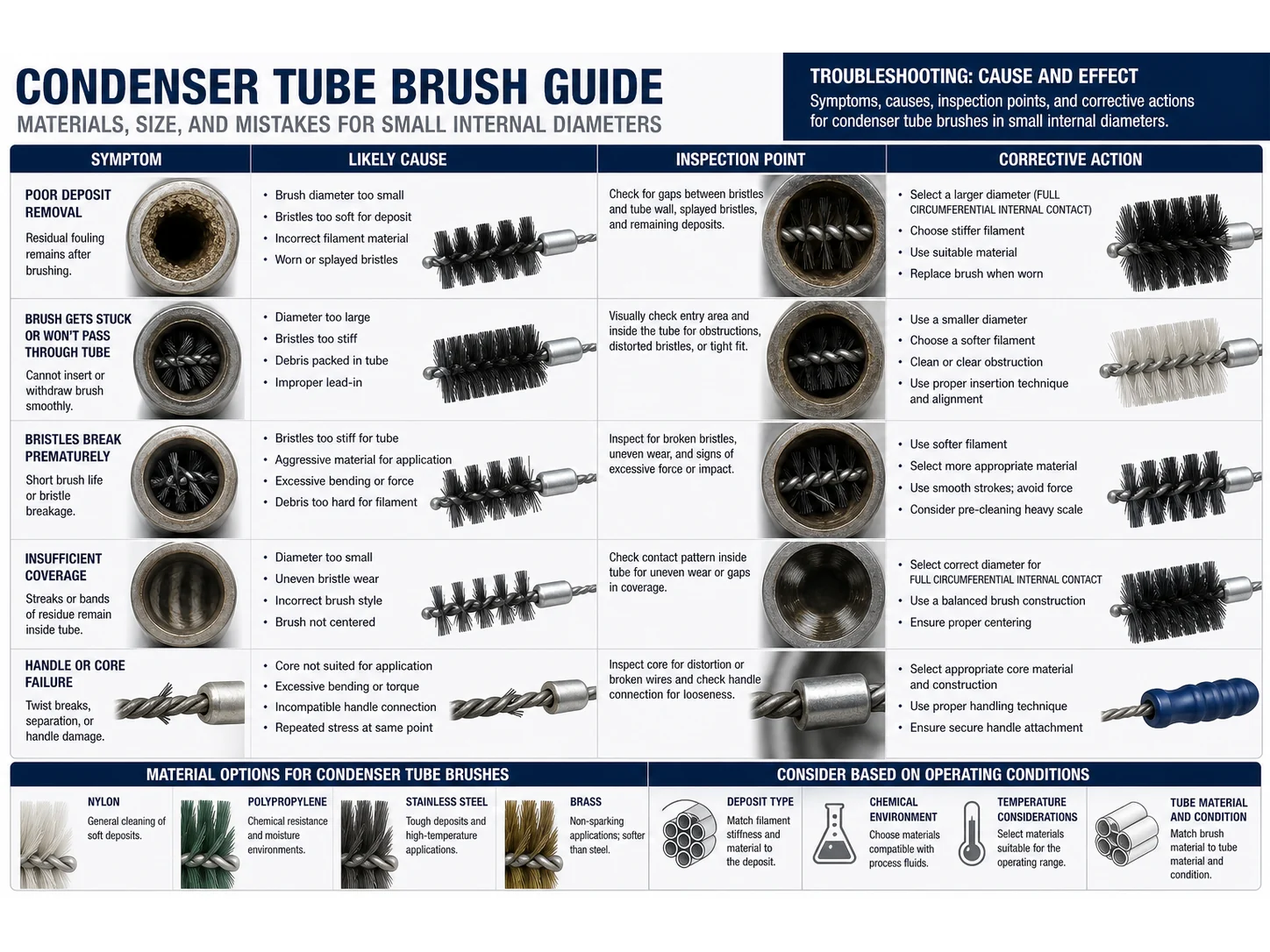
What Is a Condenser Tube Brush?
A condenser tube brush is a cylindrical cleaning tool designed to remove scale, biofouling, sediment, and other deposits from the inner walls of small-diameter condenser tubes. Unlike general-purpose tube brushes, condenser tube brushes are built for repeated passes through thin-walled metal tubes where both cleaning effectiveness and surface protection are essential. The brush typically consists of a twisted wire core or stem holding multiple rows of bristle material, often with a threaded end or shank for attachment to a manual handle, flexible shaft, or motorized drive system.
For boilers, chillers, cooling towers, condenser systems, heat-exchanger maintenance, and O&M practices, this article cites U.S. Department of Energy FEMP — Operations & Maintenance Best Practices: A Guide to Achieving Operational Efficiency, Release 3.0; boiler, chiller, cooling tower, and heat-exchanger maintenance chapters.
Why Small Internal Diameters Require Special Attention
When condenser tube internal diameters fall below 12 mm (roughly ½ inch), standard cleaning brushes often fail in three ways: they provide too little fill contact, they bind inside the tube, or they flex inconsistently. A brush that is oversized by only a small margin can jam and damage thin tube walls, while an undersized brush will skip over deposits without removing them. The balance between fill ratio, bristle stiffness, and core flexibility becomes the primary technical challenge.
Material Options for Condenser Tube Brushes
Condenser tube brush bristles can be made from several materials, each suited to different residue types and tube sensitivities. The following table compares the most common materials used for small internal diameter applications.
| Brush Material | Best for Residue Type | Surface Risk | Chemical Resistance | Typical Use |
|---|---|---|---|---|
| Nylon (abrasive-impregnated) | Soft scale, light deposits | Low | Good | Soft copper alloys, thin-walled stainless steel |
| Brass wire | Moderate scale, light corrosion | Medium | Fair | Harder tube metals, periodic cleaning |
| Stainless steel wire | Hard scale, rust, baked-on deposits | High | Excellent | Thick-walled stainless, heavy fouling |
| Natural fiber (Tampico, palmyra) | Loose debris, polishing | Very low | Low (avoid wet rot) | Final pass, soft surfaces |
| Polypropylene | Light cleaning in wet environments | Very low | Outstanding | Food-grade, demineralized water systems |
For small diameters, nylon and soft brass are often the safest starting points unless the deposit is exceptionally hard. Stainless steel bristles can scratch soft copper or brass tubes and should only be used when the tube material is harder than the bristle or when surface finish is not critical.
Diameter, Stiffness, and Handle/Core Considerations
Small-diameter condenser tube brushes are specified by three main physical parameters: overall brush diameter (OD), core diameter, and bristle trim length. The brush OD should typically be 0.1–0.5 mm larger than the tube’s actual ID to ensure full bristle contact without excessive drag. Core diameter must leave enough room for bristle flexion; a core that is too thick makes the brush rigid and prone to jamming. Stiffness is controlled by core wire gauge and bristle density—tighter helix twists and harder bristle materials both increase stiffness. For very small tubes (< 8 mm ID), a flexible cable core is often preferred over a stiff twisted wire core to allow the brush to follow tube bends without kinking. Handles and mounting options include fixed plastic handles for manual operation, threaded studs for swabs, and quick-connect ends for powered shafts—the choice depends on whether cleaning is performed in-place or on a bench.
How to Choose a Condenser Tube Brush Based on Operating Conditions
Use the following decision factors to narrow your selection:
- Residue type: Match bristle material to deposit hardness and adhesion.
- Tube material and surface sensitivity: Always use a bristle material that is softer than the tube wall to prevent scratching.
- Equipment interface: Determine the handle, shank, or drive connection required.
- Wet or chemical exposure: In systems with continuous chemical dosing or high humidity, polypropylene or stainless steel withstands degradation better than natural fibers.
- Hygiene expectations: For food or pharmaceutical condensers, use materials that resist bacterial buildup and can be sterilized.
- Maintenance frequency: Daily cleaning demands durable, chemical-resistant bristles; infrequent cleaning may allow softer materials.
- Custom size requirements: If standard off-the-shelf brushes do not fit, request a supplier drawing to confirm OD, core, and tip detail before ordering.
Common Specification Mistakes and How to Avoid Them
Even experienced buyers make specification errors that lead to poor cleaning or equipment damage. Avoid these common mistakes:
- Specifying by tube nominal size instead of actual measured ID. Tube schedules and manufacturing tolerances can create a mismatch. Measure the true internal diameter before ordering.
- Assuming all nylon bristles are the same. Abrasive grit loading, bristle diameter, and trim length vary widely. Specify the grit grade and bristle thickness if possible.
- Ignoring core flexibility. In coiled or U-bend condenser tubes, a rigid twisted core can hang up. Use a braided wire or cable core for bends.
- Choosing the lowest-cost brush without checking bristle retention. Lost bristles inside a condenser can cause blockages downstream. Look for brushes with anchored bristles, especially in small diameters.
- Overlooking chemical compatibility. Acidic or alkaline cleaners can degrade natural fibers and some nylons. Confirm bristle material resistance with the supplier.
When a Standard Condenser Tube Brush Is the Wrong Choice
Condenser tube brushes work well for routine deposit removal, but they are not designed for every situation. If you encounter baked-on silicate scale, heavy pitting corrosion, or uneven tube deformity, a simple manual or powered brush may be insufficient. In such cases, consider alternative methods: chemical cleaning, high-pressure water jetting with flexible lances, or mechanical expansion tools. Also, if the tube ID is under 4 mm, ready-made brushes often lack sufficient bristle density; a custom-constructed swab or mandrel-mounted abrasive pin may be needed. Always request a sample test or supplier drawing when deviating from standard sizes.
Final Takeaway
Choosing a condenser tube brush for small internal diameters means balancing fill ratio, bristle material, and core flexibility against deposit type and tube sensitivity. Start by measuring the true tube ID, pick a bristle material softer than the tube wall, verify handle or drive compatibility, and avoid the common mistake of oversizing. When standard options fall short, a custom brush with supplier-reviewed specifications is far cheaper than replacing a damaged condenser tube.
Frequently Asked Questions
What is the difference between a condenser tube brush and a general tube brush?
Condenser tube brushes are sized and built specifically for thin-walled heat exchanger tubes, with tighter diameter control and gentler bristle options to avoid tube damage. General tube brushes may be too aggressive or have loose bristle retention for sensitive condenser applications.
How do I measure the internal diameter of my condenser tube accurately?
Use a caliper or inside micrometer at the tube end, and if possible, check mid-length with a bore gauge. Measure multiple tubes to account for tolerance variation. Do not rely on nominal pipe size charts.
Can I use a brass brush on stainless steel condenser tubes?
Brass is softer than stainless steel, so it is generally safe and will not scratch the tube. However, brass can leave yellow deposits on stainless if high friction occurs; test in one tube first.
What bristle material is best for cleaning saltwater condenser fouling?
For saltwater biofouling and light scale, abrasive nylon or polypropylene brushes work well. They resist corrosion and do not damage the protective oxide layer on many alloys.
How often should I replace a condenser tube brush?
Replace when bristles show visible wear, flatten, or when the brush no longer maintains contact with the tube wall. In high-use power plant or marine settings, inspection after every major cleaning campaign is recommended.
Is a flexible shaft better than a fixed handle for small tubes?
A flexible shaft or cable drive is better for in-place cleaning of bent or hard-to-reach tubes. A fixed handle works well for straight tubes on a workbench but may cause binding in curved sections.
What is a safe fill ratio for small-diameter condenser tube brushes?
Aim for a brush OD that is 0.2–0.3 mm larger than the tube ID for soft deposits, and 0.1–0.2 mm larger for hard deposits, to prevent jamming. Always test a sample first.
Technical References
- U.S. Department of Energy — Air Conditioner Maintenance
- ASME — Y14.5 Dimensioning and Tolerancing
- OSHA — 1910.147 Control of Hazardous Energy
- American Brush Manufacturers Association — Brush Lingo
Which bristle material fits this job — AISI 304 Stainless Steel Wire, Nylon PA or Abrasive Nylon?
| Material | Continuous temperature (°C) | Peak temperature (°C) | Water absorption | Hardness |
|---|---|---|---|---|
| AISI 304 Stainless Steel Wire | 400 | 500 | 0% | Rockwell B 70–95 depending on temper and cold work |
| Nylon PA | 93 | 121 | 0.3–9% by PA grade and conditioning | Medium to firm; filament diameter and trim length control bending force. |
| Abrasive Nylon | 120 | 150 | 0.1–1.0% | Abrasive filament; stiffness and cutting level is controlled by PA base, grit type, grit size, filament diameter and trim height. |
| Brass Wire | 150–200 | 250–300 | 0% | Rockwell B 40–90 |
| AISI 316 Stainless Steel Wire | 400 | 500 | 0% | Rockwell B 70–95 depending on temper and cold work |
Figures as published by Alleima; Brushtec / DuPont; Perlon. Confirm the exact grade against the supplier datasheet before ordering.
What should replace Tube & Pipe Bore Brushes for condenser tube brush?
- Tube & Pipe Bore Brushes — Tube and bore brushes work by radial contact inside a confined diameter; wire wheels and cups work mainly on external edges, profiles, welds, and broad surfaces.
- AISI 304 Stainless Steel Wire — Use AISI 316 stainless steel wire for chloride, marine, dairy, beverage, chemical washdown, or higher pitting-resistance requirements. Use carbon steel for dry aggressive cutting and brass or abrasive nylon for lower marking risk.
- Nylon PA — Compare Nylon PA with PP, PBT, PET. Change material when wet stiffness, temperature, chemical resistance, conductivity, particle shedding, or surface marking becomes the limiting factor.
- Abrasive Nylon — Compare Abrasive Nylon with PP, PBT, PET. Change material when wet stiffness, temperature, chemical resistance, conductivity, particle shedding, or surface marking becomes the limiting factor.