
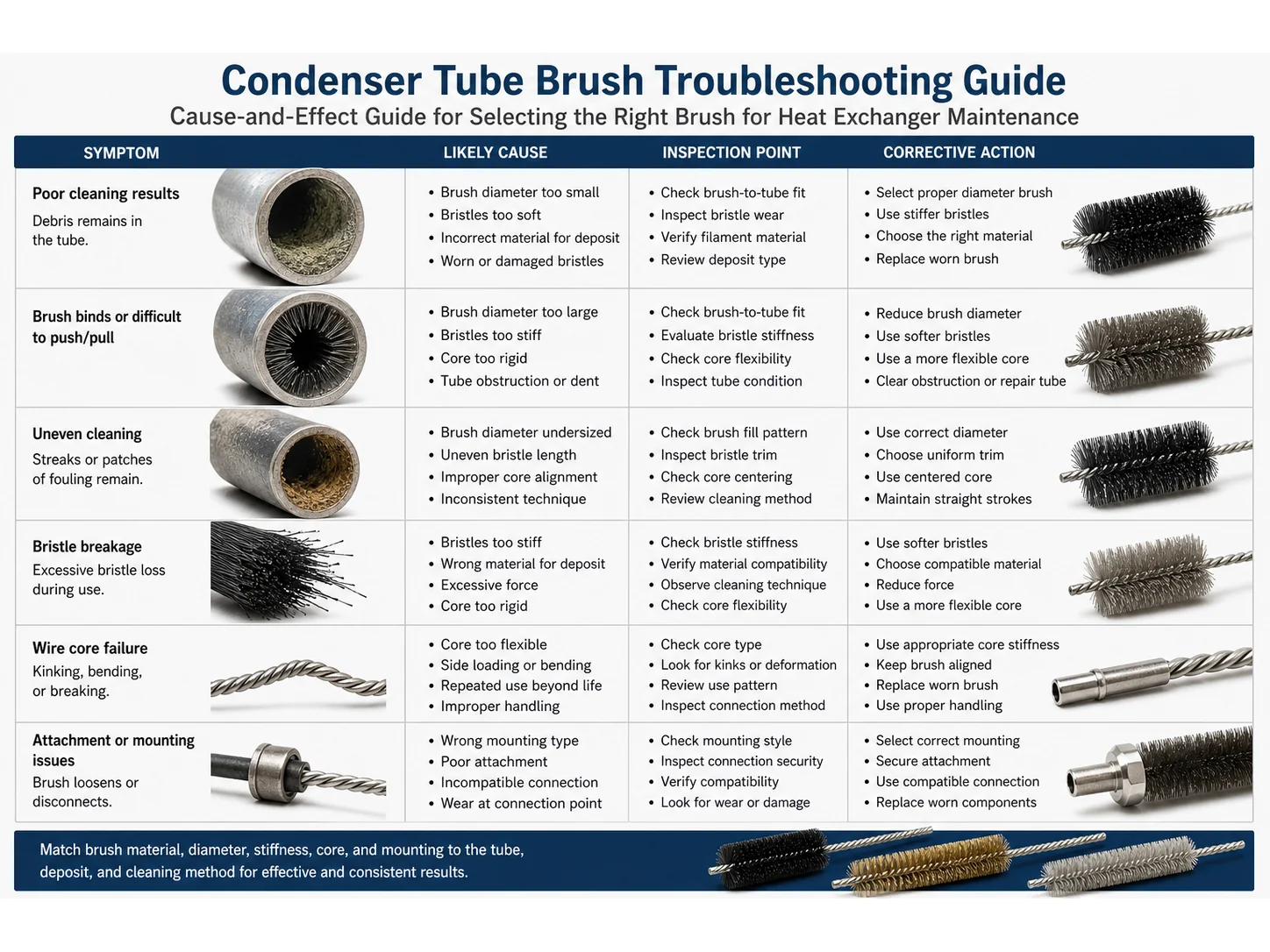
What Is a Condenser Tube Brush?
A condenser tube brush is a cylindrical brush used to mechanically clean the inside of straight or slightly curved tubes in shell-and-tube heat exchangers, chillers, boilers, and condensers. It typically features bristles attached to a central core or twisted wire stem, and it is pushed, pulled, or rotated through the tube to dislodge deposits without damaging the tube wall. The goal is to restore design heat transfer coefficients and reduce pressure drop.
For boilers, chillers, cooling towers, condenser systems, heat-exchanger maintenance, and O&M practices, this article cites U.S. Department of Energy FEMP — Operations & Maintenance Best Practices: A Guide to Achieving Operational Efficiency, Release 3.0; boiler, chiller, cooling tower, and heat-exchanger maintenance chapters.
Why Proper Tube Cleaning Matters
Heat exchanger fouling—whether from mineral scale, microbiological slime, sediment, or corrosion products—can reduce thermal efficiency by 20–50% and increase pumping energy due to narrower flow passages. Regular mechanical cleaning with the right condenser tube brush is the most direct way to maintain performance. A poorly chosen brush, however, can scratch tubes, leave residue behind, or even break off inside the tube.
Common Condenser Tube Brush Materials and When to Use Them
The bristle material dictates what type of deposit can be removed and whether the brush is safe for the tube surface. Below are the most common materials along with their typical applications.
| Material | Best For | Surface Safety | Wet/Chemical Tolerance | Typical Residue |
|---|---|---|---|---|
| Nylon | Soft scale, biofilm, light debris | Safe for copper, brass, stainless, and plastic tubes | Good resistance to water, mild chemicals | Mud, algae, silt |
| Polypropylene | Aggressive cleaning; resistant to acids and alkalis | May scratch soft metals if oversize | Excellent chemical resistance | Hard water scale, chemical residue |
| Tampico (natural fiber) | Polishing, light cleaning; often used with abrasives | Very safe; non-scratching | Absorbs water; not for strong chemicals | Light oxidation, film |
| Carbon steel wire | Heavy rust, scale, carbon deposits | Aggressive; can score copper, brass, aluminum | Rusts if not dried; avoid with acids unless coated | Hard scale, weld slag, corrosion |
| Stainless steel wire | Hard scale, tenacious deposits in steel tubes | Aggressive; avoid on soft metals | Good chemical and moisture resistance | Calcium scale, iron oxide, hardened sludge |
| Brass wire | Non‑sparking cleaning; moderate scale | Medium; can scratch aluminum and soft copper | Resists corrosion better than steel | Medium scale, carbon |
| Abrasive‑filled nylon | Polishing and light descaling in one pass | Depends on grit; can be formulated for safety | Good water tolerance; limited strong‑acid compatibility | Light scale, oxide films, biofilm |
How to Choose the Right Brush Size and Diameter
Brush diameter is the single most critical spec. The standard recommendation is to choose a brush that is 0–5% larger than the tube’s inside diameter (ID) for soft bristles, and up to 10% larger for very flexible materials like Tampico. A brush that is too small will skip over deposits; too large will be difficult to push through and may break. For example, a ¾‑inch tube (nominal ID = 0.652 inches) typically uses a brush diameter of 0.660–0.680 inches. Length should cover the full tube or be modular so multiple brushes can be joined for longer passes. Always measure tube ID with a caliper rather than relying on nominal pipe sizes.
Stiffness, Core, and Mounting Options
The core governs how force is transmitted and how the brush connects to the drive mechanism:
- Single‑spiral (twist‑in‑wire): Most common for manual and low‑speed powered cleaning. The twisted wire stem provides moderate flexibility. Compatible with standard drill chucks.
- Double‑spiral / double stem: Adds rigidity for heavy‑duty cleaning and helps maintain concentricity in larger diameters.
- Shaft‑mounted brushes: A straight or flexible shaft replaces the twisted wire, allowing higher torque and longer reach. Often used with cleaning machines with through‑feed capability.
- Handle‑type: Hand‑operated T‑handles or pistol grips for light maintenance or where no power is available.
Stiffness is a function of bristle material density, filament diameter, and trim length. A stiffer brush removes tougher deposits but requires more force and may be unsuitable for thin‑walled or soft‑metal tubes. Consider wet versus dry operation: some bristles soften when wet, reducing effectiveness.
Matching the Brush to Cleaning Application
Use these decision criteria to narrow down options:
- Residue type: Soft, biological films → Tampico or soft nylon. Hard scale → stainless steel or abrasive nylon. Oily/greasy deposits → polypropylene with solvent pre‑rinse.
- Surface sensitivity: Copper, brass, or thin‑walled titanium tubes → always use non‑metallic bristles unless absolutely necessary. Stainless steel or thick‑walled carbon steel tubes → can tolerate wire brushes if OD/ID ratio allows.
- Equipment interface: Brushes for manual feed differ from those intended for high‑speed rotary cleaning machines. Check shaft diameter and connection type.
- Wet or chemical exposure: If cleaning involves acid descaling, avoid natural fibers and plain steel. Polypropylene and stainless steel are safer choices.
- Hygiene expectations: For food‑grade or pharmaceutical heat exchangers, materials must be non‑shedding and compatible with clean‑in‑place (CIP) solutions. Consider certified food‑grade nylon or sealed‑end constructions.
- Maintenance frequency: In high‑fouling services, choose more durable materials and consider automated brush systems to reduce labor.
Common Specification Mistakes When Selecting a Condenser Tube Brush
- Guessing tube ID instead of measuring: Nominal pipe sizes do not equal actual ID. A 1” schedule 40 pipe has an ID of 1.049”, while a 1” copper tube is 0.995”. Using the wrong diameter leads to poor cleaning or stuck brushes.
- Over‑aggressive bristle material: Using steel wire on copper or brass tubes can cause score marks that become corrosion initiation sites.
- Ignoring core flexibility: Slightly curved or sagging tubes require a more flexible core; a rigid brush can jam or break.
- Neglecting chemical exposure: Pouring an acid descaler onto a natural fiber brush or carbon steel core can destroy the brush and contaminate the cleaning fluid.
- Ordering without a sample test: A single sample brush tested on a fouled tube tube bundle will reveal fit, rotation feel, and residue removal better than any data sheet.
- Skipping length specification: Brushes that are too short leave untouched sections; overly long brushes become unwieldy and may whip.
- Forgetting mounting compatibility: The brush end type (ball drive, loop, threaded, hex) must match the drive adapter, guide rod, or cleaning gun.
- Assuming one brush type fits all tube materials: Mixed‑material heat exchangers (e.g., copper tubes with steel tube sheets) may require different brushes for different sections.
When a Standard Condenser Tube Brush Is the Wrong Choice
A standard condenser tube brush works well for routine maintenance and moderate fouling. It reaches its limit when:
- Hard, thick scale (e.g., silicates, baked‑on carbon) cannot be removed by bristle action alone. Consider complementary hydroblasting, chemical cleaning, or a rotary tube cleaner with cutter heads.
- Highly curved or U‑tube bundles require a flexible shaft brush system with a smooth ball tip to navigate bends.
- Very long tubes (over 20 feet) may need segmented brushes with couplings and spring‑loaded centering guides to prevent kinking.
- Internal tube restrictions such as spiral inserts, turbulators, or rifled surfaces demand a brush specifically designed not to damage these enhancements.
- High‑purity applications (semiconductor cooling tubes, medical gases) need brushes made entirely of non‑contaminating materials, often with validated particle testing.
- The right brush geometry is unknown. When in doubt, request a drawing from the brush manufacturer showing bristle fill, trim length, and core dimensions relative to the tube cross‑section. This prevents ordering a brush that looks correct on paper but fails in the field.
Final Takeaway
Selecting a condenser tube brush is not about finding the strongest bristle or the nearest standard size. It is about matching the brush material, diameter, and core to the deposit type, tube metallurgy, and cleaning method. Start by measuring actual tube ID, identify the predominant fouling, choose a bristle material that cleans without damaging the tube, and test one brush before committing to a full order. Avoid the common mistakes of oversizing, material mismatch, and ignoring chemical exposure, and your heat exchanger maintenance will be safer, faster, and more effective.
Frequently Asked Questions
What is the recommended brush oversize for condenser tubes?
Can I use a steel wire brush on copper condenser tubes?
It is not recommended. Steel wire can scratch the inner surface, removing protective oxide layers and creating grooves where new fouling quickly accumulates. If mechanical removal of hard scale from copper tubes is necessary, consider abrasive‑filled nylon with a mild grit or a chemical pre‑treatment step.
How often should I clean condenser tubes with a brush?
Frequency depends on water quality, operating temperature, and the presence of biological or scaling potential. Many plants clean when heat transfer performance drops by 10–15% or pressure drop rises above a threshold. In high‑fouling cooling water services, monthly to quarterly cleaning with a condenser tube brush is common.
What if my tubes have enhanced or rifled surfaces?
Enhanced surfaces are more fragile and collect fouling inside grooves. Use only bristle materials recommended by the chiller or heat exchanger manufacturer—typically soft nylon or Tampico. Abrasive or wire brushes will smooth out the enhancements, permanently reducing heat transfer.
Can I drive a condenser tube brush with a power drill?
Yes, many single‑spiral brushes have a wire loop or ball end that can be chucked into a standard drill. However, use low speeds (under 500 rpm) and avoid high torque that could twist the core or whip the brush inside the tube. For longer duration cleaning, a variable‑speed tube cleaning machine with water flush is safer.
What is the best brush for removing biofilm and organic slime?
A medium‑soft nylon or Tampico brush works well for biofilm because it has enough stiffness to wipe the tube wall without scratching. Tampico absorbs water and swells slightly, which can improve wall contact. For heavy biofouling, consider a brush followed by a sanitizing rinse.
How do I measure the ID of a condenser tube correctly?
Clean a short accessible section of the tube bore, then use a precision caliper or inside micrometer. Measure in two perpendicular directions to check for out‑of‑round condition. Record the smallest repeatable reading as the basis for brush diameter selection.
What if my condenser has tubes that are not perfectly straight?
Slightly bowed tubes are common in long bundles. Choose a brush with a flexible single‑spiral core and ensure the brush body is short enough to pass through the bow without jamming. For U‑tube bundles, use only brushes designed with a flexible ball‑end shaft, not rigid spiral brushes.
Technical References
- U.S. Department of Energy — Air Conditioner Maintenance
- ASME — Y14.5 Dimensioning and Tolerancing
- OSHA — 1910.147 Control of Hazardous Energy
- American Brush Manufacturers Association — Brush Lingo
Which bristle material fits this job — Nylon PA, AISI 304 Stainless Steel Wire or Carbon Steel Wire?
| Material | Continuous temperature (°C) | Peak temperature (°C) | Water absorption | Hardness |
|---|---|---|---|---|
| Nylon PA | 93 | 121 | 0.3–9% by PA grade and conditioning | Medium to firm; filament diameter and trim length control bending force. |
| AISI 304 Stainless Steel Wire | 400 | 500 | 0% | Rockwell B 70–95 depending on temper and cold work |
| Carbon Steel Wire | 200–300 | 350–450 | 0% | Rockwell C 40–60 |
| Abrasive Nylon | 120 | 150 | 0.1–1.0% | Abrasive filament; stiffness and cutting level is controlled by PA base, grit type, grit size, filament diameter and trim height. |
| AISI 316 Stainless Steel Wire | 400 | 500 | 0% | Rockwell B 70–95 depending on temper and cold work |
Figures as published by Brushtec / DuPont; Alleima; Perlon. Confirm the exact grade against the supplier datasheet before ordering.
What should replace Tube & Pipe Bore Brushes for condenser tube brush?
- Tube & Pipe Bore Brushes — Tube and bore brushes work by radial contact inside a confined diameter; wire wheels and cups work mainly on external edges, profiles, welds, and broad surfaces.
- Nylon PA — Compare Nylon PA with PP, PBT, PET. Change material when wet stiffness, temperature, chemical resistance, conductivity, particle shedding, or surface marking becomes the limiting factor.
- AISI 304 Stainless Steel Wire — Use AISI 316 stainless steel wire for chloride, marine, dairy, beverage, chemical washdown, or higher pitting-resistance requirements. Use carbon steel for dry aggressive cutting and brass or abrasive nylon for lower marking risk.
- Carbon Steel Wire — Compare Carbon Steel Wire with Carbon steel wire, brass wire, abrasive nylon. Change material when wet stiffness, temperature, chemical resistance, conductivity, particle shedding, or surface marking becomes the limiting factor.