
What Is a Wheel Brush Cleaner?
A wheel brush cleaner is a rotary brush with a central arbor that mounts onto power tools like angle grinders, bench grinders, or dedicated finishing machines. The brush face (periphery) is packed with wire filaments or abrasive bristles that contact the workpiece tangentially. This design provides aggressive, consistent material removal for cleaning weld seams, removing heavy slag, or prepping surfaces for inspection. It differs from standard hand brushes and cup-style brushes in its ability to cover larger areas with less operator fatigue and more controlled pressure.
Common Types and Options for Weld Cleanup Brushes
Both wheel brush cleaners and standard cleaning brushes come in several configurations. Understanding the basic types helps narrow the choice before comparing performance.
- Crimped wire wheel brushes: Softer action, good for light spatter removal and blending on delicate surfaces.
- Twisted/tufted wire wheel brushes: More aggressive cutting, ideal for heavy slag, deep corrosion, and stubborn weld scale.
- Abrasive nylon wheel brushes: Embedded with silicon carbide or aluminum oxide grit; non-sparking and suited for stainless or non-ferrous metals where cross-contamination is a concern.
- Standard hand wire brushes: Low-cost, manual, good for small touch-ups or inaccessible corners but labor-intensive.
- Cup brushes: Sit on the end of a power tool shaft; good for inside corners and irregular profiles but may not match the linear coverage of a wheel brush.
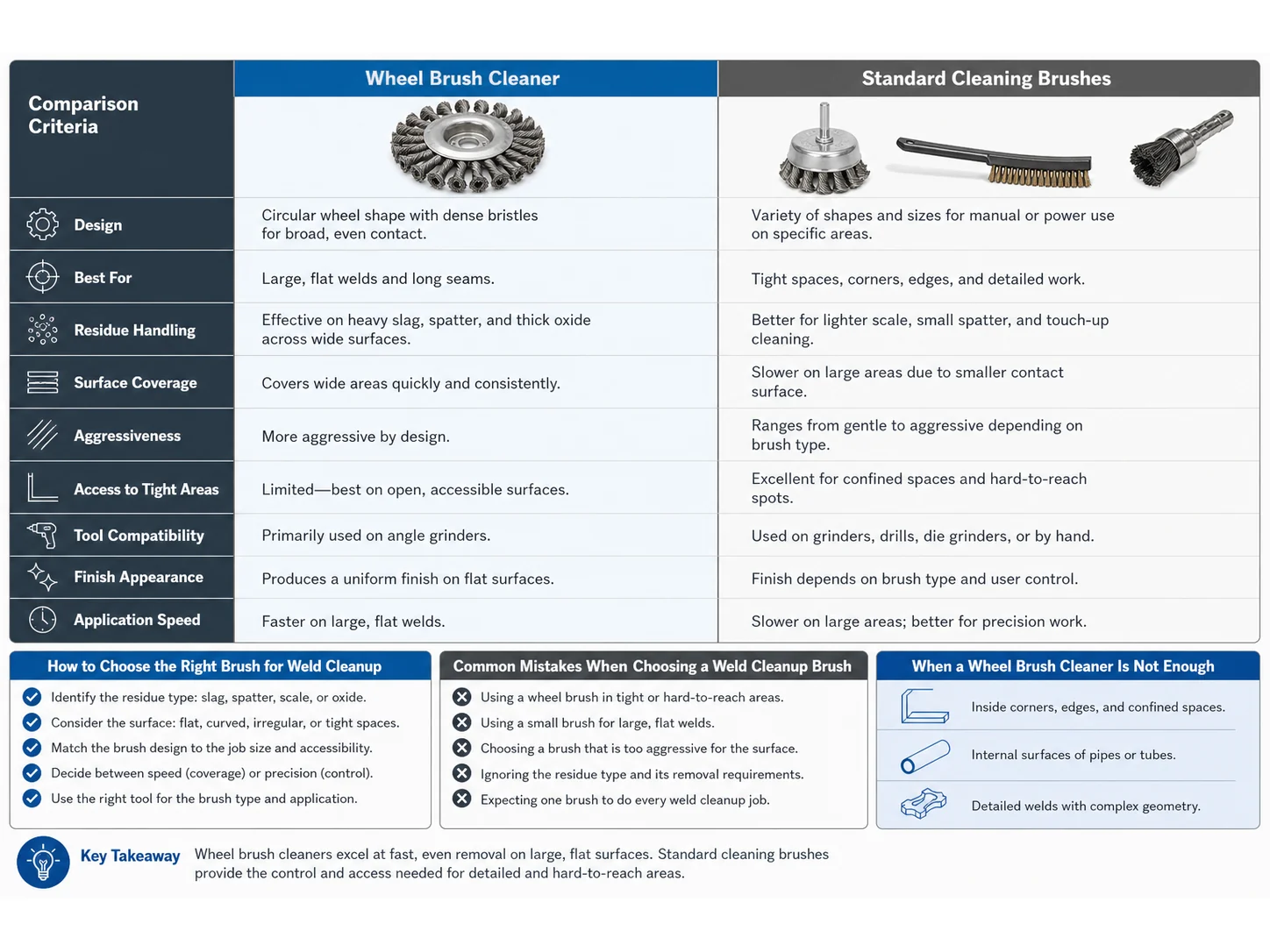
Wheel Brush Cleaner vs Standard Cleaning Brushes: Comparison Table
| Factor | Wheel Brush Cleaner | Standard Cleaning Brushes |
|---|---|---|
| Cleaning Aggressiveness | High; consistent over large flat or slightly curved areas | Variable; cup brushes can be aggressive on small spots; hand brushes are mild |
| Surface Coverage Rate | Fast; wide contact strip along the wheel periphery | Slower; limited to brush face diameter or manual stroke |
| Operator Fatigue | Low; tool does most of the work | High with hand brushes; moderate with cup brushes |
| Access to Tight Spaces | Poor; wheel diameter limits entry into inside corners and narrow gaps | Good; cup brushes and small hand brushes reach confined areas |
| Finish Consistency | Uniform; creates even scratch pattern | Patchy; manual variation leads to uneven finish |
| Wire Shedding Risk | Moderate; depends on speed and quality | Higher with hand brushes; cup brushes may shed |
| Mounting & Compatibility | Requires a machine with a straight arbor; common sizes 4–8 inches | Cup brushes use threaded shanks; hand brushes are manual |
| Wet/Chemical Use | Possible with stainless or abrasive nylon; wire may rust if not washed and dried | Hand brushes can be used with solvents; cup brushes need corrosion-resistant wire |
| Custom Sizes | Readily custom-manufactured in diameter, width, and filament specification | Limited customization for hand brushes; cup brushes available in standard sizes |
How to Choose the Right Brush for Weld Cleanup
Start with the weld residue you need to remove, then match the brush to your operating conditions.
- Residue type: Light spatter and heat tint → crimped wheel or abrasive nylon. Heavy slag and mill scale → twisted wire wheel brush. Rust or paint over welds → coarse crimped or abrasive-filled wheel.
- Surface sensitivity: Stainless steel or aluminum requires a brush that won’t contaminate. Use stainless wire or non-abrasive nylon wheel brushes approved for the alloy. Avoid standard carbon steel brushes on stainless.
- Equipment interface: Wheel brush cleaner needs a constant speed power tool with the correct arbor size and guard. Hand brushes and cup brushes adapt to drills and die grinders more easily.
- Wet or chemical exposure: If the cleaning step involves a pickling gel or acid wash, verify bristle material compatibility. Nylon or stainless withstand chemicals better than plain steel.
- Hygiene requirements: Food-grade or pharmaceutical welds demand brushes that won’t shed or corrode. Sealed hub designs and stainless filaments are preferred.
- Maintenance frequency: Wheel brushes used daily need periodic dressing and proper storage. If infrequent use, corrosion-resistant bristles extend life.
- Custom sizes: When off-the-shelf diameters or widths don’t fit the weld geometry, custom-designed wheel brushes provide the exact face width and fill density needed.
Common Mistakes When Choosing a Weld Cleanup Brush
- Using carbon steel wire on stainless: Embeds free iron, causing rust spots on stainless welds.
- Ignoring RPM rating: Running a wheel brush above its rated speed increases shedding and risk of injury.
- Opting for the largest diameter: A 6-inch wheel may last longer but may not access curvature; a 4-inch or a cup brush could be a better fit.
- Skipping a test piece: Brush stiffness and wire gauge vary; testing on scrap material prevents rework and surface damage.
- Choosing by cost drivers alone: low-cost wire wheels often shed excessively and have inconsistent fill, creating extra cleanup work.
When a Wheel Brush Cleaner Is the Wrong Choice
A wheel brush cleaner excels at broad weld cleanup, but it has limits. For blind holes, deep corners, or pipe interiors, a standard cup brush, long-handle bottle brush, or a flap wheel may be needed. If the weld must meet strict corrosion resistance (e.g., marine or chemical processing), mechanical brushing alone is insufficient; chemical passivation or pickling is required. In cases where the surface finish must be verified and repeatable, a supplier drawing review or sample test with a custom-designed wheel brush helps confirm the right filament, density, and speed combination before full-scale ordering.
Final Takeaway
Choose a wheel brush cleaner when you need fast, uniform weld cleaning on accessible flat or slightly contoured surfaces, especially for production-scale work. Stick with standard brushes for touch-ups, tight spaces, or when portability and low cost outweigh speed. Let the weld residue, base metal, and access geometry guide the decision—not the cost drivers tag.
Frequently Asked Questions
Can a wheel brush cleaner remove all weld discoloration?
It can remove heat tint and light oxide films, but deep blue or rainbow discoloration (especially on stainless) often requires additional chemical treatment or electropolishing for complete removal.
Is a wheel brush safer than a hand wire brush?
When used with proper guards, PPE, and correct RPM, a power-driven wheel brush can be safer because it reduces repetitive manual motion and keeps the operator’s hands away from hot or sharp weld edges. However, high-speed rotating wire filaments present flying debris risks, so full face protection is necessary.
What diameter wheel brush do I need for a typical angle grinder?
Common sizes range from 4 to 8 inches. A 4- or 5-inch wheel fits standard 4.5-inch angle grinders, while larger bench or pedestal grinders accept wider diameters. Always verify the arbor size (⅝-inch or 1-inch) and grinder guard clearance.
Can I use the same wheel brush for carbon steel and stainless steel welds?
No. Use a dedicated stainless steel wire wheel for stainless welds. Cross-use transfers carbon steel particles, causing rust on stainless. Color-code brushes or clearly label them to avoid mix-ups.
How do I clean and store wheel brush cleaners to prevent premature wear?
After use, remove metal dust and slag by running the brush briefly against a piece of wood or a soft stone. Store in a dry environment; if moisture is present, use a corrosion-resistant wire grade or apply a light oil film.
Are abrasive nylon wheel brushes as durable as wire brushes?
Abrasive nylon wheels wear down as the abrasive grit fractures and the filaments shorten. They typically have a shorter life than wire for heavy chunks, but they provide a consistent, non-sparking finish and avoid rust contamination—making them ideal for stainless or aluminum.
When should I consider custom-designed wheel brushes?
If standard diameters, widths, or filament density cannot reach the weld profile or achieve the required surface finish, a custom design may be needed. Consult a manufacturer with a drawing to ensure the brush fits the intended machine and working angle.
Technical References
- ABMA — ANSI B165.1 Power Brush Safety Slips
- OSHA — 1910.242 Hand and Portable Powered Tools
- OSHA — 1910.215 Abrasive Wheel Machinery
- OSHA — Personal Protective Equipment
- OSHA — Hexavalent Chromium
Which bristle material fits this job — Abrasive Nylon, AISI 304 Stainless Steel Wire or Carbon Steel Wire?
| Material | Continuous temperature (°C) | Peak temperature (°C) | Water absorption | Hardness |
|---|---|---|---|---|
| Abrasive Nylon | 120 | 150 | 0.1–1.0% | Abrasive filament; stiffness and cutting level is controlled by PA base, grit type, grit size, filament diameter and trim height. |
| AISI 304 Stainless Steel Wire | 400 | 500 | 0% | Rockwell B 70–95 depending on temper and cold work |
| Carbon Steel Wire | 200–300 | 350–450 | 0% | Rockwell C 40–60 |
| Nylon PA | 93 | 121 | 0.3–9% by PA grade and conditioning | Medium to firm; filament diameter and trim length control bending force. |
| AISI 316 Stainless Steel Wire | 400 | 500 | 0% | Rockwell B 70–95 depending on temper and cold work |
Figures as published by Perlon; Alleima; Brushtec / DuPont. Confirm the exact grade against the supplier datasheet before ordering.
What should replace Wheel Brushes for hand wire brush?
- Wheel Brushes — Wheel brushes give narrow edge contact; cup brushes cover a broader open face, while end brushes concentrate contact at the end of a small stem for recesses.
- Cup Brushes — Cup brushes cover a broader face than wheel brushes; end brushes are better for small recesses or pockets where the cup body blocks access.
- Handheld Detail Brushes — Handheld detail brushes cover general precision cleaning; auto-detailing brushes impose tighter controls for painted, polished, leather, display, and trim surfaces.
- Abrasive Nylon — Compare Abrasive Nylon with PP, PBT, PET. Change material when wet stiffness, temperature, chemical resistance, conductivity, particle shedding, or surface marking becomes the limiting factor.