
Custom Cleaning Brush
SS304 Weld Cleaning Hand Brush
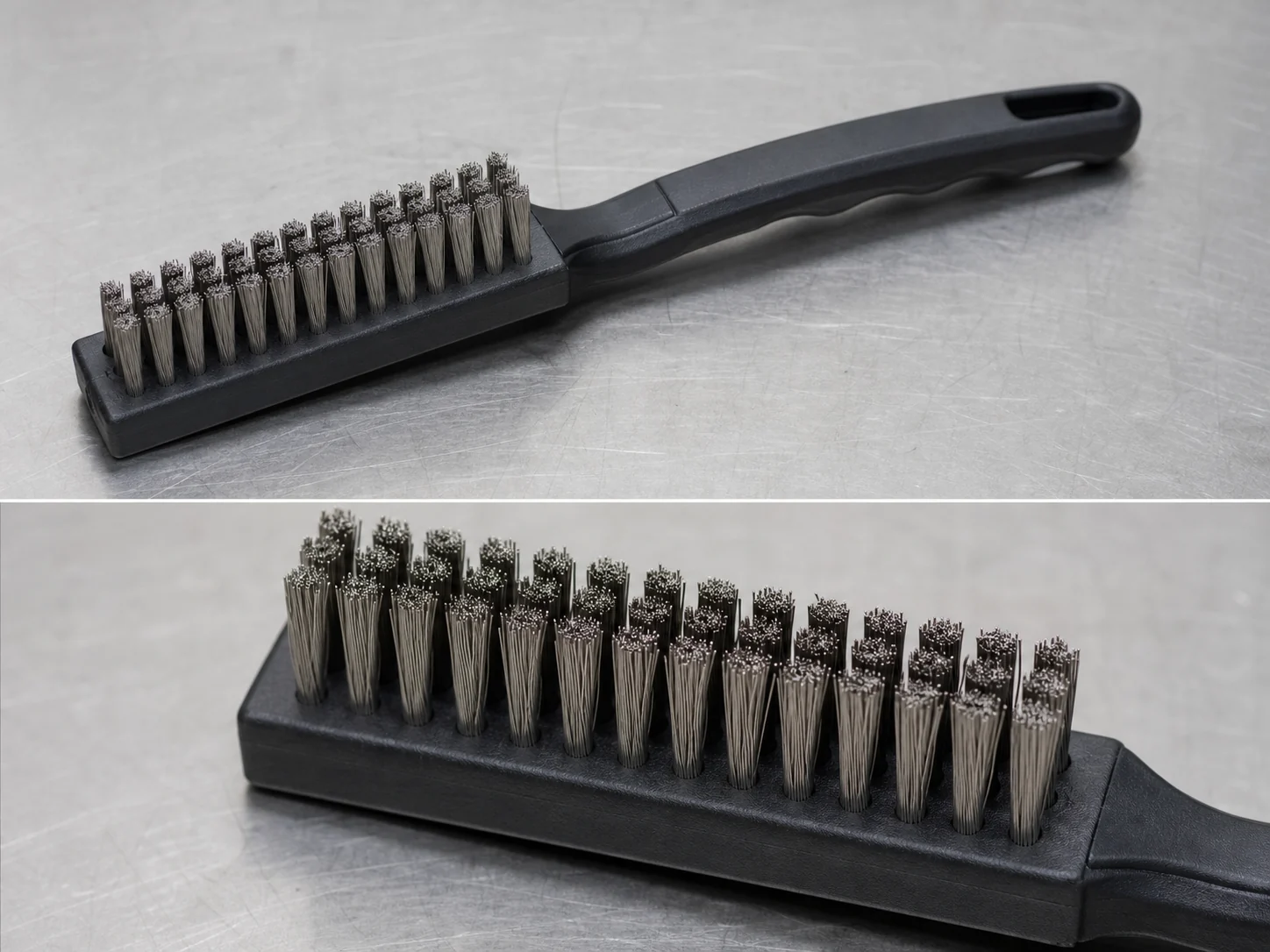
SS304 wire hand brush removes weld discoloration and oxide without contaminating stainless steel. Fixed 30 mm head, PA66-GF30 handle, customizable for B2B.
Small brush
500 pcs
Minimum order
Held in one hand: tube, bottle, detail and swab brushes — including long-handled ones with a small head.
Production lead time, once the specification is confirmed
- Up to 500 pcsWithin 7 days
- 501–50,000 pcsWithin 14 days
- Over 50,000 pcsWithin 21 days
Peak season can extend these times; the shipping date is confirmed in writing with your quotation. Sampling and shipping are quoted separately.
An SS304 stainless steel wire hand brush for removing weld discoloration, oxide, and light scale from stainless steel weld zones. The fixed brush head and rigid PA66-GF30 handle provide controlled manual cleaning on flat faces, profiles, edges, and weld seams without contaminating the base metal.
What can this brush do for you?
Removes weld heat tint and oxide without contaminating the stainless steel
The SS304 wire bristles are made from the same austenitic stainless steel family as most welded stainless parts. Brushing leaves no free carbon steel particles behind, so the weld area stays free of embedded iron that can cause rust spots or reduce corrosion resistance. After cleaning, the surface is ready for passivation or further finishing.
Reaches into fillet corners, weld toes, and narrow joints
The 30 mm diameter head with a 120 mm working length fits into inside corners, around pipe joints, and along fillet welds where a flat hand brush cannot fully contact the weld zone. The angular head option improves access into tight junctions and behind flanges.
Applies controlled pressure with a rigid, comfortable handle
The PA66-GF30 handle is stiff and dimensionally stable, so the brush head does not flex or wobble during use. The 28 mm grip diameter reduces hand fatigue during repeated weld cleanup, and the fixed connection lets you push with enough force to remove light scale and spatter without losing control.
Removes light burrs and small spatter droplets without gouging
SS304 wire is softer than carbon steel wire, so it cuts less aggressively into the base metal. With normal hand pressure, the brush lifts loose oxide, small weld spatter beads, and fine burrs while leaving the underlying stainless surface intact. For heavy slag or thick scale, use a chipping hammer or power wire brush first.
Withstands wet environments and mild cleaning chemicals
The stainless steel wire and glass-fiber-reinforced handle do not corrode in damp shops, washdown areas, or outdoor stainless fabrication sites. The brush can be rinsed after use without rusting or degrading the handle.
What is a SS304 Weld Cleaning Hand Brush?
A SS304 Weld Cleaning Hand Brush is a manual, hand-held brush with SS304 stainless steel wire bristles set into a fixed head that is permanently connected to a reinforced polymer handle. It is used in the post-weld finishing stage to remove heat tint, oxide scale, weld spatter, and light burrs from stainless steel components after TIG, MIG, or stick welding.
During use, the operator holds the handle and moves the brush back and forth across the weld bead, toe line, and adjacent heat-affected zone. The wire bristles scrape away discoloration and loose oxide while the stainless steel material of the bristles prevents iron contamination of the weld. This is critical for stainless parts that will be used in corrosive environments, food processing, pharmaceutical, marine, or architectural applications where even small carbon steel particles can initiate pitting or rust staining.
The brush is intended for manual finishing, not heavy material removal. It will not replace grinding, sanding, or abrasive blasting for deep pits, thick mill scale, or heavy weld reinforcement. It is best used as the final mechanical cleaning step before passivation, pickling, or polishing.
Technical Specifications
The table below lists the standard configuration. All parameters can be adjusted to match your weld geometry, surface finish requirement, and operator preference.
| Parameter | Value / Options |
|---|---|
| Brush head diameter | 30 mm (nominal; other diameters available) |
| Head shape | Cylindrical (tube style) or angular |
| Head length | 120 mm (trim length) |
| Bristle material | SS304 stainless steel wire |
| Wire diameter | 0.15 mm, 0.20 mm, or 0.25 mm (selected for finish aggressiveness) |
| Wire fill density | Standard fill; higher or lower densities available on request |
| Handle material | Glass-fiber-reinforced PA66 (PA66-GF30) |
| Handle length | 180 mm |
| Grip diameter | 28 mm |
| Overall length | Approx. 300 mm |
| Connection | Fixed (head molded or pressed into handle) |
| Operating environment | Wet or dry manual cleaning; handle resistant to common mild detergents and solvents |
| Brush type | Custom Handheld Detail Brushes |
| How it is driven | Hand-guided |
| Cleaning target | stainless steel fabrication shop, food and beverage equipment, and pharmaceutical and biotech process component cleaning |
| Surface or part | welds, metal, weld seams, carbon steel, weld zones, flat faces, edges, and profiles |
| Residue or debris | scale, oxide, carbon, light scale, spatter, weld discoloration, particles, and rust |
| Mounting / connection | Fixed (head molded or pressed into handle) |
Where does this brush work best?
- Stainless steel fabrication shops: cleaning TIG and MIG weld beads on frames, brackets, enclosures, and machinery guards before passivation.
- Food and beverage equipment: removing heat tint from welded tanks, piping, and fittings where carbon contamination is unacceptable.
- Pharmaceutical and biotech process components: post-weld cleanup of stainless tubing and vessels prior to passivation and inspection.
- Marine hardware and railing: restoring the passive layer on welded stainless railings, stanchions, and deck fittings exposed to salt spray.
- Architectural stainless steel: removing discoloration from visible welds on handrails, cladding, and furniture before final brushing or polishing.
- Maintenance departments: general stainless weld repair and touch-up work where a power tool is overkill.
How do I choose the right one?
Pick the head shape based on access
For long straight weld seams, pipe exteriors, or flat surfaces, the cylindrical head provides even contact across the full 120 mm length. For inside corners, fillet welds in tight spots, or areas around flanges and brackets, the angular head lets you angle the bristles into the weld root without the handle getting in the way.
Select wire diameter for the required finish
Thinner wire (0.15 mm) removes heat tint and light oxide with finer scratches, leaving a smoother surface that is closer to the original finish. Thicker wire (0.25 mm) cuts faster and removes light scale and small spatter, but it will leave more visible brush marks. If a decorative or mirror finish is required, choose 0.15 mm and follow with a non-woven abrasive pad or passivation.
Match the brush material to the base metal
Use SS304 wire on stainless steel and other corrosion-resistant alloys. Carbon steel wire is more aggressive but leaves carbon steel particles that can rust on stainless surfaces. Do not use a carbon steel wire brush on stainless steel. For aluminum or titanium, use a dedicated brush to avoid cross-contamination.
When to use a different brush or method
This brush is not for heavy weld scale, thick slag, or deep oxidation. Use a knotted or crimped power wire brush for aggressive removal, or a chipping hammer and grinder for large spatter. For very fine polishing or electropolished finishes, follow manual brushing with abrasive pads, electrochemical cleaning, or passivation. For cleaning internal bores or pipes, use a tube brush with SS304 bristles instead of this hand brush.
Can I customize this brush?
Yes. We adjust the head geometry, wire fill, and handle to match your weld joint and operator ergonomics. To define a custom configuration, provide the weld type (fillet, butt, corner), joint access space, surface finish target, and any handle ergonomic or branding requirements.
- Head shape: cylindrical, angular, flat, or custom molded geometry
- Head dimensions: diameter from 20 mm to 50 mm, length from 80 mm to 200 mm
- Wire fill: SS304 wire diameter from 0.10 mm to 0.35 mm, fill density, trim length, and bristle pattern
- Handle: length, grip diameter, ergonomic contour, hanging hole, or anti-slip overmold
- Color and marking: custom handle color, pad printing, laser marking, or molded logo
- Packaging: bulk box, individual polybag, retail card, or project-specific packing
If your project requires material documentation, inspection reports, or third-party testing support, we can assist during the customization process.
Which filament survives the cleaning chemicals a SS304 weld cleaning hand brush meets?
Will the SS304 wire brush scratch my stainless steel surface?
Yes, any wire brush will leave fine scratches. SS304 wire is softer than many tool steels and produces lighter marks than carbon steel wire, but it is not scratch-free. For a mirror or decorative finish, use the thinnest wire (0.15 mm), apply light pressure, and follow with a non-woven abrasive pad, passivation, or electropolishing as required.
Can I use this brush on carbon steel welds?
You can, but it is not the best choice. Carbon steel wire brushes are more aggressive and cost less for cleaning carbon steel parts. The SS304 brush will work on light carbon steel scale, but it will wear faster and is more expensive. Reserve SS304 brushes for stainless and other corrosion-sensitive metals.
Does the brush leave any residue on the weld?
The SS304 bristles do not shed carbon steel particles, so there is no free iron left on the surface. However, the brushing action itself can smear oxide and fine wire wear particles into the surface. A final rinse with clean water or a solvent wipe is recommended before passivation or painting (if painting stainless steel, which is rare).
How should I store and maintain the brush?
Rinse the brush with clean water after use and shake out excess moisture. Store it in a dry place. Do not expose the handle to strong acids, chlorinated solvents, or temperatures above 120 °C for extended periods. If the wire bristles become bent, broken, or clogged with debris, replace the brush. The head is not detachable from the handle.
What is the difference between SS304 and SS316 wire brushes?
SS316 wire contains molybdenum, which gives slightly better corrosion resistance in chloride environments. For most weld cleaning applications on 304 or 316 stainless steel parts, SS304 wire is fully sufficient and more economical. If the part will be used in seawater or aggressive chemical service, specify SS316 wire to avoid any potential galvanic or pitting concern from the brush material itself.
When should I use a power wire brush instead of this hand brush?
Use a power wire brush when you have large weld areas, thick oxide, or need a consistent, high-speed finish. Hand brushing is slower but gives better control in corners, around fittings, and on delicate or thin-walled parts where a power brush could remove too much material or distort the geometry. For large production runs, consider a power brush on a bench grinder or angle grinder.
Guides that go deeper on this
Custom Manufacturing RFQ
Describe Your Application
For a custom quote, we need the key dimensions, surface or part, residue, material preference, quantity, and reference image or drawing.
Drawing or photo optional — it speeds things up, it does not gate the enquiry.
Custom Brush RFQ
Send Your Brush Project
Upload a drawing, product photo, or sample photo and provide the core dimensions and cleaning conditions.
“We need a brush to remove wet residue from a stainless steel conveyor, about 800mm wide. The current brush wears quickly. We can send photos.”
“We sell drinkware and need a cleaning brush to include with the product. Quantity around 5,000 pieces.”