
Custom Cleaning Brush
PA66 General Hand Cleaning Brush
Stiff PA66 nylon hand brush for conveyors, trays, tanks, and washdown cleaning. Metal-free, hot-water tolerant, customizable dimensions and handles.
Small brush
500 pcs
Minimum order
Held in one hand: tube, bottle, detail and swab brushes — including long-handled ones with a small head.
Production lead time, once the specification is confirmed
- Up to 500 pcsWithin 7 days
- 501–50,000 pcsWithin 14 days
- Over 50,000 pcsWithin 21 days
Peak season can extend these times; the shipping date is confirmed in writing with your quotation. Sampling and shipping are quoted separately.
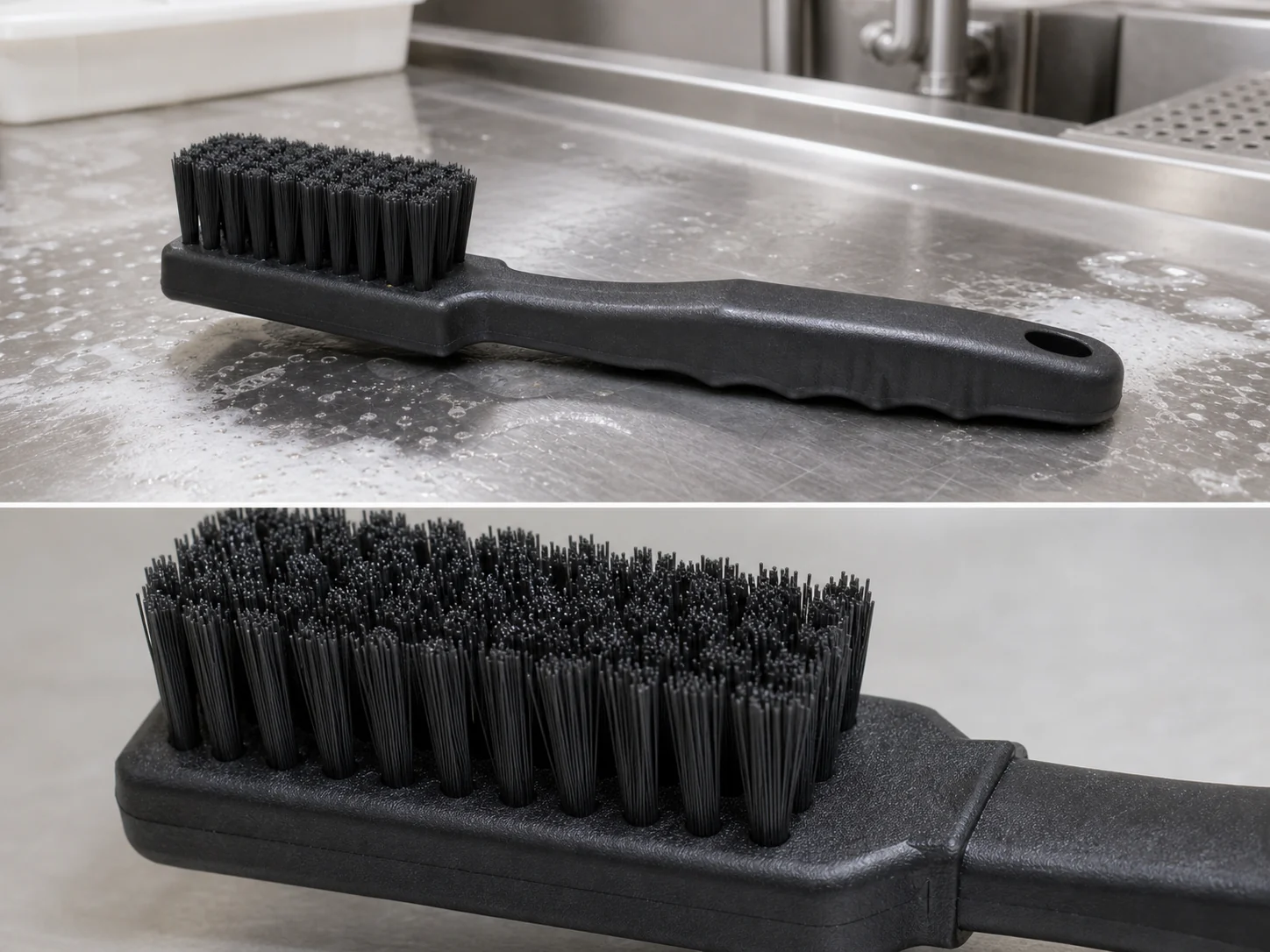
A stiff, all-plastic hand cleaning brush for scrubbing food processing equipment, including conveyors, trays, tanks, drums, guards, and removable process parts. The rectangular PA66 nylon bristle face and integrated polypropylene handle remove flour, crumbs, fat, dough, syrup, and product film without the metal-fragment risk of a wire brush.
What can this brush do for you?
Scrub sticky buildup without the wire-fragment risk
PA66 monofilament is stiff enough to break through dried dough, tacky syrup, and solidified fat, yet it is non-metallic. On food lines where a single loose wire strand can shut down a batch, this brush removes residue without adding a second contamination threat.
Keep its scrub feel through hot water and washdown chemicals
Nylon 66 absorbs less moisture than PA6 and retains a higher share of its dry stiffness in wet, heated conditions. It tolerates common alkaline cleaning detergents used in food plant sanitation, so the bristles do not soften into a mat after the first washdown cycle.
Cover wide flat surfaces in fewer strokes
The 90 mm long, 35 mm wide rectangular face lays down a broad band of bristles across conveyor beds, tray bottoms, tank walls, and machine guards. The straight edges push loose material into seams and corners instead of skipping over them.
Stay controlled when hands are wet or gloved
The polypropylene handle measures 130 mm long with a 28 mm grip diameter, sized for a gloved hand under washdown conditions. Because the standard tool has no exposed metal, it does not rust, corrode, or leave staining on stainless equipment.
What is a PA66 General Hand Cleaning Brush?
A PA66 General Hand Cleaning Brush is a hand-guided scrubbing tool in which PA66 nylon monofilament is set in dense rows into a polypropylene head and handle. It is a manual sanitation tool used between production runs and during changeovers to clear food residues from accessible equipment surfaces.
In use, the operator works the rectangular face across the surface in short push-pull strokes, applying pressure through the handle while water or detergent carries loosened debris away. The bristles flex enough to follow minor weld seams and sheet metal joints, then spring back for the next stroke. The tool is not powered, mounted, or motorized; it cleans only where the operator can physically reach.
The standard configuration uses a 90 mm head, 35 mm brushing width, and 20 to 25 mm trim length. That size gives a balance between coverage and one-hand control while wearing gloves. For wider surfaces or deeper reach, dimensions can be changed without altering the basic design.
Do not use this brush on moving conveyors, rotating parts, or equipment that has not been locked out. It is a hand tool for stationary cleaning, not a live-line tool.
Technical Specifications
| Parameter | Value / Options |
|---|---|
| Overall length | Approximately 220 mm (90 mm head + 130 mm handle) |
| Head shape | Rectangular brushing face |
| Head length | 90 mm |
| Brushing face width | 35 mm |
| Bristle material | PA66 nylon monofilament |
| Filament diameter | 0.30 to 0.50 mm, selected by required stiffness |
| Bristle trim length | 20 to 25 mm, project-adjustable |
| Handle / base material | Polypropylene (PP) |
| Handle length | 130 mm |
| Grip diameter | 28 mm |
| Maximum continuous washdown temperature | 80 °C with standard PP handle; higher-temperature handle option available |
| Chemical tolerance | Good resistance to common alkaline and mildly acidic detergents; not intended for strong solvents or prolonged oxidizing sanitizer soak |
| Metal content | No exposed metal filaments in standard construction |
| Color / marking | Standard production color; custom colors, pad print, laser marking, and color coding available |
| Brush type | Custom Handheld Detail Brushes |
| How it is driven | Hand-guided |
| Cleaning target | bakery and snack processing, dairy operation, and confectionery line cleaning |
| Surface or part | conveyors, guards, tanks, trays, holes, removable process parts, pipes, and tubes |
| Residue or debris | crumbs, dough, fat, flour, syrup, product film, protein film, and food residue |
| Mounting / connection | Fixed |
All dimensions can be adjusted for the project. The table reflects the standard configuration used as a starting point.
Where does this brush work best?
- Bakery and snack processing: crumb trays, conveyor frames, pans, and proofing racks where flour, dough, and crumbs build up between batches.
- Meat, poultry, and dairy operations: removable guards, chutes, trays, and stainless tanks where fat and protein film accumulate during hot water washdown.
- Sauce, beverage, and confectionery lines: syrup, caramel, and flavor coatings on tray bottoms, tank exteriors, and guard plates.
- General plant sanitation: machine frames, covers, bins, and washdown stations where an operator needs one durable hand cleaning brush across multiple shifts.
The rectangular head is best on flat and moderately curved surfaces. For pipe interiors, deep holes, or threaded fittings, a tube or twisted-wire stem brush is the appropriate shape.
How do I choose the right one?
Match bristle stiffness to the residue
For loose crumbs and flour, a 0.30 mm filament is usually enough. For dried dough, fat layers, and sticky films, move to 0.40 to 0.50 mm filament or a higher fill density. If the deposit is baked on, carbonized, or mineralized, PA66 will likely not remove it; a wire or abrasive brush is the better tool.
Check the surface before deciding on force
PA66 is a safe general choice for stainless steel and most uncoated metals. On painted, coated, or bright-polished surfaces, test on a hidden area first. If the finish must remain completely mark-free, a softer PBT or polypropylene filament may be the safer option.
Set the dimensions for the cleaning zone
The standard 90 x 35 mm face and 130 mm handle work well for general equipment cleaning. For wide conveyor beds, choose a wider head. For guard rails and brackets, a narrower face is easier to control. If operators reach into tanks, request a longer handle. Grip diameter should match the largest glove size used on the line.
Confirm the washdown conditions
PA66 bristles handle hot water and typical alkaline detergents well. The standard PP handle is the temperature-limiting part at 80 °C continuous. If steam cleaning or stronger sanitizers are used, select a heat-resistant handle option and confirm chemical exposure before finalizing the material set.
When to choose another brush:
- Heavy rust, scale, weld slag, or carbon deposits: use a wire brush or abrasive brush.
- Pipe interiors, holes, and threads: use a tube brush or twisted-wire stem brush.
- Polished, coated, or delicate surfaces: use a softer filament brush such as PBT, horsehair, or polypropylene.
- Large floor areas: use a deck scrub brush with a long handle.
Can I customize this brush?
The standard configuration is a starting reference, not a fixed design. We can adjust the geometry, materials, interface, and marking to fit your cleaning station.
- Head geometry: length, width, corner radius, bristle face angle, and trim profile.
- Bristle options: PA6, PBT, or polypropylene alternatives; filament diameter; fill density; flagged or crimped tips for dusting applications.
- Handle: length, ergonomic shape, rubber overmold, hang hole, grip texture, and material including glass-filled polypropylene or nylon for higher washdown temperatures.
- Color and marking: custom colors, pad print, laser marking, molded logo, and plant-by-color coding systems.
- Packaging: bulk cartons, individual polybags, retail sleeves, and customer-specific packing labels.
To define a custom configuration, provide the surface material, residue type, cleaning chemical and temperature, desired head and handle dimensions, glove size or grip preference, and any color or marking requirement. A drawing, photo, or sample of the part being cleaned helps us finalize the design faster. If the project requires material documentation, inspection support, or third-party testing, we can coordinate those requirements during customization.
Which filament survives the cleaning and still lasts on a PA66 general hand cleaning brush?
What is the practical difference between PA66 and PA6 bristles?
PA66 absorbs less water than PA6 and retains more of its stiffness at elevated washdown temperatures. If the brush will be used in hot, wet conditions or cleaned frequently with detergent, PA66 is the more stable choice. For light-duty room-temperature cleaning, PA6 or PBT may be sufficient and lower cost.
How can I tell whether the bristle stiffness is right for the job?
Press the brush against the surface at the working angle with normal pressure. If the bristles stay matted down or do not spring back, they are too soft for the residue. If they skip, chatter, or require excessive force, they are too stiff. Always test on a hidden area of the equipment before full-line use.
What temperature and chemicals can I clean this brush with?
The standard brush tolerates hot water up to 80 °C and common alkaline detergents. Do not soak it in strong solvents, strong acids, or oxidizing sanitizers for long periods, because the handle and base can degrade. Rinse after use and store the brush dry when possible.
How often should the brush be replaced?
Inspect each shift for loose or splayed bristles, cracked handle or base, and bristle tips that have become split or hardened. Replace the brush when it no longer recovers its shape after use or when filament loss is visible. Heavy sticky residues may shorten replacement intervals compared with dry material handling.
Can this brush be used on direct food-contact surfaces?
The standard tool is intended for cleaning equipment surfaces in food processing areas. If the brush itself will contact food or a direct food-contact surface, specify that in the requirement so we can select suitable raw-material grades and provide the documentation your project needs.
Will the brush leave marks on stainless steel?
PA66 is far less aggressive than wire, but any mechanical brushing can produce fine marks on bright or mirror-polished stainless under heavy pressure. For polished surfaces, reduce pressure, use a softer filament option, or request a sample for validation on the actual finish.
Guides that go deeper on this
We have not written a guide specific to this one yet. The material that covers selection, filament, dimensions, maintenance and sourcing is collected in the technical resources library.
Custom Manufacturing RFQ
Describe Your Application
An accurate custom quote starts with the dimensions, working surface, residue, material choice, connection, quantity, and reference files.
Drawing or photo optional — it speeds things up, it does not gate the enquiry.
Custom Brush RFQ
Send Your Brush Project
Upload a drawing, product photo, or sample photo and provide the core dimensions and cleaning conditions.
“We need a brush to remove wet residue from a stainless steel conveyor, about 800mm wide. The current brush wears quickly. We can send photos.”
“We sell drinkware and need a cleaning brush to include with the product. Quantity around 5,000 pieces.”