
Custom Cleaning Brush
PBT Food Equipment Hand Brush
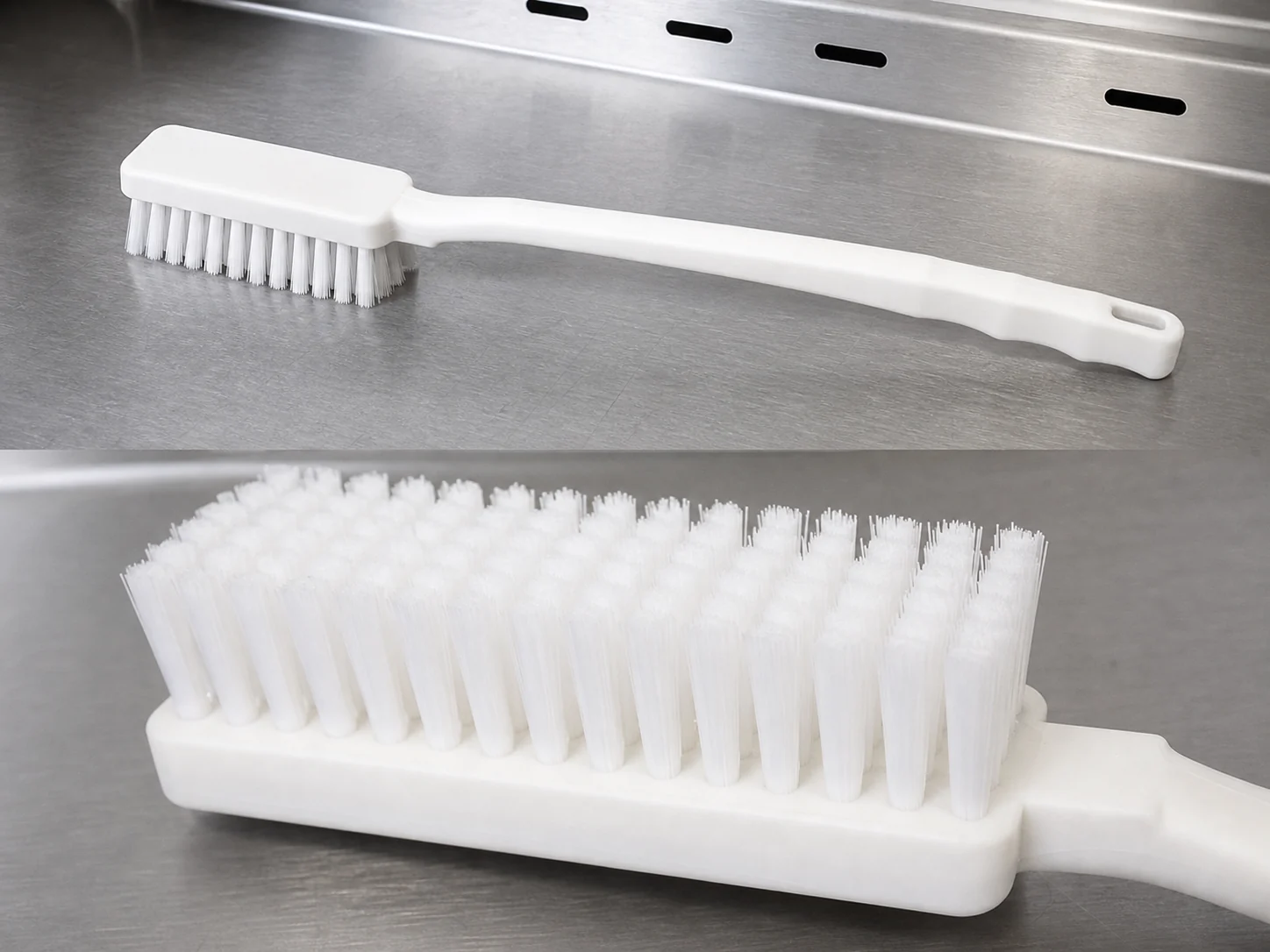
Rectangular PBT food equipment hand brush with PP handle for washing conveyors, trays, tanks, and guards.
Small brush
500 pcs
Minimum order
Held in one hand: tube, bottle, detail and swab brushes — including long-handled ones with a small head.
Production lead time, once the specification is confirmed
- Up to 500 pcsWithin 7 days
- 501–50,000 pcsWithin 14 days
- Over 50,000 pcsWithin 21 days
Peak season can extend these times; the shipping date is confirmed in writing with your quotation. Sampling and shipping are quoted separately.
A manually operated rectangular scrub brush built with stiff PBT monofilament and a polypropylene head and handle for daily washdown cleaning of food production equipment. The dense bristle face clears crumbs, dough, fat, and product film from tables, conveyors, trays, and guards while holding its stiffness through hot water and detergent cycles.
What can this brush do for you?
Stiffness that survives wet washdown work
PBT monofilament keeps its spring and standing height after repeated exposure to hot water, alkaline cleaners, and routine acid-based detergents. The tufts stay upright instead of matting down, so the brush keeps a working edge for loosening dried dough, syrup, fat films, and compacted crumbs rather than turning into a flat pad that slides over the residue.
A rectangular face that cleans open equipment surfaces in fewer passes
The 120 mm × 45 mm head lays a broad band of bristles across work tables, tray bottoms, and conveyor decks. Square head ends let the operator work the brush into corners, along side rails, and around frame edges without switching to a second tool. More contact area per stroke means fewer passes to clear a machine section during changeover.
Handle position keeps hands back from residue and washdown chemicals
The 160 mm polypropylene handle gives operators standoff from the surface being scrubbed, so they can apply pressure without dragging gloves through product film or detergent. The PP grip does not absorb water or fat, stays lightweight through a full cleaning shift, and resists cracking in wet conditions.
Fixed connection removes a common failure and contamination point
The head block and handle are joined in a fixed molded connection rather than a hinge or swivel joint. There is no pivot slot where food soil can pack in, and no mechanical joint that loosens after repeated use. The brush behaves as one solid tool under heavy hand pressure.
Molded-in zone colors for hygiene segregation
Color is molded into the head block and handle rather than painted on, so it will not flake or peel into the process area. Teams can order the same brush format in different colors to visually separate raw product zones from ready-to-eat areas and reduce cross-contamination risk on the floor.
What is a PBT Food Equipment Hand Brush?
A PBT Food Equipment Hand Brush is a hand-guided cleaning tool made with a rectangular block of PBT (polybutylene terephthalate) monofilament fixed to a polypropylene handle. It is used where operators scrub food residue from accessible equipment surfaces during product changeover or scheduled washdown, rather than where an automated rotating brush does continuous cleaning.
During use, the bristle face is pushed, pulled, or worked in short circular strokes across the target surface. The stiff filaments cut under dried films, dislodge attached deposits, and push loose crumbs and powder toward a collection point. Water or detergent then carries the loosened residue away. The brush contacts crumb trays, stainless tops, belt sides, guards, and removable process parts, and it works with standard washdown chemistry. It is not a replacement for a sanitizing step, a wire brush, or a CIP system.
Technical Specifications
The table shows the standard configuration. All dimensions, trim, filament diameter, and colors are adjustable to the actual line and cleaning protocol.
| Parameter | Value / Options |
|---|---|
| Head shape | Rectangular |
| Head size | 120 mm length × 45 mm width (adjustable) |
| Bristle material | PBT monofilament |
| Bristle trim length | 20–30 mm, project-set |
| Filament diameter | 0.30–0.50 mm, selected for stiffness |
| Head block / handle material | Polypropylene (PP) |
| Handle length | 160 mm from head rear to grip end |
| Grip diameter | 32 mm round or contoured option |
| Connection | Fixed molded head-to-handle |
| Service temperature | Up to 80°C (175°F) continuous wet washdown; higher exposure to be confirmed |
| Chemical compatibility | Common alkaline and acid food-industry detergents at use dilution |
| Colors | Blue, red, white, green, yellow, or zone-specific colors |
| Brush type | Custom Handheld Detail Brushes |
| How it is driven | Hand-guided |
| Cleaning target | production table and cutting surface, flat conveyor belt, and plastic or stainless tray cleaning |
| Surface or part | guards, trays, conveyors, rails, edges, belts, tanks, and frames |
| Residue or debris | crumbs, dough, fat, product film, protein film, flour, dried film, and food residue |
| Mounting / connection | Fixed molded head-to-handle |
Where does this brush work best?
- Production tables and cutting surfaces where flour, dough, crumbs, and protein films collect between runs.
- Flat conveyor belts, side rails, and support frames where product debris packs along edges and under guards.
- Plastic or stainless trays, totes, and lugs after emptying sticky, fatty, or syrupy product.
- Exteriors of mixers, hoppers, tanks, and drums during washdown, especially around rims, seams, and bolt heads.
- Removed guards, covers, baffles, and small process parts cleaned at a sink station before reassembly.
How do I choose the right one?
Match filament stiffness to the residue and surface
Dried dough, compacted flour paste, fat, and protein film require a firmer PBT filament. Polished stainless or coated surfaces benefit from a finer filament or a slightly longer trim to reduce contact pressure. If the residue is carbonized, baked-on, or mineralized, move to a stainless wire or abrasive brush rather than demanding more pressure from PBT.
Check the head face against the actual cleaning area
A 120 × 45 mm head is efficient for open decks and wide trays. For cleaning between side rails, inside narrow guides, or around close-spaced fittings, specify a narrower or notched head. If the full face cannot sit flat on the surface, only the outer tufts carry the load and wear out quickly.
Set the handle reach for the work position
The 160 mm handle suits benchtop work and vertical machine faces. Extend the handle when operators clean tank exteriors, conveyor undersides, or overhead guards, provided the equipment is locked out. A longer handle keeps hands farther from residue and washdown spray but reduces leverage on heavy scrubbing strokes.
Confirm chemical and heat exposure before ordering
PBT and PP are compatible with most detergent lines up to about 80°C in continuous wet service. If steam cleaning, high-concentration oxidizers, or hotter water are part of the routine, provide the actual chemicals and temperatures so the material combination can be verified or changed.
Know when this brush is the wrong tool
This hand brush is for accessible flat-to-contoured surfaces. It will not clean inside tubing, deep narrow cavities, or between tightly spaced rollers—a tube brush, strip brush, or detail brush belongs there. It is also not a substitute for CIP, for sanitizing, or for metallic and abrasive removal of burned or mineralized deposits.
Can I customize this brush?
PBT food equipment hand brushes are configured around the specific line and hygiene program. We can adjust:
- Head block — length, width, face angle, contoured ends, notches for rails or guards, and reinforced corner tufts
- PBT bristles — filament diameter, trim length, tuft density and pattern, edge rows, unflagged standard or flagged/crimped option
- Handle — length, grip shape and diameter, hanging hole, textured surface, or overmolded grip
- Connection — fixed standard or a replaceable head for high-volume consumable programs
- Material options — alternative filament or handle resin where heat, chemical, or wear requirements exceed PBT/PP
- Color and marking — zone color, pad print, hot stamp, laser marking, or identification code
- Packaging — bulk case, individually poly-bagged, pallet quantity, or project-specific packing
To build the correct configuration, provide the surface material and dimensions, residue type, washdown chemical and temperature, preferred handle reach, and any hygiene-zone color system. A drawing, photo, or sample of the existing brush helps match the format. If your program requires material documentation, lot traceability, inspection plans, or third-party testing, we can support those project requirements during customization.
Which filament survives the cleaning chemicals a PBT food equipment hand brush meets?
How can I verify that a surface is actually clean after brushing?
After rinsing, wipe the brushed area with a clean white cloth or single-use wipe. If the cloth picks up film or color, the trim length, filament stiffness, or stroke method may need adjustment—or the residue is beyond the mechanical cleaning ability of the brush.
What should operators check before starting a shift?
Inspect the bristle face for flattened, worn, or missing tufts and look for cracks or chips in the PP block and handle. Press the bristles flat and release them; they should spring back upright. Replace the brush if tufts remain bent, the handle is cracked, or the head block has separated from the handle.
Can this brush be used with steam or very hot water?
The PBT/PP combination is typically used in washdown water up to about 80°C (175°F). Steam application can soften the bristles and shorten service life, so if steam or dry heat above this level is part of the process, specify the temperature so the correct material can be selected.
Does brushing replace a sanitizing or rinse step?
No. The brush loosens and moves residue, but loosened material still needs to be rinsed away. If the surface is subject to a sanitation schedule, that step remains separate. The brush is a mechanical cleaning tool, not a sanitizing device.
Should one brush be used across raw and ready-to-eat areas?
No. Use different molded colors or identification codes and keep brushes physically separated to help operators follow hygiene-zone segregation. A single general-purpose brush moving between zones increases cross-contamination risk.
What kind of residue cannot be removed effectively with PBT bristles?
Hard scale, baked-on carbon, heavy rust, and strongly adhering mineral deposits exceed the capability of a PBT hand brush. Use a stainless wire, abrasive, or specialty brush for those deposits. PBT is selected for food soils and wet residue removal, not for grinding away hardened scale.
Guides that go deeper on this
Custom Manufacturing RFQ
Describe Your Application
An accurate custom quote starts with the dimensions, working surface, residue, material choice, connection, quantity, and reference files.
Drawing or photo optional — it speeds things up, it does not gate the enquiry.
Custom Brush RFQ
Send Your Brush Project
Upload a drawing, product photo, or sample photo and provide the core dimensions and cleaning conditions.
“We need a brush to remove wet residue from a stainless steel conveyor, about 800mm wide. The current brush wears quickly. We can send photos.”
“We sell drinkware and need a cleaning brush to include with the product. Quantity around 5,000 pieces.”