
Custom Cleaning Brush
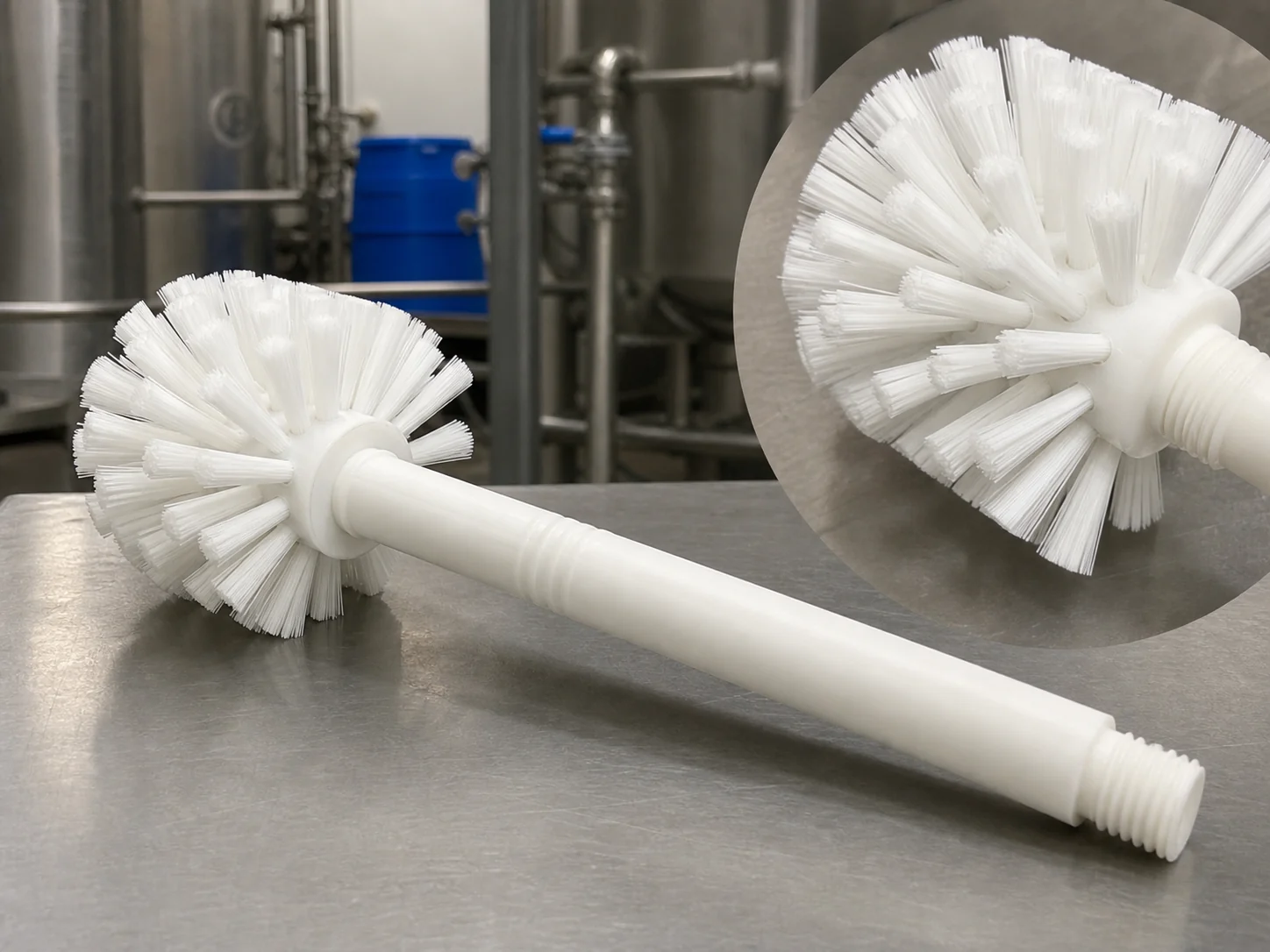
150mm PBT Food Drum Brush
Clean open-top drums, tanks, trays and food processing parts with this 150mm PBT food drum brush. Stiff PBT holds shape in hot washdown.
Small brush
500 pcs
Minimum order
Held in one hand: tube, bottle, detail and swab brushes — including long-handled ones with a small head.
Production lead time, once the specification is confirmed
- Up to 500 pcsWithin 7 days
- 501–50,000 pcsWithin 14 days
- Over 50,000 pcsWithin 21 days
Peak season can extend these times; the shipping date is confirmed in writing with your quotation. Sampling and shipping are quoted separately.
This 150 mm PBT food drum brush gives sanitation and production teams a stiff, low-moisture cleaning head for open-top drums, barrels, tanks, trays, and removable food-contact parts. The round 150 mm fill covers broad curved surfaces, while the 600 mm threaded handle keeps operators back from hot water and washdown chemicals.
What can this brush do for you?
Cuts through fat, protein, dough, and syrup films
The semi-stiff PBT filaments spring back under pressure instead of folding over, so the working face scrapes loose sticky films that softer nylon bristles tend to slide across. Fats, proteins, syrups, dough, and product film release with fewer repeated strokes.
Keeps its stiffness in continuous wet washdown
PBT absorbs very little moisture, so the bristles hold their shape and spring after hours of hot-water and detergent exposure. The brush does not go limp, mat down, or lose scrubbing pressure halfway through a sanitation shift.
Covers wide curved drum walls in one pass
The 150 mm outside diameter puts a broad contact patch against drum sidewalls, tank interiors, and curved fillets. The 320 mm long fill lets the operator sweep from the upper wall into the bottom radius without switching tools.
Threaded head changes in seconds
The brush head is removable, so a worn or color-coded head can be replaced without discarding the handle. Spare heads are easier to store, and operators can keep different stiffness grades for raw, cooked, and allergen areas.
Long handle keeps hands away from heat and chemicals
The 600 mm polypropylene handle and 28 mm grip position the operator outside the worst splash zone while scrubbing deep drums, tanks, and low process parts. Less direct contact with hot water, detergent foam, and sanitizer.
What is a 150mm PBT Food Drum Brush?
A 150 mm PBT Food Drum Brush is a round, radial-fill hand brush used for manual washdown of food processing vessels and parts. The working head is a cylinder of stiff PBT filaments about 150 mm in outside diameter and 320 mm along the fill, set around a polypropylene core. A threaded connection attaches the head to a 600 mm polypropylene handle, so one handle can carry replacement heads or different fill grades.
In use, the operator inserts the brush through the open top of a drum, barrel, tote, or mixing tank, presses the fill against the sidewall, and uses push, pull, and rotating strokes to loosen residue. The round shape follows curved walls and bottom corners without the dead zones of a flat scrub head. Outside drums, the same brush works flat trays, belt frames, chutes, guards, and other removable parts.
This is a mechanical residue-removal tool. It loosens adhered food soils before rinsing, foaming, or sanitation, but it does not replace those steps. It is also not intended for narrow bung openings or pipe interiors below about 160 mm; those applications need a tube or spiral brush.
Technical Specifications
The table shows the standard configuration for this brush. Dimensions, bristle stiffness, thread style, and handle details can be adjusted to your drum and washdown process.
| Parameter | Value / Options |
|---|---|
| Brush outside diameter | 150 mm |
| Working head length | 320 mm |
| Head shape | Round, radial fill around solid polypropylene core |
| Bristle material | Food-grade PBT filament, medium stiffness |
| Bristle diameter | 0.30–0.50 mm; standard 0.40 mm, adjusted to residue type |
| Fill density | Standard; dense fill available for heavy films |
| Core / hub material | Polypropylene (PP) with threaded insert |
| Connection | Threaded removable head, male or female matched to handle |
| Handle material | Polypropylene (PP) |
| Handle length | 600 mm |
| Grip diameter | 28 mm |
| Maximum continuous service temperature | 80°C in hot water and common detergents |
| Chemical exposure | Resistant to typical alkaline cleaners, mild acids, and dilute chlorinated washdown products; verify concentration |
| Color | Natural, blue, white, or custom color coding |
| Brush type | Custom Handheld Detail Brushes |
| How it is driven | Hand-guided |
| Cleaning target | open-top ingredient drum and barrel, mixing tank, and bakery and confectionery process part cleaning |
| Surface or part | drums, tanks, trays, sidewalls, guards, belts, chutes, and corners |
| Residue or debris | dough, fat, protein, syrup, batter, dressing, flour, and sugar |
| Mounting / connection | Threaded removable head, male or female matched to handle |
Overall reach from grip to working end is approximately 920 mm. For deeper drums or stricter temperature requirements, the head and handle can be re-specified.
Where does this brush work best?
- Open-top ingredient drums and barrels in bakeries, sauce and dressing production, dairy plants, and meat preparation — for sidewall and bottom residues of dough, batter, fat, protein, and syrup.
- Mixing tanks, brine drums, marinade tanks, and soak vessels where curved stainless interiors need manual scrubbing before rinse or between batches.
- Bakery and confectionery process parts such as depositor trays, dough troughs, sheeter guards, and conveyor belt frames where flour, sugar, and fat pack into corners and rails.
- Removable guards, chutes, hoppers, and tote lids too large for a short utility brush but too small for a floor scrubber.
- Central washdown stations where the brush must survive repeated hot-water, detergent, and hard-use cycles through a production shift.
How do I choose the right one?
Check the narrowest opening first. A 150 mm fill needs clearance on all sides to rotate freely. In most drums and tanks that means an opening or internal spacing of at least 160–170 mm. If the opening tapers, measure at the narrowest point. For tighter ports or pipe interiors, a smaller-diameter brush or a tube brush is more appropriate.
Match bristle stiffness to the residue. Medium PBT handles protein, fat, dough, and syrup films well. For light films and frequent washdown, 0.30–0.40 mm filament reduces effort. For heavy or sticky deposits, select 0.45–0.50 mm filament or dense fill. If deposits are dried, baked-on, carbonized, or mineral scale, PBT will burnish but not remove them — use an abrasive or wire brush instead.
Confirm temperature and chemical exposure. PBT and polypropylene are suitable for hot water up to about 80°C and common alkaline, acidic, and dilute chlorinated cleaners. For steam sterilization, continuous operation above 80°C, or aggressive solvent cleaners, specify a stainless core, verify the handle grade, and confirm chemical compatibility before ordering.
Consider reach and replacement strategy. The 320 mm head and 600 mm handle give roughly 920 mm of working reach. Deep drums may need a longer handle or head. Because the head is threaded, keeping one spare head per residue zone allows a quick change during sanitation without taking the handle out of service.
Use this reference when your cleaning job changes:
| Cleaning condition | Suggested configuration |
|---|---|
| Light film, frequent washdown | 0.30–0.40 mm PBT, standard fill |
| Heavy fat, protein, dough, or syrup | 0.45–0.50 mm PBT, dense fill |
| Opening under about 160 mm | Smaller diameter brush or tube/spiral brush |
| Dried, baked-on, or carbonized deposits | Abrasive or stainless wire brush, not PBT |
| Continuous temperature above 80°C or steam | Stainless core insert and material verification |
| Polished stainless finish | Standard PBT with fill inspected for embedded debris |
Can I customize this brush?
Most food drum brush orders are adjusted to the actual drum and process. Provide the internal drum diameter, opening size, sidewall height, residue type, wash water temperature, cleaning chemicals, and whether brushes need color coding by zone. A drawing, sample, or photo of the drum and existing handle shortens the sampling process.
Common customizations include:
- Head dimensions — outside diameter (for example 100–200 mm), working fill length (200–500 mm), and shape such as full cylinder, taper, or barrel profile
- Bristle fill — PBT filament diameter, stiffness grade, straight or crimped filament, flagged tips for thin films, fill density, and color
- Core and thread — polypropylene, stainless steel, or chemical-resistant core; male or female thread, thread size, quick-release, or fixed mount
- Handle — length, grip diameter, ergonomic or loop grip, hanging hole, textured finish, color, and molded logo
- Zone color coding — different head, bristle, or handle colors to separate raw, cooked, allergen, and non-food areas
- Packaging and marking — bulk carton, individually bagged, plant-specific labels, laser marking, or pad printing
If your project requires material declarations, migration test support, third-party inspection, or other project-specific documentation, we can assist with those requirements during customization.
Which filament survives the cleaning and still lasts on a 150mm PBT food drum brush?
How do I know if this brush will fit my drum?
Measure the narrowest opening and the smallest internal spacing the head must pass through. Allow at least 10–15 mm clearance around the 150 mm fill so the bristles can flex and the head can rotate. If the opening tapers, test at the narrowest point, not in the middle of the drum.
What does PBT give me that nylon doesn’t?
PBT absorbs very little water and keeps its stiffness better in hot, wet washdown, so the bristles do not soften or mat down after long exposure to water and detergent. It also recovers its shape after pressure. Nylon may be more resistant in certain solvent or extreme-abrasion environments, so aggressive chemical conditions should still be checked.
Will this brush scratch polished stainless steel?
Under normal hand pressure, PBT filaments do not gouge standard 304 or 316 stainless surfaces. The bigger risk is grit and metal debris picked up in a non-food area becoming embedded in the fill. Rinse and inspect the fill before use, and keep separate heads for raw, cooked, and utility zones.
How do I know when to replace the head?
Check at the start of each shift for flattened, split, or mushroomed filament tips, permanent leaning that does not recover, or missing tufts. If the operator needs noticeably more strokes to remove the same residue, the head has lost its working edge. Replacing the threaded head is faster and cheaper than replacing the whole brush.
Can I leave the brush soaking in sanitizer overnight?
PBT and polypropylene tolerate many dilute sanitizers, but prolonged immersion in strong chlorine, acid, or solvent solutions can embrittle the filaments and stress the core. Rinse the brush after use and hang it dry. If your sanitation SOP requires soaked storage, provide the chemical and concentration so the materials can be verified.
Does this brush replace CIP or spray-ball cleaning?
No. The brush is a manual detail tool for surfaces that CIP jets do not reach or for removing residues before a CIP or sanitation cycle. It does not replace rinsing, chemical circulation, or sanitation. Use it as the mechanical step in the full cleaning sequence, then complete the required rinse and sanitizing steps.
Guides that go deeper on this
Custom Manufacturing RFQ
Describe Your Application
To prepare the correct quotation, provide the dimensions, cleaning task, residue, material, mounting details, quantity, and a drawing or photo.
Drawing or photo optional — it speeds things up, it does not gate the enquiry.
Custom Brush RFQ
Send Your Brush Project
Upload a drawing, product photo, or sample photo and provide the core dimensions and cleaning conditions.
“We need a brush to remove wet residue from a stainless steel conveyor, about 800mm wide. The current brush wears quickly. We can send photos.”
“We sell drinkware and need a cleaning brush to include with the product. Quantity around 5,000 pieces.”