
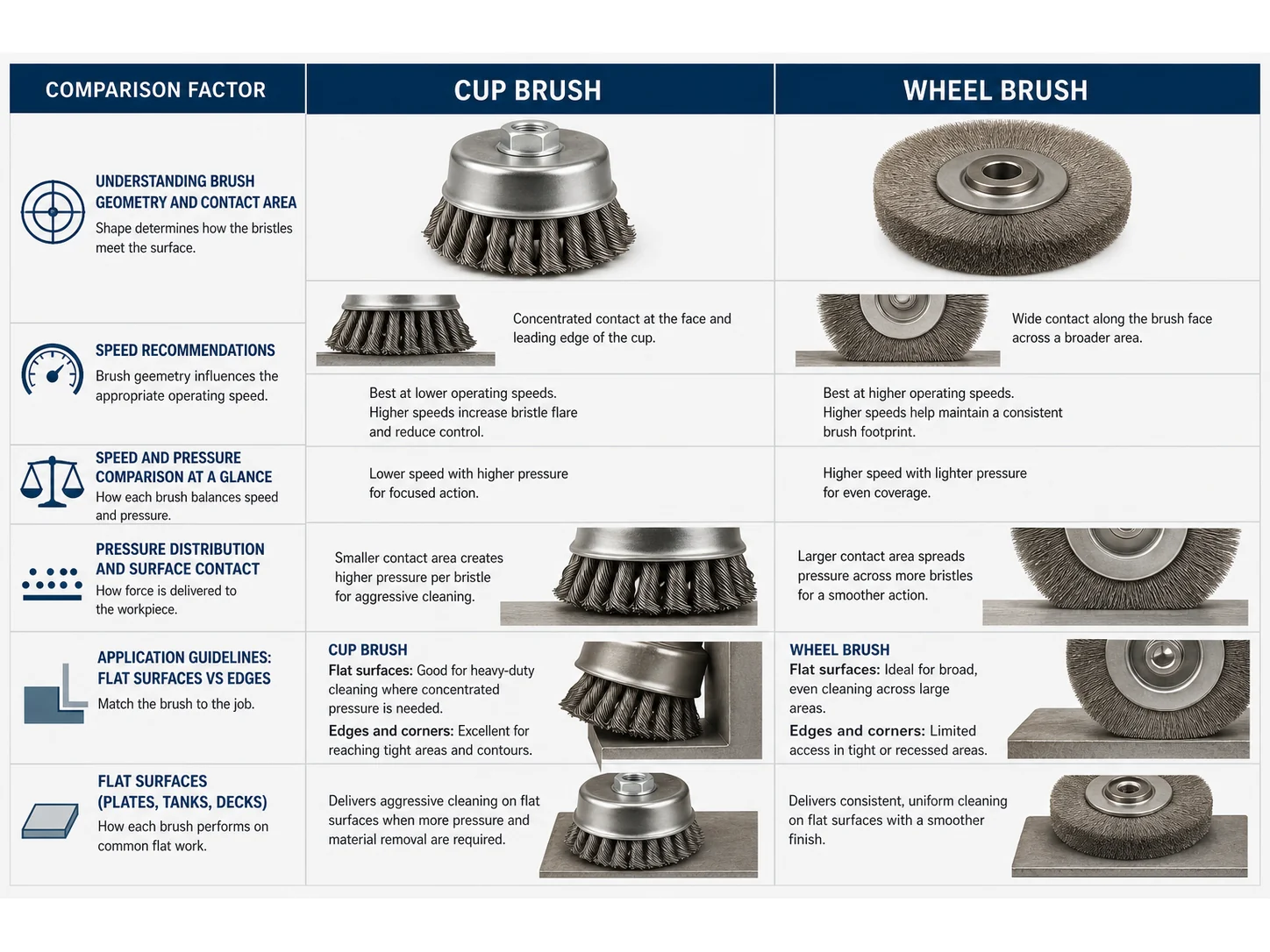
Understanding Brush Geometry and Contact Area
A cup brush features twisted wire knots arranged in a circular cup shape, with the working face formed by the knot tips along the rim. This design concentrates the contact area into a narrow ring, producing high unit pressure ideal for aggressive edge work. In contrast, a wheel brush has radial wire bristles extending from a central hub, providing a broad flat face that distributes pressure evenly over a larger surface area. The geometry directly affects how speed and pressure interact: cup brushes can be run at higher rotational speeds because the knot construction withstands centrifugal forces better, while wheel brushes often benefit from moderate speeds to control bristle flaring and wire breakage.
Speed Recommendations: Cup Brush vs Wheel Brush
Operating speed is a critical variable. Cup brushes are typically designed for higher RPM ranges—commonly up to the maximum no-load speed of a 4.5″ angle grinder (around 10,000–11,000 RPM)—making them effective for fast stock removal and heavy rust cleaning. Wheel brushes, especially crimped wire types, perform best at slightly lower speeds (often 6,000–9,000 RPM) to maintain wire flow and avoid excessive vibration. Always check the manufacturer’s rated RPM on the brush and never exceed it. Key considerations:
- Higher speed: increases material removal rate but also heat and wear; suits cup brushes on tough, thick steel.
- Lower speed: improves control and finish consistency; preferable for wheel brushes on large flat areas.
- Tool compatibility: both types work on angle grinders, but cup brushes are also common on high-speed die grinders, while wheel brushes can be used on bench grinders or dedicated polishing machines.
Speed and Pressure Comparison at a Glance
| Factor | Cup Brush | Wheel Brush |
|---|---|---|
| Typical operating speed | 8,000–11,000 RPM (aggressive) | 6,000–9,000 RPM (controlled) |
| Contact area | Narrow rim (high unit pressure) | Broad face (low unit pressure) |
| Pressure distribution | Concentrated on edge; can bite into surfaces | Spread evenly; less risk of digging in |
| Best for flat surfaces | Requires skill; may leave ridges if not overlapped | Excellent; uniform finish with proper technique |
| Best for edges / corners | Superior; reaches tight angles effectively | Limited; bristles may splay or miss tight spots |
| Wire breakage risk | Lower due to knot construction | Higher if oversped or over‑pressured |
Pressure Distribution and Surface Contact
Because the cup brush’s working edge is only a thin ring, the same downward force produces significantly higher unit pressure compared to a wheel brush. This makes cup brushes highly effective for breaking up heavy scale, removing weld slag, or cutting through thick rust. However, on large flat surfaces, that concentration can create groove patterns, uneven material removal, and rapid wear of the rim. A wheel brush, with its wider contact patch, “floats” over flat areas with less tendency to gouge, allowing faster travel speeds with consistent results. The trade-off is that a wheel brush struggles to apply enough pressure into sharp corners and recessed areas.
Application Guidelines: Flat Surfaces vs Edges
Flat surfaces (plates, tanks, decks)
For large expanses, a wide wheel brush is usually the better choice. Use moderate speed (7,000–9,000 RPM) and light, even pressure—let the tool’s weight guide the brush. Overlapping passes by half the brush width prevents banding. A cup brush can be used if aggressive material removal is needed, but it demands constant attention to angle and pressure; tilting the brush slightly so only one side of the rim contacts increases cutting action but also uneven wear.
Edges, corners, and weld seams
A cup brush excels here. The rim can reach into tight grooves, around bolt heads, and along sharp edges that a flat wheel brush cannot access. Use higher speed and moderate pressure to quickly clean without burning the wires. For deep corners, a small‑diameter cup brush on a die grinder provides even better access. Wheel brushes are generally ineffective for edge profiling—bristles deflect outward and fail to deliver focused impact.
Optimization by Material and Task
Wire type and brush diameter also influence speed‑pressure decisions. The table below provides general starting points; always test on a scrap piece before full production.
| Material | Task | Brush Choice | Speed | Pressure |
|---|---|---|---|---|
| Mild steel, heavy rust | Rust & scale removal | Knotted cup brush | High (10,000+ RPM) | Moderate‑heavy |
| Steel plate, light corrosion | Surface prep before paint | Crimped wheel brush | Medium (7,000–8,500 RPM) | Light |
| Aluminum, soft metals | Oxide removal, blending | Nylon abrasive wheel brush | Low‑medium (4,000–6,000 RPM) | Very light; avoid smearing |
| Weld seams (steel) | Slag & spatter removal | Small cup brush | High (depends on tool) | Moderate |
| Wood, soft fibers | Cleaning, texturing | Non‑abrasive nylon cup/wheel | Low | Light; test for burning |
Note: For thin sheet metal, excessive pressure with any brush can cause warping. Use light pressure and slower travel to avoid heat buildup.
Common Mistakes in Speed and Pressure Selection
- Over‑speeding a crimped wheel brush: Centrifugal force flattens the bristles, reducing contact and causing rapid wire breakage. Stick to rated RPMs.
- Too much pressure with a cup brush: This wears the rim prematurely and can create deep scratches, especially on softer base metals.
- Using a wheel brush for edge work: Bristles bend away from the corner, providing poor cleaning and risking operator kickback.
- Running a cup brush too slow: Low RPM reduces impact energy, causing the brush to “bump” instead of cut, leading to poor material removal and operator fatigue.
- Ignoring brush diameter: Surface speed (feet per minute) increases with diameter; a 6″ cup brush at the same RPM has nearly 40% higher rim speed than a 4.5″ cup brush, affecting aggressiveness and wear.
When Geometry Mismatch Causes Uneven Wear
Every brush wears, but mismatch between brush geometry and the work surface accelerates the process unevenly. A cup brush used solely on flat stock will wear down the outer rim in a ring pattern, while the inner wires remain relatively untouched. This reduces cleaning efficiency and forces the operator to change the brush angle or apply additional pressure, which further accelerates wear. Conversely, a wheel brush forced into corners will exhibit wire splaying on the outer edges, leaving the center bristles under‑utilized. In both cases, early replacement becomes necessary, driving up consumable costs and downtime. Recognizing these limits helps decide when to switch between brush types—or when a specialty brush (e.g., end brush, stringer bead brush) is the better investment for the task.
Final Takeaway
Choose a cup brush when you need aggressive, focused cleaning on edges, corners, and heavy rust—run it at higher speeds with moderate pressure. Choose a wheel brush for large flat surfaces where uniform finish and wider coverage matter more than raw cutting power—keep speeds moderate and pressure light. Always match the brush diameter, wire type, and rated RPM to the tool and material, and retire any brush that shows uneven wear or damage. By respecting the geometry‑driven trade‑offs between speed and pressure, operators gain longer brush life and better surface quality without trial‑and‑error damage.
When a Cup Brush Is the Wrong Choice
This brush is not enough when the main problem is blocked access, unsafe working conditions, damaged equipment, incompatible chemicals, or a process setting that keeps recreating the residue. In those cases, review base material, burr or oxide level, target finish, brush speed, pressure, and acceptable surface change and confirm the surrounding cleaning method before increasing brush stiffness or contact pressure.
Frequently Asked Questions
Can I use a cup brush on a large flat surface?
Yes, but it requires technique. Use light pressure and overlapping passes to avoid creating ridges. A wheel brush is generally more efficient and yields a more uniform finish on wide flat areas.
Why does my wheel brush shed wires so quickly?
Rapid wire loss usually indicates overspeeding, excessive pressure, or using a crimped wire brush for heavy material removal. Switch to a knotted brush for aggressive work, reduce speed, or lighten the applied force.
What is the maximum safe speed for a cup brush?
The safe maximum speed is stamped on each brush. Most quality cup brushes for angle grinders are rated for at least 10,000 RPM, but always confirm the rating before mounting. Never exceed the brush’s labeled RPM.
Do cup brushes require more pressure than wheel brushes?
They don’t require more force, but their smaller contact area creates much higher unit pressure for the same downward load. This means you need to apply less physical effort to get strong cutting action—a light touch is often enough.
How do I prevent uneven wear on a cup brush?
Keep the brush as flat as possible against the work surface, avoiding excessive tilting. Rotate the tool or workpiece periodically so different sections of the rim wear evenly. Replace the brush when the wire length on the rim becomes too short.
Can I use a wheel brush to clean rust out of corners?
Wheel brushes are not designed for inside corners. The bristles splay out and fail to deliver impact into the root. A cup brush or a small end brush on a die grinder is far more effective for such tight geometry.
Is there a brush that works well for both flat surfaces and edges?
Some operators use a cup brush on both by changing technique, but no single brush is optimal for both. For production environments, keep both types on hand and switch as needed. Alternatively, a stringer bead brush offers a middle ground for certain weld cleaning tasks.
Technical References
- ABMA — ANSI B165.1 Power Brush Safety Slips
- OSHA — 1910.242 Hand and Portable Powered Tools
- OSHA — 1910.215 Abrasive Wheel Machinery
- OSHA — Personal Protective Equipment
Which bristle material fits this job — Abrasive Nylon, Nylon PA or Carbon Steel Wire?
| Material | Continuous temperature (°C) | Peak temperature (°C) | Water absorption | Hardness |
|---|---|---|---|---|
| Abrasive Nylon | 120 | 150 | 0.1–1.0% | Abrasive filament; stiffness and cutting level is controlled by PA base, grit type, grit size, filament diameter and trim height. |
| Nylon PA | 93 | 121 | 0.3–9% by PA grade and conditioning | Medium to firm; filament diameter and trim length control bending force. |
| Carbon Steel Wire | 200–300 | 350–450 | 0% | Rockwell C 40–60 |
| PA6 Nylon | 80–100 | 130–160 | 1.5–3.0% | Shore D 75–85 |
| PA66 Nylon | 100–120 | 150–180 | 1.0–1.8% | Shore D 80–88 |
Figures as published by Perlon; Brushtec / DuPont. Confirm the exact grade against the supplier datasheet before ordering.
What should replace Cup Brushes for nylon abrasive wheel brush?
- Cup Brushes — Cup brushes cover a broader face than wheel brushes; end brushes are better for small recesses or pockets where the cup body blocks access.
- Wheel Brushes — Wheel brushes give narrow edge contact; cup brushes cover a broader open face, while end brushes concentrate contact at the end of a small stem for recesses.
- Abrasive Nylon — Compare Abrasive Nylon with PP, PBT, PET. Change material when wet stiffness, temperature, chemical resistance, conductivity, particle shedding, or surface marking becomes the limiting factor.
- Nylon PA — Compare Nylon PA with PP, PBT, PET. Change material when wet stiffness, temperature, chemical resistance, conductivity, particle shedding, or surface marking becomes the limiting factor.