
Custom Cleaning Brush
100mm P120 SiC Cup Brush
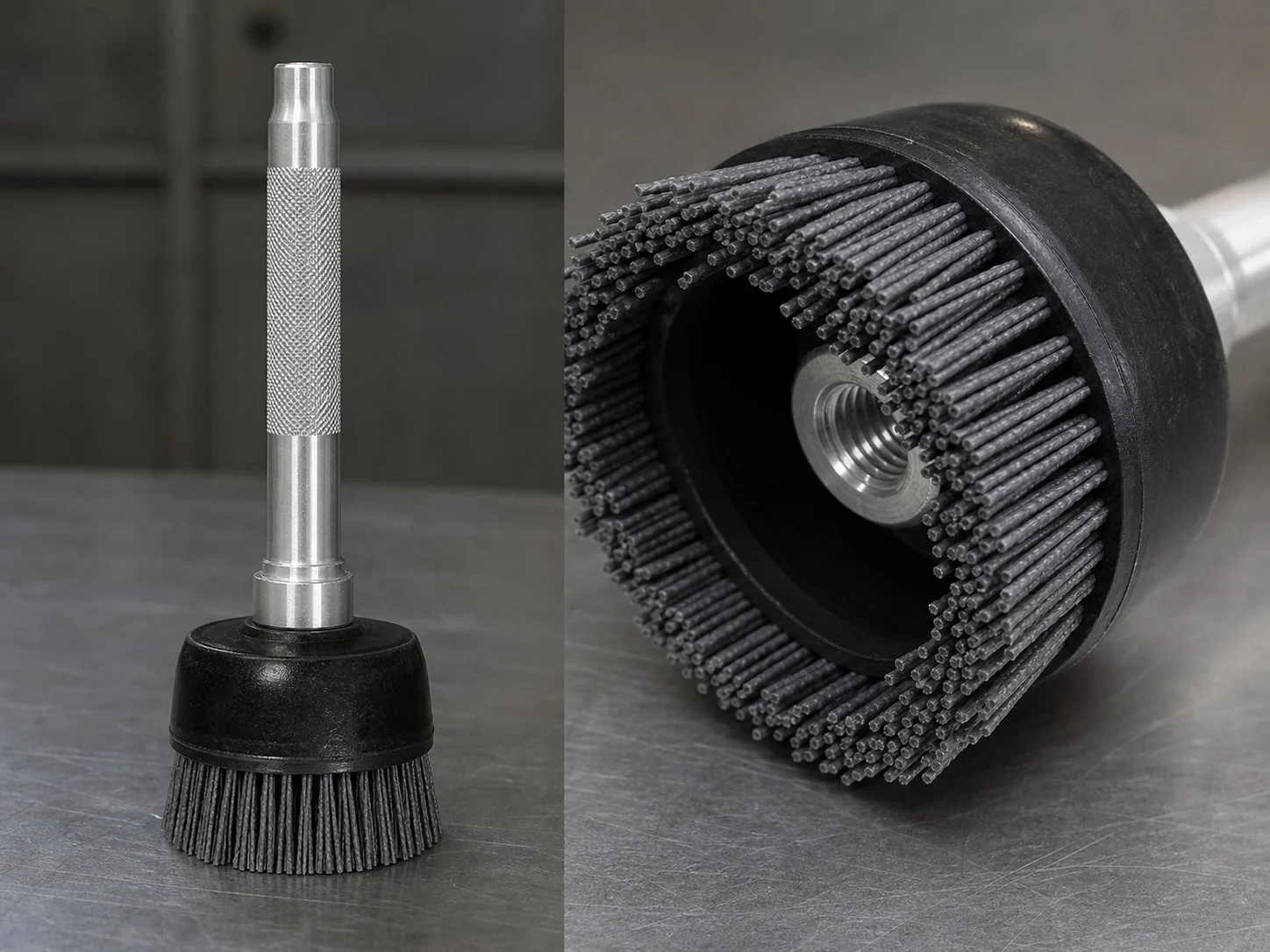
100mm P120 SiC abrasive nylon cup brush for angle grinders: deburring, weld blending, oxide removal, and satin finishing with M14 threaded aluminum hub.
Small brush
500 pcs
Minimum order
Held in one hand: tube, bottle, detail and swab brushes — including long-handled ones with a small head.
Production lead time, once the specification is confirmed
- Up to 500 pcsWithin 7 days
- 501–50,000 pcsWithin 14 days
- Over 50,000 pcsWithin 21 days
Peak season can extend these times; the shipping date is confirmed in writing with your quotation. Sampling and shipping are quoted separately.
A 100mm abrasive nylon cup brush loaded with P120 silicon carbide for controlled surface finishing on flat faces, profiles, edges, and weld zones. The 35mm cup trim and threaded aluminum hub mount to a standard angle grinder to deburr, blend, and prepare surfaces without the gouging and wire shedding of conventional wire cup brushes.
What can this brush do for you?
Cuts with control through P120 silicon carbide
The abrasive is carried inside nylon filaments, not bonded to a rigid wheel. Each filament exposes sharp silicon carbide edges that remove fine burrs, oxide, weld discoloration, and light scale while flexing under load. P120 is fine enough to leave a consistent matte or satin line and coarse enough to do real surface preparation.
Cup geometry covers flat work and follows mild contours
The 100mm working face is a cup, not a disc. With the face perpendicular to the spindle, one pass covers panels, plates, and wide profiles. The outer rim reaches into fillets, edge transitions, and shallow profile corners that a flat disc or flap wheel skips.
Nylon filaments flex instead of gouging
Because the bristles bend, the brush follows surface irregularities instead of digging one rigid groove. It removes contamination and light imperfections without substantially changing part geometry, which is why it is used after machining and before coating, bonding, or plating.
No steel wire to embed or rust
Abrasive nylon wears gradually into fine dust instead of breaking off as metal slivers. On stainless steel, aluminum, and parts headed to clean assemblies, there is no wire contamination risk and no rust staining from broken filament ends.
Lightweight aluminum hub reduces fatigue
The 6061 aluminum alloy base keeps rotating mass lower than a steel alternative, reducing vibration and arm fatigue in continuous use. The threaded hub allows quick brush head changes without changing the operator’s tool setup.
Repeatable finish across a production run
A powered cup brush repeats the same contact pressure and direction on every part. Operators can hold a consistent satin, blend, or pre-coat finish on repeated parts with less hand rework and fewer rejected pieces.
What is a 100mm P120 SiC Cup Brush?
A 100mm P120 SiC cup brush is a power-brush consumable for surface finishing on rotary tools, most commonly a 100mm or 125mm angle grinder. The cup-shaped head has a 100mm diameter working face and a 35mm deep trim of abrasive nylon filaments loaded with silicon carbide. The base is machined from 6061 aluminum alloy with a standard M14 x 2.0 female thread, so the brush installs directly onto compatible spindles.
In operation, the tool spins the cup face and the operator guides it over the workpiece. The brush is designed for flat and slightly contoured surfaces: the face works wide areas, and the outer rim handles edges, weld zones, and shallow transitions. Light to moderate pressure keeps the filaments cutting instead of bending flat.
P120 is a medium-fine grit. That makes this a finishing and conditioning tool, not a heavy stock removal or aggressive descaling tool. Remove heavy rust, mill scale, weld spatter, or thick coating first with a wire brush, grinding disc, or coarse abrasive. The cup brush then refines the surface to a uniform line before the next process.
Technical Specifications
The table below lists the standard configuration. Diameter, trim depth, grit, thread, and bristle density can be adjusted for project-specific finishing work.
| Parameter | Value / Options |
|---|---|
| Head diameter | 100 mm |
| Head shape | Cup-shaped working face |
| Working face depth / trim length | 35 mm |
| Bristle material | Silicon carbide (SiC) abrasive-loaded nylon |
| Grit | P120 |
| Base / hub material | 6061 aluminum alloy |
| Connection | Threaded removable; M14 x 2.0 female thread (standard) |
| Recommended operating speed | 4,500–8,000 RPM |
| Maximum operating speed | 9,000 RPM |
| Compatible tools | Angle grinders and rotary tools with M14 spindle and guard clearance for 100mm accessories |
| Operating environment | Dry or light wet use with water/coolant; avoid aggressive chemical soaking of the aluminum hub |
| Brush type | Custom Cup Brushes |
| How it is driven | Machine-driven, mounted in the equipment |
| Cleaning target | deburring and edge blending, removing light oxidation, and surface preparation cleaning |
| Surface or part | aluminum, welds, edges, profiles, hubs, weld zones, flat faces, and metal |
| Residue or debris | scale, weld discoloration, rust, oxide, sharp edges, spatter, haze, and mold |
| Mounting / connection | Threaded removable; M14 x 2.0 female thread (standard) |
Where does this brush work best?
- Deburring and edge blending on laser-cut, punched, or CNC-machined parts where sharp edges need softening without changing dimensions.
- Removing light oxidation, weld discoloration, and heat tint from stainless steel and aluminum before passivation, coating, or assembly.
- Satin finishing and scratch blending on flat panels, architectural profiles, handrails, and enclosures.
- Surface preparation before paint, powder coat, bonding, or plating by creating a controlled anchor pattern without deep gouges.
- Cleaning mold release, light flash, and surface haze from composite, fiberglass, and hard plastic parts.
- Blending weld seams on sheet metal assemblies where a visible grain direction is acceptable.
How do I choose the right one?
The 100mm P120 SiC cup brush is a specific configuration. The remaining decisions are whether this diameter and grit fit your surface, and whether your tool can run it safely.
Match the thread and guard first
Confirm your spindle is M14 x 2.0. If it is a different size, request an alternate thread or adapter hub. Check that the grinder guard clears a 100mm accessory and that the tool no-load speed is at or below 9,000 RPM. If the grinder has variable speed, set it within the 4,500–8,000 RPM working range.
Choose the grit and filament aggressiveness for the finish requirement
P120 handles fine burrs, light oxide, heat tint, and satin blending. For heavier scale or deeper scratches, start with P80/P60 in the same cup or use a wire cup brush first. For a smoother, more refined surface, follow with P180/P240 or a non-woven conditioning brush. To increase cut without changing grit, specify a shorter trim, larger filament diameter, or higher bristle density. To improve conformance around contours, use a longer trim or smaller filament diameter.
Consider the workpiece material
Silicon carbide is sharp and friable, so it works well on stainless steel, aluminum, titanium, hard alloys, glass-reinforced composites, and hard plastics. On very soft metals such as copper, brass, or pure aluminum, P120 may cut faster than intended and leave a visible grain. Use lighter pressure, lower speed, a finer grit, or test on scrap first. For wood, the cup face can load or generate heat at high speed; a flap brush or disc is often a better fit.
Use the right operating practice
Keep the brush moving and use light to moderate pressure. Let the abrasive do the work. Excessive pressure bends the filaments flat, increases heat, and shortens life. On large flat areas, overlap passes by about half the brush face to avoid visible lane lines.
| Starting condition | Recommended tool |
|---|---|
| Fine burrs, light oxide, heat tint, satin finish | This 100mm P120 SiC cup brush |
| Heavy rust, mill scale, weld spatter | Wire cup brush or coarse abrasive first |
| Mirror or high-gloss finish | Finer abrasive or polishing process after brushing |
| Deep internal bores or narrow slots | Mounted point or end brush |
Can I customize this brush?
The 100mm P120 SiC cup brush is built around standard angle grinder mounting, but the cup geometry, abrasive grade, and connection can be adjusted for a production finishing line.
- Brush diameter and working face depth: 80, 100, 115, or 125mm diameters; shorter or longer trim to change stiffness and aggressiveness.
- Abrasive grade and material: P60 through P320 in silicon carbide, aluminum oxide, or ceramic-loaded nylon depending on the surface and finish requirement.
- Filament construction: filament diameter, straight or crimped configuration, density, and distribution pattern to tune cut, loading, and surface grain.
- Cup profile: flat face, flared rim, conical, or special edge profile for access into a specific part geometry.
- Hub and thread: M14 standard; M10, 5/8-11, or custom arbor/adapter; aluminum, steel, or fiberglass-reinforced nylon base.
- Color and marking: custom bristle color, laser marking on the hub, product code, or private label packaging.
- Packaging: bulk, individual sleeve, blister, or project-specific kitting.
To define a custom configuration, send the tool spindle thread, no-load RPM, workpiece material, current surface condition, target finish or Ra value, and a photo or drawing of the part geometry. For industrial programs, we can also support material data, first article samples, inspection criteria, and project documentation.
What size should a 100mm P120 sic cup brush be, and when has it worn past use?
How do I know if my angle grinder is safe for this cup brush?
Check three things: the spindle thread is M14 x 2.0, the guard clears a 100mm accessory, and the grinder no-load speed does not exceed 9,000 RPM. Before touching the workpiece, run the brush off the work for about 30 seconds. If it vibrates, chatters, or the hub does not seat flat, stop and inspect the thread and mounting faces.
What happens if I apply too much pressure?
The filaments bend flat, cutting action drops, heat rises, and the surface can become discolored or unevenly worked. The brush wears faster and the hub may be stressed. Use light, even pressure and let the rotating abrasive do the cutting. If the cut is too slow, move to a coarser grit instead of pushing harder.
Can this cup brush be run wet?
Yes, a light water or water-based coolant flow reduces dust and heat on metals. Keep the flow away from the tool motor, and dry the brush after use so the filaments do not mat and the aluminum hub does not stay wet. Do not soak the brush in aggressive chemicals.
How can I tell when the brush is worn out?
Replace it when the trim length has shortened by roughly half of the original 35mm, the finish becomes uneven, cut drops noticeably, or vibration increases. Also inspect the aluminum hub and thread for cracks or deformation before remounting. A worn brush used too long produces inconsistent surface quality and more heat.
Can this cup brush reach inside a tight 90-degree welded corner?
No. The cup face works along open edges, fillets, and shallow transitions, but the aluminum hub and 100mm face cannot enter narrow inside corners. For tight intersections, use a mounted point brush, end brush, or smaller diameter cup configuration. Choose the tool that can contact the full surface without binding the hub.
Does the brush leave anything on the surface before coating?
Abrasive nylon leaves fine abrasive dust and nylon particles, not metal slivers. Clean the surface with compressed air or a solvent wipe after brushing and before painting, powder coating, or bonding. The brush prepares the surface; the final cleaning step is still required.
Guides that go deeper on this
How to Choose Nylon Abrasive Wheel Brush
Read this guideGuideCup Brush vs Wheel Brush Speed and Pressure Trade-Offs
Read this guideGuideCup Brush vs Wheel Brush: Which One to Use
Read this guideGuideNylon Cup Brushes: Polishing or Cleaning, and What Fill?
Read this guideGuideSponge Cup Brushes: Cleaning, Absorbing or Polishing?
Read this guideCustom Manufacturing RFQ
Describe Your Application
Send the key measurements, cleaning requirement, residue, material direction, mounting method, quantity, and drawing or photo.
Drawing or photo optional — it speeds things up, it does not gate the enquiry.
Custom Brush RFQ
Send Your Brush Project
Upload a drawing, product photo, or sample photo and provide the core dimensions and cleaning conditions.
“We need a brush to remove wet residue from a stainless steel conveyor, about 800mm wide. The current brush wears quickly. We can send photos.”
“We sell drinkware and need a cleaning brush to include with the product. Quantity around 5,000 pieces.”