
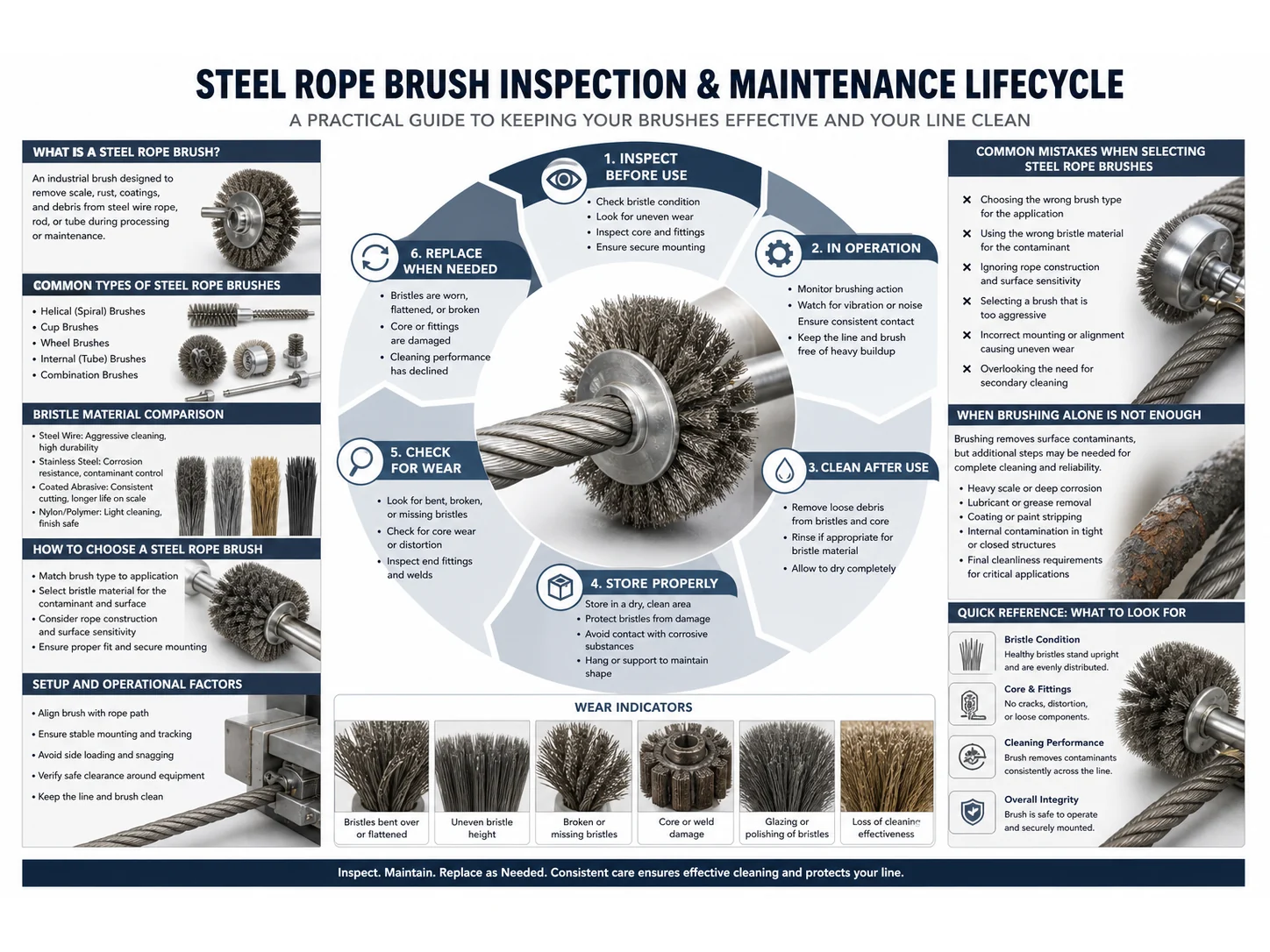
What Is a Steel Rope Brush?
A steel rope brush is a rotary cleaning tool built from a central hub and a wrapped wire rope that holds the bristles. It threads around the product (like a wire or rod) and rotates at high speed. The bristles strike the moving surface to dislodge contaminants without cutting the base metal. It is often used in descaling sections, after drawing stands, or before coating baths.
Common Types of Steel Rope Brushes
Brush selection starts with the bristle material and the way the brush mounts to the shaft. The three practical categories are:
- Crimped wire rope brushes – Good for general light-to-medium scale removal on carbon steel wire. The crimped wire has some flex and works well at moderate line speeds.
- Knot wire rope brushes – The twisted knots provide more aggressive cutting action. They are suited for heavier rust or thick mill scale where rapid cleaning is required.
- Abrasive nylon rope brushes – Filled with silicon carbide or aluminum oxide grit. They are a go-to when the steel grade is sensitive to scratching or when minimal cold work on the surface is allowed.
Bristle Material Comparison
| Material | Best Use Case | Surface Sensitivity | Dry / Wet | Temperature Limit | Maintenance Need |
|---|---|---|---|---|---|
| Carbon steel wire | Carbon steel rod/wire, heavy scale | Moderate scratch risk | Dry or light oil | Up to 300°F (150°C) | Replace when bristles lose cut |
| Stainless steel wire (304/316) | Stainless or non‑ferrous wire, food‑grade or corrosive lines | Low scratch risk | Dry or wet, some chemical exposure | Up to 600°F (315°C), depends on grade | Check for work hardening and breakage |
| Abrasive nylon (SiC or AlOx) | Delicate or high‑finish wire, light residue | Minimum scratching | Dry or wet, wide chemical tolerance | Typically under 200°F (93°C) | Monitor grit wear; nylon can soften |
| Knot‑twisted carbon steel | Extremely heavy scale, fast line speeds | Higher scratch risk | Dry only | Similar to carbon steel wire | Aggressive wear, inspect daily |
How to Choose a Steel Rope Brush
Do not select a brush by cost alone. Confirm these five factors before ordering:
- Product size range – Specify the minimum and maximum diameter of wire, rod, or tube the brush must clean. A brush that is too tight will stall or damage the surface; one that is too loose will not clean effectively.
- Mounting method – Check the shaft diameter, keyway, or hub connection. Rope brushes commonly mount on a straight shaft with a center bore and a key or clamping collar. Ask for a dimensioned drawing or a sample hub.
- Bristle material and trim length – Match the bristle to the contaminant and base metal (see table above). Trim length affects brush stiffness and flexibility around curves or weld seams.
- Cleaning objective – Define the residue to be removed (scale, rust, drawing soap, emulsion). Provide a reference photo or draw a sketch. A supplier cannot guess the required finish grade.
- Line speed and wrap angle – State the typical operating speed and how much of the wire’s circumference the brush must contact. Higher speeds often require longer bristles or multiple brush stations.
Setup and Operational Factors
Even the correct brush will perform poorly if the placement or operating conditions are wrong:
- Position in the line – Install the brush where the wire is under consistent tension and free of whip. Avoid locations directly after a bending roll without a guide.
- Contact pressure – Too little pressure leaves residue; too much overheats bristles and can work‑harden the wire surface. Start light and increase until cleaning becomes uniform.
- Wet vs. dry operation – Wet cleaning can cool the brush and flush debris, but it may require stainless bristles and seal‑protected bearings.
- Safety guarding – A rope brush running at high speed throws contaminants. Use a hood with proper extraction or vacuum pick‑up.
Common Mistakes When Selecting Steel Rope Brushes
- Choosing the lowest-cost wire grade – Low‑carbon wire bristles can rust quickly in humid conditions and stain the product. Match material to the environment, not just the purchase cost.
- Ignoring bristle fatigue – A brush that looks “full” may have bristles that are work‑hardened and ready to snap. Plan a replacement schedule based on operating hours, not just visual inspection.
- Using the same brush for multiple steel grades – Carbon steel bristles can embed particles into stainless steel wire, causing corrosion later. Dedicate brushes where purity is critical.
- Overlooking mounting precision – A loose hub or an undersized key can cause vibration that damages both the brush and the wire surface.
- Skipping a trial run – Always test a sample brush on your actual line with your typical residue before ordering a full set. A supplier that refuses a sample order is a red flag.
When a Steel Rope Brush Is the Wrong Choice
A steel rope brush removes loose or mechanically bonded contaminants, but it cannot dissolve chemical soils, remove deep pits, or clean inside blind holes. In many lines, brushing must be combined with other processes:
- Vacuum extraction – Essential for capturing airborne dust and preventing re‑deposition. A brush hood without suction can turn a cleaning step into a contamination spreader.
- Air knife or blower – After a wet wash, an air knife removes remaining water and loose debris before the wire enters a dryer or coating bath.
- Scraper or pre‑wipe – Heavy soap paste or thick clay‑type lubricants can pack between bristles. A fixed scraper ahead of the brush reduces loading.
- CIP (Clean‑in‑Place) rinse – In food/pharma applications, the brush should survive rinse cycles; however, chemical cleaning alone often replaces mechanical brushing for sanitary pipe interiors.
- Ultrasonic or chemical bath – For drawing compounds that are soluble or for micro‑fine debris, a pre‑treatment tank before the brush station improves overall results.
Final Takeaway
Start with the wire size, line speed, and the exact residue you need to remove. Choose bristle material that balances aggression against surface finish requirements, then confirm the mounting interface with a dimensioned drawing. Run a trial, measure the result, and only then scale to production. A well‑matched steel rope brush reduces waste, prevents coating defects, and pays for itself quickly—without being the most expensive option on the shelf.
Frequently Asked Questions
What is the difference between a crimped wire rope brush and a knot wire rope brush?
Crimped wire has smaller, more flexible bristles that cover the surface evenly and are ideal for light scale or wiping. Knot wire uses twisted bundles that hit harder and clear heavy rust faster but can leave a rougher finish.
Can I use a steel rope brush on stainless steel wire?
Yes, but use stainless steel bristles to avoid iron contamination that leads to rust spotting. A knot stainless brush or a medium grit abrasive nylon brush works well depending on how delicate the surface must remain.
How do I know when to replace the brush?
Measure the cleaning gap. If you must tighten the brush mounting by more than 10–15% of the original bristle length just to get acceptable cleaning, the bristles are too short or too worn. Also check for uneven wear patterns that cause vibration.
What line speed can a steel rope brush handle?
There is no single number. A fine‑grit abrasive nylon brush on a small‑diameter wire may run at 300 m/min, while a coarse carbon steel knot brush on 25 mm rod might top out around 60 m/min. The brush supplier should ask for your speed range and adjust bristle density and trim length accordingly.
Do I need a separate brush for wet lines?
Not always, but wet environments call for stainless steel bristles and seals to prevent rust and bearing washout. If water‑based coolant or chemical rinse is present, carbon steel bristles will corrode quickly and can stain the product.
Can a steel rope brush clean weld seams?
It can clean the area around a seam, but a rope brush is not designed to grind down a high seam lump. For that, a fixed-position wire wheel or a seam scraper is more appropriate. Running a rope brush over a high seam at speed can snag and break bristles.
Why does my brush leave black smudge on the wire?
Black smudge usually means bristle wear debris or re‑deposited contaminant. Check that the brush speed and line speed are matched, that the brush is not over‑pressed, and that your dust extraction system is pulling fines away from the wire surface.
Should I order a custom brush or an off‑the‑shelf size?
If your wire diameter, mounting shaft, and cleaning goal match a standard brush, use the stock item for faster delivery. For unique materials, tight tolerance requirements, or high‑volume lines, a custom brush with a sample approval step avoids costly mis‑matches.
Technical References
Which bristle material fits this job — AISI 304 Stainless Steel Wire, Abrasive Nylon or Carbon Steel Wire?
| Material | Continuous temperature (°C) | Peak temperature (°C) | Water absorption | Hardness |
|---|---|---|---|---|
| AISI 304 Stainless Steel Wire | 400 | 500 | 0% | Rockwell B 70–95 depending on temper and cold work |
| Abrasive Nylon | 120 | 150 | 0.1–1.0% | Abrasive filament; stiffness and cutting level is controlled by PA base, grit type, grit size, filament diameter and trim height. |
| Carbon Steel Wire | 200–300 | 350–450 | 0% | Rockwell C 40–60 |
| Nylon PA | 93 | 121 | 0.3–9% by PA grade and conditioning | Medium to firm; filament diameter and trim length control bending force. |
Figures as published by Alleima; Perlon; Brushtec / DuPont. Confirm the exact grade against the supplier datasheet before ordering.
What should replace AISI 304 Stainless Steel Wire when it stops working?
- AISI 304 Stainless Steel Wire — Use AISI 316 stainless steel wire for chloride, marine, dairy, beverage, chemical washdown, or higher pitting-resistance requirements. Use carbon steel for dry aggressive cutting and brass or abrasive nylon for lower marking risk.
- Abrasive Nylon — Compare Abrasive Nylon with PP, PBT, PET. Change material when wet stiffness, temperature, chemical resistance, conductivity, particle shedding, or surface marking becomes the limiting factor.
- Carbon Steel Wire — Compare Carbon Steel Wire with Carbon steel wire, brass wire, abrasive nylon. Change material when wet stiffness, temperature, chemical resistance, conductivity, particle shedding, or surface marking becomes the limiting factor.
- Nylon PA — Compare Nylon PA with PP, PBT, PET. Change material when wet stiffness, temperature, chemical resistance, conductivity, particle shedding, or surface marking becomes the limiting factor.