
Custom Cleaning Brush
Cast Iron Cleaning Brush
Select an industrial cast iron cleaning brush as a wheel, cup, or end brush with carbon steel, 316 stainless, or brass wire.
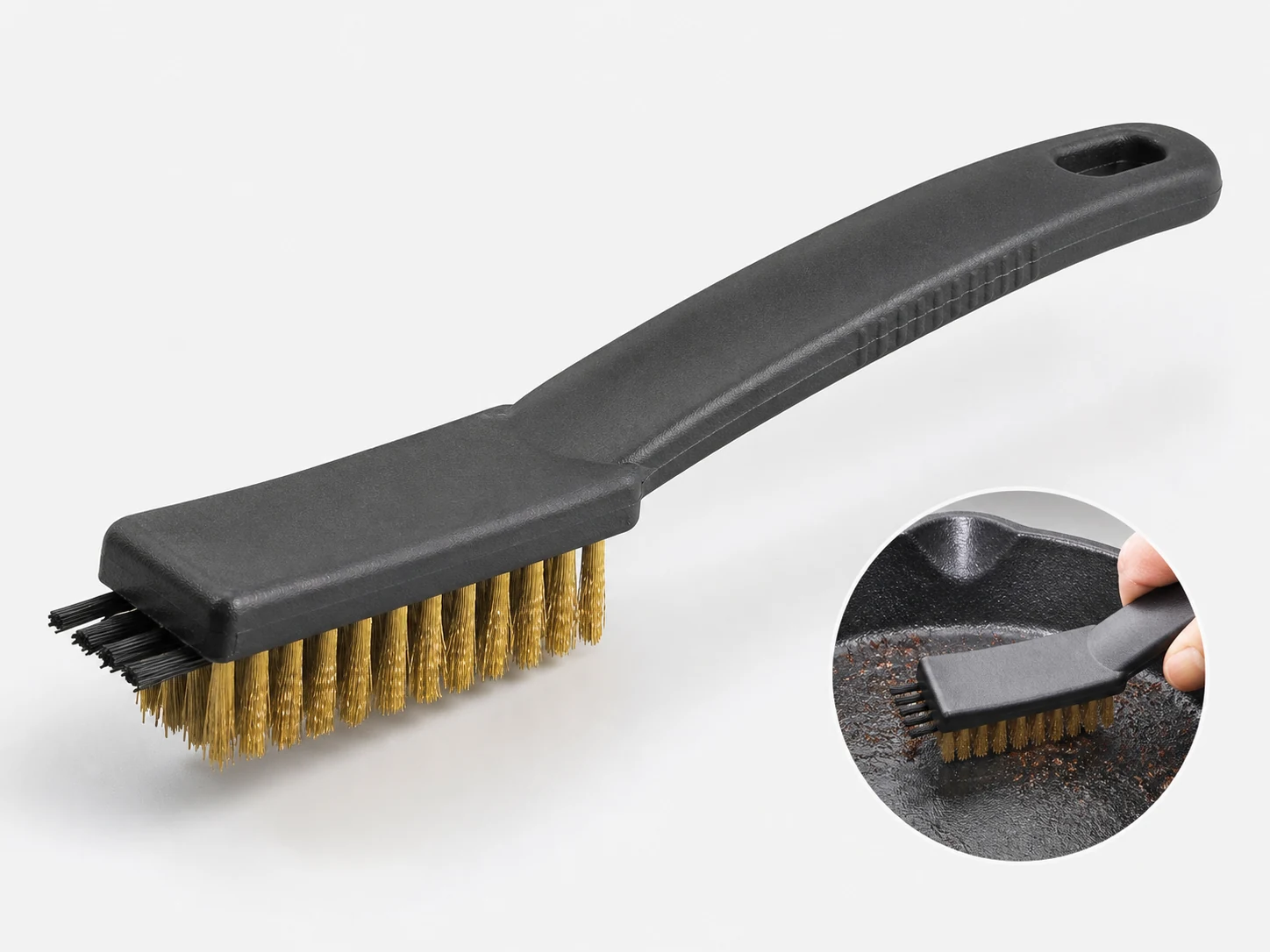
Medium brush
100 pcs
Minimum order
Worked with two hands or on a pole: chimney, gutter and pond-filter brushes, discs, cups and tank brushes.
Production lead time, once the specification is confirmed
- Up to 100 pcsWithin 7 days
- 101–5,000 pcsWithin 14 days
- 5,001–50,000 pcsWithin 21 days
- Over 50,000 pcsConfirmed with your quotation
Peak season can extend these times; the shipping date is confirmed in writing with your quotation. Sampling and shipping are quoted separately.
For maintenance, fabrication, and rebuild teams working on cast iron machine structures, castings, weldments, and tooling, this industrial cast iron cleaning brush removes foundry scale, rust, oxide, weld spatter, and embedded shop debris while leaving the base surface largely intact. It is supplied as a wheel, cup, or end brush with carbon steel, 316 stainless steel, or brass wire fill selected for the part and contamination risk.
What can this brush do for you?
Breaks foundry scale and rust from raw castings without grinding away geometry
The wire tips strike and scrape hard deposits so they release in fragments instead of being abraded away as stock. That distinction matters on cast iron machine bases, housings, and fixtures where a machined face or reference surface must stay dimensionally stable.
Reaches ribs, pockets, T-slots, and fillets where a flat wheel cannot contact
Wheel, cup, and end forms cover open plate surfaces, corner transitions, internal webs, tee slots, and narrow recesses. Cup and end profiles let the wire tips work into concave cast features and around bosses that a large disc skips, reducing hand scraping and secondary cleanup time.
Cleans oxide and spatter around weld repairs without changing the weld profile
When a cast iron housing, pump casing, or bracket is repaired by welding, this brush removes pre-weld oxide and post-weld spatter from the joint area. Knot-wire cups and end brushes concentrate working tips in the toe line and fillet, while the wire action does not cut the weld itself.
Leaves a controlled finish instead of random scratch marks
Wire diameter, trim length, and fill construction can be set for coarse scale removal or a fine satin condition. Thin crimped wire with a longer trim produces an even brushed surface on gasket faces and exposed cast surfaces; heavier knot wire handles thick rust and spatter.
Adjusts to contamination risk with three fill materials
Carbon steel wire offers aggressive cleaning on ferrous cast iron. 316 stainless avoids rust bloom after wet processes. Brass wire provides a softer, non-sparking contact for gasket faces, soft castings, or areas where ferrous particle embedding would cause later staining or corrosion.
What is a Cast Iron Cleaning Brush?
A Cast Iron Cleaning Brush is an industrial cast iron wire brush for power tools such as angle grinders, bench grinders, pedestal grinders, die grinders, and drills. It uses controlled-length wire fill mounted in a wheel, cup, or end configuration — not abrasive grain — to dislodge scale, rust, oxide, spatter, old residue, and loose debris. It is a surface-finishing tool: it changes the condition of the surface, not the machined dimensions or shape.
In operation, the brush rotates and the wire tips strike the cast surface at an angle. Each wire deflects under load, chips or scrapes the contamination loose, and snaps back for the next revolution. The result depends on wire material and diameter, trim length, fill density, speed, and feed direction. On raw cast iron, the brush typically runs after blasting or needle scaling to remove loosened scale and oxide; on machined cast iron, it removes rust and dried coolant without taking down the machined face.
This is not a grinding disc, and it will not remove deep pits, fill holes, or correct dimensional error. Use light to moderate contact pressure and keep the brush moving so the wires cut contamination instead of polishing the iron in one spot.
Technical Specifications
The values below describe a typical industrial cast iron cleaning brush configuration. We set the final dimensions, fill, mount, and speed rating from your power tool and the access geometry on the cast part.
| Parameter | Value / Options |
|---|---|
| Brush form | Wheel, cup, or end brush, selected from access geometry |
| Fill material | Carbon steel wire, 316 stainless steel wire, or brass wire |
| Wire diameter | 0.15–0.50 mm (0.006–0.020 in) |
| Trim length | 15–40 mm (0.59–1.57 in) |
| Fill construction | Crimped or twist-knot wire construction |
| Working diameter | Wheel: 65–230 mm; cup: 50–125 mm; end: 10–50 mm, project-adjusted |
| Mount / interface | 22.23 mm arbor, M14 x 2 or 5/8-11 thread, 6 mm or 1/4 in shank, matched to tool |
| Maximum operating speed | Marked on the brush hub; never exceed the stamped rating |
| Hub / backing | Steel or stainless steel cup or center plate, reinforced for high RPM |
| Operating environment | Dry standard; stainless or brass fill for wet, chemical, or corrosion-sensitive use |
| Finish range | From coarse scale removal to uniform satin, controlled by wire diameter and trim length |
| Brush type | Custom Cup Brushes |
| How it is driven | Hand-guided |
| Cleaning target | raw casting and machine base, machined table, and press die cleaning |
| Surface or part | welds, carbon steel, cast surfaces, tooling, bases, holes, housings, and fixtures |
| Residue or debris | rust, oxide, scale, spatter, carbon, coolant, chips, and paint |
| Mounting / connection | 22.23 mm arbor, M14 x 2 or 5/8-11 thread, 6 mm or 1/4 in shank, matched to tool |
Wire size and trim length are the two levers that matter most on cast iron: thicker wire with a short trim removes scale and spatter; thinner wire with a long trim produces the softer satin finish. We confirm the combination against your current surface condition.
Where does this brush work best?
- Raw castings and machine bases: remove molding sand residue, light burn-on scale, rust, and coating remnants before machining, paint, or assembly.
- Machined tables, fixtures, and vises: remove dried coolant, chips, rust bloom, and light oxide from T-slots and clamping surfaces without disturbing flatness.
- Press dies, punches, and die shoes: clean oxide, zinc stearate, smut, and debris from punch/die surfaces, stripper pads, and pockets using cup and end forms.
- Weld repairs on cast iron: prepare bevels and remove spatter after welding housings, pump casings, brackets, and frames. Knot wire reaches toe lines and fillets.
- Gasket faces and sealing surfaces: remove rust, old gasket material, and oxide from flanges and cover faces before reassembly, with brass or crimped stainless wire where marking must be minimal.
- Machine rebuild and reconditioning: clean cast iron gear cases, ways, bearing saddles, and index bases during overhaul before inspection and reassembly.
How do I choose the right one?
Start with the surface and the access path, not with the brush itself. Four decisions set the correct brush: form, fill material, aggressiveness, and mount/speed.
1. Match the form to the access geometry
- Wheel brushes work broad flat cast surfaces, plates, and long rails where you can pass over the area continuously.
- Cup brushes work edges, shoulders, corners, fillet weld zones, and areas around bosses because they can be angled into the transition.
- End brushes work holes, pockets, narrow gaps, T-slot bottoms, and internal recesses where the other forms cannot enter.
2. Choose the wire material by contamination risk and surface requirement
Carbon steel is the economical, aggressive choice for ferrous cast iron when paint or further treatment follows and rust staining from embedded wire particles is not a concern. Choose 316 stainless when the part will be stored wet, used in a corrosion-sensitive assembly, or when carbon steel particles would flash rust before painting. Choose brass when the cast surface is soft, when gasket or sliding surfaces must stay mark-free, or when a non-sparking tool is required in the work area. Do not use a carbon steel brush on stainless, aluminum, or bronze parts; the transferred particles will corrode.
3. Set aggressiveness with wire diameter and trim length
| Cast iron condition | Wire diameter | Trim length | Fill construction |
|---|---|---|---|
| Heavy foundry scale, thick rust, weld spatter | 0.35–0.50 mm | 15–25 mm | Twist-knot |
| Moderate oxide and dried coolant | 0.25–0.35 mm | 20–30 mm | Crimped or knot |
| Light rust, gasket faces, fine satin finish | 0.15–0.25 mm | 30–40 mm | Crimped |
4. Confirm the mount and rated speed before running
The hub must match the tool: arbor hole, threaded nut, or shank. Always compare the tool’s no-load speed with the maximum speed marked on the brush. Running a brush above its rating can throw wires, imbalance the tool, and injure the operator. Use threaded or nut-mounted cup/wheel forms on angle grinders, arbor-mount forms on bench and pedestal grinders, and shank-mounted end brushes on die grinders and drills.
If the cast iron still carries hard embedded burn-on sand or thick mill scale, preclean with needle scaling, abrasive blasting, or a grinding disc and use the wire brush as the finishing step. Wire brushes clean the surface; they are not a substitute for stock removal or dimensional correction.
Can I customize this brush?
Every cast iron cleaning job has different access geometry, tooling, and contamination requirements. We build the brush around your workpiece and process, not around a stock catalog item.
Typical variables we set together:
- Form and dimensions: wheel outer diameter, cup diameter and depth, end brush diameter and overall length, face width, and trim projection.
- Wire fill: carbon steel, 316 stainless, or brass; 0.15–0.50 mm wire; crimped, twist-knot, or straight construction; fill density and row configuration.
- Mounting interface: arbor hole size, M14 x 2 or 5/8-11 thread, shank diameter, keyed hub, or custom adapter for your machine.
- Hub and backing: steel or stainless cup or center plate, reinforced construction, pilot recess, or reduced-diameter hub for deep access.
- Speed and balance: dynamic balancing for the operating speed, stamped maximum rating, and configuration for vibration-sensitive cast-iron processes.
- Project support: packaging, bulk or individual packing, part marking, and assistance with material declarations, inspection requirements, or third-party testing when your end customer requires them.
Send us the power tool make, model, and no-load speed; a sketch or photo of the cast surface and the areas you cannot reach; the current surface condition and desired finish; and any contamination restrictions. We will propose the form, fill, hub, and dimensions from that information.
Which filament survives the cleaning and still lasts on a cast iron cleaning brush?
Will a wire brush remove cast iron base material when I clean it?
A correctly selected wire brush removes almost no measurable stock in normal use. The wire tips chip and scrape the scale or oxide off the surface. If you dwell in one spot with heavy pressure, especially with thick wire and a short trim, you can polish, work-harden, or lightly deform very soft cast iron. Keep the brush moving and use light-to-moderate contact; if you need actual dimension change, use an abrasive or grinding operation.
How do I keep carbon steel wire marks from rusting before paint?
Carbon steel wires can leave fine ferrous particles that flash rust when exposed to moisture. If the cast iron will be painted soon after cleaning, use 316 stainless wire, or wipe the surface with a residue-free solvent and paint within the same shift. Do not use water-based cleaners between brushing and painting without thorough forced drying.
Can I use the same carbon steel brush on cast iron and aluminum parts?
No. Carbon steel wire transfers iron particles to aluminum, causing galvanic corrosion and leaving a contaminated surface. Keep dedicated stainless or brass brushes for non-ferrous work, and do not mix them in the same processing area unless each brush is clearly marked and stored separately. If there is any chance of cross-use, specify stainless or brass from the start.
What does the maximum RPM marked on the brush actually control?
The rating is the highest free rotational speed the brush is built to withstand safely. As speed increases, centrifugal force on the wire tips increases sharply; exceeding the rating can throw wire pieces, distort the hub, or make the brush out of balance. Check the tool’s no-load speed against the brush marking every time a brush is fitted, and do not use damaged or modified hubs.
How do I know when the brush is worn out?
Compare the remaining trim length to the original. When individual wires break off, fill density drops and cleaning gets slower. If the trim is below about half its original length, the brush no longer produces the same contact and should be replaced. Replace it immediately if you see loose center plates, cracked hubs, uneven wear, or any vibration that starts during use — those are not normal break-in behavior.
Will this brush remove burn-on sand or hard mill scale from a raw cast iron surface?
Only the loose or lightly adhered portion. Burn-on sand and thick mill scale are often harder than wire tips and are better removed by abrasive blasting, needle scaling, or grinding before brushing. Use the brush after those steps to remove residual loose material and oxide and to leave a uniform surface for inspection, machining, or paint.
Guides that go deeper on this
Custom Manufacturing RFQ
Describe Your Application
To prepare the correct quotation, provide the dimensions, cleaning task, residue, material, mounting details, quantity, and a drawing or photo.
Drawing or photo optional — it speeds things up, it does not gate the enquiry.
Custom Brush RFQ
Send Your Brush Project
Upload a drawing, product photo, or sample photo and provide the core dimensions and cleaning conditions.
“We need a brush to remove wet residue from a stainless steel conveyor, about 800mm wide. The current brush wears quickly. We can send photos.”
“We sell drinkware and need a cleaning brush to include with the product. Quantity around 5,000 pieces.”