
Custom Cleaning Brush
300mm PP Car Wash Side Disc Brush
300 mm round PP side disc brush for car wash side arms. Quick-change hub, 180 mm polypropylene filaments, and fine film removal on painted panels.
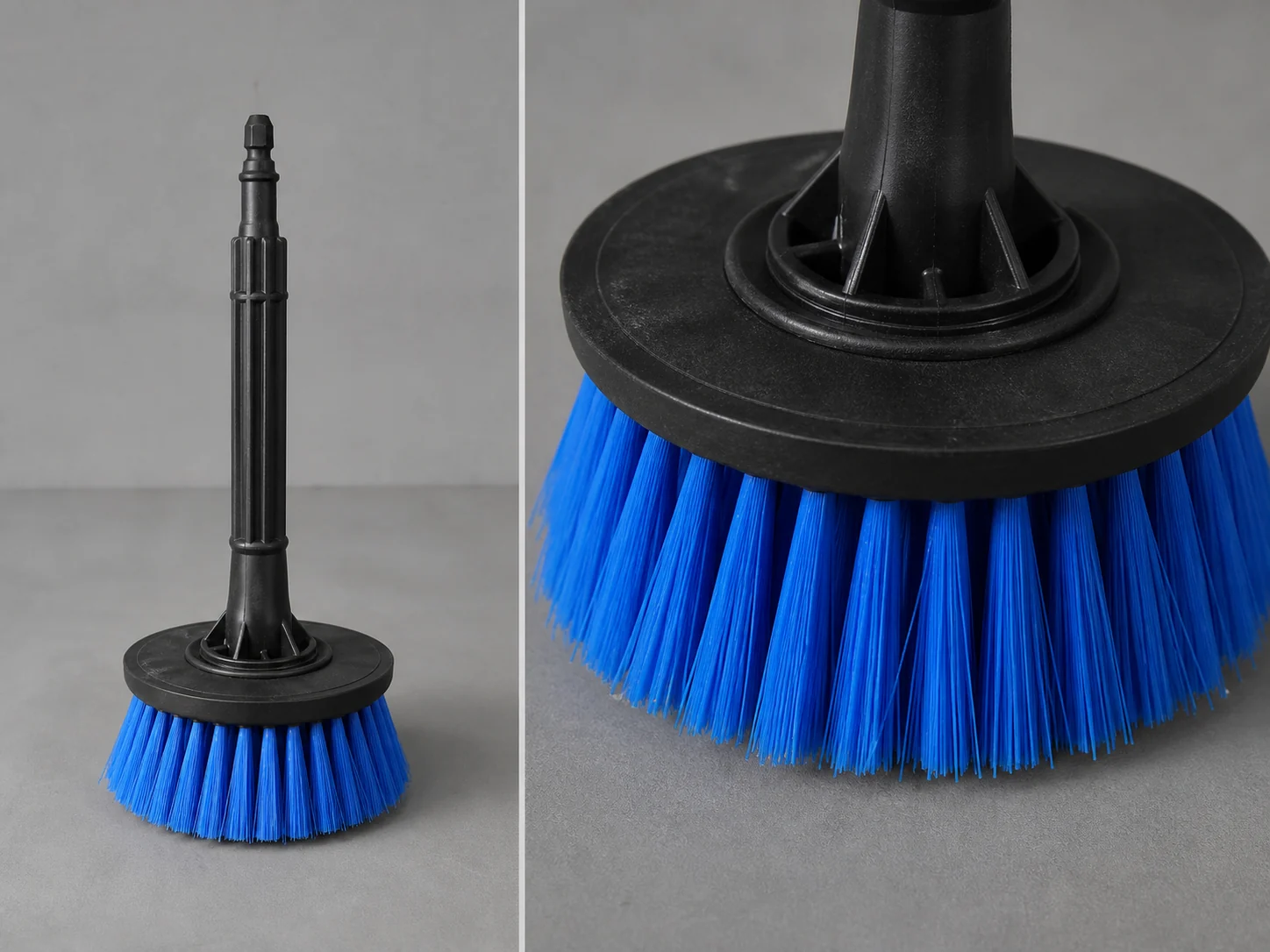
Medium brush
100 pcs
Minimum order
Worked with two hands or on a pole: chimney, gutter and pond-filter brushes, discs, cups and tank brushes.
Production lead time, once the specification is confirmed
- Up to 100 pcsWithin 7 days
- 101–5,000 pcsWithin 14 days
- 5,001–50,000 pcsWithin 21 days
- Over 50,000 pcsConfirmed with your quotation
Peak season can extend these times; the shipping date is confirmed in writing with your quotation. Sampling and shipping are quoted separately.
The 300mm PP Car Wash Side Disc Brush is a 300 mm round polypropylene filament disc built for rotating side-wash arms and side brush stations in automatic car wash systems. Its quick-change hub and dense 0.3 mm or finer PP filament face remove road film, mud, and detergent residue from vertical vehicle panels while keeping lane service fast.
What can this brush do for you?
300 mm Sweep Matches Tall Vehicle Side Panels
The full 300 mm disc face turns against door skins, fenders, and rocker lines as the side-wash arm follows the vehicle. Thousands of fine PP filament tips contact the panel at once, so one pass removes more film and breaks up detergent residue instead of leaving narrow scrub tracks.
Quick-Change Hub Keeps High-Volume Lanes Running
The central quick-change coupling allows a maintenance tech to pull a worn or damaged disc and mount a fresh one directly on the side unit without pulling the shaft or side arm. In a tunnel line, that means the brush is back in service between wash cycles rather than during an extended shutdown.
PP Filaments Keep Their Spring in Water and Chemistry
Polypropylene does not absorb water, so the filaments don’t soften, sag, or mat after repeated exposure to pre-soak, shampoo, and rinse agents. They recover their working height after each pass and keep consistent tip contact through the shift.
Fine Filament Tips Lift Film Instead of Gouging Clear Coat
Filaments at 0.3 mm or finer create a dense, compliant working face that rolls over road film, mud, insect residue, and oil film and releases it from the surface. The cleaning action comes from filament flex and tip density, not from an abrasive layer embedded in the brush face.
All-PP Disc Body Cuts Corrosion and Rotating Mass
The back plate and filament are both polypropylene, so the disc adds no steel plate to rust or add unnecessary rotating weight to the side shaft. Lighter rotating mass means easier starts and less stress on bearings and drive components in high-cycle car wash equipment.
What is a 300mm PP Car Wash Side Disc Brush?
A 300mm PP Car Wash Side Disc Brush is a tufted rotary cleaning disc installed on automatic car wash side-wash arms or vertical side brush stations. The round PP plate carries dense PP filaments from one face, while the rear hub connects to the machine through a quick-change coupling. During operation the disc rotates against the vehicle side, and the filament tips scrub the vertical surface, lower sills, and rocker area as the arm follows the vehicle contour.
The 180 mm filament working length keeps the hub plate clear of the body while allowing the fine tips to bend around mild curvature. The brush is designed for regular removal of soft, attached road film — not for heavy baked-on debris or bonded abrasive grit. In most lines it works best when paired with pre-soak or foam dwell time and a rinse pass; the brush supplies the mechanical agitation that releases the film the chemistry has already softened.
Because the disc is a consumable in a continuously wet, chemically active environment, the material choice is as important as the diameter. PP was selected for water resistance, chemical tolerance in normal car-wash solutions, low weight, and filament recovery. The quick-change hub is the part that makes the brush a practical field replacement rather than a custom rebuild item.
Technical Specifications
The table lists the default configuration for the 300 mm disc. Hub bores, bolt circles, filament length, and tip treatment are matched to the machine during order confirmation.
| Parameter | Specification |
|---|---|
| Brush diameter | 300 mm |
| Disc shape | Round face disc |
| Filament material | Polypropylene (PP) |
| Filament diameter | ≤0.3 mm; flagged or straight tips selectable per project |
| Filament trim length | 180 mm working length from hub face; adjustable |
| Hub / back plate material | Polypropylene (PP) |
| Connection | Quick-change coupling; bolt circle and pilot bore matched to machine |
| Tufting | Dense concentric tuft pattern; ring count adjustable |
| Operating environment | Wet car wash with water-based pre-soak, shampoo, and rinse agents |
| Standard wash-water temperature | Up to 60°C / 140°F continuous; higher temperatures require material review |
| Typical residue targets | Road film, mud, dust, insect residue, oil film, detergent film |
| Brush type | Custom Disc Brushes |
| How it is driven | Machine-driven, mounted in the equipment |
| Cleaning target | automatic tunnel side-wash station, in-bay rollover side brush, and high-volume car wash location cleaning |
| Surface or part | hubs, roads, panels, conveyors, bores, pins, and bends |
| Residue or debris | road film, mud, detergent residue, dust, insect residue, and insects |
| Mounting / connection | Quick-change coupling; bolt circle and pilot bore matched to machine |
If your existing side brush has a different overall diameter, filament length, or hub pattern, the disc can be rebuilt to the dimensions your equipment requires.
Where does this brush work best?
- Automatic tunnel side-wash stations. As a replacement face for rotating side arms that scrub passenger cars and light trucks through the foam and rinse passes.
- In-bay rollover side brushes. When a 300 mm round disc is the existing side-contact format or when converting an older corroded steel-backed disc to a lighter PP body.
- High-volume car wash locations. Where quick-change hubs are needed to minimize downtime during disc replacement and routine maintenance.
- Clear-coated and painted side panels. For daily removal of road film, dust, bug residue, mud, and detergent residue on painted surfaces where an abrasive brush would not be acceptable.
- Light trucks and vans with flat side sections. For side surfaces the disc can cover effectively at normal conveyor speed, provided the arm stroke and contact angle are set correctly.
How do I choose the right one?
Confirm the machine interface before anything else
Check the shaft, quick-change plate, or side-arm hub on your equipment. Note the pilot bore diameter, bolt-circle diameter, bolt count, drive pin or key layout, and the direction of rotation. A disc that matches 300 mm diameter but misses the coupling pattern will not mount. We can match the hub to your drawing or to the original brush part number.
Set the filament length to the arm geometry and contact force
The 180 mm working length works on arms that keep the hub safely clear of the vehicle while allowing the tips to flex. Long filaments wrap around doors and mirrors better but apply lower tip pressure and can splay at speed. Short filaments scrub harder but bring the plate closer to the panel. Verify that at maximum arm deflection, the hub still cannot touch the surface.
Pick the filament diameter and tip finish for your residue
Fine PP filaments at 0.3 mm or less are the right starting point for road film, insect residue, detergent film, and other soft soil on clear-coated paint. Flagged or split tips increase foam retention and contact density. If the line regularly sees thick mud, dried clay, or heavy mineral film, do not simply move to a much stiffer filament; add pre-soak dwell and pressure pre-rinse first. A coarser PP filament is available, but it shifts the brush toward heavier mechanical action and requires more careful pressure control.
Match the material to wash temperature and chemistry
Standard PP handles normal car-wash detergents, low-pH pre-soaks, alkaline shampoos, and rinse aids at ambient-to-warm water. For continuous hot water above 60°C (140°F), strong solvents, or high-caustic processes, nylon or PBT filaments and a different hub material may be the better choice. Give us the wash chemical list and water temperature during ordering; the default PP disc is no substitute for a material review in extreme chemistry.
When this side disc is not the right brush
This is a side-panel brush, not a wheel brush. Wheel faces, rim barrels, and tire sidewalls need shorter, shaped filaments and a different tuft pattern; use a dedicated wheel brush. For very large flat-sided commercial vehicles, a longer cylindrical wrap brush covers more area per pass than a 300 mm disc. And when bonded grit, tar, or dried mud is the main problem, no side brush alone is enough — combine the disc with chemical dwell and high-pressure rinse.
Can I customize this brush?
The 300 mm PP configuration is the standard reference, not the limit. We build the disc around the machine, the lane speed, and the film the site actually sees. Before production, confirm at least these points:
- Disc diameter and filament trim length — other diameters and shorter or longer filament lengths can be specified for different side units or pressure requirements.
- Filament construction — PP filament with straight or flagged tips, filament diameter, ring layering, and tuft density can be modified; nylon or PBT filament can be evaluated when wash chemistry or temperature demands it.
- Hub and coupling — pilot bore, bolt circle, bolt size, drive pins or slots, and quick-change plate form matched to the equipment drawing.
- Tuft pattern — ring count, gap rings for water flow, and tuft spacing tuned for the vehicle mix and conveyor speed.
- Color and marking — custom disc colors for lane/station identification; part number marking on the hub for maintenance and reorder control.
- Packaging — bulk cartons, individual bags, or project-specific packaging for distributor partners.
Send the machine brand and model, original brush part number or dimensioned drawing, coupling details, wash chemistry, water temperature, cars-per-day, and lane speed. We will confirm the hub interface and filament layout against the equipment. If your project requires material declarations, inspection records, or third-party testing support, that can be arranged during customization.
When is a 300mm PP car wash side disc brush worn out rather than just dirty?
How do I verify that this disc is a direct replacement for the side brush I am running now?
Compare three things before ordering: the overall disc diameter, the filament trim length and tip finish, and the hub/coupling pattern. Remove the existing disc and measure the pilot bore, bolt circle, bolt count, and any drive pins or slots. If only the bolt pattern differs, ask us to fabricate the rear hub to your drawing.
What should the operator check at the start of each wash shift?
Inspect the brush face for wrapped string, broken filaments, embedded grit, or loose tufts. Rinse off any debris collected during the previous shift and run the arm briefly to confirm the disc spins without wobble or noise. Remove hard particles before opening the lane; trapped grit is the fastest way to create swirl marks on painted surfaces.
How can we tell that the brush needs replacement instead of a simple adjustment?
Measure the remaining filament length from the plate to the tips. When the working length is below about 60–70% of the new length, or when tufts are matted and no longer spring back after a pass, replacement is typically due. Loose tufts, a cracked hub, or balance vibration also mean the disc should come out immediately.
Does the PP side disc scratch painted surfaces?
PP filaments are softer than automotive clear coat and are selected for paint-contact use. However, any brush can create swirls when it holds embedded grit, runs with excessive arm pressure, or continues operating after the flagged tips are worn flat. Keep the brush rinsed, inspect it daily, and set arm pressure so the filament tips do the work instead of the plate.
Can this 300 mm disc be used for wheels and tires as well?
It is not shaped for wheel work. Wheel brushes use shorter, more aggressive or specially profiled filaments to reach the rim barrel and tire sidewall, and this side disc’s long 180 mm filaments and round face are designed for vertical painted panels. Using it on wheels will produce poor contact and may throw dirty water onto an already cleaned panel.
What is the effect of running the disc in hot water?
Standard PP is intended for ambient-to-warm wash water up to about 60°C (140°F) in normal car-wash chemistry. If your tunnel uses hot-water wash or heated chemical delivery above that range, the filament and disc body should be reviewed for softening and long-term deformation. Provide the actual temperature and chemical list before specifying the material.
Guides that go deeper on this
Custom Manufacturing RFQ
Describe Your Application
Please share the brush dimensions, working area, residue type, material direction, quantity, and a drawing or photo for quotation.
Drawing or photo optional — it speeds things up, it does not gate the enquiry.
Custom Brush RFQ
Send Your Brush Project
Upload a drawing, product photo, or sample photo and provide the core dimensions and cleaning conditions.
“We need a brush to remove wet residue from a stainless steel conveyor, about 800mm wide. The current brush wears quickly. We can send photos.”
“We sell drinkware and need a cleaning brush to include with the product. Quantity around 5,000 pieces.”