
Custom Cleaning Brush
600mm PP Pool Cleaning Disc Brush
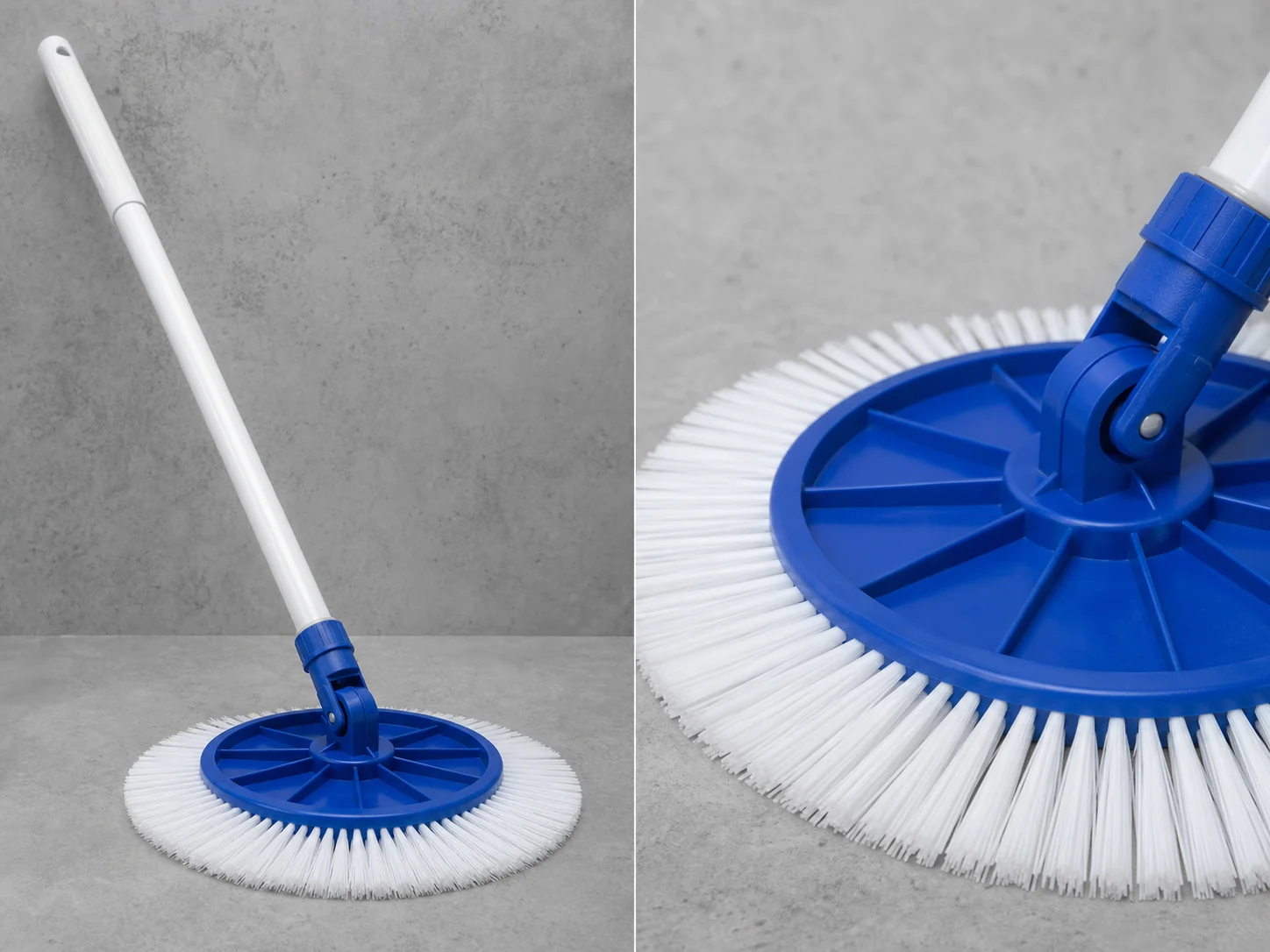
600mm polypropylene disc brush head for algae and biofilm removal on pool walls, floors, and tile lines. Quick-change coupling for standard pool poles.
Medium brush
100 pcs
Minimum order
Worked with two hands or on a pole: chimney, gutter and pond-filter brushes, discs, cups and tank brushes.
Production lead time, once the specification is confirmed
- Up to 100 pcsWithin 7 days
- 101–5,000 pcsWithin 14 days
- 5,001–50,000 pcsWithin 21 days
- Over 50,000 pcsConfirmed with your quotation
Peak season can extend these times; the shipping date is confirmed in writing with your quotation. Sampling and shipping are quoted separately.
A 600 mm polypropylene disc brush head for manual algae and biofilm removal on pool walls, floors, steps, and tile lines. The round 600 mm working face and quick-change pole coupling cover large submerged areas while keeping all wetted components chlorine- and saltwater-resistant.
What can this brush do for you?
Covers Wide Wall and Floor Areas in Fewer Passes
The 600 mm round head puts a broad band of polypropylene bristles against the surface, so each stroke removes algae and organic film across a far larger area than a standard 300 mm or 400 mm brush. On large flat pool walls and floors, operators finish routine brushing noticeably faster without increasing downforce.
All-Polypropylene Construction Handles Pool Chemistry
The bristles and backing disc are molded from polypropylene, which resists chlorine, bromine, and salt-chlorine environments. There is no exposed metal brush head to corrode, shed rust, or add dissolved metals to the pool water. The head stays serviceable after repeated submerged use.
Quick-Change Coupling Works with Existing Pool Poles
The brush head does not include a bonded handle. A quick-change coupling lets the operator snap it onto a standard telescoping pool pole, swap between brush heads without tools, and use the same pole for the 600 mm disc and other attachments. Buyers who already maintain a pole inventory avoid paying for duplicate handles.
Round Disc Follows Walls, Floors, and Radius Transitions
The circular shape with a relatively short 45 mm bristle length keeps the filaments upright enough to scrub flat surfaces, yet the disc can pivot on the pole connection to follow wall-to-floor corners, steps, and curved bowl transitions. The perimeter of the disc reaches into tile lines and surface texture where algae first attaches.
Dense PP Bristle Face Lifts Biofilm Without Metal Contact
Polypropylene filaments are stiff enough to break the slime layer and pull attached algae off plaster, pebble, concrete, and fiberglass, but they are far less aggressive than stainless steel or carbon steel wire. That makes the brush appropriate for regular preventive brushing on surfaces where wire brushes would etch or leave marks.
What is a 600mm PP Pool Cleaning Disc Brush?
A 600 mm PP pool cleaning disc brush is a large round scrub head engineered for manual pool maintenance. It is a brush head only: the operator supplies a telescopic pole, and the quick-change coupling at the center of the disc mates the head to the pole. During use, the operator pushes the disc along submerged walls and floors, overlapping strokes to shear algae, biofilm, and loose sediment from the surface. The 600 mm diameter provides surface coverage; the 45 mm polypropylene bristles provide the cleaning action.
This brush is not a wire brush and not a suction-side cleaner. It relies on the operator’s arm motion, not water flow. It is selected when routine brushing is part of the water-treatment program and when the surface cannot tolerate metal brush contact. On most residential and commercial pools, this means weekly or more frequent maintenance between automatic cleaner cycles.
The head is fully plastic. Bristles are set in a molded or drilled PP backing disc, and the coupling is plastic or plastic-bodied unless specified otherwise, which avoids galvanic corrosion and rust bleed. Because the tool is used submerged, buoyancy is moderate; the operator controls it with the pole, not by weight alone. This matters when ordering large-diameter brushes for long shifts: lighter heads reduce fatigue, but they may require a deliberate downward push compared with heavier stainless brush heads.
The brush is best understood as a maintenance tool, not a restoration tool. It clears fresh algae, slime, biofilm, pollen film, and loose sediment. It will not grind off calcified scale, deep black algae roots, or years of neglected plaster staining.
Technical Specifications
| Parameter | Standard Configuration / Options |
|---|---|
| Head diameter | 600 mm |
| Head shape | Round disc |
| Bristle material | Polypropylene (PP) |
| Bristle trim length | 45 mm; other lengths available on request |
| Backing / base material | Polypropylene (PP) |
| Included handle | None; brush head only |
| Pole connection | Quick-change coupling; standard pool pole taper, other adapters available |
| Wetted materials | PP bristle and backing; plastic coupling, no exposed metal |
| Chemical exposure | Suitable for chlorine, bromine, and salt-chlorine pool water |
| Operating mode | Manual pole-guided brushing, submerged or at waterline |
| Bristle stiffness | Medium; filament diameter and stiffness adjustable on custom orders |
| Brush type | Custom Disc Brushes |
| How it is driven | Machine-driven, mounted in the equipment |
| Cleaning target | routine algae and biofilm removal, weekly brushing of tile line and grout, and large commercial swimming pool cleaning |
| Surface or part | floors, walls, tile, pool walls, tile lines, plaster, metal, and concrete |
| Residue or debris | algae, biofilm, scale, rust, slime, sediment, organic film, and corrosion |
| Mounting / connection | Quick-change coupling; standard pool pole taper, other adapters available |
Specifications reflect the standard 600 mm PP configuration. Diameter, bristle length, filament diameter, coupling type, and backing color can be changed for project or retail programs.
Where does this brush work best?
- Routine algae and biofilm removal on in-ground concrete, plaster, pebble, and aggregate pool walls and floors.
- Weekly brushing of tile lines and grout joints to prevent green and black algae adhesion.
- Large commercial swimming pools, waterparks, and aquatic facilities with high bather load and frequent biofilm formation.
- Above-ground and vinyl-liner pools when the operator uses moderate pressure and the PP bristle stiffness suits the liner condition.
- Salt-chlorinated pools and chlorine or bromine systems where metal brush heads would corrode.
- Steps, shallow areas, and slope transitions where a broad round head can be pivoted to maintain contact.
How do I choose the right one?
Confirm the coupling and pole fit first
The brush head has no handle, so the quick-change coupling must match the pole end you currently use. Most telescoping pool poles have a standard tapered or threaded end, but there are variations. If you already have poles, send the pole make or end diameter so we can verify or supply an adapter. A head that cannot lock onto the pole is not usable even if the bristle spec is perfect.
Match PP stiffness to the pool surface and algae pressure
PP bristles in a 45 mm trim length provide medium scrubbing force. That is appropriate for fresh algae, biofilm, and organic film on plaster, concrete, pebble, tile, and fiberglass. For vinyl liners, use lighter pressure or a flagged PP filament; for rough aggregate, the same bristle works because the disc spreads force over many tufts. If the pool has mature black algae or calcified deposits, PP will not cut through it — a stainless steel wire brush or chemical treatment is needed.
Size the working face to the pool geometry
600 mm is efficient on large open walls and floor areas, but it may be oversized for narrow steps, swim-outs with tight radii, and small above-ground pools. If more than about 20% of the brushing area cannot be reached with a 600 mm face, consider pairing it with a smaller 300-400 mm brush or specifying a smaller custom diameter.
Consider operator fatigue and stroke speed
A 600 mm head adds drag when pulled through water, especially with firm bristles. Operators with shorter poles or smaller pools may find it tiring over long shifts. The all-PP construction keeps weight low, but the drag still scales with diameter. If the maintenance team brushes multiple pools per day, test one unit before committing to a fleet.
When to use a different brush
Choose a stainless steel or wire brush only when scale, mineral deposits, or rooted black algae require cutting action and the surface is hard enough to tolerate it. Do not use this PP disc as a substitute for chemical algae treatment, pressure washing, or acid cleaning on neglected surfaces. For painted or very soft gelcoat, verify bristle stiffness first; a flagged nylon alternative may be safer.
| Pool surface or condition | Suggested brush choice |
|---|---|
| Fresh algae or biofilm on plaster, concrete, pebble, tile, or fiberglass | 600mm PP Pool Cleaning Disc Brush (this brush) |
| Vinyl liner with normal algae accumulation | 600mm PP disc with moderate pressure, or flagged PP for older liner |
| Calcium scale, black algae roots, or neglected rough plaster | Stainless steel wire brush or chemical treatment, not this brush |
| Small spa, narrow steps, or tight swim-out radius | Smaller 300-400 mm brush or hand brush |
Can I customize this brush?
The 600 mm PP disc is available as a standard product, but most projects benefit from adjusting the coupling, bristle, or branding. To define a configuration, provide the pole end specification, pool surface, desired diameter, bristle length and stiffness, and packaging requirements.
- Diameter — 300, 400, 500, 600, 700 mm, or custom sizes within tooling limits.
- Bristle variables — trim length (30, 45, 60 mm), filament diameter, stiffness grade, tuft density, and tuft pattern (radial, spiral, perimeter row).
- Bristle material — PP standard; nylon, PBT, or stainless steel options where the application demands it.
- Backing — solid PP disc, drilled PP, UV-stabilized, reinforced, or custom color.
- Coupling — quick-change, threaded, snap-lock, or custom pole adapter to match buyer’s poles.
- Branding — molded logo, pad print, laser marking on the disc back or edge.
- Packaging — bulk cartons, retail header card, private-label sleeve, or project-specific packing.
- Project support — material declarations, inspection reports, and third-party testing can be arranged for buyer-specific requirements.
How long does a 600mm PP pool cleaning disc brush last, and how is it cleaned between runs?
Does the 600mm PP pool cleaning disc brush include a handle?
No. It is a brush head engineered for a standard telescopic pool pole with a quick-change coupling. If you need a matching pole or adapter, include your pole model in the request; the coupling can be matched.
Can I use this brush on a vinyl liner pool?
Yes, with a caveat. PP is softer than steel and many nylon filaments, so it is commonly used on vinyl. Use overlapping strokes without heavy downward force, and inspect an inconspicuous area first if the liner is older or embossed. For extra protection, we can supply flagged PP tips or a softer filament grade.
How do I know when the brush head needs replacement?
Look at the bristle face under light. If the bristles are folded over, shorter than 20-25 mm at the working face, or the disc no longer rebounds when you press the tufts to the side, the head has lost its effectiveness. Also check the coupling for cracks or oval wear. A worn brush will leave algae film behind even with correct strokes.
Will this brush remove calcium scale or black algae?
No. PP bristles are designed for algae, biofilm, and organic film. Calcium scale and black algae roots require a stainless steel wire brush, pumice stone on appropriate surfaces, or chemical treatment followed by brushing. Using this disc for those jobs will round the bristles without removing the deposit.
Is the brush okay to leave in a chlorinated or saltwater pool?
The PP bristle and backing are resistant to pool chemistry, and the plastic coupling avoids metal corrosion. Still, rinse the head with fresh water after heavy salt or chemical use and store it out of direct sunlight. This extends coupling life and keeps the bristles from taking a set.
What kind of stroke pattern works best with a 600mm disc?
Use long overlapping strokes along the wall, then finish with a horizontal pass at the waterline and a separate pass along corners and tile lines. Let the bristles do the work; pressing hard bends them and reduces the contact area. Rotate the pole occasionally to prevent the operator from always sweeping with the same side of the disc.
Guides that go deeper on this
Custom Manufacturing RFQ
Describe Your Application
Please share the brush dimensions, working area, residue type, material direction, quantity, and a drawing or photo for quotation.
Drawing or photo optional — it speeds things up, it does not gate the enquiry.
Custom Brush RFQ
Send Your Brush Project
Upload a drawing, product photo, or sample photo and provide the core dimensions and cleaning conditions.
“We need a brush to remove wet residue from a stainless steel conveyor, about 800mm wide. The current brush wears quickly. We can send photos.”
“We sell drinkware and need a cleaning brush to include with the product. Quantity around 5,000 pieces.”