
Custom Cleaning Brush
Disc Brush PCB
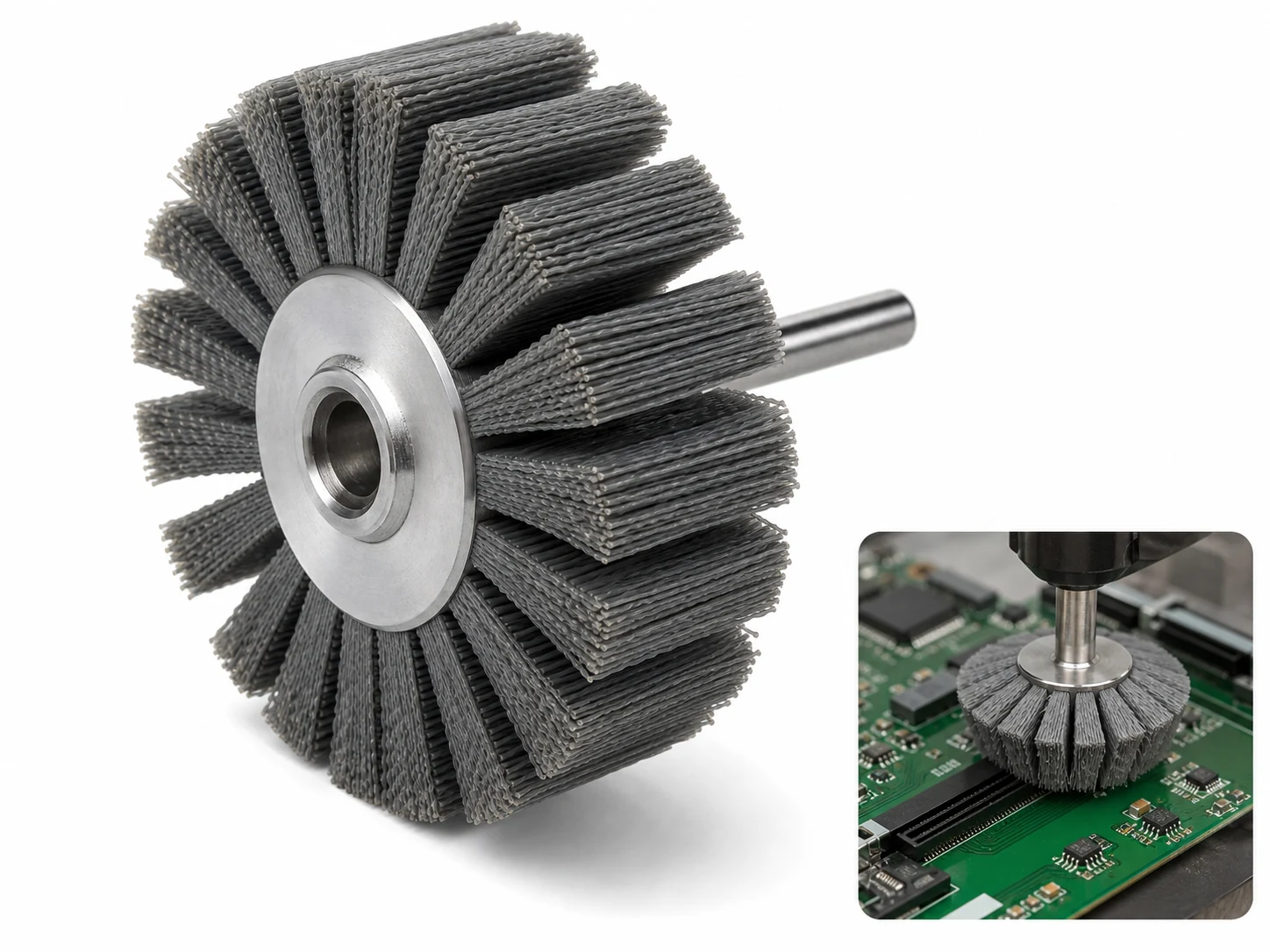
Shaft-mounted nylon disc brush for PCB cleaning: removes drilling dust, fiber, light oxide and loose flux residue without scratching boards.
Medium brush
100 pcs
Minimum order
Worked with two hands or on a pole: chimney, gutter and pond-filter brushes, discs, cups and tank brushes.
Production lead time, once the specification is confirmed
- Up to 100 pcsWithin 7 days
- 101–5,000 pcsWithin 14 days
- 5,001–50,000 pcsWithin 21 days
- Over 50,000 pcsConfirmed with your quotation
Peak season can extend these times; the shipping date is confirmed in writing with your quotation. Sampling and shipping are quoted separately.
A shaft-mounted nylon disc brush for inline PCB surface preparation and static-control cleaning. It uses controlled filament-tip contact to lift drilling dust, fiber, light oxide and loose flux residue from board surfaces, edge connectors and plated holes without scratching the finish, and is configurable in diameter, bore, fill density and filament grade to match your cleaning machine.
What can this brush do for you?
Lifts fine particles from board surfaces and edges without cutting into thin traces
Nylon filament tips flex under contact and sweep rather than scrape. The 0.05–0.50 mm filament range lets you match tip density to the feature size: fine filaments reach dust between closely spaced pads and around small components, while larger diameters add stiffness for heavier dry debris. The standard non-abrasive PA fill does not remove copper, solder mask or plated finish under normal line pressure.
Covers the board width in one pass with stackable disc sections
Each disc carries a controlled band of filament tips. By spacing multiple discs on the same shaft, you build a continuous cleaning face across the full board width without dead lanes. If one section wears faster due to board edge or conveyor position, that disc can be replaced independently instead of replacing an entire roller.
Mounts directly onto existing brushing-machine shafts
The center bore, keyway or hub is machined to your machine shaft, so the disc stack seats concentrically and runs at line speed without hub slip or wobble. Core thickness and bore tolerance are set to the shaft diameter and stack pitch of your equipment.
Uses non-abrasive contact as the default
The standard disc is built with plain nylon PA filament. Abrasive nylon is only offered where a defined finishing duty requires controlled micro-abrasion, such as removing light oxide or preparing copper foil before lamination. This prevents process drift where board finish must stay unchanged.
Works with static-control and extraction systems
Fine dust on PCBs is often static-attracted. The open disc structure lets extraction airflow pull loosened particles away from the working face, and the filament can be supplied with static-dissipative or conductive additives where the line requires active ESD control. The disc itself is not a substitute for an ionizer or grounding path, but it can be integrated into an existing static-control setup.
What is a Disc Brush PCB?
A Disc Brush PCB is a rotating circular brush used inside PCB cleaning and surface-preparation machines. It consists of a central plastic or metal core with nylon filaments anchored around the outer circumference or on one face, and it mounts onto a driven shaft by a center bore, hub or machine-specific plate. As the board travels through the line, the rotating filament tips contact the surface and lift loose contamination from the working face.
It is not a hand brush and not a heavy deburring wheel. The cleaning result depends on three machine-side variables: rotation speed, filament-to-board interference, and board travel speed. Together they set how much tip pressure the board sees and how long each point remains in contact. A disc brush is generally selected over a continuous roller brush when the machine uses modular disc stacks, when width must be adjusted by adding or removing discs, or when individual sections need easier replacement.
The standard fill for this product is nylon PA. The filament diameter, trim length, density and crimp are then matched to the contaminant and the board finish. Abrasive nylon and other polymer fills can be selected where the process specification calls for them.
Technical Specifications
The table shows the standard working range. Disc diameter, core thickness, bore/hub and visible filament length are machine-specific, so the final drawing is confirmed against your shaft and line layout.
| Parameter | Value / Options |
|---|---|
| Disc outer diameter | 50–300 mm, set to board width and brush-roll layout |
| Bore / hub inner diameter | 10–50 mm; plain bore, keyway, set screw or hub as specified |
| Core thickness | Project-specific; matched to shaft step and disc-to-disc pitch |
| Trim length (visible filament) | 10–50 mm |
| Filament diameter | 0.05–0.50 mm, selected by particle size and surface finish |
| Filament material | Non-abrasive nylon PA; abrasive nylon or alternative polymer on request |
| Fill pattern | Straight set, wavy, crimped or custom density for contact uniformity |
| Contact mode | Controlled filament-tip contact; abrasive grade only where a defined finishing duty requires it |
| Operating use | Dry or lightly damp PCB cleaning lines; filament grade selected for detergent or solvent type |
| Balance | Statically or dynamically balanced to the specified running speed and stack configuration |
| Brush type | Custom Disc Brushes |
| How it is driven | Machine-driven, mounted in the equipment |
| Cleaning target | post-drilling and routing, pre-lamination surface preparation, and pre-solder mask and legend cleaning |
| Surface or part | boards, bores, edges, connectors, holes, hubs, panels, and pcb surfaces |
| Residue or debris | dust, oxide, particles, fiber, flux, haze, flux residue, and loose particles |
| Mounting / connection | 10–50 mm; plain bore, keyway, set screw or hub as specified |
When specifying the brush, provide shaft diameter, keyway or hub drawing, board width, board thickness, line speed, contaminant description and any chemical exposure. These inputs determine the final filament density and interference recommendation.
Where does this brush work best?
- Post-drilling and routing cleaning: removes epoxy/glass-fiber dust, drill swarf and loose particles from board surface and hole exits before desmear, plating or lamination.
- Pre-lamination surface preparation: light brushing of copper-clad laminate and prepreg surfaces to remove dust and light oxide before dry-film or resist application.
- Pre-solder mask and legend cleaning: conditions the surface so coatings bond without leaving filament marks or haze.
- Carrier and film cleaning: removes lint and static-attracted particles from PCB carriers, conveyors, transport films and panel handling surfaces in cleanroom lines.
- Edge connector and gold finger contact areas: removes dust and light surface contamination with non-abrasive filament; avoid abrasive fill on plated contact areas unless the process explicitly requires it.
- Wet-line first-stage cleaning: works ahead of spray/ultrasonic modules to reduce particulate load and minimize recontamination in rinsing tanks.
How do I choose the right one?
Start from the machine interface, not from the disc diameter alone. The bore or hub has to match the shaft, and the core thickness has to fit the existing stack pitch. Confirm the keyway or set-screw position as well; a disc that seats slightly off-center will vibrate, wear unevenly and leave cleaning gaps.
Set the disc diameter and stack width from the board path. The brushing face must cover the full board width with a small overlap between discs. For wide panels, multiple discs are placed side by side. For boards with selective areas to avoid, the stack may be arranged so only certain zones receive tip contact.
Match the filament to the surface and contaminant. Use standard non-abrasive nylon PA for dust, fiber and light loose residue on solder mask, plated features and laminate surfaces. Choose finer filament diameters for very fine line/space boards and exposed thin films; choose larger diameters or stiffer grades for heavier dry debris. Choose abrasive nylon only when the process has a defined finishing requirement, such as micro-roughening copper before lamination or removing a specific light oxide layer. Abrasive grades used without a defined duty will remove surface material unnecessarily and can create haze or thickness loss on plated finishes.
Balance trim length and density against line speed. Longer trim bends more under the same interference and applies gentler pressure; shorter trim is stiffer and more aggressive. Dense fill gives fuller surface coverage but can retain more moisture in wet lines; lower density releases particles more easily into extraction airflow. The correct combination is a function of line speed, board thickness and the residue you need to remove.
Consider wet or chemical exposure before choosing the filament grade. Nylon PA absorbs moisture and its stiffness changes between dry and saturated conditions. If the brush runs in a wet process or contacts saponifier or solvent, specify the intended chemistry so the material grade and hub construction are selected accordingly. Conditioning the brushes in the process fluid before final process setup prevents setpoint drift.
When a different tool may be better: If the task is to remove burrs from drilled holes or mechanical stock from board edges, a dedicated abrasive deburring wheel or brush with positive interference is more appropriate. If the residue is cured solder paste, heavy baked flux or ionic contamination, a disc brush alone will not remove it; combine it with cleaning chemistry, ultrasonic or spray cleaning and rinse. For very narrow recesses or connectors below the reach of the filament tips, a small-diameter brush or swab may be needed in a separate operation.
Can I customize this brush?
Yes. The disc is built around your machine dimensions and process conditions. We need the shaft diameter, keyway or hub details, disc-to-disc spacing, board width, board thickness, line speed, contaminant type and any wet chemistry. A drawing or a worn sample brush is the fastest way to match the original interface.
Typical adjustable parameters:
- Disc diameter and core thickness — matched to the shaft layout and available machine envelope.
- Bore, keyway, hub or plate interface — plain bore, set screw, keyed bore, split hub or machine-specific mounting plate.
- Trim length and filament diameter — set from required tip pressure and reach.
- Filament material and grade — nylon PA grades, static-dissipative or conductive additives, abrasive nylon, or another polymer when chemistry demands it.
- Fill pattern and density — straight, wavy, crimped or custom set for more or less aggressive contact.
- Color and marking — color coding by duty or line, hub marking, laser marking or identification labels for maintenance tracking.
- Packaging — bulk, stack sets, individual cartons, or ESD-safe packaging when the brush is used in static-sensitive areas.
If your project requires material documentation, inspection reports or third-party testing support, we can assist with those project-specific requirements during the configuration process.
How do you confirm a disc brush PCB has actually cleaned the surface?
How do I check whether the bristle length is still adequate for my process?
Measure the remaining trim length at several points around the disc and compare it with the as-built drawing. If the filament is visibly shorter, curled, matted or has lost tip density, the contact face no longer matches the original setup. Uneven wear shows up as streaks or dull bands on the board surface. Replace discs before trim length falls below the minimum contact overlap specified for your line.
Can a disc brush remove flux residue by itself?
No. Dry brushing removes loose particles and some light film, but it does not remove ionic flux residue or baked-on contamination. Use it as the mechanical preconditioning stage before spray, ultrasonic or immersion cleaning, and keep the chemistry, rinsing and drying stages in place. Verify ionic cleanliness with the normal resistivity or contamination test for your process.
What should I check before installing a new disc stack?
Inspect the shaft for burrs, rust or damaged keyways. Confirm that every disc slides onto the shaft without forcing and that the stack spacing is equal to the original layout. Run the shaft at low speed first to check for wobble or vibration, then bring it to process speed. A disc that does not seat concentrically will produce uneven contact and may wear out quickly.
Will the brush scratch bare copper or plated pads?
The standard non-abrasive nylon PA fill is intended for gentle filament-tip cleaning and will not scratch surfaces under normal line pressure and interference. Damage can still occur from excessive interference, high shaft speed, worn bearings, or incorrect abrasive fill. Start with the lowest interference that gives the required cleaning result and verify the finish under magnification before running full production.
Can this brush be used in a wet cleaning line?
Yes, if the filament grade, core material and hub are specified for that chemistry. Nylon PA absorbs water and changes stiffness when saturated, so wet lines require a different setup than dry lines. If the process uses aggressive solvents or strong acids, confirm compatibility before selection; an alternative polymer filament may be needed.
How do I prevent static buildup while the brush is running?
High-speed dry brushing can generate static charges on both the board and the brush. For ESD-sensitive products, specify static-dissipative or conductive filament additives, provide a grounding path on the shaft or hub, and run ionizing bars near the brushing area. Extraction airflow should be set so loosened particles are removed without being redistributed onto the board.
Guides that go deeper on this
Custom Manufacturing RFQ
Describe Your Application
For a custom quote, we need the key dimensions, surface or part, residue, material preference, quantity, and reference image or drawing.
Drawing or photo optional — it speeds things up, it does not gate the enquiry.
Custom Brush RFQ
Send Your Brush Project
Upload a drawing, product photo, or sample photo and provide the core dimensions and cleaning conditions.
“We need a brush to remove wet residue from a stainless steel conveyor, about 800mm wide. The current brush wears quickly. We can send photos.”
“We sell drinkware and need a cleaning brush to include with the product. Quantity around 5,000 pieces.”