
Custom Cleaning Brush
Diamond Disc Brush
Diamond-impregnated filament disc brush for deburring, edge blending, and surface finishing on machined faces, profiles, and recesses.
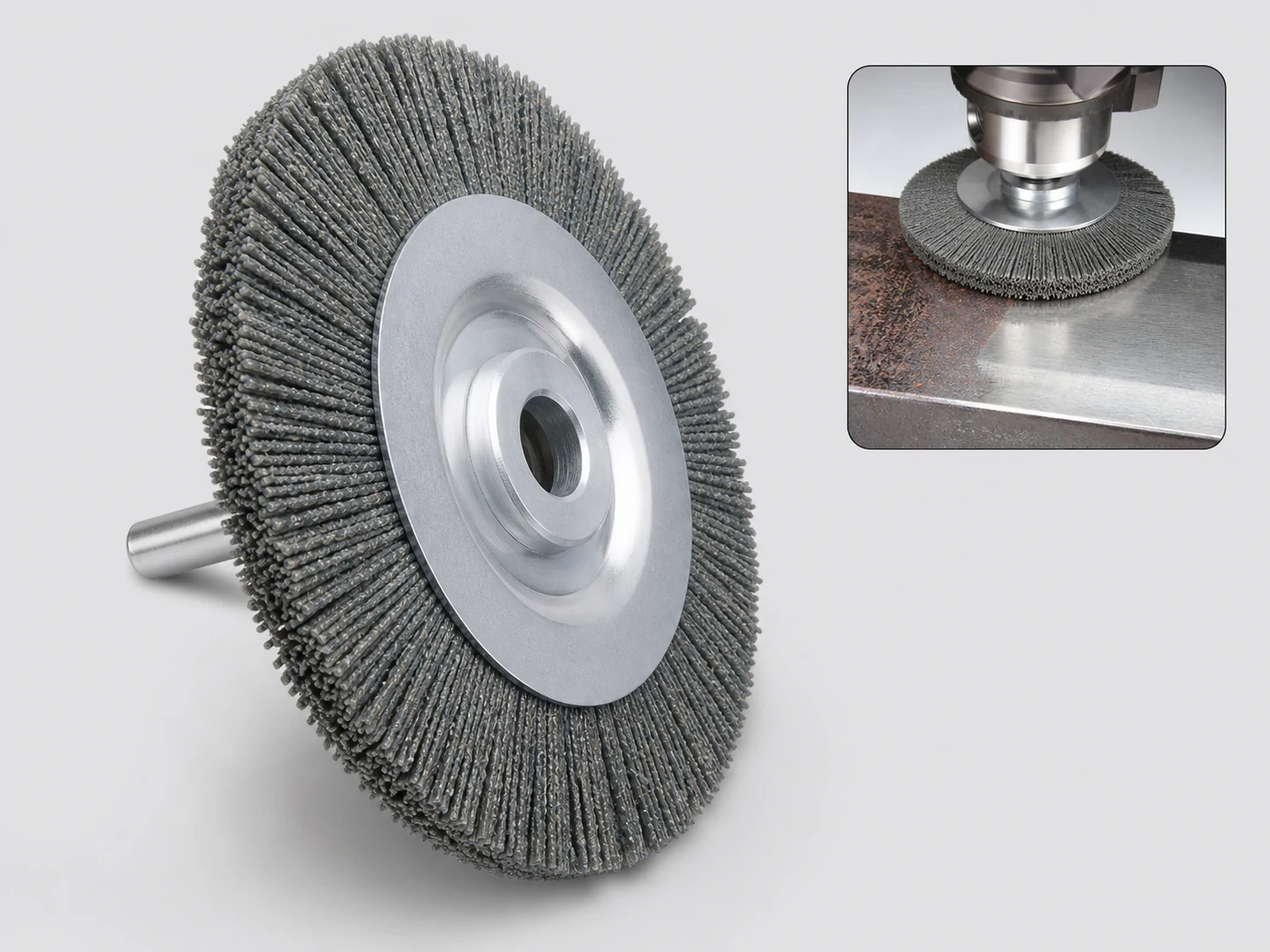
Medium brush
100 pcs
Minimum order
Worked with two hands or on a pole: chimney, gutter and pond-filter brushes, discs, cups and tank brushes.
Production lead time, once the specification is confirmed
- Up to 100 pcsWithin 7 days
- 101–5,000 pcsWithin 14 days
- 5,001–50,000 pcsWithin 21 days
- Over 50,000 pcsConfirmed with your quotation
Peak season can extend these times; the shipping date is confirmed in writing with your quotation. Sampling and shipping are quoted separately.
A Diamond Disc Brush pairs a rotary disc backing with diamond-impregnated abrasive nylon filaments that deburr, clean, and finish machined faces, edges, recesses, and profiles. It removes burrs, oxide, oil film, polishing compound, scale, and loose particles while letting the filament flex so the base part geometry stays intact.
What can this brush do for you?
Removes burrs without changing the part profile
The diamond abrasive is carried inside flexible nylon filaments rather than on a rigid bonded face. When the filament contacts a burr, it cuts the burr at the root and then deflects instead of digging into the surrounding material. That is the difference between a controlled edge break and an unintended chamfer on machined edges, cross-hole intersections, gear teeth, and thread starts.
Follows fillets, root radii, and recessed features
Because each filament bends, the brush face wraps into fillet roots, keyway bottoms, profile grooves, and the transition where two machined planes meet. A solid abrasive wheel only touches the highest point; this brush keeps abrasive contact across the entire local surface, so those zones do not end up in the hand-deburring queue.
Holds its cut rate as the brush wears
The diamond particles are distributed through the filament, not just coated on the surface. As the nylon trims back during use, new sharp diamond is continuously exposed at the working end. The brush keeps a more consistent cut from the first part to the last, which reduces piece-to-piece finish drift in production lots.
Cuts cleanly on both hard and soft metals
Diamond does not rely on the workpiece being soft. It deburrs hardened steel, stainless, titanium, and carbide as well as aluminum, copper, and brass. On aluminum, the cutting action tends to slice the burr and shed the chip instead of loading the filament the way some conventional abrasives do, which matters when one cell runs mixed materials.
Combines deburring with surface conditioning
With the right grit and filament stiffness, one pass can remove the burr and leave a surface ready for coating, plating, anodizing, or assembly. Light oil film, polishing compound, and oxidation lift away during the same operation, so the part can move to the next step without a separate cleaning station.
What is a Diamond Disc Brush?
A Diamond Disc Brush is a rotary finishing tool built on a disc-shaped backing hub. Diamond-impregnated abrasive nylon filaments are anchored across the face or around the perimeter and rotate against the workpiece on a spindle, flexible shaft, or dedicated rotary finishing machine. The tool is not a metal wire brush and not a solid resin-bond abrasive wheel; the working medium is a polymer filament loaded with diamond abrasive.
In use, the operator or machine presents the rotating brush to the part. The filaments strike the edge or face, cut or lift the target residue, and flex around contours as they pass. Typical targets are burrs produced by milling, turning, drilling, or stamping; light scale and oxide; oil film; polishing compound; and loose particles that remain on flat faces, edges, recesses, and circular work zones.
The disc is a finishing and conditioning tool. It is not meant to replace a bonded or electroplated wheel for heavy stock removal, and it will not grind a new geometry into a part. Its value is in the controlled removal of burrs and surface films while leaving the machined profile intact. Operating speed, feed force, and coolant choice affect how quickly the filament cuts and how long the disc lasts, so those parameters should be validated on the actual part rather than carried over from another abrasive process.
Technical Specifications
Dimensions, filament grade, grit, and mounting are configured to the machine spindle and the part. The table below lists the parameters we ask about before building a Diamond Disc Brush.
| Parameter | Value / Options |
|---|---|
| Disc outside diameter | 50–300 mm, selected to reach the work zone and suit the machine |
| Active face width / trim length | Project-specified; adjusted to the required contact band on the part |
| Base / hub thickness | Matched to backing material, diameter, and speed class |
| Bore / arbor | 6, 10, 12, 14, 16, 22, or 25.4 mm; plain bore, keyway, threaded insert, or flanged hub to match the spindle |
| Filament material | Nylon PA 6, PA 6/6, or PA 612 loaded with synthetic diamond abrasive |
| Filament diameter | 0.2–2.5 mm; thicker for stiffer cut, thinner for conformability |
| Abrasive grit | 36#–1000#; coarse for burr removal, fine for pre-polish and cleanup |
| Filament layout | Radial pattern, disc face pattern, twisted tufts, or custom density; trim can be flat, angled, or stepped |
| Maximum operating speed | 1,000–3,000 RPM, size dependent; the speed marked on the hub must not be exceeded |
| Backing plate / hub material | Steel, aluminum, or glass-filled polymer, chosen for weight, corrosion resistance, and RPM |
| Operating environment | Dry or with water-soluble coolant; nylon grade is selected for the actual chemical exposure |
| Brush type | Custom Disc Brushes |
| How it is driven | Machine-driven, mounted in the equipment |
| Cleaning target | cnc-machined component, threaded part, and fixture maintenance cleaning |
| Surface or part | edges, profiles, recesses, aluminum, hubs, composite, gears, and instruments |
| Residue or debris | burrs, polishing compound, oxide, scale, oil film, particles, light scale, and loose particles |
| Mounting / connection | 6, 10, 12, 14, 16, 22, or 25.4 mm; plain bore, keyway, threaded insert, or flanged hub to match the spindle |
If your machine runs a non-standard arbor or the part requires a specific contact band, provide the spindle drawing or a sample hub so the interface can be built to fit.
Where does this brush work best?
- CNC-machined components — cross-drilled holes, milled pockets, turned shoulders, and edge breaks on aluminum, steel, and stainless before anodizing, plating, or assembly.
- Gears, splines, and threaded parts — flexible filaments remove tooth-flank fuzz and thread-start burrs without flattening the profile.
- Die-cast, MIM, and sintered parts — parting-line flash, light scale, and surface film come off without deforming thin walls or wiping out rounded features.
- Mold, tool, and fixture maintenance — oily films, polishing compound, and light oxide are removed from cavity faces, clamping areas, machine tables, and rotary indexers.
- Precision instrument and medical device components — fine grit leaves a burr-free edge and a clean surface on stainless instrument parts before further finishing.
- Composite and glass-fiber reinforced parts — edge fuzz and fiber splinters are trimmed without chipping the laminate.
How do I choose the right one?
Start with the spindle and the work zone, not with the burr alone. Measure the arbor or thread, list the machine speed, and check the disc diameter you can physically swing. The disc must fit the work area and the guard while still reaching the target edge or face. The maximum RPM printed on the hub must be higher than the planned running speed.
Then match the grit to the burr size and the required surface finish.
| Grit range | Typical job | Result on machined parts |
|---|---|---|
| 36#–120# | Visible machining burrs, light scale, heavier oxide | Fast cut with a coarser surface; may need a follow-up pass |
| 180#–320# | General deburring and edge blending | Burr-free edges with a fine satin finish ready for coating or assembly |
| 400#–1000# | Pre-polish, polishing compound removal, light surface conditioning | Very fine finish; does not remove heavy burrs |
Filament stiffness is the conformability control. Thicker filaments from about 1.5 to 2.5 mm stay straighter and cut more aggressively on flat faces and shallow recesses. Thinner filaments from about 0.2 to 0.8 mm wrap into fillets, root radii, and internal corners but remove less material per pass. A longer trim length flexes more and follows contours; a shorter trim length is stiffer and keeps the contact band tighter. Choose the stiffest filament that still reaches every feature on the part, because added stiffness usually means more cut per pass.
Consider whether the operation runs wet or dry. Coolant washes the debris away and keeps the part and filament cooler, but it also softens some nylon grades slightly. If the brush will run under flood coolant, tell us the coolant chemistry so the filament material can be matched. In dry operations, dust extraction and workpiece temperature need to be watched.
Use a different tool when the job is outside this brush’s range. A bonded or electroplated diamond wheel is the right choice when you need to remove a heavy continuous burr ridge or change geometry. A wire disc brush or knotted wire wheel works faster for loose rust, thick paint, and spatter when scratch depth is not critical. A non-woven surface conditioning disc is enough when the only goal is a decorative satin appearance with no burr. The Diamond Disc Brush is the right fit when you need flexible, edged contact that removes a burr and conditions the surface in the same operation.
Can I customize this brush?
Yes. The disc is built around your spindle, part geometry, and finish requirement. The most useful inputs are a part drawing or sample part, the machine type and arbor details, the running speed, the material being processed, the burr location and size, and the required final edge or surface condition.
We can adjust:
- Disc geometry — outside diameter, active face width, overall height, hub step, and back plate profile
- Filament — nylon grade, diameter, cross-section, diamond type and concentration, single or mixed grit, trim length, and trim shape
- Filament pattern — radial density, tuft arrangement, face layout, or a custom pattern for uneven part features
- Mounting interface — bore diameter, keyway, threaded insert, quick-change flange, or bolt circle to match existing tool holders
- Backing plate — steel, aluminum, or composite material, thickness, corrosion protection, and balancing level
- Color and identification — filament color coding, hub marking, batch number, or customer part number
- Packaging — bulk, individual sleeve, labeled case, or project-specific export packing
If your project requires material documentation, outgoing inspection reports, third-party testing, or import/export compliance support, those requirements can be handled as part of the project specification.
How do you tell when a diamond disc brush is worn out?
How can I tell whether the brush is cutting or just burnishing?
Run a thumbnail or a probe along the edge after the pass. If the burr root is still attached but the surface looks polished, the grit may be too fine, the feed force too light, or the speed too low. A distinct edge break with a clean, lightly textured surface means the brush is cutting. If the part heats noticeably and the filaments glaze or melt, reduce speed or pressure first.
Will the disc wear unevenly on a shaped part?
It can if the same zone stays in the same corner or edge. Rotate the part orientation between lots, alternate feed direction, or index the brush periodically so the filament consumption spreads across the face. Severe local shortening of the trim is a process problem, not a normal wear pattern.
Can I use the brush on plastic or composite components?
Yes, but select a fine grit and start at the low end of the speed range. Plastics can soften from frictional heat, and glass-fiber composites need enough abrasive cut to trim fibers rather than push them over. Validate the speed and dwell time on a representative scrap part before committing the production run.
What is the difference between a diamond disc brush and a diamond grinding wheel?
A diamond wheel is rigid and changes the part geometry to shape it. The disc brush removes burrs, fuzz, films, and light scale while the flexible filaments conform to the existing profile. If a part needs stock removal, grind first; use the brush for the final edge and surface condition.
What should I check during routine inspection between shifts?
Inspect the hub for cracks, distortion, or worn bore/key surfaces. Check that the filament trim length is reasonably even and that no melted or glazed patches appear. Look for workpiece fragments embedded in the filament and remove them. If the brush vibrates, stops cutting at the same settings, or shows a visibly reduced working diameter, replace it before it affects part quality.
Guides that go deeper on this
When to Customize Diamond Disc Brush
Read this guideGuideFloor Scrubber Brush Selection: Disc Brush vs Roller Brush
Read this guideGuidePCB Cleaning and Deburring: Which Disc Brushes Avoid Damage?
Read this guideGuideWhen to Customize Combined Sanding Disc Brush
Read this guideGuideWhich Disc Brushes Belong on Glass Processing Lines?
Read this guideCustom Manufacturing RFQ
Describe Your Application
For an accurate quotation, please provide the main dimensions, material preference, working surface, residue, quantity, and a drawing or photo.
Drawing or photo optional — it speeds things up, it does not gate the enquiry.
Custom Brush RFQ
Send Your Brush Project
Upload a drawing, product photo, or sample photo and provide the core dimensions and cleaning conditions.
“We need a brush to remove wet residue from a stainless steel conveyor, about 800mm wide. The current brush wears quickly. We can send photos.”
“We sell drinkware and need a cleaning brush to include with the product. Quantity around 5,000 pieces.”