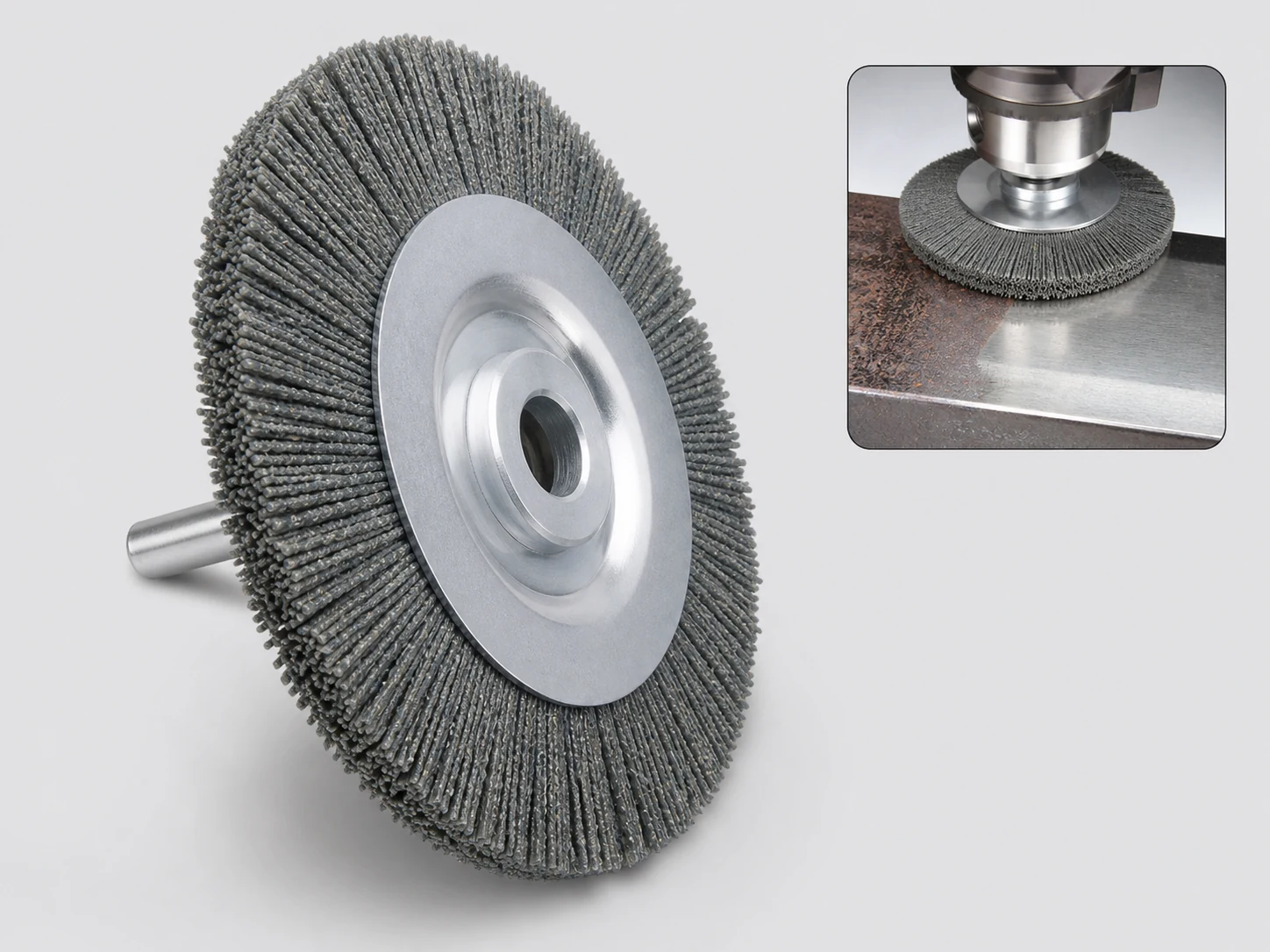
What Is a Diamond Disc Brush?
A diamond disc brush consists of flexible filaments or bristles impregnated with diamond abrasive, mounted radially or in a disc format around a central hub. It is used in automated or manual processes to achieve consistent surface finishes without smearing or loading. Unlike traditional bonded abrasive wheels, the flexible bristles conform to part geometry, making the tool suitable for irregular shapes, holes, and edges.
Common Types and Standard Options
For the safety point in this section, the relevant OSHA reference is OSHA — 1910.242 Hand and Portable Powered Tools.
For the safety point in this section, the relevant OSHA reference is OSHA — 1910.215 Abrasive Wheel Machinery.
For the safety point in this section, the relevant OSHA reference is OSHA — Personal Protective Equipment.
For brush terminology and construction language, this section references ABMA — ANSI B165.1 Power Brush Safety Slips.
For brush terminology and construction language, this section references American Brush Manufacturers Association — Brush Lingo.
Most manufacturers offer diamond disc brushes in a few standard configurations. The most common variations include:
- Bristle pattern: radial (flat disc), cup, or wheel designs. Each pattern affects contact area and access to recessed features.
- Diamond grit size: typically available from coarse (60-80 grit) for aggressive stock removal to fine (400-600 grit) for finishing.
- Filament diameter and length: standard ranges balance flexibility and cutting action.
- Disc outer diameter and arbor hole: catalog sizes fit common machine spindles.
Standard products cover a wide range of general-purpose applications, but when your process demands exacting tolerances, unusual dimensions, or unique material combinations, customization becomes a practical step.
When a Standard Diamond Disc Brush Is Enough
Off-the-shelf diamond disc brushes work well when these conditions are met:
- Your part geometry is open and allows the standard brush diameter and bristle length to reach all critical surfaces.
- The material being processed (e.g., hardened steel, carbide) falls within the brush manufacturer’s typical recommendation.
- Desired surface finish (Ra) is achievable with standard grit options.
- Cycle time and machine parameters align with catalog speed and feed recommendations.
- Order quantity is small to medium, and production schedule allows for stock availability.
If you can answer “yes” to most of these, a standard brush will likely save time and cost. The key is to verify by testing a sample if possible.
Customization Decision Factors: What Buyers Should Prepare
When a standard diamond disc brush falls short, a custom order becomes necessary. To receive an accurate quote and a functional part, prepare the following information for your inquiry:
- Brush type and configuration: specify disc, cup, or wheel style, and if a sample or drawing is available.
- Dimensional drawing or sample: provide outer diameter, thickness, arbor size, bristle length, and any special profile. A physical sample or CAD file reduces miscommunication.
- Bristle material and diamond grit: confirm the filament base (nylon, polyester, etc.), diamond type (synthetic, coated), and grit size. This directly affects cutting life and finish quality.
- Core or holder material: aluminum, steel, plastic, or composite. This choice influences rigidity, weight, and cost.
- Mounting interface: keyway, set-screw, or flange mount; note any machine-specific requirements.
- Quantity and annual volume: prototype quantities differ from production volumes, and pricing depends heavily on batch size.
- Application details: material to be processed, desired surface finish (Ra or Rz), maximum burr size, machine type (CNC, robotic, manual), coolant or dry conditions, and cycle time target.
- Operating environment: temperature extremes, chemical exposure, or cleanroom requirements may dictate binder and filament materials.
- Packaging and documentation needs: special labeling, certificates of conformance, or individual packaging for automated handling lines.
Providing a complete specification packet speeds up the technical review and helps avoid iterative back-and-forth that delays delivery.
Comparing Custom vs. Standard Diamond Disc Brushes
| Factor | Standard Brush | Custom Brush |
|---|---|---|
| Fit to Application | General-purpose; may require process compromise | Engineered to exact part geometry and finish goal |
| Performance Consistency | Good for common materials and shapes | Optimized filament pattern, grit, and density reduce variation |
| production schedule | Often in stock or short delivery (days to 2 weeks) | Typically weeks to months, depending on tooling and testing |
| Cost per Unit | Lower, due to mass production | Higher initial cost; may decrease with volume |
| project quantity requirement | Low or no minimum | Often subject to a minimum that covers setup and materials |
| Sample Confirmation | Purchase a trial quantity | Requires prototyping and approval cycles |
| Risk | Low—product is proven for generic use | Requires close collaboration; unclear specs can lead to a non-functional brush |
Common Mistakes in RFQs and Custom Orders
Even experienced engineers can overlook details that derail a custom diamond disc brush order. Avoid these frequent pitfalls:
- Skipping a dimensional drawing or sample: Written descriptions alone are open to interpretation. Always provide a visual reference.
- Ignoring machine interface details: An arbor size or mounting style that works on one machine may not work on another. Confirm shaft diameter, keyway, and torque requirements.
- Specifying grit size without proving performance: The “same” grit number can behave differently across manufacturers. Run a test piece if possible.
- Not defining the full operating envelope: Dry vs. wet, continuous vs. intermittent use, and pressure settings all influence filament bonding and wear.
- Overlooking packaging and labeling: Automated lines may reject parts without barcodes or specific tray orientation.
- Assuming custom means better: A custom brush is useless if the underlying process parameters (speed, feed, coolant) are not controlled.
When Customization Is Not Enough: Limits and Expert Review
Even a perfectly specified custom diamond disc brush has boundaries. If any of the following apply, a different approach—or an expert review—may be necessary:
- You require ultra-fine finishes (below Ra 0.1 µm) that need lapping or superfinishing equipment rather than a brush.
- The part material is exotic or brittle (e.g., certain ceramics or single-crystal alloys) where uncontrolled cutting forces could cause sub-surface damage. Consult a tribology or manufacturing engineer.
- Production volumes are extremely high and you cannot tolerate any brush changeover downtime. In such cases, an automated brush-changing system or alternative finishing method may be more economical.
- Health, safety, or regulatory constraints (e.g., FDA, aerospace) demand certifications and traceability that a small custom run cannot provide without a full qualification program.
In these situations, the cost and risk of a custom brush may outweigh the benefits. Engage a technical team or supplier early to map out a feasible process solution.
Final Takeaway
Standard diamond disc brushes solve a large portion of deburring and finishing tasks with speed and low cost. Customization becomes the right path when geometry, finish, or productivity requirements clearly exceed the capabilities of off-the-shelf products. The difference between a successful custom brush and a wasted order lies in the detail and completeness of your inquiry. Provide a drawing or sample, define the full operating context, and work with a supplier who asks technical questions, not just order numbers.
Frequently Asked Questions
What is the difference between an abrasive disc brush and a diamond disc brush?
A diamond disc brush uses diamond particles embedded in the filaments, making it harder and longer-lasting when working on tough materials like carbide, hardened steel, or glass. An abrasive disc brush might use silicon carbide or aluminum oxide, which are better suited for softer metals or general-purpose use.
How do I know what grit size to request?
Start with the surface finish requirement (Ra) of the part. Coarse grits (60–120) remove material faster but leave a rougher surface; fine grits (320–600) produce smoother finishes. If you are unsure, request sample brushes with two or three grits and test them on actual parts.
Can I get a custom disc brush without a drawing?
Possibly, but it increases the risk of an incorrect product. Many manufacturers can reverse-engineer a sample brush or work from a sketch with key dimensions, but a mechanical drawing with tolerances is the safest route.
Does a custom diamond disc brush always cost more than a standard one?
Unit cost for a custom brush is usually higher due to tooling, small batch production, and engineering time. However, if a custom brush reduces cycle time or extends life significantly, the overall process cost may be lower.
What is the smallest quantity I can order for a custom brush?
project quantity requirement quantities depend on the complexity and the manufacturer’s setup process. Prototype quantities (as low as a project-specific quantity) are often possible, but the per-piece cost will be higher than a production run. Always ask for a prototype option before committing to a full order.
How long does it take to develop a custom diamond disc brush?
Typical development can range from a few weeks for simple modifications to a few months if new tooling or extensive testing is required. Clear communication and complete specifications help shorten the timeline.
What should I do if the custom brush does not perform as expected?
First, verify that your machine parameters match the recommended speed, feed, and coolant conditions. If the problem persists, work with the supplier to analyze wear patterns, finish quality, and any dimensional deviations. A well-documented testing process will help pinpoint whether the issue is with the brush design or the application.