What Is a PVC Disc Brush?
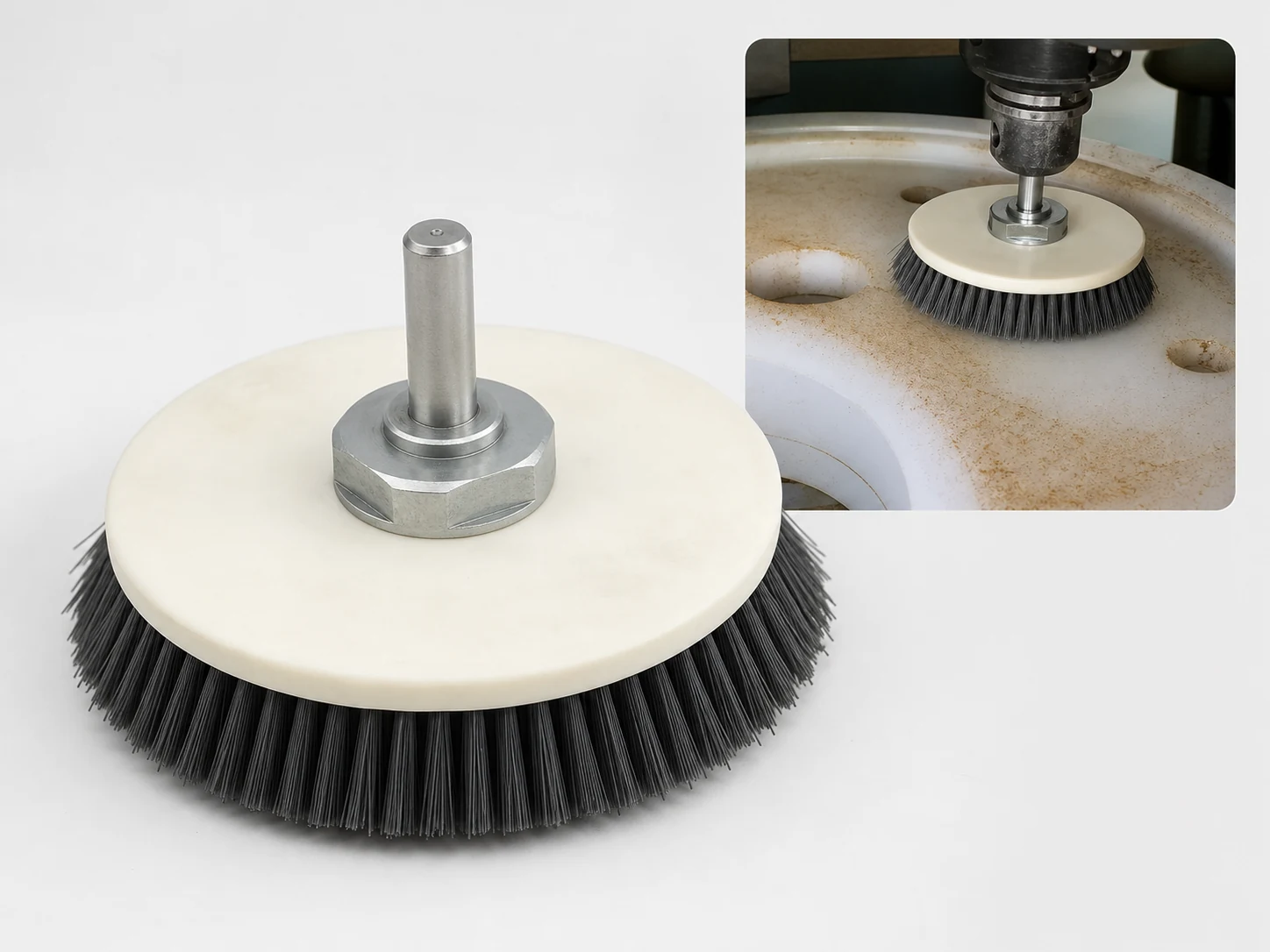
A PVC disc brush is a cylindrical or disc-shaped brush assembly where the bristles are anchored in a polyvinyl chloride (PVC) core or holder. The bristles can be made from various materials—nylon, polypropylene, abrasive filaments, wire, or natural fibers—and are arranged in a radial or spiral pattern. The brush mounts onto a shaft or flange and rotates to perform surface treatment, material removal, or cleaning. PVC as a core material offers chemical resistance, moisture tolerance, and moderate mechanical strength, making it suitable for many wet or corrosive environments.
When Does a Standard PVC Disc Brush Fall Short?
For the safety point in this section, the relevant OSHA reference is OSHA — 1910.242 Hand and Portable Powered Tools.
For the safety point in this section, the relevant OSHA reference is OSHA — 1910.215 Abrasive Wheel Machinery.
For the safety point in this section, the relevant OSHA reference is OSHA — Personal Protective Equipment.
For brush terminology and construction language, this section references ABMA — ANSI B165.1 Power Brush Safety Slips.
For brush terminology and construction language, this section references American Brush Manufacturers Association — Brush Lingo.
A standard brush is the right starting point when your dimensions, speed, and bristle requirements align with catalog specifications. You should consider customization when:
- No standard diameter or face width fits your machine envelope or work zone.
- The required bristle material (e.g., high‑temperature nylon, conductive filaments, food‑grade polyester) is unavailable in stock configurations.
- The core material must withstand chemicals, temperatures, or mechanical loads beyond PVC’s limits.
- Mounting must match a proprietary shaft design, keyway, or quick‑change system.
- Operating conditions such as high RPM, abrasive slurry, or strict hygiene standards demand a non‑standard design.
- Regulatory or documentation needs (FDA, 3‑A, ATEX) cannot be met by generic brushes.
If only one or two parameters differ from a catalog item, a supplier may offer a “modified standard” without full tooling costs. When multiple factors change, custom engineering often yields better long‑term value.
Key Specifications to Define for a Custom PVC Disc Brush
Providing complete specifications upfront reduces quotation time and prevents costly revisions. The table below summarizes the main parameters buyers should prepare.
| Parameter | What to Specify | Why It Matters |
|---|---|---|
| Overall Diameter (OD) | Exact outer tip‑to‑tip dimension | Determines coverage, peripheral speed, and clearance |
| Face Width | Bristle‑covered length along the axis | Affects contact area and work throughput |
| Bristle Material | Polymer type, diameter, crimp, abrasive grit if applicable | Controls aggressiveness, wear life, and compatibility |
| Core / Holder Material | PVC grade, metal, or composite | Impacts chemical resistance, balance, and operating RPM |
| Mounting Interface | Bore size, keyway, set‑screw location, flange pattern | Ensures secure fit and concentricity |
| Bristle Pattern | Radial, spiral, staggered, or custom layout | Influences cleaning action, debris clearance, and stiffness |
| Operating Environment | Temperature, chemicals, moisture, abrasive exposure | Dictates material selection and safety margins |
| Quantity | Prototype and production volumes | Determines tooling investment and per‑unit cost |
How Bristle Material and Core Choices Affect Performance and Durability
Bristle material is often the most impactful decision. The following table compares common materials for industrial disc brush applications.
| Material | Typical Use | Pros | Cons |
|---|---|---|---|
| Nylon 6/6 or 6/12 | General cleaning, light deburring | Good abrasion resistance, moderate temperature tolerance, cost‑effective | Absorbs moisture, not suitable for very high temperatures |
| Polypropylene | Chemical processing, food contact | Excellent chemical resistance, low moisture absorption | Lower stiffness, poor high‑temperature performance |
| Abrasive Nylon (silicon carbide or alumina) | Deburring, edge radiusing, surface finishing | Combines brushing and grinding, long life | Higher cost, can be aggressive on soft substrates |
| Wire (steel, stainless, brass) | Heavy rust removal, weld cleaning | Extremely aggressive, high temperature tolerance | Risk of scratching, sparking, contamination |
| Natural Fiber (Tampico, horsehair) | Polishing, dusting, gentle cleaning | Soft, compliant, low‑scratch | Limited durability, not for wet processes |
The core material typically remains PVC for moderate conditions, but when exposure to strong acids, solvents, or temperatures above 60°C (140°F) is expected, alternatives like polypropylene, nylon, or metal hubs should be evaluated. A heavier core can also improve rotational stability at high speeds.
Mounting Interface and Compatibility Considerations
A custom disc brush must fit your drive system precisely. Common mounting styles include:
- Plain bore: Simple hole; relies on keyway and set‑screw or friction fit.
- Keyed bore with set‑screw: Standard for positive torque transfer.
- Flange mount: Bolt circle or pilot diameter for face mounting; preferred when axial space is tight.
- Threaded hub: Screws directly onto a threaded shaft.
- Taper‑lock bushing: Quick installation/removal, good concentricity.
Always provide a drawing or sample of the shaft end to the supplier. Dimensional tolerance can be critical for high‑speed operations to avoid vibration and premature brush failure.
Preparing an RFQ: What to Include to Avoid Delays and Rework
An effective Request for Quotation (RFQ) for a custom PVC disc brush should contain:
- A dimensioned sketch or CAD file showing OD, ID, width, and mounting details.
- Bristle material specification (type, diameter, grit if abrasive).
- Core material and color (if required for process visibility).
- Maximum RPM, operating temperature range, and chemical exposure.
- Target life expectancy or replacement criteria.
- Required quantity and desired production schedule.
- Any compliance or documentation needs (FDA, material certifications, RoHS).
- Packaging requirements (bulk, individual wrap, moisture protection).
Missing information is the number one reason for delayed quotes. If a physical sample of a previous brush is available, sending it often accelerates the process.
Common RFQ Mistakes When Ordering Custom Brushes
Technical buyers frequently encounter these pitfalls:
- Specifying only OD and ID. Face width, bristle length, and bristle diameter all influence brush density and action.
- Omitting environmental data. A brush that works in dry air may fail in a caustic bath or high‑humidity chamber.
- Ignoring shaft speed and load. Centrifugal force at high RPM can splay bristles or unbalance a poorly designed core.
- Equating “custom” with “expensive.” A small design change can sometimes eliminate the need for new tooling, keeping costs near standard levels.
- Requesting vague “food‑grade” without the specific regulation. 3‑A, EHEDG, and FDA each have different material and design criteria.
- Not asking about sample or first‑article inspection. Without a pre‑production sample, the first full batch carries risk.
When to Invest in Custom Tooling vs. Adjusting Your Process
Custom tooling—such as injection molds for PVC hubs or specialized tufting fixtures—makes sense when:
- Annual volume exceeds a few hundred units and the design is stable.
- Repeat orders are expected only after validation for at least two to three years.
- The brush is a critical component with zero tolerance for field failure.
- Standard assembly methods cannot achieve the required bristle density or balance class.
If the brush is for a one‑off project or experimental process, ask suppliers about “tool‑less” customization: laser‑cut cores, hand‑set bristles, or modular assemblies that adapt stock components. Sometimes a small process change—like adjusting flow rate or cleaning chemistry—can make a standard brush perform acceptably, avoiding tooling costs entirely.
Final Takeaway
Customizing a PVC disc brush is not about choosing the most exotic materials; it is about aligning every specification with a real operating condition. Start by exhausting standard catalog options. If they fail on a verifiable technical requirement, build your RFQ around the actual gap. Provide complete dimensional, material, and environmental data, and always request a sample before committing to full production. A well‑specified custom brush will pay for itself through longer service life, less downtime, and better process consistency.
Frequently Asked Questions
What is the minimum information needed for a quick budgetary quote?
Most suppliers can provide a rough estimate with the outer diameter, face width, bristle material, and approximate annual quantity. For a firm quotation, mounting details and environmental conditions are necessary.
Can I send a physical sample instead of a drawing?
Yes, sending a sample brush—even if worn—is often the fastest way to communicate dimensions, bristle type, and construction. Include notes about any changes you want.
How do I choose between nylon and abrasive nylon bristles?
For light cleaning or wiping, standard nylon is sufficient. When you need to deburr, radius edges, or remove light scale, abrasive nylon with silicon carbide or alumina grit is the better choice. The grit size and filament diameter determine aggressiveness.
Is PVC always the best core material for wet applications?
PVC resists many chemicals and moisture, but strong solvents, concentrated acids, or temperatures above 60°C (140°F) can degrade it. In those cases, consider polypropylene, nylon, or even stainless steel hubs after checking corrosion data.
What is a reasonable RPM limit for a PVC disc brush?
Typical PVC cores can handle surface speeds up to 1,800–2,500 RPM for small diameters, but larger discs must run slower to prevent centrifugal force from damaging the core or bristles. Always ask the supplier for a maximum safe operating speed (MSOS) based on your exact design.
How many prototypes should I order before full production?
For a first‑time custom design, order at least a project-specific quantity to test on several machines under real conditions. This sample run reveals balance, wear, and fit issues that one prototype may miss.
Are there food‑grade PVC disc brush options?
PVC can be formulated for incidental food contact, but many food processors require stainless steel hubs and FDA‑compliant bristle materials such as polyester or certain nylons. Specify the exact standard (FDA 21 CFR, EU 1935/2004, 3‑A) when ordering.
How do I compare quotes from different brush manufacturers?
Check that both quotes cover the same bristle filament diameter, density, core material grade, and mounting tolerances. A lower cost often reflects thinner bristle packing, lower‑grade PVC, or looser manufacturing tolerances that can cut service life in half.