
Custom Cleaning Brush
PVC Disc Brush
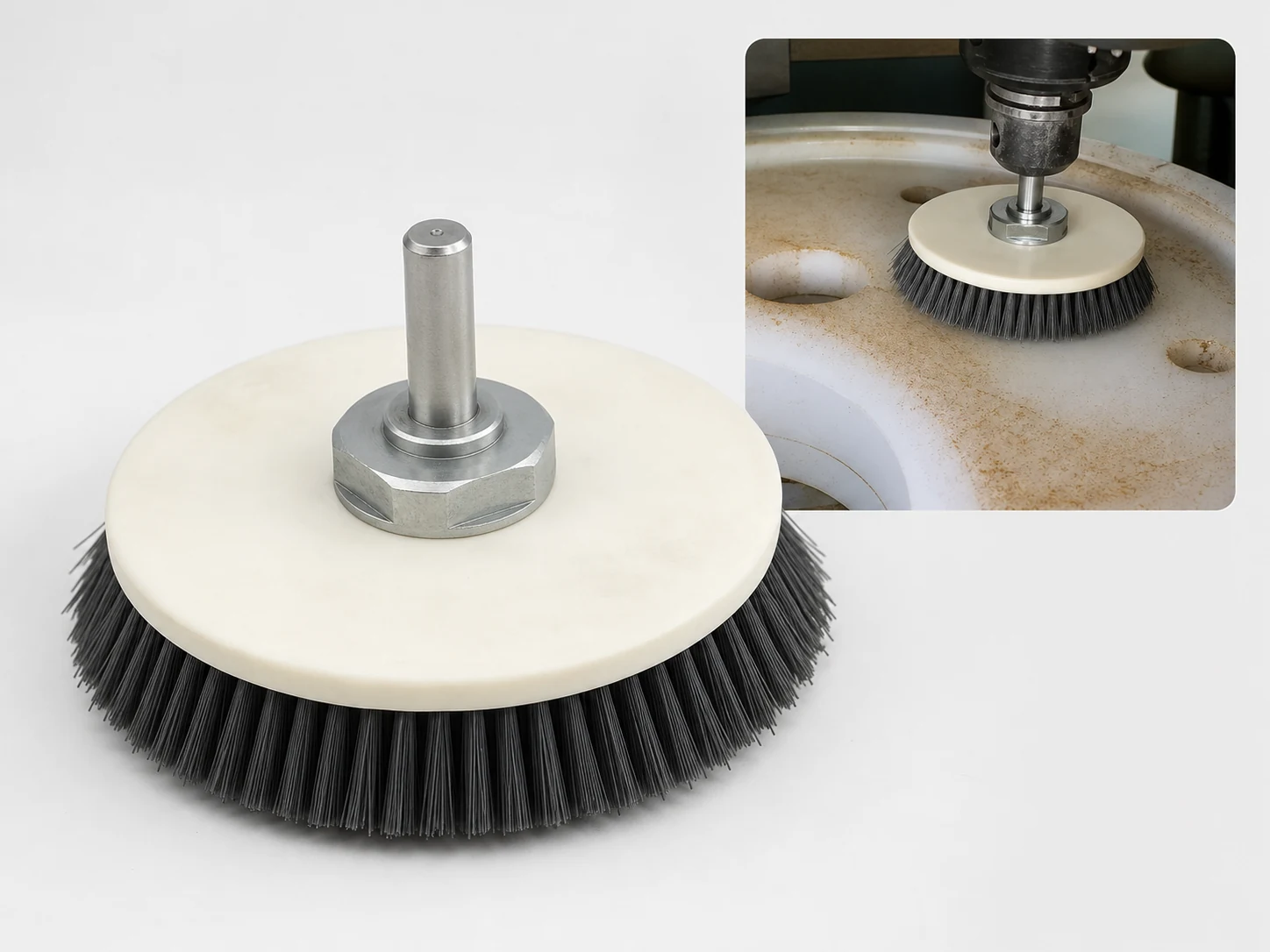
Custom PVC disc brush with nylon filament face for deburring, cleaning, and finishing. Specify diameter, bore, trim, and filament for your rotary machine.
Medium brush
100 pcs
Minimum order
Worked with two hands or on a pole: chimney, gutter and pond-filter brushes, discs, cups and tank brushes.
Production lead time, once the specification is confirmed
- Up to 100 pcsWithin 7 days
- 101–5,000 pcsWithin 14 days
- 5,001–50,000 pcsWithin 21 days
- Over 50,000 pcsConfirmed with your quotation
Peak season can extend these times; the shipping date is confirmed in writing with your quotation. Sampling and shipping are quoted separately.
A rotary disc brush with a rigid PVC backing and nylon filament working face for powered surface finishing and cleaning of flat faces, edges, recesses, and machine components. The PVC disc carries the tuft pattern and mounts directly to your spindle or drive plate to remove dust, burrs, light oxide, oil film, polishing compound, and loose particles without the aggressive action of wire or abrasive wheels.
What can this brush do for you?
Mounts to Your Existing Rotary Equipment
The PVC disc is bored, keyed, or drilled to match your spindle, drive plate, or bolt pattern. It can replace a worn brush without changing machine setup, provided the interface dimensions are specified during ordering.
Removes Process Residue Without Metal Contact
Nylon filaments remove light burrs, oxide films, oil films, and polishing compound. Because the working contact is polymer rather than steel, there is no risk of leaving ferrous particles on the workpiece or scratching sensitive surfaces such as aluminum, anodized parts, or coated components.
Holds Up in Wet and Mild Chemical Environments
The PVC backing and standard nylon fill resist moisture, common water-based cleaning solutions, and mild alkaline or acidic conditions. This allows the brush to run in wash-down or coolant-assisted operations without backing corrosion or filament degradation.
Reaches Recesses and Profiles When Configured for the Part
The tuft arrangement around the disc edge or on the face can be adapted to clean grooves, slots, fillets, and stepped areas. When the part has difficult-to-reach features, the disc trim, tuft density, and edge profile can be specified so the brush contacts those zones as well as the main face.
Balanced Construction for Smooth Operation
PVC is easy to machine and balance, so the assembled disc runs smoothly at normal finishing speeds. Less vibration means longer bearing life on the machine and more consistent surface contact from the first part to the last.
What is a PVC Disc Brush?
A PVC Disc Brush is a rotary brushing tool in which a rigid PVC disc forms the structural backing and carries nylon or other polymer filaments arranged in a circular tuft pattern. It is mounted on a motorized spindle, bench grinder adapter, polishing machine, or dedicated brushing head and rotated against the workpiece to clean, deburr, or finish flat and shaped surfaces.
During operation, the filaments flex under contact and their tips sweep across the surface. Tuft density, filament diameter, and trim length together determine how much pressure each tip applies and how aggressively the brush removes surface residue. Face-mounted tufts work best on wide flat areas, while edge-mounted tufts clean sidewalls, grooves, and narrow recesses.
The PVC disc transfers torque from the hub to the working face and holds the tufts in a fixed plane. It is not a hand tool and must be run at an appropriate speed. The PVC backing has a practical continuous temperature limit around 60°C (140°F), so the brush is intended for room-temperature or mildly warm processes rather than hot-work cleaning.
Technical Specifications
| Parameter | Value / Options |
|---|---|
| Outside diameter | 50–400 mm, matched to work area and machine guard |
| Active face width / trim length | 10–60 mm beyond disc edge or face, depending on configuration |
| Disc thickness | 6–20 mm, selected for rigidity and mount design |
| Bore / hub | Plain bore, keyed bore, or bolt circle to match spindle or drive plate |
| Fill material | Nylon PA (standard); PBT or PP available for specific chemical or stiffness needs |
| Filament diameter | 0.15–0.80 mm, selected by aggressiveness and surface sensitivity |
| Tuft density / pattern | Open, medium, or dense; spiral, concentric, or edge-only layout |
| Maximum operating speed | Typically 1500–4500 RPM depending on OD and balance; verify against application |
| Operating temperature | Up to about 60°C (140°F) continuous for PVC backing |
| Chemical exposure | Resistant to water, many detergents, mild acids/alkalis; avoid ketones and aromatic solvents |
| Mounting interface | Drive plate, centering hub, keyway, or custom bolt pattern per machine |
| Brush type | Custom Disc Brushes |
| How it is driven | Machine-driven, mounted in the equipment |
| Cleaning target | deburring and edge blending of stamped, cleaning machine table, and surface preparation cleaning |
| Surface or part | pvc, edges, recesses, grooves, slots, flat faces, profiles, and machine components |
| Residue or debris | oil film, polishing compound, oxide, particles, burrs, dust, loose particles, and powder |
| Mounting / connection | Plain bore, keyed bore, or bolt circle to match spindle or drive plate; Drive plate, centering hub, keyway, or custom bolt pattern per machine |
All dimensions and specifications above can be adjusted to your project. The table lists the most commonly specified parameters; final values are confirmed from your machine drawing and application requirements.
Where does this brush work best?
- Deburring and edge blending of stamped, laser-cut, or machined flat metal parts.
- Cleaning machine tables, fixtures, plates, and conveyor surfaces between production runs.
- Surface preparation before painting, powder coating, plating, or bonding: removes light oxide, oil film, and polishing compound.
- Finishing aluminum, stainless steel, and coated parts where a wire brush would scratch or embed particles.
- Cleaning grooves, slots, or recessed profiles using edge-tufted or custom-trimmed configurations.
- Wet process lines where water or mild cleaning solutions are present.
How do I choose the right one?
Confirm the drive interface first. Spindle diameter, bolt pattern, keyway, and centering features must be matched exactly. A mismatched bore causes runout, vibration, and premature bearing wear on your machine.
Size the outside diameter to the surface. A large flat area benefits from a larger OD for broader coverage, but the disc must fit inside the machine guard and reach around adjacent features. A narrow recess or slot may require a smaller OD with longer edge trim.
Match the filament to the residue and surface. Fine nylon filament (0.15–0.30 mm) handles light dust, oil films, and polishing compound on sensitive surfaces. Medium filament (0.30–0.50 mm) removes light burrs and oxide. Thicker filament (0.50–0.80 mm) or PBT provides more stiffness for edge blending on harder materials.
Set the tuft density for the job. Higher density gives smoother contact on flat faces and more uniform finishing. Lower density allows chips to clear and heat to dissipate in deep grooves and recesses.
Check temperature and chemicals. If the process surface or environment exceeds roughly 60°C (140°F), or if strong solvents such as ketones or aromatic hydrocarbons are present, a PVC-backed brush is likely not the right choice. In those cases, evaluate a metal-backed disc brush or a different filament system.
Validate at operating speed. Run the brush at the intended RPM for a short test. Check disc temperature and vibration. If the disc becomes hot to the touch or the brush vibrates, reduce speed, adjust balance, or reconsider the configuration.
| Condition | Recommended configuration |
|---|---|
| Large flat surface, light residue | Large OD, dense face tufts, fine nylon |
| Deep recess or slot | Smaller OD, longer edge trim, open density |
| Oily or wet environment | Nylon fill with PVC backing, confirm chemical compatibility |
| Heavy burr / edge blending | Larger filament diameter or PBT, medium density |
| High-temperature process | Not recommended; evaluate metal-backed brush |
Can I customize this brush?
To define a custom PVC disc brush, provide the outside diameter, bore/hub dimensions or bolt pattern, required trim length, filament material and diameter, tuft density and pattern, operating RPM, workpiece material, residue type, and cleaning chemicals. A drawing or sample of the mount helps us get the interface right faster.
We can adjust:
- Disc geometry — outside diameter, thickness, counterbore, hub insert, edge profile, and bolt circle.
- Filament fill — material (Nylon PA, PBT, PP), diameter, trim length, tuft density, and layout (face, edge, or combination).
- Mounting interface — plain bore, keyway, set-screw collar, drive plate holes, or custom centering features.
- Color and identification — PVC base color, marking, pad printing, or label for traceability.
- Packaging — bulk, individual box, kit, or project-specific packing.
If your project requires documentation, material declarations, inspection, or third-party testing, we can assist with those requirements during the customization process.
How do you confirm a PVC disc brush has actually cleaned the surface?
What speed should I run this PVC disc brush at?
Start at the lower end of the recommended range for your disc diameter and balance. Run the brush for a few minutes at target speed, then touch the disc. If it feels warm beyond comfortable handling, reduce RPM. Excessive speed softens PVC and shortens filament life.
Can the brush be used with water or cleaning chemicals?
Yes, the PVC backing and standard nylon fill tolerate water and many water-based cleaners, mild alkalis, and dilute acids. However, ketone-based solvents, strong aromatic hydrocarbons, and chlorinated solvents can attack PVC and should be avoided. Confirm the exact chemical with us when the process is not just water.
How do I know when the disc brush needs replacing?
Check filament trim loss. When the working tips have worn down by about 20–30% of original trim length, contact pressure and cleaning action drop noticeably. Also inspect the PVC disc for cracks, warping, worn bore, or loose tufts. Replace if any of these appear.
Will this brush leave scratches or marks on my parts?
Nylon filament is non-abrasive and normally does not scratch metal surfaces. On very soft or highly polished workpieces, high speed and heavy pressure can still produce visible marks. Test on scrap first with your actual speed and pressure, and use finer filament and lower pressure if marks are unacceptable.
Can this brush remove heavy rust or welding scale?
No. Nylon filaments are not designed for heavy rust, weld spatter, hard carbon, or baked-on scale. Those conditions require wire brushes or abrasive products. Attempting to remove such deposits with a PVC disc brush will quickly wear the filaments and may overload the PVC backing.
How can I verify the brush is mounted and balanced correctly?
Rotate the brush by hand and look for runout. Then run at low speed and watch for vibration or wobble. If vibration appears, stop and check bore fit, centering, and that the disc is seated flat on the drive plate. An unbalanced brush will reduce finish quality and shorten bearing life.
Guides that go deeper on this
When to Customize PVC Disc Brush
Read this guideGuideFloor Scrubber Brush Selection: Disc Brush vs Roller Brush
Read this guideGuidePCB Cleaning and Deburring: Which Disc Brushes Avoid Damage?
Read this guideGuideWhen to Customize Combined Sanding Disc Brush
Read this guideGuideWhich Disc Brushes Belong on Glass Processing Lines?
Read this guideCustom Manufacturing RFQ
Describe Your Application
Send the key measurements, cleaning requirement, residue, material direction, mounting method, quantity, and drawing or photo.
Drawing or photo optional — it speeds things up, it does not gate the enquiry.
Custom Brush RFQ
Send Your Brush Project
Upload a drawing, product photo, or sample photo and provide the core dimensions and cleaning conditions.
“We need a brush to remove wet residue from a stainless steel conveyor, about 800mm wide. The current brush wears quickly. We can send photos.”
“We sell drinkware and need a cleaning brush to include with the product. Quantity around 5,000 pieces.”