
Custom Cleaning Brush
Side Brush
Machine-mounted road sweeper side brush for curb edges, gutters, and shoulders. Nylon PA, PP, or wire-blend fill, 400–650 mm OD, machine-specific mount.
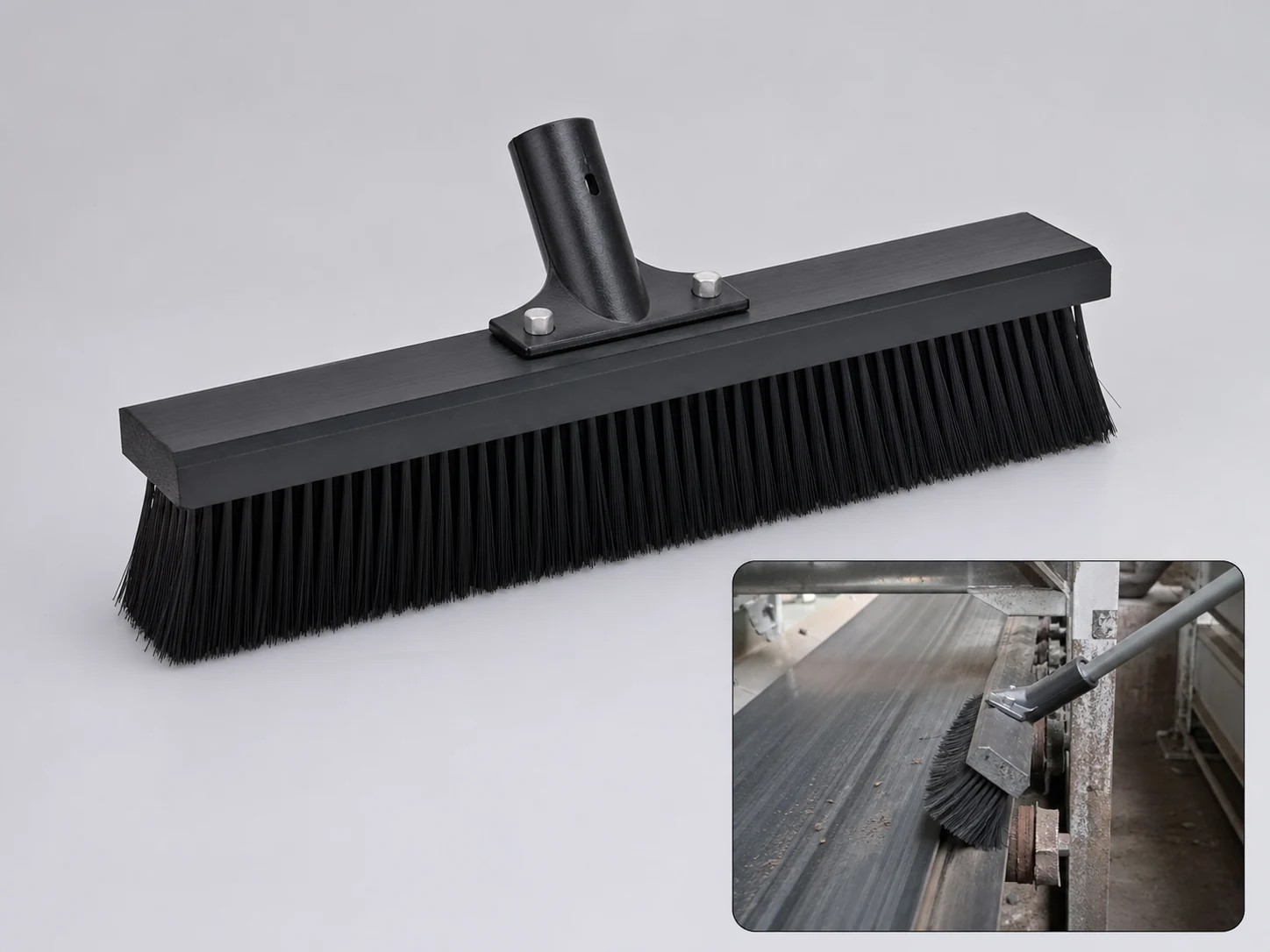
Large-format brush
100 pcs
Minimum order
Built one at a time on a core or channel: full-width rollers, sweeper brooms and long strip.
Production lead time, once the specification is confirmed
- Up to 100 pcsWithin 20 days
- 101–1,000 pcsWithin 30 days
- Over 1,000 pcsConfirmed with your quotation
Peak season can extend these times; the shipping date is confirmed in writing with your quotation. Sampling and shipping are quoted separately.
A machine-driven side brush for street sweepers, built to sweep curb edges, gutters, road shoulders, and the outer collection path that the main broom and suction inlet cannot reach. Standard fill is nylon PA filament, with PP, steel wire, and mixed poly/wire options for different debris and pavement conditions.
What can this brush do for you?
Pulls dirt out of the curb line and gutter
The side brush mounts at an offset angle, so the outer filament tips contact the vertical curb face and the flat gutter at the same time. That single pass moves dust, sand, leaves, and litter out of the line where debris collects and into the sweeper’s pickup path before the main broom makes its pass.
Feeds the main pickup system instead of leaving a windrow
Rotation direction and tuft angle are matched to the sweeper, so the brush pushes material inward and forward rather than throwing it across the traffic lane. The result is less re-sweeping, fewer visible missed bands, and faster complete passes along the route.
Maintains consistent ground contact through wet shifts
Nylon PA filament recovers its shape when wet and stands up to the constant abrasion of sand and road grit without collapsing the way softer fills can. For municipal routes that run through rain, runoff, or wet leaves, the standard fill keeps the outer tips working at the curb seam longer before trim length is lost.
Switches to a tougher fill for packed or heavy debris
When the route includes compacted mud, gravel, or construction carry-out, a PP/steel wire blend or full steel wire version adds the scraping force needed without changing the brush’s footprint or mount. Ring size, trim length, and drive interface stay the same while the contact material gets more aggressive.
Locks into the sweeper’s drive without guesswork
Outside diameter, inner mounting diameter, bolt circle, spline, and rotation direction are configured to the specific machine. The brush bolts onto the existing drive plate and runs at the sweeper’s designed speed and arm angle, so installation does not force the operator to modify the machine.
What is a Side Brush?
A Side Brush is the machine-mounted circular brush on a street sweeper that runs along the curb line or outer edge of the cleaning path. It rotates on a near-vertical axis and uses long, outward-facing filaments to sweep debris from the curb, gutter, and road shoulder toward the main broom or suction nozzle.
Most road sweeper side brushes are built as a disc-shaped assembly with a central metal or plastic hub and a ring of dense filament tufts. The working face contacts the ground at a slight angle controlled by the sweeper’s side-brush arm; the outer rim tips reach into the curb joint while the inner portion holds the collected material in the swept path.
This is a wear component, not a one-time purchase. Filament length wears down with every shift, and the brush is replaced when the trim length no longer maintains proper ground contact or curb reach. The correct outside diameter, inner diameter, trim length, and mount pattern are determined by the sweeper model and the route geometry.
A side brush is not the main pickup broom, a floor scrubber brush, or an indoor dust-control tool. It is selected for curbside and roadside sweeping where the machine needs extra reach past the main pickup edge.
Technical Specifications
| Parameter | Value / Options |
|---|---|
| Brush type | Road-sweeper side / curb brush |
| Outside diameter | 400–650 mm, set to the sweeper arm and curb reach |
| Inner / mounting diameter | 80–220 mm, matched to the drive plate and hub |
| Trim length | 200–300 mm, adjusted to ground contact and curb height |
| Fill material | Nylon PA (standard), PP, PP/steel wire blend, or steel wire |
| Filament pattern | Dense outer ring with inner support tufts; pattern and row count set per project |
| Mount | Drive plate, spline, bolt circle, and center hole matched to sweeper model |
| Rotation direction | Clockwise or counterclockwise per machine; confirmed before production |
| Ground contact | Set from machine side-brush arm angle at installation; curb reach checked on flat surface |
| Operating environment | Outdoor municipal roads, parking lots, construction haul roads, airport aprons; wet and dry sweeping |
| How it is driven | Machine-driven, mounted in the equipment |
| Cleaning target | municipal street sweeping, parking lot and commercial lot, and construction and haul road entrance cleaning |
| Surface or part | curbs, edges, roads, streets, gutters, road shoulders, joints, and pavement |
| Residue or debris | leaves, sand, gravel, litter, mud, and dust |
| Mounting / connection | 80–220 mm, matched to the drive plate and hub; Drive plate, spline, bolt circle, and center hole matched to sweeper model; Clockwise or counterclockwise per machine; confirmed before production |
All dimensions are adjusted to the actual sweeper and route. Provide the machine make, model, serial plate information, or an existing brush sample and we will confirm the correct configuration before production.
Where does this brush work best?
- Municipal street sweeping where curb, gutter, and road-shoulder debris must be moved into the suction or main broom path.
- Parking lots and commercial lots with curbed edges, islands, and tight perimeter lines the main broom cannot reach.
- Construction and haul road entrances where sand, gravel, and mud are deposited from truck tires.
- Airport aprons and taxiways, when the sweeper is used for FOD control along paved edges and joints.
- Distribution yards, ports, and industrial lots where loose aggregate, leaves, and litter collect along boundary lines.
How do I choose the right one?
Confirm the machine interface first
Record the sweeper make, model, and side-brush part number if available. The two parameters that stop everything if incorrect are the drive plate bolt circle and the center mounting diameter. Also confirm the rotation direction, because the tuft layout and wear characteristics are direction-specific.
Set diameter and trim length from arm reach, not from a catalog number alone
The outside diameter determines how far past the sweeper frame the brush reaches, and the trim length controls how much filament is available to reach the curb seam as it wears. A shorter trim saves initial cost but shortens replacement intervals; a longer trim must not overload the side-brush motor or strike the chassis at full down pressure.
Match the fill to the debris and pavement
| Fill | Best when |
|---|---|
| Nylon PA | General street debris, wet leaves, sand, dust; keeps stiffness in wet conditions and resists abrasion |
| Polypropylene (PP) | Lighter litter and dust on smooth asphalt; lower cost where wear is not the limiting factor |
| PP / steel wire blend | Packed mud, compacted gravel, or construction carry-out where extra scraping force is needed |
| Steel wire | Heavy scale, hardened debris, or long-life requirements on concrete; not for surfaces where marking is a concern |
Check the contact footprint after installation
Lower the brush onto a flat, clean surface and rotate it one full turn. The filament tips should leave an even wear band across the outer working face, not only the inner ring or only the outermost tips. If the pattern is off-center, adjust the arm angle and lock it before the route begins. A side brush with poor ground contact wears unevenly and leaves streaks on the first shift.
If the application is indoor fine-dust control, use the sweeper’s main broom or a cylindrical broom accessory instead. If the route needs a brush that follows a curb with a built-in guide wheel, look for a dedicated curb brush with guide roller rather than a standard side brush. For very heavy rocks, metal bar stock, or frozen curbside material, manual pick or a heavier mechanical sweeper attachment is more appropriate than any filament side brush.
Can I customize this brush?
Side brushes are built to the sweeper and the route. To set the configuration correctly, provide the sweeper make/model, the existing drive plate or mounting drawing, the rotation direction, the curb height/offset, typical debris, and any photographs of the current brush and mounting. If you do not have a drawing, a worn sample brush shipped to us works just as well for reverse measurement.
We can adjust:
- Dimensions — outside diameter, inner mounting diameter, trim length, and tuft ring width
- Fill material — nylon PA, PP, PP/wire blend, steel wire, or mixed zones with different filament diameters
- Filament layout — tuft density, row count, angular spacing, outer ring density, and optional wear-indicator bands
- Mounting — bolt circle, spline engagement, center hole, drive plate form, and rotation direction marking on the hub
- Hub — steel, aluminum, or engineered polymer per weight and corrosion requirements
- Identification — hub color, molded markings, label, or barcode for fleet tracking
- Packaging — bulk pallet, individual cartons, or route-quantity packs with mixed left/right sets
For municipal or airport projects that require material declarations, inspection reports, or third-party testing documentation, we can assist with the specific documentation package your purchasing team requires.
How do you tell when a side brush is worn out?
How do I know when the side brush is worn out?
Compare the remaining trim length against a new brush of the same configuration. When the filament tips no longer reach the curb seam at the sweeper’s set arm angle, or when the outer row shows broken, flat, or melted tips, the brush has stopped doing its job even if the hub is still intact. Replace before the wear band reaches the hub or metal backing.
Can the same brush be used on both the left and right side of the sweeper?
Only if the rotation direction and mounting pattern are identical on both arms. Many sweepers use mirrored left/right brushes because the drive rotates opposite directions. Confirm with the machine manual or the drive plate before interchanging; a reversed brush will sweep poorly and wear the tufts in the wrong direction.
What should I check on the mounting before placing a replacement order?
Inspect the drive plate, spline, and bolt holes for elongation, cracks, or flattened spline teeth. A worn mounting will ruin a new brush quickly. Also note the exact bolt circle diameter and the number of bolts, not just the center hole size.
Does a side brush replace the main broom or suction pickup?
No. The side brush moves material from the curb and shoulder into the sweeper’s collection path, but the main broom and suction system still do the actual pickup and containment. A missing or worn main broom will leave piled debris even when the side brush is in perfect condition.
What type of debris should I not try to side-brush?
Large rocks, metal scrap, rebar fragments, frozen lumps, or heavy wet clay larger than the filament gap can wedge between tufts, snap filaments, or damage the hub. Pick those by hand or use a heavier front-end attachment before the side brush passes.
How can I verify the correct rotation direction before installation?
Look for the direction marking on the hub or compare the tuft angle against the drive plate rotation. The outer filament tips should sweep toward the machine center, not away from it. If in doubt, rotate the brush by hand on a flat surface and watch which way the material moves.
Guides that go deeper on this
Custom Manufacturing RFQ
Describe Your Application
For a custom quote, we need the key dimensions, surface or part, residue, material preference, quantity, and reference image or drawing.
Drawing or photo optional — it speeds things up, it does not gate the enquiry.
Custom Brush RFQ
Send Your Brush Project
Upload a drawing, product photo, or sample photo and provide the core dimensions and cleaning conditions.
“We need a brush to remove wet residue from a stainless steel conveyor, about 800mm wide. The current brush wears quickly. We can send photos.”
“We sell drinkware and need a cleaning brush to include with the product. Quantity around 5,000 pieces.”