
What Are Main Broom and Side Brush in a Sweeper?
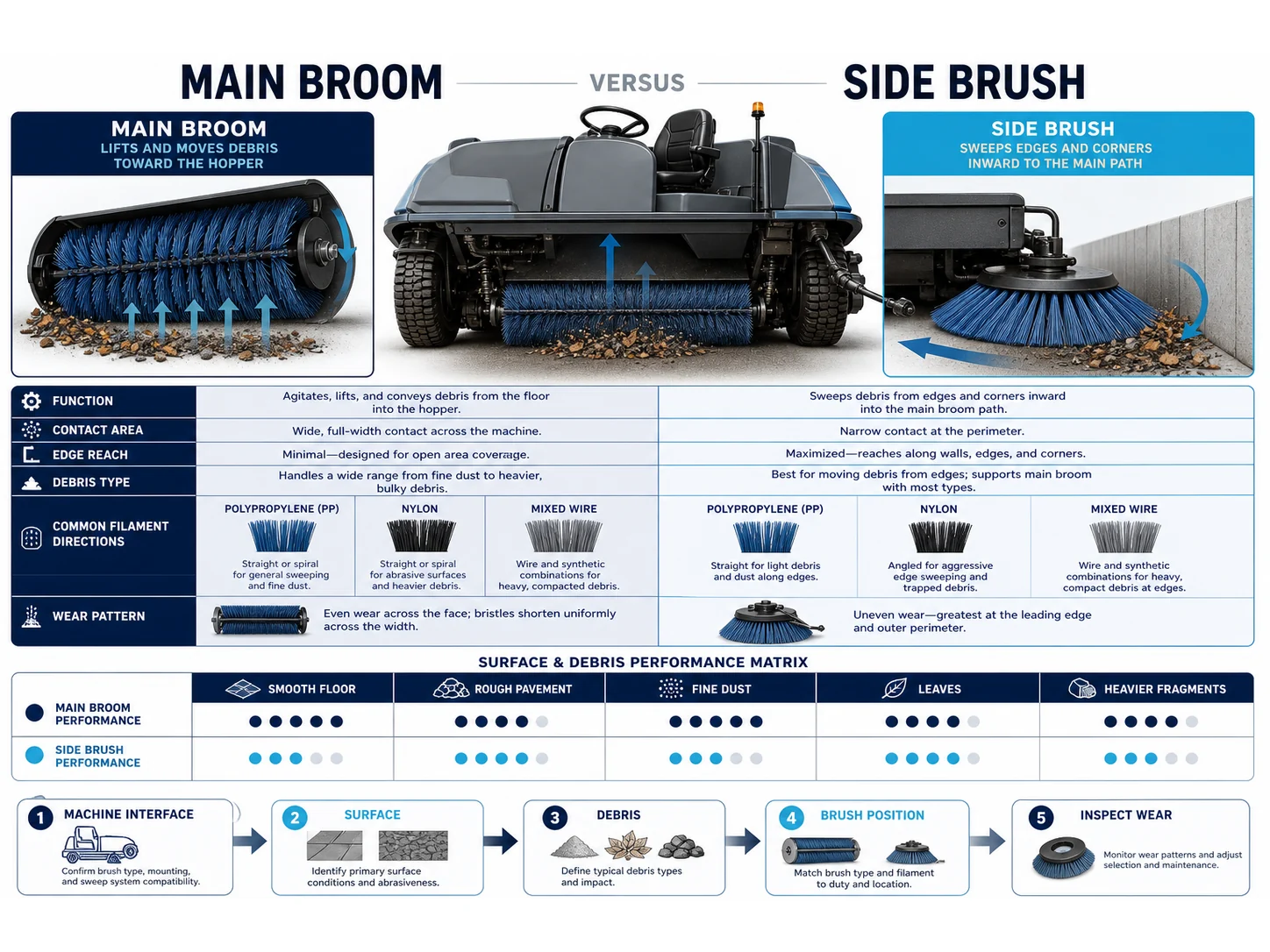
The main broom (also called the cylindrical or central brush) is the primary pickup element. It rotates horizontally under the sweeper and directs debris into the hopper. The side brush (or side broom) extends to the right or left of the machine, sweeping along edges, curbs, and corners, moving material into the path of the main broom. Not every sweeper uses a side brush—some compact models rely solely on the main broom and a dust control system—but for larger industrial and municipal sweepers, both are standard.
Common Broom and Brush Material Types
Sweeper brushes come in several bristle materials, each designed for a specific range of surface hardness, debris type, and durability expectation.
| Material | Best For | Surface Compatibility | Typical Wear Characteristics |
|---|---|---|---|
| Polypropylene (PP) | General-purpose dust, fine debris, light litter | Smooth concrete, asphalt, tile, indoor floors | Moderate life; affordable replacement; may load up with wet debris |
| Steel Wire (heavy‑duty) | Heavy, compacted debris, foundry sand, rust, scale, hard-to-remove residue | Rough concrete, steel decking, asphalt (aggressive) | Long life on tough debris; may scratch delicate surfaces |
| Nylon (synthetic fiber) | Soft surfaces, sensitive floors, wet debris, food environments | Polished concrete, terrazzo, epoxy floors, tile | Good flexibility; less aggressive; can be used wet without degrading |
| Combination (PP + steel wire) | Mixed debris where both scrubbing and pickup are needed | Medium to rough surfaces | Balanced wear; may require staggered replacement |
Main Broom vs Side Brush: Functions and Selection Factors
While both brushes collect debris, their design demands are different.
| Feature | Main Broom | Side Brush |
|---|---|---|
| Primary job | Sweeps debris directly into the hopper | Moves edge/corner debris into broom path |
| Typical diameter | 10–20 inches (varies by machine class) | 16–24 inches (disc‑type) |
| Material priority | Wear resistance, pickup efficiency | Flexibility, flick‑out action |
| Replacement driver | Center wear; bristle length loss | Edge feathering; loss of shape |
How to Select the Right Brush Based on Surface and Debris
Use this decision sequence when ordering new or replacement brushes:
- What is the floor material? Smooth sealed concrete allows nylon or polypropylene. Unsealed, rough, or steel deck needs steel wire or heavy‑duty poly.
- What debris are you picking up? Fine dust and paper waste: polypropylene. Sticky, wet, or food residue: nylon. Foundry sand, heavy grit, metal chips: steel wire.
- Are there edge areas? If you sweep along walls, curbs, or rack legs, a side brush is non‑negotiable.
- What is the operating speed and pressure? High‑speed sweepers generate more bristle fatigue; choose a material with documented service life in your application.
- Is water involved? Nylon resists water absorption and is preferred for wet sweeping. Polypropylene can become limp when saturated; steel wire may rust without proper coating or stainless alloy.
Replacement Cycle Guidelines
No brush lasts forever, but typical replacement intervals help plan maintenance budgets:
- Polypropylene: a condition-based interval, depending on floor roughness and debris weight.
- Steel wire: 600–1,200 hours on heavy debris; wire breakage and aggressive wear indicate time to change.
- Nylon: a condition-based interval; bristle “set” (permanent bending) reduces pickup before visible wear.
- Side brush: Often wear 20–30% faster than main brooms because they work at higher RPM and strike curbs.
Set a visual inspection trigger: when a main broom’s bristle length is 50% of new, replace it. For side brushes, replace when the flick‑out pattern becomes uneven or bristles are missing.
Common Mistakes in Sweeper Brush Selection
- Choosing wire brushes for smooth polished floors – Will leave scratches that require costly refinishing.
- Using soft brushes on heavy, sharp debris – Rapid wear and poor pickup result.
- Ignoring side brush maintenance – A worn side brush leaves a trail of missed debris along edges.
- Mixing incompatible materials on the same machine – A steel wire main broom combined with a polypropylene side brush may not clear the path effectively; debris size and weight often dictate uniform material choice.
- Delaying replacement to save money – Worn brushes increase machine amp draw, lower cleaning quality, and can damage the broom core or drive mechanism.
When a Water Sweeping System Is Needed
Sweeper brush selection alone cannot solve every dust or sticky debris problem. If your operation demands:
- Very fine dust that becomes airborne in dry sweeping,
- Sticky, oily, or wet debris that mats bristles,
- Food processing hygiene standards requiring continuous washdown,
- Areas with zero‑dust tolerance (electronics, pharmaceuticals),
then a water sweeping system (integrated spray bars, water‑flushed hoppers) or a scrubber‑dryer may be necessary. In these cases, brush material still matters—nylon or stainless steel wire stays functional when wet—but the water system becomes the primary dust and debris management tool.
Final Takeaway
The right sweeper brush selection balances floor material, debris type, and operating environment. Start with a clear definition of your daily debris and surface roughness, then use the material comparison table to narrow choices. Treat side brushes as equal partners to the main broom and set replacement triggers by hours and visual condition. When dust, stickiness, or hygiene demand it, move beyond brush selection to a water‑assisted sweeping or scrubbing solution.
When a Sweeper Brush Is the Wrong Choice
This brush is not enough when the main problem is blocked access, unsafe working conditions, damaged equipment, incompatible chemicals, or a process setting that keeps recreating the residue. In those cases, review access, residue type, surface sensitivity, brush stiffness, operating environment, and replacement routine and confirm the surrounding cleaning method before increasing brush stiffness or contact pressure.
Frequently Asked Questions
Can I use the same brush material for both main broom and side brush?
Often yes, but it is not automatic. If your side brush encounters curbs or obstacles, a more flexible material like polypropylene or nylon might reduce damage, while the main broom may be steel for heavy debris. Match both to the debris type and surface.
How do I know when a side brush needs replacement?
Visually, bristles become short, uneven, or bent permanently. A simple test: run the sweeper next to a straight wall; if a visible trail of debris remains along the edge, the side brush is likely worn or out of adjustment.
Is a heavy‑duty wire brush safe on asphalt?
It can be. Asphalt is softer than concrete, so aggressive steel wire may groove the surface over time. Use a finer wire fill or a combination brush to reduce scarring while still removing heavy debris.
Can I wash polypropylene brushes with water?
Occasional rinsing is fine, but continuous wet operation can cause the bristles to absorb water and lose stiffness. For extended wet sweeping, switch to nylon or a water‑resistant material.
Do I need a side brush if I only sweep wide‑open floors?
In a large open warehouse without walls, racks, or obstacles, a side brush may provide minimal benefit. However, if you must clean right up to dock edges, columns, or aisle racks, a side brush is essential.
What is the difference between a brush and a broom in sweeper terms?
The terms are often used interchangeably. In practice, “main broom” refers to the cylindrical pickup brush, while “side brush” is the disc‑style edge sweep. The selection logic is the same for both.
Should I stock different brush materials for seasonal changes?
If your debris changes with seasons—leaves in fall, sludge in spring, dry dust in summer—it may be cost‑effective to keep two sets: a general‑purpose poly for light debris and a heavy‑duty steel wire set for wet, heavy, or compacted material.
Technical References
Which bristle material fits this job — Nylon PA, AISI 304 Stainless Steel Wire or Polypropylene PP?
| Material | Continuous temperature (°C) | Peak temperature (°C) | Water absorption | Hardness |
|---|---|---|---|---|
| Nylon PA | 93 | 121 | 0.3–9% by PA grade and conditioning | Medium to firm; filament diameter and trim length control bending force. |
| AISI 304 Stainless Steel Wire | 400 | 500 | 0% | Rockwell B 70–95 depending on temper and cold work |
| Polypropylene PP | 80–100 | 120–140 | ≤0.03% | Shore D 65–75 |
Figures as published by Brushtec / DuPont; Alleima; Perlon. Confirm the exact grade against the supplier datasheet before ordering.
What should replace Road Sweeper Brooms when they stop working?
- Road Sweeper Brooms — Road-sweeper brooms prioritize debris pickup, gutter reach, impact resistance, surface following, and dust control; floor-machine brushes prioritize scrubbing chemistry, controlled downforce, and indoor floor finish. Closest alternative: Floor Scrubber Sweeper Brushes.
- Nylon PA — Compare Nylon PA with PP, PBT, PET. Change material when wet stiffness, temperature, chemical resistance, conductivity, particle shedding, or surface marking becomes the limiting factor.
- AISI 304 Stainless Steel Wire — Use AISI 316 stainless steel wire for chloride, marine, dairy, beverage, chemical washdown, or higher pitting-resistance requirements. Use carbon steel for dry aggressive cutting and brass or abrasive nylon for lower marking risk.
- Polypropylene PP — Compare Polypropylene PP with Nylon, PBT, PET. Change material when wet stiffness, temperature, chemical resistance, conductivity, particle shedding, or surface marking becomes the limiting factor.