
Custom Cleaning Brush
500mm PA66 Road Sweeper Side Brush
500 mm PA66 road sweeper side brush for curb, gutter and pavement edge sweeping. Wear-resistant nylon bristles with a quick-change steel coupling.
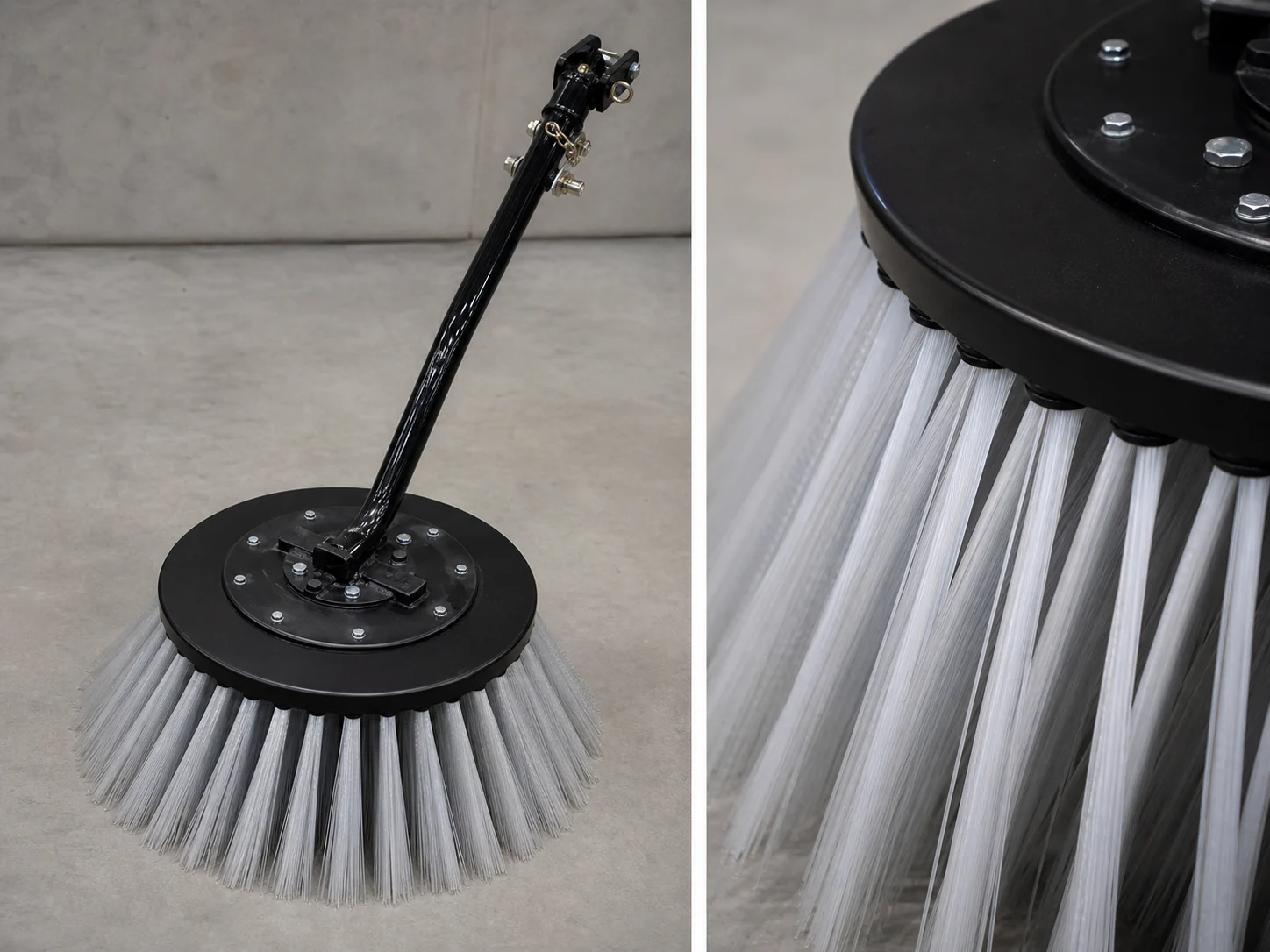
Medium brush
100 pcs
Minimum order
Worked with two hands or on a pole: chimney, gutter and pond-filter brushes, discs, cups and tank brushes.
Production lead time, once the specification is confirmed
- Up to 100 pcsWithin 7 days
- 101–5,000 pcsWithin 14 days
- 5,001–50,000 pcsWithin 21 days
- Over 50,000 pcsConfirmed with your quotation
Peak season can extend these times; the shipping date is confirmed in writing with your quotation. Sampling and shipping are quoted separately.
The 500 mm diameter PA66 side brush sweeps curbs, gutters, and pavement edges on municipal and compact road sweepers. Its nylon bristle ring throws dust, sand, gravel, leaves, and litter toward the main pickup path while the quick-change steel coupling keeps replacement downtime short.
What can this brush do for you?
Clears the curb and gutter line without leaving a dead band
The 500 mm sweep circle reaches from the side-broom arm to the curb face, so the brush can pull sand, gravel, leaves, and litter out of the gutter instead of pushing it along the machine path. The perimeter tufted ring throws materials inward toward the main broom or hopper pickup.
PA66 bristles recover their shape after repeated curb strikes
Bristle tips hit expansion joints, curb lips, and uneven pavement thousands of times per shift. PA66 nylon resists permanent set and matting, so the brush keeps a crisp flicking edge instead of flattening into a worn skirt.
Runs dry or damp without rotting or corroding at the contact face
PA66 stays serviceable when gutters are wet, and the powder-coated carbon steel plate protects the tuft block from road splash and de-icing residue. There is no natural fiber to rot and no metal bristle to corrode in normal sweeping conditions.
Quick-change coupling reduces road-call time
The central quick-change hub lets the operator drop the worn brush and fit the next one without re-drilling or adjusting the arm. Paired with the 500 mm standard diameter, this makes scheduled side-brush replacement a short stop rather than a shop job.
What is a 500mm PA66 Road Sweeper Side Brush?
A 500mm PA66 Road Sweeper Side Brush is a machine-mounted, disc-type gutter brush installed on the side-broom arm of a road sweeper. It is not a hand tool and has no handle; the sweeper itself rotates the brush and controls the down pressure. The bristle ring sweeps a circular path just outside the main frame, moving material from the curb, gutter, and pavement edge into the main broom pickup path.
The brush is built around a powder-coated carbon steel backing plate. PA66 nylon monofilaments are tufted around the plate perimeter and trimmed to a working length, typically 250 mm. The hub uses a quick-change coupling, so the complete brush is replaced as a unit. During operation the brush runs on a vertical or near-vertical shaft at a slight working angle; only a portion of the ring contacts the road at any moment, which spreads wear around the circle as the plate rotates.
The 500 mm diameter sets the width of the side cleaning band. Fit depends on the side-arm bolt circle, pilot hole, rotation direction, and chassis clearance more than on the debris being swept.
Technical Specifications
| Parameter | Value / Options |
|---|---|
| Brush diameter | 500 mm nominal |
| Brush form | Round disc-type side broom |
| Bristle material | PA66 nylon monofilament |
| Bristle trim length | 250 mm standard, project-adjustable |
| Bristle construction | Tufted around perimeter; tuft density and ring count matched to debris type |
| Backing plate | Powder-coated carbon steel |
| Mounting | Quick-change coupling; bolt-circle diameter, shaft pilot, and drive pattern set at order |
| Rotation direction | Clockwise or counterclockwise, selected for the sweeper side arm |
| Operating environment | Wet or dry concrete, asphalt, chip seal, and jointed hard pavement |
| Service temperature | -20°C to 70°C continuous |
| Brush type | Custom Road Sweeper Brooms |
| How it is driven | Machine-driven, mounted in the equipment |
| Cleaning target | municipal curb and gutter sweeping, parking lot and commercial pavement, and road construction and milling cleanup cleaning |
| Surface or part | curbs, edges, roads, gutters, pavement, hoppers, joints, and holes |
| Residue or debris | leaves, litter, sand, dust, gravel, carbon, and fiber |
| Mounting / connection | Quick-change coupling; bolt-circle diameter, shaft pilot, and drive pattern set at order; Clockwise or counterclockwise, selected for the sweeper side arm |
Where does this brush work best?
- Municipal curb and gutter sweeping: moves sand, dust, leaves, and litter from the curb face and parking lane into the main broom or hopper on truck-mounted and compact sweepers.
- Parking lots and commercial pavement: reaches island edges, drain grates, and expansion joints where the main broom has limited access.
- Road construction and milling cleanup: clears loose aggregate, millings, and soil from road shoulders and edge lines after paving or repair work.
- Industrial yard and warehouse apron sweeping: ride-on sweepers use the side ring to pull debris away from racking, curbs, and building edges.
- Seasonal leaf and debris cleanup: flicking action rolls wet leaves and twigs from the gutter so they can be collected.
How do I choose the right one?
Start with machine fit, not just diameter
The nominal 500 mm measurement is only half of the fit. Confirm the side-arm mounting hole circle, pilot bore, drive pin or keyway, and rotation direction. If the plate does not match the arm, the brush can wobble, wear unevenly, or sit at the wrong angle. Send the original plate drawing or a photo with measurements.
Match trim length and tuft density to debris
The 250 mm standard trim suits general street debris: sand, dust, loam, leaves, and light gravel. A longer trim follows uneven joints and crowned edges better but gives softer contact. A shorter trim is firmer and more aggressive on packed grit. Denser tufting improves fine-dust flicking, while a more open pattern helps leaves and bulky litter release rather than wrap.
Account for wet or abrasive service
PA66 is a strong general-purpose choice for wet and dry sweeping. If the route is dominated by sharp aggregate, millings, or frequent curb strikes, consider a heavier monofilament, additional rings, or a mixed-fill side brush. Continuous hot-asphalt work or high-temperature washing may justify a higher-temperature filament material.
Know when this is not the right brush
Use a steel-combination or more aggressive side brush for broken glass, scrap metal, or heavy construction debris that would chew through nylon quickly. Use a smaller side brush for narrow sidewalk sweepers where a 500 mm path is too wide. The side brush also feeds the pickup system; it does not replace the main broom, hopper, vacuum, or dust-suppression water spray.
Can I customize this brush?
Side brushes are fitted to a specific machine and route, so we build them to the sweeper arm rather than to a universal hub. The main information we need is the sweeper make or model, side-arm photo or drawing, mounting hole circle, pilot diameter, shaft rotation, desired trim length, and the main debris types.
- Diameter and trim length: 500 mm standard plus other diameters; trim length from shorter more aggressive to longer more conforming configurations.
- Bristle configuration: PA66 filament diameter, straight or crimped fiber, color, tuft count, ring spacing, and fill pattern.
- Backing plate: powder-coated carbon steel as standard; stainless steel or aluminum where corrosion or weight matters.
- Coupling or hub: bolt circle, pilot bore, keyway, drive pin, or quick-change latch geometry matched to the arm.
- Rotation direction: clockwise or counterclockwise, marked on the plate to prevent installation errors.
- Marking and packaging: identification marking on the plate, color-coded bristles, individual cartons, pairs, or bulk pallet packing.
If your route or contract requires material documentation, inspection, or project-specific compliance support, we can assist with those requirements during customization.
Which filament belongs on a 500mm PA66 road sweeper side brush, and how is that verified?
How do I confirm that this 500 mm side brush fits my sweeper?
Compare the mounting hole circle, pilot bore, and rotation direction against the existing side brush drawing. If you do not have a drawing, measure the current plate and note the sweeper model before ordering. A 500 mm brush needs enough side-arm clearance to avoid contacting the chassis or curb at full down pressure.
What should I inspect before installing the brush?
Check the backing plate for cracks or deformation, the mounting holes for elongation, and the quick-change coupling for wear or corrosion. Confirm the rotation direction marked on the plate matches the side-arm motor. Installing a side brush in the wrong rotation throws material away from the pickup path.
How do I know when to replace the side brush?
Measure the bristle trim length from the backing plate. Most routes replace the side brush when the trim is worn down by roughly one third to forty percent, or when the curb line still shows sand, leaves, or litter after a pass. Uneven wear concentrated on one side usually means the arm angle or down pressure needs adjustment rather than a premature brush change.
Will this brush remove material packed into cracks and expansion joints?
It clears surface debris along joints and at the edge of pavement, but it will not pull out material packed below the road surface. Deep joint or pothole material still needs air lancing, manual picking, or a separate mechanical operation. The side brush moves loose material into the main pickup path; it is not the pickup system itself.
Does PA66 get soft when sweeping wet roads?
PA66 stays tough in damp conditions and will not rot or corrode, although a small temporary stiffness change is normal when the bristles absorb moisture. The brush works through routine wet sweeping. If your process uses high-temperature washing or steam, keep the brush within the -20°C to 70°C service range.
When should I choose a different side brush material or diameter?
Choose a steel-combination or abrasive fill for broken glass, metal fragments, or heavy construction debris. Choose a different diameter if machine clearance or turning radius cannot accept 500 mm. Choose a softer or smaller brush for decorative paving, narrow sidewalks, or areas where curb separation is less critical.
Guides that go deeper on this
Custom Manufacturing RFQ
Describe Your Application
To quote this brush accurately, send the size, material, cleaning target, residue, quantity, and any available drawing or sample photo.
Drawing or photo optional — it speeds things up, it does not gate the enquiry.
Custom Brush RFQ
Send Your Brush Project
Upload a drawing, product photo, or sample photo and provide the core dimensions and cleaning conditions.
“We need a brush to remove wet residue from a stainless steel conveyor, about 800mm wide. The current brush wears quickly. We can send photos.”
“We sell drinkware and need a cleaning brush to include with the product. Quantity around 5,000 pieces.”