
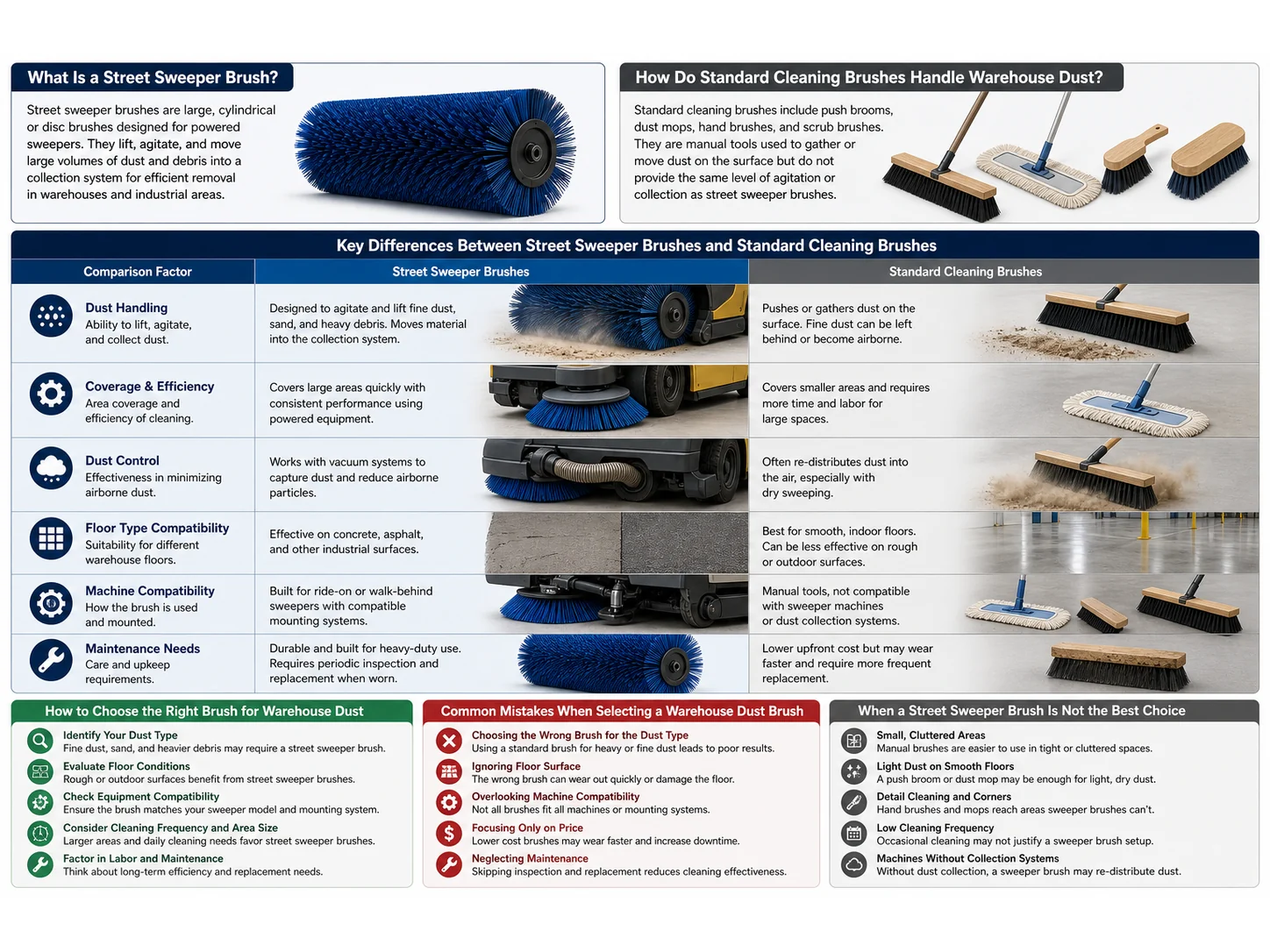
What Is a Street Sweeper Brush?
A street sweeper brush is a cylindrical or segmented brush designed to attach to the main or side broom assembly of an industrial sweeper machine. It uses densely packed bristle filaments—usually polypropylene, wire, or a blend—to scrub and flick fine particles, sand, and light debris directly into a hopper or dust-collection system. Unlike a handheld brush, it rotates at high speed under mechanical power, making it effective for large open areas, high-traffic warehouse aisles, and spaces where fine dust reaccumulates quickly.
How Do Standard Cleaning Brushes Handle Warehouse Dust?
Standard cleaning brushes for warehouses include:
- Push brooms: good for coarse debris but often push fine dust around rather than capture it.
- Deck brushes / scrub brushes: useful for wet scrubbing smaller areas, but labor-intensive for daily whole-warehouse upkeep.
- Dust mops: attract fine particles but require frequent treatment and can lose effectiveness on textured concrete.
- Handheld wire brushes: aggressive on caked-on deposits but impractical for floor-scale dust.
These tools rely on manual effort, have limited dust containment, and can actually aerosolize fine dust, moving the problem into the air rather than removing it. For sub-10‑micron dust in a 50,000 sq ft warehouse, manual methods are rarely efficient or consistent.
Key Differences Between Street Sweeper Brushes and Standard Cleaning Brushes
| Factor | Street Sweeper Brush | Standard Cleaning Brush |
|---|---|---|
| Mounting & Interface | Machine‑mounted via core, flange, or quick‑change hub | Manual handle, screw‑on block, or Velcro pad |
| Typical Diameter | 8″–36″ (cylindrical) or side brush disc up to 30″ | 3″–36″ (broom head or block), but no rotating power |
| Bristle Material | Polypropylene (PP), nylon, wire, or abrasive‑filled blends | PP, tampico, horsehair, wire, microfiber |
| Stiffness & Aggression | Measurable filament gauge (0.020″–0.060″) and trim length; designed for high‑speed contact | Varies widely; often compromises between stiffness and sweep‑ability |
| Dust Control | Works with skirts and vacuum/dust‑collection system; captures particles | Typically no containment; can raise airborne dust |
| Surface Sensitivity | Can be too aggressive for polished or coated floors without correct filament choice | Softer options available; easier to protect sensitive surfaces |
| Cost & Complexity | Higher upfront; ongoing filament replacement; requires compatible sweeper | Lower initial cost; low mechanical complexity; labor cost can be high over time |
| Coverage Rate | 20,000–100,000+ sq ft per hour depending on machine width | 2,000–5,000 sq ft per hour per person |
How to Choose the Right Brush for Warehouse Dust
Use these decision factors to match the brush to your operation:
- Residue type: light, dry dust suits polypropylene; oily or sticky residue may require a wire blend or abrasive filament. Standard brushes can handle spot cleaning but lack the pickup efficiency of a sweeper brush with a hopper.
- Surface sensitivity: polished concrete or epoxy floors may scratch under a stiff street sweeper brush. In those cases, a softer nylon filament or a dust mop might be safer—or select a sweeper brush with flagged (split‑end) tips.
- Equipment interface: confirm the brush core diameter, drive type (locking pin, snap‑ring, keyway) matches your sweeper model. Standard brushes require no interface, but they also provide no mechanical advantage.
- Wet or chemical exposure: if floors are washed or exposed to mild chemicals, polypropylene resists degradation better than natural fibers. Wire brushes can rust if not stainless. Standard brushes with wood blocks may swell.
- Hygiene expectations: food or pharma warehouses often need non‑absorbent, FDA‑compliant filaments. A street sweeper brush can be specified with food‑grade polypropylene and a sealed core; standard brushes may harbor bacteria in wood or fiber mixes.
- Maintenance frequency: high‑cycle operations benefit from a quick‑change sweeper brush that can be swapped in minutes. Manual tools require less frequent replacement but more labor hours.
- Custom size requirements: odd aisle widths or machine clearance may demand a custom brush diameter or trim. Many suppliers offer cut‑to‑length cylindrical brushes; standard brushes are mostly off‑the‑shelf sizes.
Common Mistakes When Selecting a Warehouse Dust Brush
- Choosing by cost drivers alone: a low‑cost push broom may seem cheaper, but the hidden expense is labor hours and poor dust control that can damage inventory or trigger health complaints.
- Ignoring filament memory and wear: a poly brush that bends permanently after heavy use will no longer flick dust effectively. Always check filament gauge and heat‑set memory for your dust load.
- Mismatching the brush core to the machine: even a slight difference in core ID (e.g., 2‑3/8″ vs. 2‑1/2″) can cause slippage or vibration, reducing sweeping performance and damaging the drive.
- Overlooking dust containment: a street sweeper brush without the proper skirt or vacuum setting will blow dust sideways. Pair it with the full dust‑control system.
- Assuming one brush fits all seasons: winter salt, summer humidity, or occasional spills may call for a filament change. Keep two brush types on rotation if conditions change.
When a Street Sweeper Brush Is Not the Best Choice
A street sweeper brush can be overkill—or simply the wrong tool—in these scenarios:
- Small, tightly packed storage areas where a ride‑on sweeper cannot maneuver; a dust mop or backpack vacuum with a brush tool is more practical.
- Polished or coated floors that will show micro‑scratches even from soft polypropylene. Order a sample brush section and test before committing to a full machine run.
- Wet, sticky debris such as syrup or grease: a street sweeper brush may smear the residue rather than pick it up. A scrubber with a cylindrical scrub brush or a deck brush with hot water is better.
- Limited budget and small area (under 5,000 sq ft). The machine + brush investment may not pay back in labor savings. A high‑quality push broom with dust‑control pan may suffice if used consistently.
- Frequent need for brush drawing or custom engineering review: if your dust contains irregular particles or you need a complex profile, request a supplier drawing and sample test before finalizing the street sweeper brush order. Standard brushes rarely need this step.
Final Takeaway: Matching the Brush to the Dust Challenge
For large‑scale warehouse dust, a street sweeper brush mounted on a properly set up sweeper machine will outperform any manual brush in speed, dust containment, and consistency. Standard cleaning brushes still earn their place in tight spaces, delicate surfaces, and spill‑response. The best choice starts by defining your dust type, surface tolerance, and machine compatibility—then selecting the filament, core, and stiffness that make dust disappear instead of just relocate.
Frequently Asked Questions
Can I use a street sweeper brush on a standard floor scrubbing machine?
No. Street sweeper brushes are designed for dry sweeping machines with vacuum/dust‑collection systems. Scrubbing machines use disc or cylindrical brushes with different core mountings and lower RPM, typically for wet cleaning. Using the wrong brush can damage both the brush and the machine.
How often should I replace a street sweeper brush in a dusty warehouse?
Replacement depends on hours run, filament wear, and the abrasiveness of the dust. In a high‑dust warehouse running 8 hours a day, check the brush weekly for bristle length. When trim length wears below 50% of its original or filaments lose stiffness, it’s time to replace. Many warehouses budget for a change every 3–6 months.
Does a street sweeper brush work on uneven warehouse floors?
Yes, but only if the sweeper’s floating head and the brush’s filament flexibility are matched to the floor variation. Stiff filament on a severely pitted floor can break bristles and leave dust behind. A softer or flagged filament often bridges small gaps better.
What’s the difference between a side brush and a main brush on a street sweeper?
The main brush is a cylindrical roller that sweeps directly into the hopper. Side brushes are disc-shaped and rotate vertically to pull dust and debris from edges and corners toward the main brush path. Both are considered street sweeper brushes and must be ordered to manufacturer instructions specs for your machine.
Can I wash and reuse a street sweeper brush?
Most polypropylene brushes can be rinsed with water and mild detergent, but soaking or using strong chemicals can weaken the filament and damage the core. Always let the brush dry completely before reinstalling to prevent mildew and core corrosion. Wire brushes should be dried immediately to avoid rust.
Are there food‑grade street sweeper brushes for warehouses that store food?
Yes. Look for brushes with polypropylene filaments and a polypropylene or stainless steel core that meet FDA or EU food‑contact material requirements. These brushes use non‑absorbent materials and avoid metal fill that could shed. Always verify the brush’s compliance documentation before purchase.
How do I know if my warehouse dust requires a wire‑filament street sweeper brush?
Wire filaments are for heavy, coarse, or sticky debris—not fine dust. If your dust is fine and dry, a polypropylene or nylon brush engages better. If the dust includes metal shavings, caked mud, or oily residue, a wire‑poly blend can help, but test first: wire may abrade your concrete and create sparks in flammable dust environments.
Technical References
Which bristle material fits this job — Nylon PA, AISI 304 Stainless Steel Wire or Polypropylene PP?
| Material | Continuous temperature (°C) | Peak temperature (°C) | Water absorption | Hardness |
|---|---|---|---|---|
| Nylon PA | 93 | 121 | 0.3–9% by PA grade and conditioning | Medium to firm; filament diameter and trim length control bending force. |
| AISI 304 Stainless Steel Wire | 400 | 500 | 0% | Rockwell B 70–95 depending on temper and cold work |
| Polypropylene PP | 80–100 | 120–140 | ≤0.03% | Shore D 65–75 |
| Microfiber | 80–120 | 140–170 | 0.2–1.0%Material Itself ; Structure Can Absorb 3–7 Times Its Own Weight | — |
Figures as published by Brushtec / DuPont; Alleima; Perlon. Confirm the exact grade against the supplier datasheet before ordering.
When are Road Sweeper Brooms the wrong choice?
- Road Sweeper Brooms — Use vacuum-only pickup, plow, pressure wash, or milling for fine airborne dust, packed ice, or bonded deposits.
- Nylon PA — The nylon family spans several grades, so heat, moisture and chemical limits should follow the selected PA resin rather than a generic nylon value.
- AISI 304 Stainless Steel Wire — Avoid using AISI 304 as the default in marine, brine, hypochlorite, and persistent chloride environments; use AISI 316 when higher pitting and crevice-corrosion resistance is required.
- Polypropylene PP — Avoid high-temperature brushing or heavy abrasion where nylon/abrasive nylon is needed.
What should replace Road Sweeper Brooms when they stop working?
- Road Sweeper Brooms — Road-sweeper brooms prioritize debris pickup, gutter reach, impact resistance, surface following, and dust control; floor-machine brushes prioritize scrubbing chemistry, controlled downforce, and indoor floor finish. Closest alternative: Floor Scrubber Sweeper Brushes.
- Nylon PA — Compare Nylon PA with PP, PBT, PET. Change material when wet stiffness, temperature, chemical resistance, conductivity, particle shedding, or surface marking becomes the limiting factor.
- AISI 304 Stainless Steel Wire — Use AISI 316 stainless steel wire for chloride, marine, dairy, beverage, chemical washdown, or higher pitting-resistance requirements. Use carbon steel for dry aggressive cutting and brass or abrasive nylon for lower marking risk.
- Polypropylene PP — Compare Polypropylene PP with Nylon, PBT, PET. Change material when wet stiffness, temperature, chemical resistance, conductivity, particle shedding, or surface marking becomes the limiting factor.