
Material
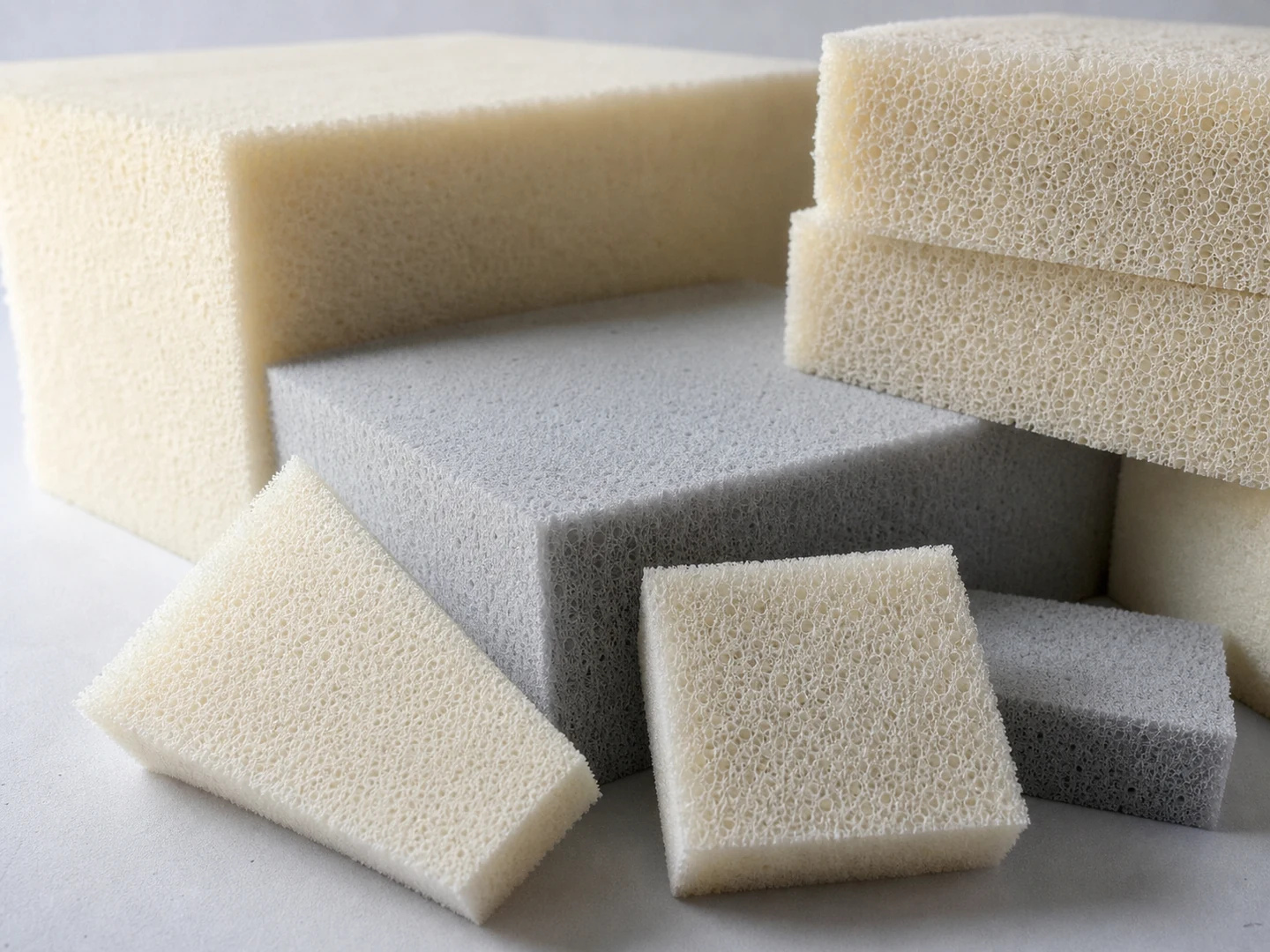
PU Sponge
Polyurethane porous material
Choose PU Sponge based on its stiffness, recovery, wear, wet-service, chemical, and temperature behavior. For a usable stiffness specification, provide the material, filament diameter, free trim, density, grade, and operating conditions.
Datasheet values
- Foam form
- Open- or closed-cell polyurethane sponge selected by wiping and liquid-transfer duty
- Density / pore size
- Grade-specific; use the selected foam supplier data
- Temperature use
- Formulation specific; validate the exact foam, adhesive and assembly
- Water uptake
- Open-cell grades can absorb and transfer liquid; capacity is grade specific
Polyurethane sponge is a cellular elastomeric material available in ether- and ester-based chemistries with different water, microbe and solvent responses.
What is PU Sponge, and where is it used?
PU Sponge belongs to the polyurethane porous material group, supplied as sponge head and foam roller, drawn in sheet, porous body and molded shape sections and set in straight rows, helical, staggered, zoned, wavy and random fill patterns.
PU Sponge is used in custom cleaning brushes for wiping, coating, liquid metering and drying rollers selected by pore size, density and wet recovery.
The realistic alternatives are PVA Sponge. What separates them here is working temperature, not headline strength.
Compare PU Sponge with PVA, PVC sponge, PP sponge. Change material when wet stiffness, temperature, chemical resistance, conductivity, particle shedding, or surface marking becomes the limiting factor.
What stiffness and contact pressure can I expect from PU Sponge?
PU Sponge is soft absorbent contact material; hardness/compression is controlled by foam or sponge density. Contact pressure here comes from cell density and from how far the sponge is compressed in use. Specify thickness and density: a soft thick sponge follows a curved or textured surface, a denser one keeps pressure on a flat face without collapsing.
Published ranges for the material itself. A finished brush runs below them, because the contact face carries load and heat at the same time.
| Property | PU Sponge | PVA Sponge |
|---|---|---|
| Shore hardness | Soft absorbent contact material; hardness/compression is controlled by foam or sponge density. | Soft absorbent contact material; hardness/compression is controlled by foam or sponge density. |
| Continuous temperature (°C) | 80 | 60 |
| Peak temperature (°C) | 110 | 90 |
| Water absorption, 24 h | Not applicable (Closed-Cell / Sheet Structure; Grade Dependent) | Not applicable (Closed-Cell / Sheet Structure; Grade Dependent) |
| Filament diameter (mm) | Not applicable (Sheet / Foam Structure) | Not applicable (Sheet / Foam Structure) |
| Flexibility | Low to High Flexibility(Structure Dependent) | Low to High Flexibility(Structure Dependent) |
The part people get wrong: stiffness is not a property of the material on its own. A thick low-density pad and a thin dense one in the same grade behave nothing alike. Fix thickness and density first, then confirm the material.
How does water affect PU Sponge performance?
A sponge has no filament absorption figure — what matters is how much liquid the open cells pick up and how much they give back under pressure.
Open-cell sponge grades are selected for liquid pickup and transfer; water uptake and recovery depend on the exact foam chemistry, density and pore structure.
What this means for your application: a saturated sponge is softer and heavier, and it stops picking anything up once the cells are full. Contact pressure falls as it loads, not as it swells.
A practical check: weigh a sample dry, saturate it and weigh it again, then squeeze it out and weigh it a third time. What it gives back is the number that matters, not what it holds.
What temperature limits apply to PU Sponge?
Polyurethane foam temperature capability is formulation specific. Use the continuous and intermittent temperature limits for the exact foam grade, adhesive, and finished brush assembly rather than a generic polyurethane number.
Where it stops working: A face that stays compressed after the load comes off means the answer is a different compound or foam grade, not more thickness.
The usable limit also moves with thickness, density and how hard the face is pressed. A thick low-density pad under light load tolerates more than a thin dense one under heavy pressure.
What chemicals attack PU Sponge?
Polyurethane foam chemistry and cell structure change solvent, water and oxidizer resistance. Confirm the exact foam grade against the cleaner and exposure conditions.
The same cleaner can be harmless or destructive depending on how strong it is, how hot it runs and how long it sits. Quote the concentration and the dwell time, not just the product name.
Before you commit to a quantity: Give the grade and cell density, the sheet or block thickness, and the cut shape and backing. Then say whether it runs wet, at what temperature, and what cleaner it meets.
What thickness and density should I specify for PU sponge?
PU sponge is supplied as sheet, porous body and moulded shapes, 3–100 mm thick. Thickness and cell density decide contact pressure: thickness sets how far the face can compress before it bottoms out, and a thin pad on a hard backing runs out of travel and starts skidding instead of wiping.
A soft thick sponge follows a curved or textured surface; a denser one keeps pressure on a flat face without collapsing. Give the cut profile and what the pad is backed with along with the two figures.
Finishing available on this material: cutting, perforation and composite coating.
What applications typically use PU Sponge?
Wiping, coating, liquid metering and drying rollers selected by pore size, density and wet recovery.
The applications that keep coming back to this grade:
- Bottle & Container Cleaning
- Cup & Mug Cleaning
- Hydration Bag Cleaning
- Laboratory Tube Cleaning
- PCB Cleaning
- Connector & Slot Cleaning
The constructions that usually carry it:
- Custom Handheld Detail Brushes
- Custom Roller and Conveyor Brushes
- Custom Tube & Pipe Bore Brushes
If the sample comes back rejected: Pore structure, foam chemistry, adhesive, and cleaner all affect service life; confirm the exact grade for solvent exposure, repeated washdown, or abrasive contact.
How do I specify PU Sponge for a custom brush?
A usable specification carries the construction, the thickness and density or Shore figure, the cut shape and backing, and the service conditions: wet or dry, temperature, and what the cleaner actually is.
The mistakes that most often send a sample back:
- Selecting PU Sponge from the material name alone without setting thickness, density or Shore hardness, and the cut shape
- Using dry stiffness to predict wet behavior without checking moisture absorption or liquid exposure
- Ignoring trapped abrasive particles, chemical concentration, temperature, or contact motion when assessing surface risk
Reference standards behind the figures on this page: ISO 527-1:2019; ASTM D638; ISO 62:2008; ASTM D570-22; ISO 868:2003; ASTM D2240-15(2021); ISO 4892-3:2024; ASTM G154-23; UL 94.
Source: AION Co., Ltd. — Polyurethane Sponge. AION supports polyurethane sponge as liquid-absorbing/wiping media with performance determined by foam structure and grade. Finished-brush temperature and chemical limits require the exact foam and assembly.
What else does the datasheet specify for PU Sponge?
| Filament cross-section | Sheet / Porous Body / Molded Shape |
|---|---|
| Electrical behaviour | Insulating |
Questions this page is asked
How should PU sponge be qualified for repeated water, cleaner or solvent exposure?
Use the actual fluid, concentration, temperature, dwell, compression, rinse and drying cycle on the complete sponge, bond and core, then measure swelling, mass, dimensions, hardness, tensile integrity, compression recovery, cracking and bond movement. Repeat for the required service duration, because hydrolysis and solvent response depend on formulation and temperature and can differ even within the same polyurethane family.
Which measurements release a PU sponge for liquid metering or wiping?
At controlled compression, speed, fluid supply and workpiece variation, measure film or pickup uniformity, residual liquid, streaks, drag, temperature and recovery after unloading. Repeat through wear and cleaning cycles and retire the sponge when permanent set, pore damage, fragments, surface glazing or adhesive movement drives contact or liquid delivery outside the approved band.
Where these figures come from
| Property | Published value | Source |
|---|---|---|
| Chemical resistance | Compatible with water and mild detergent; solvent and oxidizer resistance follows the fiber, foam and binder chemistry. | Covestro Retrieved 2026-07-20 |
| Published datasheet figures |
|
Covestro Retrieved 2026-07-20 |
| Hardness and stiffness | Soft absorbent contact material; hardness/compression is controlled by foam or sponge density. | Covestro Retrieved 2026-07-20 |
| Limitations | Not for strong solvents or abrasive surface finishing without grade data. | Covestro Retrieved 2026-07-20 |
| Temperature resistance | -20 to 80°C. | Covestro Retrieved 2026-07-20 |
| Water resistance | Absorbent porous structure for wiping, washing, drying and liquid transfer. | Covestro Retrieved 2026-07-20 |
Guides that go deeper on this
We have not written a guide specific to this one yet. The material that covers selection, filament, dimensions, maintenance and sourcing is collected in the technical resources library.
No catalogue item for this yet
Every brush here is made to order, and this one has no catalogue entry so far. Send the working surface, the residue, the access opening and the quantity, and it is quoted through the same specification route as the rest of the range.
Custom Manufacturing RFQ
Discuss This Material
Share the working surface, residue, dimensions, material direction, interface, quantity and drawing or sample photo.
Custom Brush RFQ
Request a Custom Cleaning Brush Quote
Upload a drawing, product photo, or sample photo and provide the core dimensions and cleaning conditions.
“We need a brush to remove wet residue from a stainless steel conveyor, about 800mm wide. The current brush wears quickly. We can send photos.”
“We sell drinkware and need a cleaning brush to include with the product. Quantity around 5,000 pieces.”