
Custom Cleaning Brush
Sponge Window Brush
Head widths 100 to 300 mm put a broad contact face on wide panes, with an optional squeegee blade that pulls the dirty water off in the same pass.
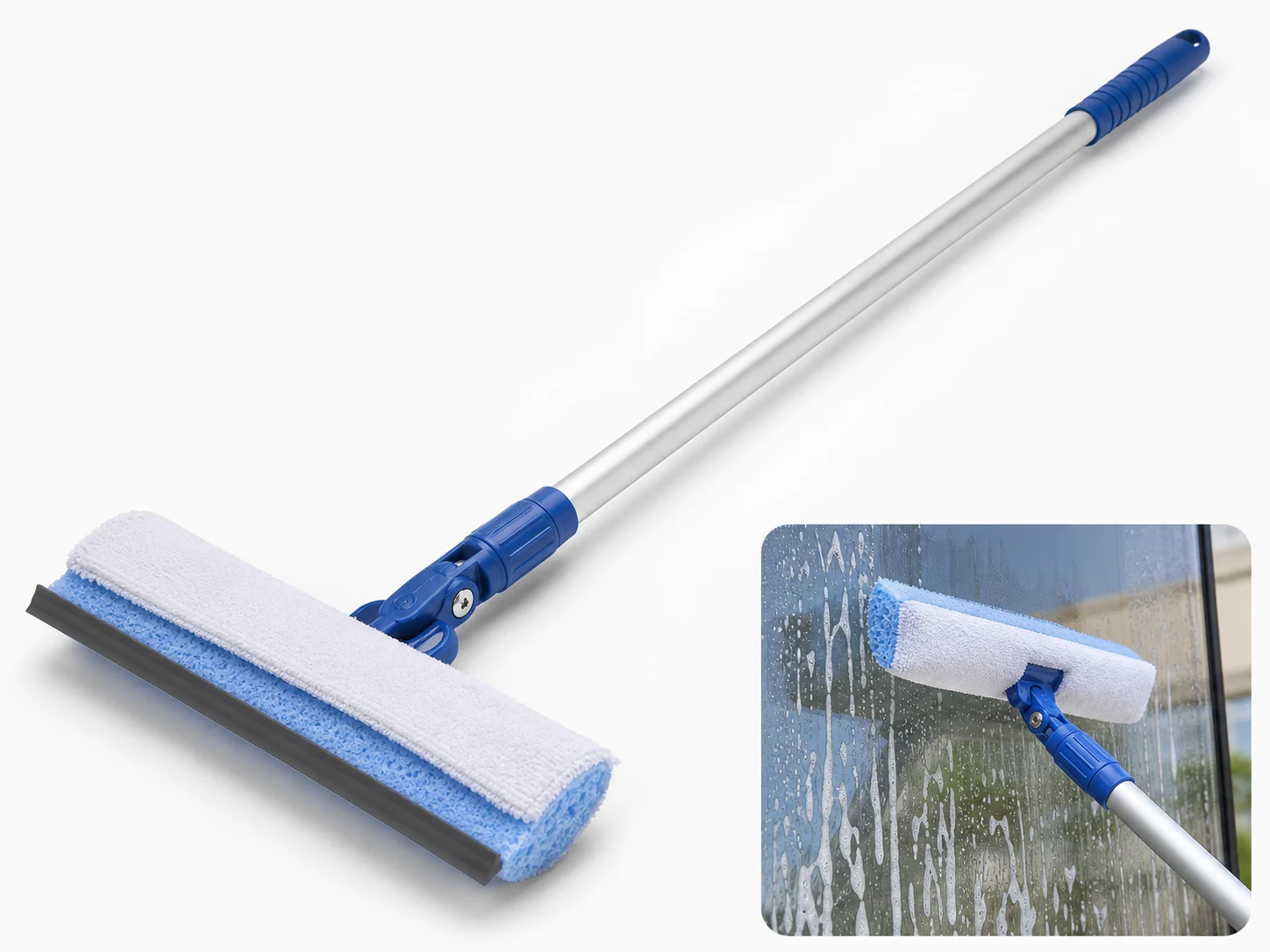
Medium brush
100 pcs
Minimum order
Worked with two hands or on a pole: chimney, gutter and pond-filter brushes, discs, cups and tank brushes.
Production lead time, once the specification is confirmed
- Up to 100 pcsWithin 7 days
- 101–5,000 pcsWithin 14 days
- 5,001–50,000 pcsWithin 21 days
- Over 50,000 pcsConfirmed with your quotation
Peak season can extend these times; the shipping date is confirmed in writing with your quotation. Sampling and shipping are quoted separately.
A soft-contact sponge window brush built for wet-cleaning flat glass, coated panels, and large glazing surfaces. The absorbent scrub face loads and agitates cleaning solution across wide panes, while an optional integrated squeegee blade pulls dirty water off in the same pass.
What can this brush do for you?
Covers wide panes in fewer, more even strokes
Head widths from 100 mm to 300 mm put a broad, continuous contact band on the glass. On storefront glazing, curtain-wall lights, and large production sheets, that means faster coverage, more uniform wetting, and fewer overlapping passes that can leave wet edges or streaked strips.
Scrubs without scratching coated or low-E surfaces
The working face is soft open-cell sponge, not abrasive filament. PU and PVA faces lift dust, glass fines, polishing slurry, and light oil film without the bristle-tip scratching that can damage coated glass. For low-E, tinted, or otherwise surface-sensitive panels, the contact stays compliant against the pane.
Wets, scrubs, and clears water with one head
When the brush is configured with a squeegee blade on the opposing edge, the operator scrubs the surface, then flips the head and pulls the released water away immediately. Dirty solution does not have time to dry back onto the glass, which is the main cause of spotting and rework.
Holds enough solution to keep the stroke wet end to end
Open-cell PU sponge absorbs a large volume of water or detergent relative to its weight and releases it under light pressure, so the leading edge stays wet through the full stroke. PVA sponge releases fluid even more evenly, which reduces dry-line flash-off on warm glass.
Reaches overhead and high glass without changing tools
The head accepts a fixed handle or a standard extension-pole interface, so an operator can scrub a transom, atrium panel, or second-story shop window from floor level. The foam face stays controllable on a pole because the wide contact area evens out the applied pressure.
The contact face can be replaced instead of the whole tool
Sponge inserts or replaceable sleeves let a crew rotate wet foam between rinses and swap in a fresh face when the old one no longer releases cleaner properly. That extends the useful life of the head, blade, and handle.
What is a Sponge Window Brush?
A Sponge Window Brush is a hand-guided wet-cleaning tool for flat or gently curved glass and coated panels. The business end is a soft, absorbent sponge face carried on a rigid plastic head; most configurations add a rubber or synthetic squeegee blade on the opposite edge and a handle or pole mount at the back.
In use, the operator saturates the sponge with water or a dilute cleaning solution, presses it to the glass, and works the surface with overlapping strokes to loosen dust, process particles, oil film, and water-soluble residues. If a blade is fitted, the tool is then reversed and the flexible lip is pulled across the wet surface to clear the spent solution. The result is clean, mostly dry glass that can be inspected or followed by a separate detailing pass.
The sponge face does the loosening; the blade does the separating. That division matters when cleaning a surface that cannot tolerate aggressive scraping or stiff bristles but still needs visible residue removal, such as coated sheet before lamination, tempered glass before inspection, or architectural glazing at the end of a build.
The two most common contact materials are PU sponge and PVA sponge. PU is tough, rehydrates easily after drying, and is a good general-purpose scrub face. PVA absorbs more water, releases it more evenly, and leaves fewer streaks, but it hardens when allowed to dry completely and must be re-soaked before use. The supporting head is normally PP or nylon, selected for detergent resistance and long-term water contact.
A sponge window brush is a maintenance and finishing tool, not a scraper. It will not remove cured silicone, paint, cement droppings, or hard mineral scale, and it is not intended for dry dusting. Those jobs need the appropriate remover or a different tool before or after the brush does its work.
Technical Specifications
The dimensions below are typical working ranges for a production sponge window brush. Width, reach, sponge type, and blade configuration are normally set to the pane size and the cleaning method.
| Parameter | Value / Options |
|---|---|
| Product form | Sponge scrub face with handle; squeegee blade optional on the opposing edge |
| Head width | 100–300 mm, selected to pane width and frame clearance |
| Sponge contact face | PU sponge, PVA sponge, or microfiber-covered PU; thickness approx 20–50 mm |
| Squeegee blade | Natural rubber, EPDM, or silicone; single or dual lip; optional |
| Blade profile | Straight, beveled, or dual-edge; length matched to head width |
| Backing plate / head body | PP, PA (nylon), or ABS; detergent-resistant, water-tolerant |
| Handle | Fixed PP/TPE grip; or adapter plate with standard tapered/threaded pole socket |
| Overall length | 200–600 mm fixed; extendable pole available for high reach |
| Head articulation | Fixed, swivel, or locking-swivel; selected by operator preference and pole use |
| Operating environment | Ambient aqueous cleaning; light to moderate detergent solutions; contact materials selected for chemical exposure |
| Cleaning target | Flat glass, coated sheet, low-E/tinted panels, glazing, smooth panel surfaces |
| Brush type | Custom Handheld Detail Brushes |
| How it is driven | Hand-guided |
| Surface or part | glass, panels, coated panels, sheets, coated sheets, flat glass, panel surfaces, and edges |
| Residue or debris | dust, fines, slurry, glass fines, polishing slurry, process particles, oil film, and paint |
| Mounting / connection | Fixed |
All width, thickness, blade, and pole-connection values are project variables. We set the final configuration from the pane size, glass or coating type, detergent, and reach method provided with the inquiry.
Where does this brush work best?
- Storefront, curtain-wall, and interior architectural glass — wide panes, high reach, and visible finish where streaking or scratching is a customer-facing defect.
- Glass fabrication and processing lines — cleaning panel surfaces, coated sheets, and smooth support areas between cutting, edging, and inspection; removes glass fines, polishing slurry, process particles, and coolant film with a non-scratch contact face.
- Coated, low-E, and tinted glass handling — when the coating would be damaged by stiff bristles or abrasive pads but still needs a wet scrub before lamination, tempering, or quality inspection.
- Solar panel and smooth-panel maintenance — large modules where an even, soft wetting pass followed by a squeegee clears dust and light soiling without the abrasive contact of a hard brush.
- Facility and custodial contracts — repeated daily or weekly window cleaning where a two-sided scrub-and-wipe tool cuts the time for each glass run and keeps replaceable contact faces in rotation.
How do I choose the right one?
Start with the largest pane or panel in the run. The head should cover a meaningful fraction of the pane width without being wider than the smallest opening around frames, mullions, or glazing channels. A 300 mm head clears big storefront lights quickly but can be clumsy on a 450 mm split window; there, a 150–200 mm head gives better control and less water carry-over onto the frame.
Select the sponge by what needs to be removed. PU sponge is the stronger scrubber for glass fines, polishing slurry, and oil film, and it can be dried and rehydrated repeatedly without degrading. PVA sponge is the better choice when streak-free release matters more than scrubbing force, but the crew needs to keep PVA wet between uses. A microfiber cover adds dust capture and a gentler touch on coated or low-E glass.
If the glass will be left to dry after scrubbing, include the squeegee blade. Natural rubber gives a smooth, chatter-free pull on interior and mild-environment glazing; EPDM or silicone lasts longer where heat or stronger cleaning chemicals are involved. For tall pole work, a swivel head follows the surface and keeps the blade lip seated; for close-up scrubbing of process residues, a locking or fixed head transmits more pressure to the slide.
The handle or pole connection has to match the operation’s existing reach system. Confirm the thread or cone fitting before ordering a new batch, or request the adapter pattern used by the crew.
| Condition | Suggested configuration |
|---|---|
| Streak-sensitive architectural glass, daily cleaning | PVA sponge with natural rubber blade and swivel head |
| Glass fabrication slurry or fines on coated panels | PU or microfiber-covered PU sponge, fixed or locking head, water rinse after each stroke |
| High overhead or extension-pole work | Wide head with swivel and standard pole adapter |
| Narrow frames or segmented windows | Narrower 100–150 mm head with shorter blade |
| Hot glass or strong detergent exposure | EPDM or silicone blade with PP or nylon head body |
Choose a different tool when the deposit is cured silicone, paint, adhesive, mortar, or hard water scale. A window scraper or chemical softener should remove those first. If the surface is profiled, textured, or heavily loaded with dry dust, a soft sponge will not provide enough mechanical action or dirt capacity; use a dusting wand, rinse, or scrub brush appropriate to the surface.
Can I customize this brush?
Yes. Window cleaning heads are ordered to pane size, reach, and cleaning method, so the main dimensions and materials are configurable rather than fixed. To get a usable configuration, provide the pane or panel dimensions, the glass or coating type, the residues being removed, the detergent or cleaning chemical, the pole system if used, and whether the operator needs a built-in blade or will use a separate squeegee.
We can adjust:
- Head geometry — width, depth, overall profile, beveled or rounded sponge ends for frame clearance, and head thickness.
- Sponge contact — PU, PVA, or microfiber-covered foam; pore size, density, thickness, and hardness matched to residue and coating sensitivity.
- Squeegee blade — rubber, EPDM, or silicone; durometer, lip angle, single or dual lip, and length.
- Head body and articulation — PP, nylon, or ABS; fixed, swivel, or locking-swivel joint.
- Handle and pole interface — fixed grip, TPE overmold, straight or angled stem, and standard tapered, threaded, or quick-connect pole fittings.
- Replaceable media design — snap-in sponge cartridge, hook-and-loop sleeve, or full replacement head for scheduled change-out.
- Color, marking, and packaging — custom colors, pad-print or laser marking, bulk pack, retail blister, or project-specific labeling.
If the glass line or facility requires material documentation, inspection support, or third-party testing for a customer specification, that can be built into the project scope during customization.
When is a sponge window brush worn out rather than just dirty?
How do I get streak-free results on large panes?
Keep the sponge evenly loaded with solution, scrub the full pane in overlapping strokes, and pull the squeegee at a low angle with a slight overlap on each pass. Wipe the blade lip between pulls. If streaks persist, reduce detergent concentration, switch to PVA, or rinse the glass with clean water before the final pull.
Why do PVA sponge brushes need to stay wet?
PVA hardens as it dries and will not absorb water or release cleaner properly until re-soaked. If the brush is stored dry, submerge the sponge in warm water for 10 to 15 minutes before use. PU sponge can dry and rehydrate more easily, which is why crews often prefer PU for tools that sit idle between shifts.
How can I tell when the sponge or blade needs replacement?
Replace the sponge when it flattens under light pressure, no longer holds solution across the stroke, or shows torn edges that contact the glass unevenly. Replace the blade when the lip has nicks, waves, or a rounded edge that leaves water trails. Both are normal wear items and are cheaper to change than reworking a finished pane.
Can this brush remove silicone, paint, or hard mineral scale from glass?
No. A sponge face is designed for water-soluble soil, dust, light oil film, slurry, and process particles. Cured silicone, paint, cement, or mineral scale should be softened or scraped with the correct surface-safe remover first, then followed by the sponge brush for final cleaning and squeegee drying.
Will the sponge scratch coated or low-E glass?
The sponge itself is non-abrasive and will not scratch a coating under normal pressure. The real risk is abrasive particles trapped in the foam. Rinse the sponge before each shift, use separate brushes for fabrication areas and final coated glass, and never use a sponge that previously picked up glass fines or grit on a low-E coating without cleaning it first.
How can I check the brush before starting a cleaning run?
Make sure the PVA sponge is fully rehydrated, the sponge face is free of embedded grit, the blade lip is clean and continuous, and the head joint locks if it has a swivel. If the pole connection has any looseness at the thread or cone, correct it before lifting the head overhead; a loose head on an extended pole is a glass breakage hazard.
Guides that go deeper on this
We have not written a guide specific to this one yet. The material that covers selection, filament, dimensions, maintenance and sourcing is collected in the technical resources library.
Custom Manufacturing RFQ
Describe Your Application
Please share the brush dimensions, working area, residue type, material direction, quantity, and a drawing or photo for quotation.
Drawing or photo optional — it speeds things up, it does not gate the enquiry.
Custom Brush RFQ
Send Your Brush Project
Upload a drawing, product photo, or sample photo and provide the core dimensions and cleaning conditions.
“We need a brush to remove wet residue from a stainless steel conveyor, about 800mm wide. The current brush wears quickly. We can send photos.”
“We sell drinkware and need a cleaning brush to include with the product. Quantity around 5,000 pieces.”