
Custom Cleaning Brush
Baby Bottle Cleaning Brush Long Handle Nylon Bristle Sponge
Long-handle baby bottle brush with soft nylon bristles and PU sponge tip for milk film, formula residue, and curved bottle interiors.
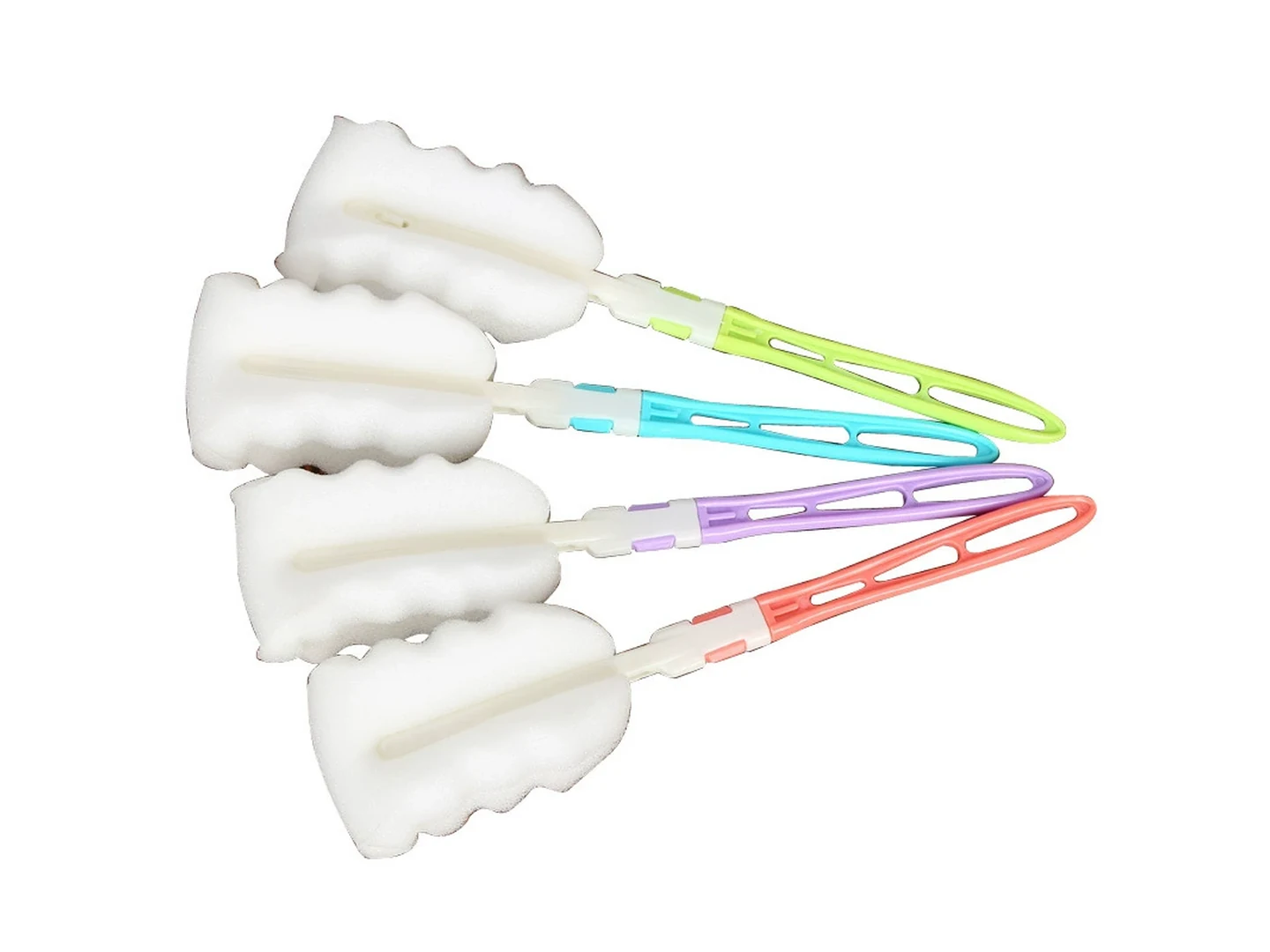
Small brush
500 pcs
Minimum order
Held in one hand: tube, bottle, detail and swab brushes — including long-handled ones with a small head.
Production lead time, once the specification is confirmed
- Up to 500 pcsWithin 7 days
- 501–50,000 pcsWithin 14 days
- Over 50,000 pcsWithin 21 days
Peak season can extend these times; the shipping date is confirmed in writing with your quotation. Sampling and shipping are quoted separately.
A long-handle baby bottle brush that pairs soft nylon bristle tufts with a PU sponge end to scrub milk film, formula residue, and biofilm from narrow-neck feeding bottles, then wipe curved shoulders and bases in the same pass — sized to reach the bottom without scratching plastic, glass, or coated interiors.
What can this brush do for you?
Scrub and wipe in one tool
The tufted nylon bristles along the shaft loosen dried milk film, formula deposits, and odor-causing residue from sidewalls, necks, and threads. The PU sponge at the working end follows the same stroke to absorb loosened debris and wipe curved surfaces. You get a scrubbing pass and a finishing pass without switching tools.
Reach deep bottles without wet hands
The extended handle is matched to bottle depth so an operator can grip outside the bottle opening and still guide the cleaning head across the base. No wrist entry, no cloth on a stick, no blind spots at the bottom of tall feeding bottles.
Soft contact that protects bottle surfaces
Nylon filament diameter can be specified as fine as 0.10 mm to produce a soft, compliant scrub that removes film without scratching polycarbonate, PPSU, Tritan, glass, or coated interiors. The bristle tips do the work; the sponge does the final wipe, so surface marking is controlled from both directions.
Sponge conforms to shoulders and base radius
The sponge head is rounded and compressible, so it bends into the curved transition between sidewall and base. Straight bristle heads often skip this area; the sponge presses into the radius and wipes away residue that would otherwise remain as a ring.
Cleans neck threads and small components
The tapered or tufted-end section passes through the bottle opening and scrubs internal threads, valve seats, and nipple collars. When the same brush is used on multiple bottle parts, one tool can handle the body, neck, and cap area instead of three separate brushes.
Rinses clean between uses
Nylon bristles release milk film and debris under a warm-water rinse, and the open-cell PU sponge can be squeezed to discharge what it absorbed. When rinsed and air-dried properly, the brush does not hold onto what it just removed.
What is a Baby Bottle Cleaning Brush Long Handle Nylon Bristle Sponge?
A Baby Bottle Cleaning Brush Long Handle Nylon Bristle Sponge is a manual cleaning tool built for the interior of narrow-neck feeding bottles and similar containers. It combines two cleaning media on one extended handle: a section of tufted nylon bristles for scrubbing, and a PU sponge head for absorbing and wiping. The handle is typically molded polypropylene, and the core that carries the bristles can be wire or plastic depending on the required stiffness and material restrictions.
In use, the brush is inserted through the bottle opening, then pumped and rotated so the bristles contact the sidewall, shoulder, neck, and base. The sponge follows the same motion and picks up liquid film and loose residue. For bottles with internal coatings or surfaces that scratch easily, the combination of controlled nylon filament diameter and compliant sponge gives effective cleaning without abrasive damage.
This is not a heavy-duty descaling or carbon-removal tool. It is designed for daily removal of milk film, formula residue, biofilm, powder, and odor deposits from baby bottles and similar containers where surface preservation and consistent hygiene matter more than aggressive mechanical force.
Technical Specifications
The table below shows the primary parameters we work with for this product. All dimensions and materials can be adjusted to your bottle, cleaning process, and target market.
| Parameter | Value / Options |
|---|---|
| Overall length | 200–450 mm, matched to bottle depth and operator preference |
| Working length | 120–300 mm, the portion that enters the bottle |
| Cleaning head configuration | Nylon bristle tufts along shaft + PU sponge tip or side sponge section |
| Bristle material | Nylon PA, filament diameter 0.10–0.50 mm |
| Bristle trim length | 8–20 mm, adjusted for scrubbing force and neck clearance |
| Sponge material | PU sponge (open-cell); PVA sponge as alternative for higher absorbency |
| Sponge head diameter | 40–60 mm (compressed to pass bottle neck; selected to contact body) |
| Handle material | Polypropylene (PP); optional TPE overmold, ABS, or stainless-steel core |
| Core | Galvanized steel, stainless steel, or plastic core for metal-free requirement |
| Neck clearance | Minimum bottle opening 10–60 mm, depending on head diameter and compression |
| Operating temperature | Up to 80°C (176°F) for standard nylon and PP; higher with specified grades |
| Color and marking | Custom Pantone color, pad printing, or laser marking available |
| Brush type | Custom Bottle & Container Brushes |
| How it is driven | Hand-guided |
| Cleaning target | baby bottle, breast pump part and bottle accessory, and formula mixing container and pitcher cleaning |
| Surface or part | shoulders, plastic, glass, sidewalls, containers, bases, necks, and thread |
| Residue or debris | milk, milk film, biofilm, leaves, liquid film, odor deposits, and powder |
| Mounting / connection | Fixed |
Where does this brush work best?
- Baby bottles and feeding bottles — standard and wide-neck designs where dried milk and formula film collect on sidewalls, shoulders, and bases.
- Breast pump parts and bottle accessories — valve housings, collars, nipples, and caps with internal threads and small recesses.
- Water bottles and sports bottles — narrow-neck reusable bottles where a sponge-on-a-stick cannot reach the base and a plain bristle brush leaves streaks.
- Glass and coated laboratory or media bottles — containers that need effective cleaning without scratching internal surfaces.
- Formula mixing containers and pitchers — larger vessels where residue clings to curved bottom transitions and a long handle improves control.
How do I choose the right one?
Start with the bottle opening and internal shape
Measure the minimum internal neck diameter and the maximum body diameter. The bristle section and the compressed sponge head must both pass through the neck without binding. The sponge should then expand enough to contact the body wall. A sponge that is too large will jam at the opening; one that is too small will not wipe the sidewalls.
Match bristle stiffness to residue and surface sensitivity
Milk film and formula residue usually respond to medium-soft nylon. For polycarbonate, PPSU, Tritan, or coated interiors, specify finer filament diameters (0.10–0.20 mm) to avoid scratching. For heavier soap scum or mineral film in hard-water areas, a slightly stiffer bristle (0.25–0.35 mm) may be needed. If the bottle is made of soft plastic that scuffs easily, combine fine nylon with the sponge for the final pass.
Decide where the sponge sits
A sponge at the tip is best for wiping the base and curved bottom. A side-mounted sponge section covers more sidewall area in each stroke. We can build both into one head when the bottle shape calls for it. For very narrow necks, a smaller sponge or bristle-only head may be the only option.
Set the handle length for control
The handle should extend at least 50–100 mm beyond the bottle mouth so the operator can grip it comfortably while the head reaches the base. Very long handles need a stiffer core to prevent wobble; specify the bottle depth when ordering.
Consider drying and hygiene in your process
Sponge heads retain moisture if not aired. For high-volume daycare, hospital, or laboratory use, choose a configuration that allows easy squeezing and hanging to dry. If the process requires fully dry tools between uses, a bristle-only or removable-sponge version may be more practical.
When this brush is not the right tool
If the residue is hard scale, burned-on carbon, or requires scraping, a wire or abrasive brush will be more effective. If the passage is extremely narrow (below about 10 mm), a dedicated tube brush or flexible stem brush is more appropriate. If the container must be cleaned without any moisture retention, a fully non-absorbent silicone or all-bristle brush may be better.
Can I customize this brush?
Baby bottle brushes are highly configurable because bottle dimensions, neck openings, materials, and retail requirements differ widely. To define your custom configuration, we need the bottle’s minimum neck ID, internal body diameter, internal depth, surface material, residue type, cleaning chemical, wash temperature, and preferred handle style. A sample bottle, CAD file, or photo with dimensions helps us get it right on the first sample.
We can adjust:
- Dimensions — overall length, working length, bristle trim length, sponge diameter, sponge thickness, and neck clearance.
- Bristle section — nylon grade, filament diameter, tuft density, tuft pattern, and placement along the shaft.
- Sponge head — PU or PVA material, open-cell density, pore size, shape (cylindrical, oval, rounded tip), and location (tip, side, or combination).
- Handle and core — PP, ABS, TPE-overmolded grip, stainless-steel or plastic core, loop/hook feature, and ergonomic shaping.
- Color and marking — custom Pantone color, molded brand mark, pad print, laser marking, or identification coding.
- Packaging — bulk, individual polybag, retail card, hanging tag, or multi-pack kit with other bottle-cleaning accessories.
If your project requires material documentation, food-contact declarations, inspection reports, or third-party testing for child-product safety, we can coordinate those requirements during the customization process.
Which filament survives the cleaning and still lasts on a baby bottle cleaning brush long handle nylon bristle sponge?
How do I clean and dry this brush after use?
Rinse the bristles under warm running water to flush out milk film and debris, then squeeze the sponge several times under water to release what it absorbed. Shake off excess water and store the brush with the sponge facing up or hang it from the handle loop. Do not leave the sponge sitting in a closed container or in standing water, as that promotes odor and bacterial growth.
Can the sponge be replaced separately?
Yes, if we design the head with a replaceable sponge attachment. For most fixed-sponge designs, the entire brush is replaced when the sponge wears out. We can supply a removable-sponge version for programs that prefer to replace only the sponge and keep the handle.
What is the difference between PU and PVA sponge for this brush?
PU sponge is more durable, holds its shape through repeated use, and resists tearing. PVA sponge absorbs more water and feels softer, which is useful for delicate surfaces, but it degrades faster and may need more frequent replacement. For baby bottles used daily, PU is usually the better balance of durability and wiping performance.
How can I check if the bristle stiffness is safe for my bottle?
Test the brush on an inconspicuous area or on a sample bottle first. Visually inspect the surface under bright light after a few strokes. If you see fine scratches or dulling, the filament diameter is too coarse for that material. We can adjust the filament diameter down or add a sponge-only section to reduce contact pressure.
Does this brush reach the curved area where the bottle base meets the sidewall?
Yes, the rounded sponge tip is designed to press into the shoulder and base radius as you rotate the brush. To verify coverage, wipe the cleaned bottle with a white cloth after brushing — if the cloth picks up residue at the base curve, the sponge diameter or handle length may need adjustment for your bottle shape.
When should I replace the brush?
Replace when the bristles splay outward and no longer stand upright, when the sponge tears or develops a persistent odor even after rinsing, or when the handle or core shows cracks, rust, or bending. With daily use, a typical brush lasts 2–4 months, but this depends on cleaning frequency, water temperature, and detergent strength.
Guides that go deeper on this
Custom Manufacturing RFQ
Describe Your Application
To prepare the correct quotation, provide the dimensions, cleaning task, residue, material, mounting details, quantity, and a drawing or photo.
Drawing or photo optional — it speeds things up, it does not gate the enquiry.
Custom Brush RFQ
Send Your Brush Project
Upload a drawing, product photo, or sample photo and provide the core dimensions and cleaning conditions.
“We need a brush to remove wet residue from a stainless steel conveyor, about 800mm wide. The current brush wears quickly. We can send photos.”
“We sell drinkware and need a cleaning brush to include with the product. Quantity around 5,000 pieces.”