
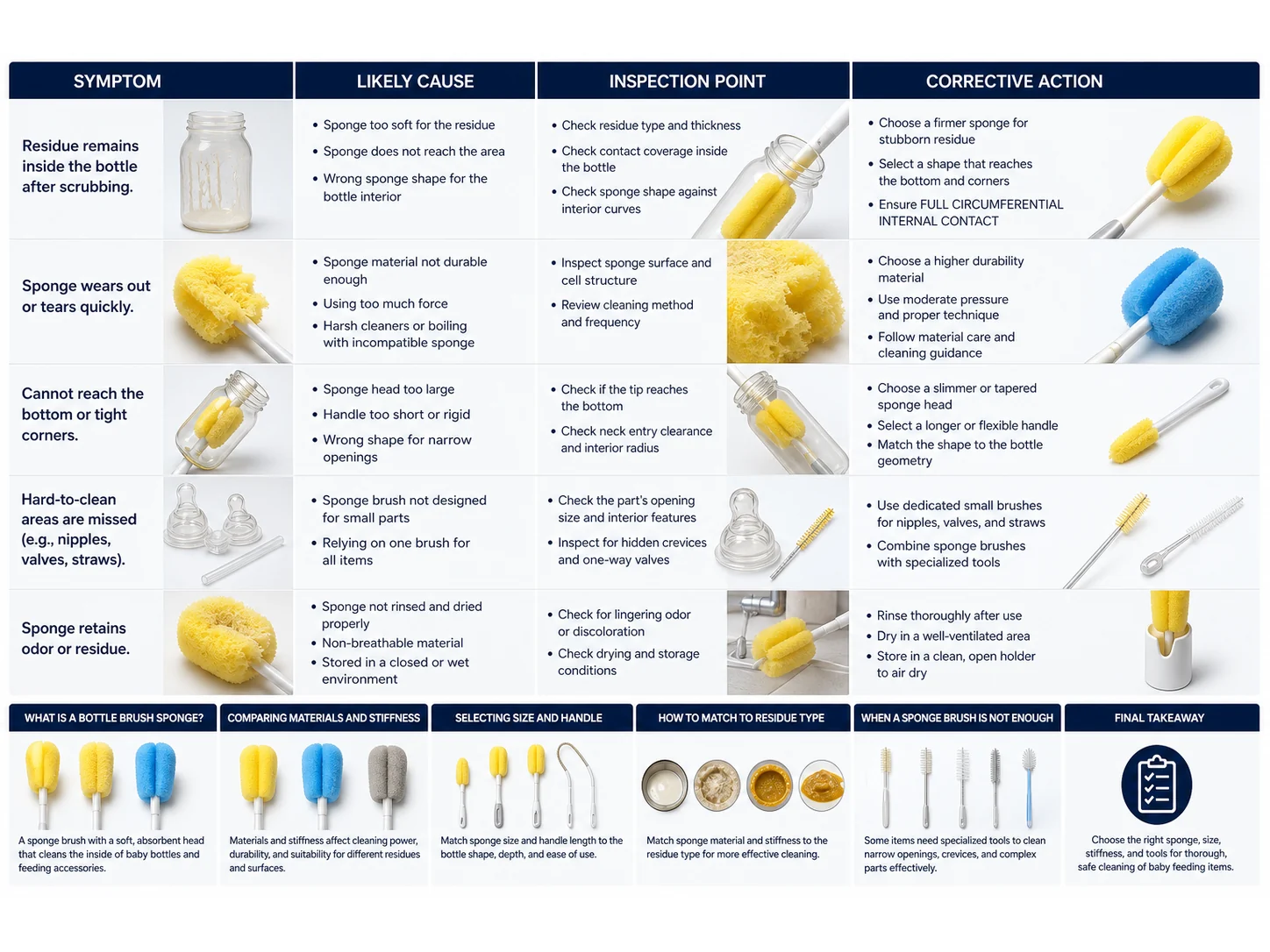
What Is a Bottle Brush Sponge?
A bottle brush sponge replaces a typical bristle brush with a soft, absorbent sponge head. The sponge conforms to curved bottle interiors, wipes away film, and reaches corners that bristles may skip. In baby feeding care, the sponge must be gentle enough for plastic, silicone, and glass surfaces while still removing milk fat, formula residue, and early-stage plaque from bottle necks and nipples. Good sponge brushes often combine a coarse scrubbing layer on one side with a finer wiping surface on the other.
Common Types of Bottle Brush Sponge Heads
Sponge heads vary by shape, material, and added features. The most common options in baby feeding kits include:
- Replaceable sponge head: A molded sponge slides over a plastic core or handle tip. The user swaps only the worn sponge.
- Two-material sponge: One side uses an open-cell foam for scrubbing; the other uses a denser sponge for wiping and drying.
- All-in-one sponge tip brush: A single-use or limited-reuse brush with a sponge fixed to the tip of a handle, often found in travel sets.
- Multi-surface wedge sponge: A contoured head designed to clean bottle bottoms, neck threads, and nipple holes without switching tools.
Comparing Bottle Brush Sponge Materials and Stiffness
Material choice affects scrubbing power, drying time, and how the sponge holds up to repeated sanitizing. The table below compares several common options.
| Material | Typical Stiffness | Best for Residue | Surface Safety | Chemical Tolerance | Replacement Cue |
|---|---|---|---|---|---|
| Polyurethane open-cell foam | Soft to medium | Light formula film, milk residue | Safe for all common bottle materials | Mild soaps; avoid strong oxidizers | When pores clog or foam tears |
| Melamine sponge (generic “magic” type) | Medium-erasing | Stubborn dried residue, hard water spots | May micro-scratch polycarbonate; test on glass/silicone | Soap and water; breaks down with bleach | When the sponge visibly wears down |
| Cellulose sponge | Soft when wet | General daily cleaning, rinsing | Very gentle, good for sensitive surfaces | Mild detergents; can discolor | When it starts to crumble |
| Non-scratch scrub sponge (looped fiber side) | Medium-scrub | Protein build-up, dried cereal bits | Designed to be safe for non-scratch surfaces | Standard dish soaps | When scrub texture flattens |
| Retail off-the-shelf household sponge | Varies; often coarse | General purpose, not baby-item optimized | Risk of scratching; check labeling | Unknown; may not withstand frequent hot water | Quick breakdown; not designed for frequent bottle cleaning |
Selecting the Right Size and Handle
Sponge size must match the bottle opening and interior shape. A sponge that is too large will struggle to pass the neck; too small leaves dead zones near the bottom.
- Diameter: For standard baby bottles (about 2–2.5 inch opening), a sponge head diameter of 1.5–2 inches works well. Wide-mouth bottles may need a slightly larger head. Always check the minimum opening diameter.
- Length: The sponge head plus handle must reach past the bottle shoulder to the bottom. Handles of 7–10 inches typically cover most infant bottles.
- Handle material: Plastic handles are lightweight and dry quickly. Stainless steel cores add durability and resist rust. Wooden-handled options exist but require careful drying.
- Grip and mounting: A non-slip grip helps when hands are wet. Suction-cup bases or hanging loops keep the brush off damp counters and allow air-drying.
How to Match the Sponge to the Residue Type
Not all baby bottle residues are the same. Choosing the sponge stiffness and material based on what you clean most often prevents damage and saves time.
- Fresh milk or formula: A soft polyurethane or cellulose sponge with warm soapy water is sufficient for daily cleaning. No heavy scrubbing required.
- Dried-on dairy film or iron-rich formula: A medium-stiffness sponge with a scrub layer (non-scratch) helps lift residues without scratching.
- Sticky fruit or veggie purées in sippy cups: A wedge-shaped sponge or melamine foam can reach corners. Use the gentle side first to avoid micro-scratches.
- Hard water spots or calcium deposits: Melamine sponge works well for occasional descaling, but do not use it aggressively on soft plastic.
- Oil-based residues (e.g., breastmilk cream separation): Pair a moderately absorbent sponge with a grease-cutting, fragrance-free dish soap.
Common Mistakes When Choosing a Bottle Brush Sponge
Even experienced caregivers can mis-specify a brush. These are the most frequent errors:
- Selecting the wrong sponge stiffness: Using a heavy-duty scrub sponge meant for pots and pans can scratch baby bottles, creating hidden bacterial crevices.
- Ignoring sponge porosity and drying: A dense, closed-cell sponge may hold moisture and breed odor or mold between uses. Look for open-cell or quick-dry designs.
- Choosing by cost drivers or color alone: A low-cost household sponge may break down after a few hot water washes and leave particles behind.
- Forgetting replacement intervals: Sponge heads should be replaced at least every 2–4 weeks in daily use, or sooner if tears or odors appear.
- Using one brush for all parts: A sponge sized for bottles may be too large for nipple holes and threads. A separate, smaller nipple brush is often needed.
- Assuming all sponges are dishwasher-safe: Not all sponge materials tolerate high heat or dishwasher drying cycles. Check before running through a sanitize cycle.
- Storing the brush wet in a closed container: This promotes bacteria growth. Always air-dry with the sponge head up.
When a Sponge Bottle Brush Is the Wrong Choice
Sponge brushes solve most daily cleaning needs for baby feeding items, but they have limits.
- When mineral scale builds up inside narrow-neck bottles: A sponge cannot scrub off hardened calcium deposits as effectively as a bristle brush with a heavy-duty cleaning solution.
- When cleaning deep cracks or scratches: If a bottle is already scratched, a sponge may push residue deeper. Replace damaged bottles instead.
- When extreme hygiene requires autoclave or boiling compatibility: Not all sponge materials withstand steam sterilization. Silicone or stainless steel bristle brushes may be better for high-heat cleaning.
- When dealing with unknown chemical exposure: If bottles were stored with solvent-based liquids, sponge brushes may absorb and re-deposit chemicals. A thorough rinse and inspection are needed first.
- When friction-only cleaning fails: Stubborn biofilm or moldy residues inside valves or spouts often require a small bristle detail brush plus a diluted bleach or vinegar soak (followed by thorough rinsing). A sponge alone cannot reach these tight paths.
- When supplier drawings or custom specifications are involved: Commercial kitchens or product developers testing new bottle shapes should request a brush drawing or sample from the brush manufacturer to verify fit and material compatibility before large orders.
Final Takeaway
Decide first what you need to clean and how often. Match the sponge material and stiffness to the residue type and bottle material. Check that the sponge head fits through the bottle opening and reaches the bottom without forcing. Replace the sponge head regularly, and always air-dry it after use. For stubborn scale, tight crevices, or sterilizer-only environments, a bristle brush or a dedicated detail brush will fill the gaps that a sponge cannot cover. If you are ordering in volume for a nursery or daycare, ask the supplier for material data sheets and sample brush heads to test with your specific bottles and cleaning chemicals.
Frequently Asked Questions
Can I use a sponge bottle brush on glass baby bottles?
Yes. Glass bottles are less prone to scratching than plastic, so a medium-stiffness sponge is safe and effective. Avoid metal-edged scrubbing layers.
How often should I replace a bottle brush sponge?
In daily home use, replace the sponge head every 2–4 weeks, or immediately if you notice tears, trapped particles, musty odor, or a slimy texture when wet.
What is the difference between a sponge bottle brush and a bristle brush?
A sponge brush uses foam to absorb and wipe, ideal for light film and daily maintenance. A bristle brush relies on bristles to scrape off stubborn, dried-on debris, often with more scrubbing power but less liquid absorption.
Is a long handle necessary for baby bottles?
For standard-size bottles, a handle of about 8–10 inches is usually enough. Longer handles can help for tall bottles or deep narrow containers, but they may be harder to control.
Can I use the same sponge brush for bottles and nipples?
Not well. A bottle-sized sponge head is too large to clean inside nipples and valve holes. Use a separate small nipple brush or a dual-ended tool with a mini sponge on one side.
What are signs I am using the wrong sponge brush size?
If the sponge head struggles to pass through the bottle neck, leaves a ring of residue at the bottom or shoulder, or you have to tilt the brush awkwardly to reach the bottom, the size is off.
How do I sanitize a sponge bottle brush?
After washing, rinse thoroughly and soak the sponge head in very hot water (check material tolerance) or a diluted food-safe sanitizing solution for a few minutes. Then rinse well and air-dry. Do not trap moisture in a sealed container.
Should I buy a brush with a replaceable sponge or a sealed fixed head?
Replaceable sponge heads reduce waste and let you swap only the worn part. Sealed fixed heads are often cheaper upfront but require replacing the entire brush when the sponge degrades. Choose based on how frequently you expect to replace the cleaning element.
Technical References
- CDC — Preventing Food Poisoning
- British Plastics Federation — Thermoplastics
- CDC — Preventing Cronobacter in Infants
- FDA — Food Safety in Your Kitchen
- NIST — Metric SI
Which bristle material fits this job — Silicone, AISI 304 Stainless Steel Wire or Melamine Foam?
| Material | Continuous temperature (°C) | Peak temperature (°C) | Water absorption | Hardness |
|---|---|---|---|---|
| Silicone | 200–250 | 280–300 | 0.1–1.0% | Shore A 20–80 |
| AISI 304 Stainless Steel Wire | 400 | 500 | 0% | Rockwell B 70–95 depending on temper and cold work |
| Melamine Foam | 150–180 | 200–240 | Open-Cell Structure Can Absorb 10–40 Times Its Own Weight | Shore OO 20–60 |
| Polypropylene PP | 80–100 | 120–140 | ≤0.03% | Shore D 65–75 |
| Boar Bristle | 60–80 | 100–120 | 10–18% | — |
Figures as published by Alleima; Material manufacturer TDS / ISO / ASTM / industry reference; Perlon. Confirm the exact grade against the supplier datasheet before ordering.
What should replace Bottle & Container Brushes for bottle brush?
- Bottle & Container Brushes — Bottle and container brushes are selected around an opening plus a larger vessel body and bottom geometry; tube and bore brushes are selected mainly around a long diameter-controlled passage. Closest alternative: Tube & Pipe Bore Brushes.
- Silicone — Compare Silicone with PP, TPE, Nylon. Change material when wet stiffness, temperature, chemical resistance, conductivity, particle shedding, or surface marking becomes the limiting factor.
- AISI 304 Stainless Steel Wire — Use AISI 316 stainless steel wire for chloride, marine, dairy, beverage, chemical washdown, or higher pitting-resistance requirements. Use carbon steel for dry aggressive cutting and brass or abrasive nylon for lower marking risk.
- Melamine Foam — Change material when temperature, chemicals, static, shedding or surface marking becomes limiting.