
Material
Melamine Foam
Melamine porous material
Choose Melamine Foam based on its stiffness, recovery, wear, wet-service, chemical, and temperature behavior. For a usable stiffness specification, provide the material, filament diameter, free trim, density, grade, and operating conditions.
Datasheet values
- Foam form
- Open-cell melamine foam pad or block
- Cleaning behavior
- Micro-abrasive foam contact; test on glossy or delicate finishes
- Liquid uptake
- Open-cell and grade dependent
- Temperature use
- Grade dependent; confirm the exact foam supplier data and complete brush assembly
Melamine Foam is used as brush fill or contact media where its property profile fits the cleaning duty.
What is Melamine Foam, and where is it used?
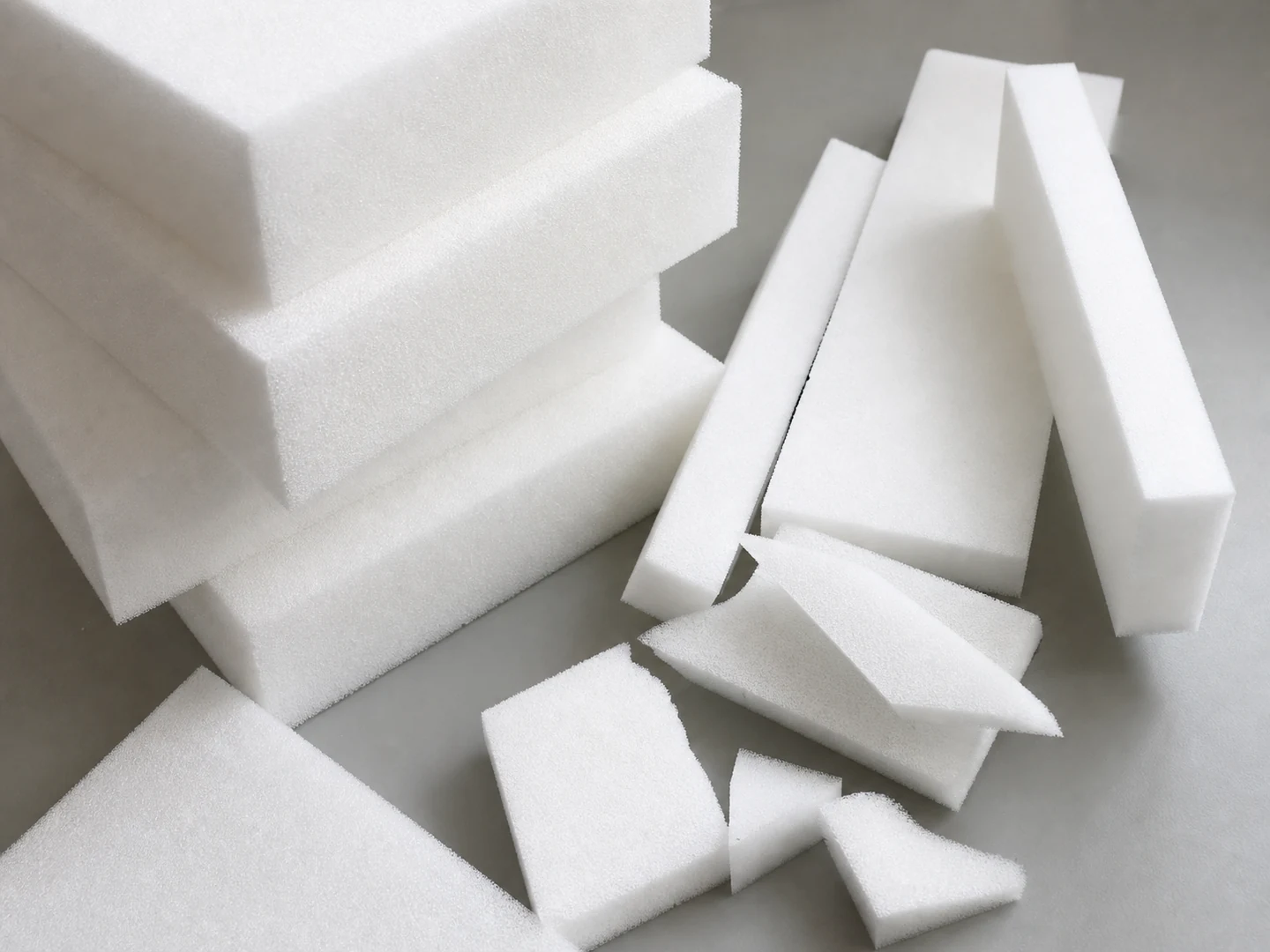
Melamine Foam is supplied as block, sheet and moulded pad, cut from an open-cell three-dimensional network and set in solid block, sheet, annular and zoned fill patterns.
Melamine Foam is chosen by block size and grade, working temperature, moisture, chemical exposure and surface risk.
Change material when temperature, chemicals, static, shedding or surface marking becomes limiting.
What stiffness and contact pressure can I expect from Melamine Foam?
Melamine Foam is measured on the Shore OO scale (20–60), the scale used for very soft foams; it is not comparable with the Shore D figures quoted for filament. It cleans by fine abrasion from its own open-cell structure rather than by bristle pressure, and it erodes as it works — so pad thickness and replacement interval matter more here than a hardness figure does.
The part people get wrong: the number that decides scrubbing pressure is diameter over trim length, not the grade name. Two brushes in this material can behave nothing alike.
How does water affect Melamine Foam performance?
Melamine foam is open-cell and can hold on the order of ten to forty times its own weight in liquid, so uptake and recovery are properties of the foam grade, not of a filament.
Open-cell grades absorb cleaning liquid; uptake and recovery are product-grade dependent.
What this means for your application: melamine works by abrading with its own cell walls, so it wears away as it cleans. A wet block is softer and lasts less time, not longer.
A practical check: run a test patch on the finish before the whole surface. Melamine is an abrasive, and on a gloss or coated surface it leaves a dulled band that cannot be put back.
What temperature limits apply to Melamine Foam?
Melamine foam can tolerate elevated temperatures in some technical grades, but temperature capability is grade and application dependent. Validate the exact foam product and brush assembly.
The published material tables quote 150–180°C continuous and 200–240°C peak. The tighter number above is the one to build to, because a brush is loaded while it is hot.
Where it stops working: A face that stays compressed after the load comes off means the answer is a different compound or foam grade, not more thickness.
Thickness, density and applied load all shift the real limit, so a thick pad touching lightly survives conditions that would crush a thin one under pressure.
What chemicals attack Melamine Foam?
Grade dependent; check the exact cleaner, concentration, temperature and exposure time against the selected melamine foam data.
Compatibility is a function of concentration, temperature and contact time together. A short rinse in a dilute solution is a different exposure from an overnight soak in a concentrated one, even with the same chemical on the label.
Before you commit to a quantity: Use resin or alloy grade TDS, ISO/ASTM property method and lot traceability when specified.
What thickness should I specify for melamine foam?
Melamine foam is supplied as block and sheet, 3–100 mm thick, with an open-cell network on the order of 0.05–1.00 mm. It is measured on the Shore OO scale (20–60), the scale used for very soft foams, which is not comparable with the Shore D figures quoted for filament.
It cleans by fine abrasion from its own cell structure, and it is consumed while it does so. Thickness is therefore service life as much as it is contact pressure: give the block size and say how long it has to last between changes.
Finishing available on this material: hydrophilic treatment, composite backing adhesive, anti-static treatment and abrasive lamination.
What applications typically use Melamine Foam?
Custom cleaning brushes requiring Melamine Foam for its mechanical, temperature, moisture or chemical behavior.
The cleaning work it is specified for most often:
- Floor Scrubbing
- Heavy Grease Industrial Floor Cleaning
Brush types built with this fill:
- Custom Disc Brushes
If the sample comes back rejected: Melamine foam is a micro-abrasive cleaning medium and can dull or mark some glossy, coated or delicate surfaces; test on the actual substrate.
How do I specify Melamine Foam for a custom brush?
Send the brush type, the thickness, the density or Shore figure, the cut shape and backing, wet or dry duty, working temperature and the actual cleaning chemistry together. Any one of them on its own leaves the stiffness undefined.
What usually goes wrong at this step:
- Selecting only by material name without defining the section, how hard it is pressed, and the operating conditions
Reference standards behind the figures on this page: ISO 527-1:2019; ASTM D638; ISO 62:2008; ASTM D570-22; ISO 868:2003; ASTM D2240-15(2021); ISO 4892-3:2024; ASTM G154-23; UL 94.
Source: Material manufacturer TDS / ISO / ASTM / industry reference — MELAMINE-FOAM material property compilation. Structured values from update package; water absorption references ISO 62/ASTM D570 where applicable; UV references ASTM G154; remaining brush-process values marked.
What else does the datasheet specify for Melamine Foam?
| Electrical behaviour | Insulating; Anti-Static Modification Can Reach 10^6–10^9 Ω |
|---|
Questions this page is asked
Which construction details should define melamine cleaning foam?
Record the foam producer and grade, cleaning-use designation, density and cell information supplied, block or pad dimensions, compression direction, backing or scrim, adhesive and lamination method, lot, and preconditioning state. Do not substitute an acoustic or thermal grade solely because it is also melamine resin foam, since conversion and cell structure affect contact, liquid uptake, abrasion and durability.
How should the micro-abrasive effect of melamine foam be checked?
Use the actual wetting fluid, pressure, speed or stroke and number of passes on a representative aged and new surface, including edges and high-gloss areas. Compare gloss, color, haze, roughness, coating thickness where relevant, transfer and visible marks against an uncleaned control and set a stop limit before broad use.
What should retire a melamine-foam contact element?
Track thickness and mass loss, tears, permanent compression, crumbling particles, retained soil or liquid, odor, backing exposure, adhesive release and drift in the verified cleaning result. Replace it when debris or retained contamination exceeds the process limit or when reduced thickness changes pressure distribution, rather than waiting for complete foam loss.
Where these figures come from
| Property | Published value | Source |
|---|---|---|
| Published specification |
|
BASF Retrieved 2026-07-22 |
Guides that go deeper on this
No catalogue item for this yet
Every brush here is made to order, and this one has no catalogue entry so far. Send the working surface, the residue, the access opening and the quantity, and it is quoted through the same specification route as the rest of the range.
Custom Manufacturing RFQ
Discuss This Material
Share the working surface, residue, dimensions, material direction, interface, quantity and drawing or sample photo.
Custom Brush RFQ
Request a Custom Cleaning Brush Quote
Upload a drawing, product photo, or sample photo and provide the core dimensions and cleaning conditions.
“We need a brush to remove wet residue from a stainless steel conveyor, about 800mm wide. The current brush wears quickly. We can send photos.”
“We sell drinkware and need a cleaning brush to include with the product. Quantity around 5,000 pieces.”