
What Is a Baby Bottle Brush?
A baby bottle brush is a specialized cleaning tool with a long handle, a stem, and a bristle or sponge tip. Its primary job is to mechanically scrub inner bottle surfaces, nipple crevices, and narrow openings where milk fats and bacteria can accumulate. Unlike generic brushes, a baby bottle brush is engineered to protect sensitive materials like plastic, silicone, or glass while providing effective removal of sticky residue without leaving scratches that can harbor germs.
Why Material and Size Matter for Baby Feeding Items
Baby bottle materials vary widely—polypropylene, PPSU, glass, stainless steel, and silicone—and each has a different sensitivity to abrasion. Using the wrong bristle material can create micro-scratches where biofilm hides from sanitizers. Size determines whether the brush can reach into narrow-neck bottles or effectively scrub wide-neck and angled designs. A brush that is too stiff can damage silicone nipples, while one too soft may not remove dried-on formula.
Key Features Compared: Materials, Size, Stiffness, and Handle Options
| Feature | Option | Best For | Considerations |
|---|---|---|---|
| Bristle Material | Nylon bristles | Glass bottles, heavy residue | Firm scrubbing; may scratch soft plastics over time |
| Silicone bristles | Plastic, silicone, PPSU bottles | Non-scratch; gentle on surfaces; often heat-resistant | |
| Sponge tip | Wide-neck bottles, sippy cups | Soft and absorbent; can trap bacteria if not dried thoroughly | |
| Stem Material | Stainless steel wire | Durability, heavy use | Can rust if coating cracks; avoid for thin glass unless plastic-coated |
| Plastic-coated wire | Everyday use, all bottle types | Protects bottle interiors; less likely to scratch | |
| Size (Diameter) | Small (≈ 2.5–3.5 cm) | Standard narrow-neck bottles | Fits most standard baby bottles; may be too small for wide-neck |
| Large (≈ 3.5–5 cm) | Wide-neck bottles, breast pump parts | Better coverage; ensure it fits through opening without forcing | |
| Stiffness | Soft | Silicone nipples, delicate parts | Less abrasive; may require more effort for dried residue |
| Medium | Everyday milk/formula residue | Balanced cleaning for most bottles | |
| Firm | Heavy buildup, glass bottles | Risk of scratching plastic; not for silicone nipples | |
| Handle Type | Loop handle | Easy hanging storage | Less ergonomic for deep scrubbing |
| Straight with grip | Comfort, control | Often with non-slip material; better for applying pressure | |
| Mounting/Storage | Suction cup base | Countertop drying | Keeps brush upright; may lose suction over time |
| Hanging loop | Hygienic drying | Allows air circulation; requires a hook |
How to Choose the Right Baby Bottle Brush
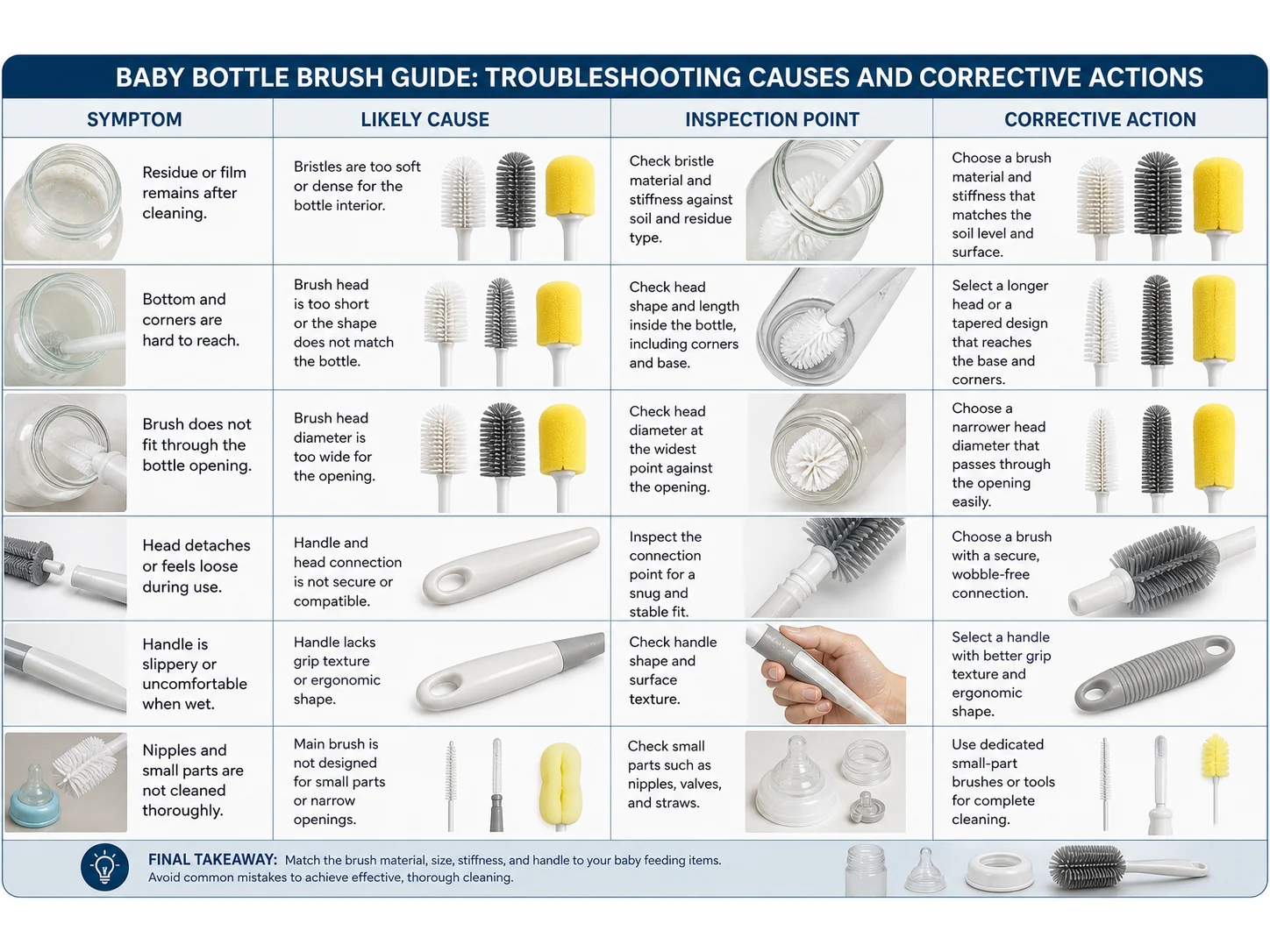
Start by identifying your primary bottle type and residue challenge. For plastic or silicone bottles, choose silicone bristles to avoid micro-scratches. For glass, a nylon bristle brush offers effective cleaning without risk of damage. Measure bottle neck diameter—narrow-neck requires a small brush, while wide-neck benefits from a wider brush or one with a contoured tip. If you clean silicone nipples, avoid firm bristles; look for soft silicone or a dedicated nipple brush. Consider ergonomics: a comfortable grip reduces hand fatigue during multiple daily cleanings. If you use a sterilizer, verify the brush material is heat-resistant and compatible.
Common Mistakes When Selecting a Baby Bottle Brush
- Choosing by cost drivers alone: Low-cost brushes may have bristles that shed or stems that rust, compromising safety.
- Ignoring bristle material: Nylon on plastic bottles can cause invisible scratches that trap bacteria.
- Wrong size: A brush too large can get stuck or damage the bottle neck; too small leaves residue behind.
- Neglecting stem durability: Bare metal stems can scratch or shatter glass bottles if not coated.
- Not replacing the brush regularly: Worn bristles lose cleaning power and can harbor germs; replace every 2–3 months or when bristles deform.
- Using the same brush for all parts: Nipples and valves need smaller, softer brushes to prevent tearing.
- Storing the brush wet: Enclosed or suction-cup bases can trap moisture; always let the brush dry completely between uses.
When a Baby Bottle Brush Is the Wrong Choice
A baby bottle brush handles mechanical cleaning, but it cannot sanitize or remove biofilm that has adhered below the surface. After brushing, always follow with hot soapy water rinsing and a sterilizing step (steam, boiling, or chemical sanitizer) as recommended by health authorities. Some complex parts, like anti-colic vents or narrow straws, require micro-brushes or pipe cleaners sized specifically for those channels. If you are designing or sourcing brushes for a commercial nursery, daycare, or manufacturing line, a standard off-the-shelf baby bottle brush likely will not meet hygiene validation requirements. In such cases, you need to review technical drawings, bristle retention specifications, and compatibility with automated cleaning systems.
Final Takeaway
Selecting a baby bottle brush starts with your bottle material and neck size, then matches bristle softness to surface sensitivity. Avoid skimping on quality—bristle and stem materials directly impact cleaning efficacy and safety. Pair the right brush with proper drying and regular replacement, and never rely on the brush alone for sanitation.
Frequently Asked Questions
What is the best material for a baby bottle brush?
Silicone bristles are generally safest for plastic and silicone bottles because they do not scratch, while nylon works well for glass. The stem should be plastic-coated wire to prevent rust and protect bottle interiors.
How do I clean a baby bottle without a baby bottle brush?
You can use a dishwasher with a sanitize cycle, or hand-wash with hot soapy water and a clean dishcloth, shaking vigorously with water and soap. However, a brush ensures mechanical removal of residue from hard-to-reach areas. For a quick method, fill the bottle with soapy water and add uncooked rice, then shake to scrub the interior.
What size bottle brush do I need for wide-neck bottles?
A brush with a diameter around 4–5 cm and a contoured or flared bristle head works best. Always check that the brush fits easily through the opening without forcing.
Are silicone bottle brushes better than nylon?
For most baby feeding items made of plastic or silicone, yes—silicone bristles are non-abrasive and heat-resistant. Nylon is better for glass bottles or heavy-duty residue but can scratch softer plastics over time.
When should I replace my baby bottle brush?
Replace your brush every 2–3 months, or sooner if bristles become flattened, splayed, or discolored, or if the stem shows signs of rust or cracking.
Can I use a baby bottle brush for breast pump parts?
Yes, but use a brush with soft silicone bristles to avoid scratching delicate silicone membranes and valves. A smaller detail brush may be needed for narrow channels.
How do I sanitize a baby bottle brush between uses?
Rinse thoroughly with hot water after each use, and occasionally soak in a diluted bleach solution (follow CDC guidelines) or run through a dishwasher if heat-resistant. Always air-dry completely.
What bristle stiffness is safe for silicone nipples?
Use a soft-bristle brush or a dedicated nipple brush. Firm or nylon bristles can tear or abrade the silicone, creating crevices where bacteria can grow.
Technical References
- CDC — Preventing Food Poisoning
- eCFR — 21 CFR 177.1500 Nylon Resins
- eCFR — 21 CFR 177.1520 Olefin Polymers
- CDC — Preventing Cronobacter in Infants
- FDA — Food Safety in Your Kitchen
- NIST — Metric SI
Which bristle material fits this job — Silicone, Nylon PA or AISI 304 Stainless Steel Wire?
| Material | Continuous temperature (°C) | Peak temperature (°C) | Water absorption | Hardness |
|---|---|---|---|---|
| Silicone | 200–250 | 280–300 | 0.1–1.0% | Shore A 20–80 |
| Nylon PA | 93 | 121 | 0.3–9% by PA grade and conditioning | Medium to firm; filament diameter and trim length control bending force. |
| AISI 304 Stainless Steel Wire | 400 | 500 | 0% | Rockwell B 70–95 depending on temper and cold work |
| PBT | 120–140 | 160–180 | 0.05–0.20% | Shore D 80–90 |
| Polypropylene PP | 80–100 | 120–140 | ≤0.03% | Shore D 65–75 |
Figures as published by Brushtec / DuPont; Alleima; Perlon. Confirm the exact grade against the supplier datasheet before ordering.
What should replace Bottle & Container Brushes for baby bottle brush?
- Bottle & Container Brushes — Bottle and container brushes are selected around an opening plus a larger vessel body and bottom geometry; tube and bore brushes are selected mainly around a long diameter-controlled passage. Closest alternative: Tube & Pipe Bore Brushes.
- Silicone — Compare Silicone with PP, TPE, Nylon. Change material when wet stiffness, temperature, chemical resistance, conductivity, particle shedding, or surface marking becomes the limiting factor.
- Nylon PA — Compare Nylon PA with PP, PBT, PET. Change material when wet stiffness, temperature, chemical resistance, conductivity, particle shedding, or surface marking becomes the limiting factor.
- AISI 304 Stainless Steel Wire — Use AISI 316 stainless steel wire for chloride, marine, dairy, beverage, chemical washdown, or higher pitting-resistance requirements. Use carbon steel for dry aggressive cutting and brass or abrasive nylon for lower marking risk.