
Custom Cleaning Brush
Wooden Long Handle Bottle Brush Cleaner
Long-handle natural-fiber bottle brush with wooden grip for narrow-neck bottles, growlers, and carafes. Custom diameters, lengths, and Tampico/Sisal fills.
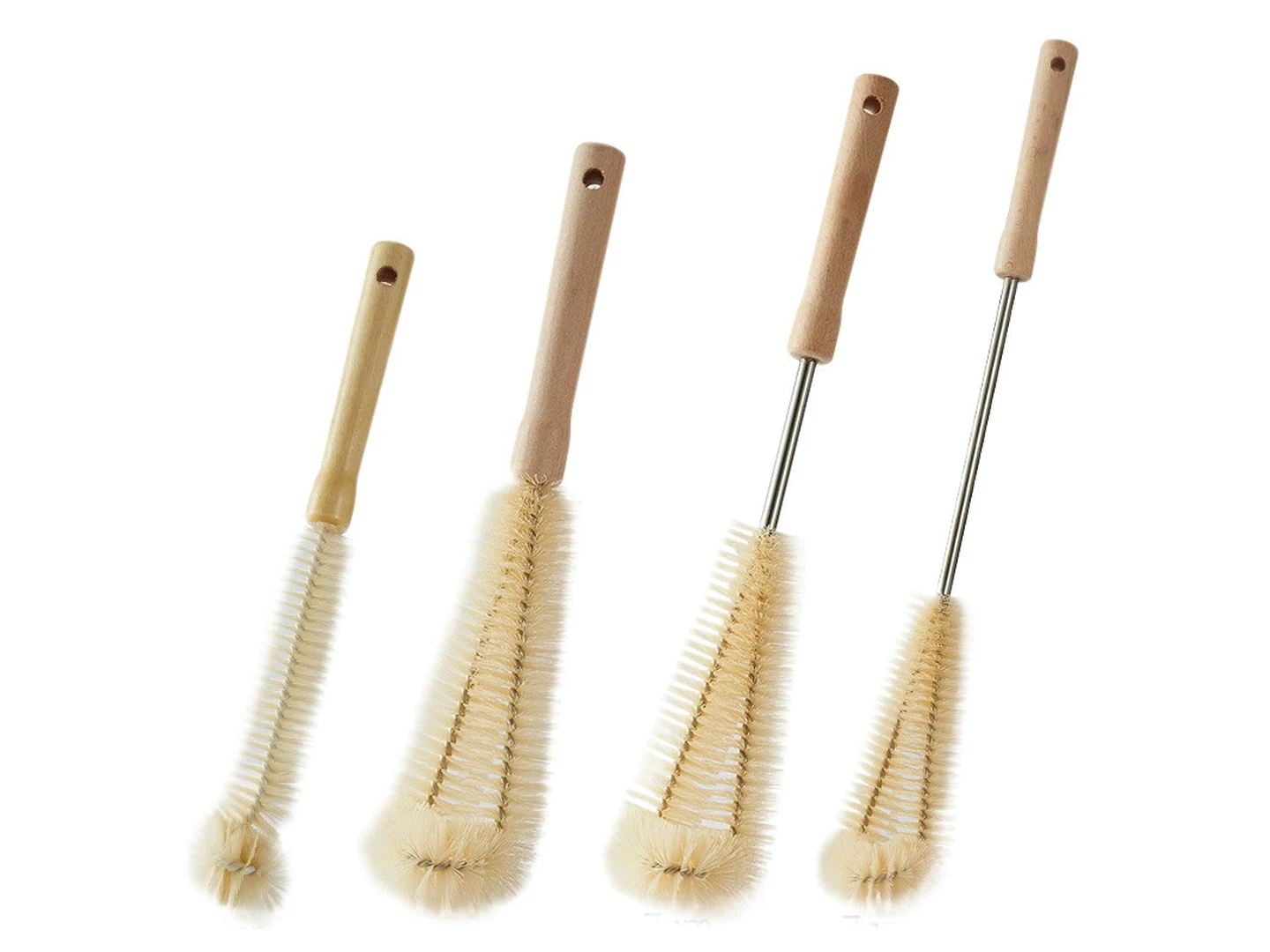
Small brush
500 pcs
Minimum order
Held in one hand: tube, bottle, detail and swab brushes — including long-handled ones with a small head.
Production lead time, once the specification is confirmed
- Up to 500 pcsWithin 7 days
- 501–50,000 pcsWithin 14 days
- Over 50,000 pcsWithin 21 days
Peak season can extend these times; the shipping date is confirmed in writing with your quotation. Sampling and shipping are quoted separately.
A long-reach natural-fiber bottle brush with a comfortable wooden handle, built for hand-cleaning narrow-neck water bottles, growlers, carafes, and decanters. The full-length handle lets you scrub sidewalls, shoulders, and bottle bases without putting a hand inside the container.
What can this brush do for you?
Keeps your hands outside tall and narrow containers
The long wooden handle places the brush head at the base of a bottle while your hand stays above the neck. That reach removes the need to push your fingers, a sponge, or a short-handled brush into an opening that cannot accept them. You control rotation and pressure from the handle end instead of trying to work from inside the bottle.
Natural Tampico or Sisal bristles hold water and detergent on the surface
Unlike synthetic filaments, natural Tampico and Sisal absorb water and cleaning solution, carrying it from the neck down to the residue and holding it against the interior wall during scrubbing. That retained moisture extends contact time and helps loosen dried beverage film, syrup residue, and odor deposits without repeatedly re-wetting the brush.
Scrubs off film and odor without scratching glass or coated interiors
Tampico is a medium-stiff natural fiber that flexes under pressure, so it removes protein film, sugar residue, and soft bio-slime while leaving glass, glazed ceramic, and many interior coatings unmarked. Sisal offers a firmer option for heavier soiling where more mechanical action is required.
Cylindrical head fills the sidewall and works through a full 360-degree rotation
The tufted head is built as a full-circle brush, so a simple push-pull and twisting motion covers the sidewall, shoulder, and base transition in one pass. The bristles also reach into the corner between the sidewall and bottom where flat sponges and straight brushes leave residue behind.
Twisted-wire core keeps the head in line and resists permanent bending
The bristles are locked between twisted steel wires, which gives the head axial stiffness for bottom pressure while allowing the tool to follow the container’s bore. A well-matched core stays straight under normal hand force, so the brush returns to the same shape instead of folding at the handle junction.
What is a Wooden Long Handle Bottle Brush Cleaner?
This is a hand-operated cleaning brush made from three main parts: a wooden grip at one end, a twisted steel wire shaft in the middle, and a cylindrical natural-fiber brush head at the working end. The head is inserted through the bottle neck and moved against the interior surfaces with push, pull, and rotating strokes.
The long wooden handle is the defining feature of this tool. It lets an operator scrub a 500 ml water bottle, a 2 L growler, or a tall decanter from the outside, keeping the hand clear of detergent and used wash water. The handle length, shaft length, and head diameter together determine how deep the brush can reach and how much sidewall contact it makes.
Natural Tampico or Sisal bristles work by absorbing a portion of the wash water and detergent, carrying it to the interior wall, and releasing it as the bristles flex. This makes the brush suited for non-abrasive removal of beverage film, yeast bio-slime, syrup residues, and odor deposits. It is not designed for scraping corrosion, baked-on carbon, or hardened mineral scale.
Because the handle is wood and the fill is natural fiber, the tool is intended for hand washing and air drying. Prolonged soaking, dishwasher cycles, steam sterilizing, and autoclave processes will degrade the wood, soften the finish, and break down the natural fiber. If the cleaning environment requires those conditions, a synthetic-filament brush or a silicone brush is the appropriate alternative.
Technical Specifications
| Parameter | Typical specification |
|---|---|
| Handle material | Natural hardwood such as beech or birch; sanded smooth; optional food-safe oil or clear lacquer finish |
| Handle length | 80–180 mm, matched to container depth and grip preference |
| Overall length | 200–450 mm, from end of handle to brush tip |
| Head diameter | 20–70 mm, chosen to fit the bottle body diameter and neck opening |
| Working head length | 60–150 mm, set to the internal contact area |
| Head form | Full-round tufted cylinder; tapered or rounded end optional |
| Bristle material | Tampico fiber, Sisal fiber, or specified blend |
| Filament diameter | 0.10–0.50 mm; coarser filament for firmer scrubbing action |
| Core wire | Twisted galvanized steel or 304 stainless steel; 2.0–4.0 mm wire |
| Wet environment | Hand washing with water and mild detergents, up to 70°C intermittent |
| Drying method | Rinse, shake, and hang head-down from the handle hole; do not soak the wood |
| Brush type | Custom Bottle & Container Brushes |
| How it is driven | Hand-guided |
| Cleaning target | reusable water bottle and travel drinkware, glass carafe, and growler and homebrew bottling container cleaning |
| Surface or part | containers, sidewalls, necks, shoulders, glass, thread, corners, and bases |
| Residue or debris | syrup, fiber, yeast, beverage film, odor deposits, scale, sugar residue, and mineral scale |
| Mounting / connection | Fixed |
The three key dimensions to confirm before ordering are head diameter, working head length, and overall length. Handle length is the remaining difference. If you supply the bottle neck inner diameter, body inner diameter, internal depth, and preferred grip length, we can fit the brush to the container instead of requiring a fixed retail size.
Where does this brush work best?
- Reusable water bottles and travel drinkware — tall 500 ml to 1.5 L bottles with necks too narrow for a hand or sponge; the full-round head cleans the sidewall and bottom corner after daily use.
- Glass carafes, decanters, and serving pitchers — where interior film and odor need to be removed without scratching the glass or coating.
- Growlers and homebrew bottling containers — where yeast deposits, beer film, and odor settle at the shoulder and base; Sisal fill provides extra action on sticky growth in uncoated glass.
- Narrow-neck beverage jars, kombucha vessels, and syrup bottles — hand-washing workflows where a long handle is needed to reach below the neck while controlling pressure.
- Hand-washed feeding bottles and drinkware accessories — routines that do not use a dishwasher or steam sterilizer; the bristles reach threads, shoulder, and base while the handle stays dry. Sanitizing should still be performed with an appropriate separate method.
How do I choose the right one?
Four measurements usually decide whether this brush will fit and work well: the narrowest neck opening, the internal bottle diameter, the internal depth, and the type of residue you need to remove. Adding the cleaning temperature and handle preference then finalizes the configuration.
Start with the narrowest opening and the internal diameter
The head diameter should be close to the bottle’s internal body diameter so the bristles contact the full sidewall. At the same time, the head must compress enough to pass through the neck without forcing the twisted core or cracking the container. As a practical check, the head should enter the neck with light hand pressure and no need to bend the metal shaft.
Set the length from the container depth
For a bottle 300 mm tall, choose an overall length near 350–400 mm so the operator can still hold the wooden handle with a full grip above the neck. The handle does not need to extend far above the opening; extra length adds leverage but also reduces control. Very deep narrow containers may need a custom overall length rather than a standard off-the-shelf size.
Match the fiber to the soiling and surface
- Tampico fiber — medium stiffness, absorbent, gentle enough for glass, glazed ceramic, and coated interiors. Use for beverage film, soft sugar residue, and light odor deposits.
- Sisal fiber — coarser and stiffer, higher scrubbing force, lower water retention. Use for yeast bio-slime, sticky syrup, heavier protein soiling, or uncoated stainless steel and glass containers.
- Blended fill — a mix of the two can balance water retention and scrubbing action when residue is moderate but persistent.
Check the core and handle for the working conditions
For everyday hand washing with water and mild detergent, a galvanized twisted-wire core is usually sufficient. If the brush will sit wet between uses, contact acidic cleaners, or be used in a commercial kitchen or brewery, choose a stainless steel core and a sealed hardwood handle. Natural fill still limits the maximum sustained temperature, so do not select this brush for hot CIP, dishwasher, or autoclave systems.
When another brush is the better choice
Choose a tube brush for internal bores below about 10 mm or channels too narrow for a full round head. Choose a silicone bottle brush if the container has a delicate internal coating, requires dishwasher and autoclave compatibility, or cannot tolerate any fiber shedding. Choose a wire bottle brush for removing hardened scale or burned residue in metal containers. This wooden handle brush is the right fit for hand washing, non-scratch contact, reach, and comfortable long-handle control.
Can I customize this brush?
Yes. Most orders are matched to a specific bottle family rather than sold as a fixed retail size. To define the brush, send the bottle’s neck inner diameter, body inner diameter, interior depth, surface material, main residue, cleaning chemical, and water temperature. A drawing, sample container, or photos of the neck and base reduce back-and-forth.
We can adjust:
- Handle — wood species, length, diameter, straight or contour-turned shape, end hole or hanging loop, natural oil or lacquer finish, printed or laser-marked logo.
- Head — diameter, length, tuft density, cylindrical or tapered profile, round-end tuft for bottom scrubbing, or reduced tip for neck and cap threads.
- Bristle fill — Tampico, Sisal, or a custom blend; filament diameter; natural color or dyed fiber sections for identification.
- Core — galvanized steel or stainless steel wire; wire gauge; bent or offset core for curved containers where needed.
- Fit dimensions — overall length, working length, and handle length set to the exact container height and operator preference.
- Packaging — bulk polybag, individual card sleeve, hang tag, retail box, or branded project packaging.
If the project requires material documentation, food-contact verification, third-party inspection, or other project-level certification support, provide the applicable standard in the RFQ and we can assist from the customization stage.
What size should a wooden long handle bottle brush cleaner be, and how long does it last?
How can I tell whether the head diameter fits my bottle before ordering?
Measure the narrowest neck opening and the widest internal body diameter. The head should be approximately the same as or slightly larger than the body diameter while still passing through the neck with light pressure. A good test is to insert the brush through the neck: if you have to bend the metal shaft or force it, the head is too large; if the bristles do not touch the sidewall when the brush is centered, it is too small.
Can this brush go in a dishwasher or bottle sterilizer?
No. The wooden handle and natural Tampico or Sisal fill break down under sustained heat, steam, and dishwasher detergents. Hand wash the brush with warm water, rinse thoroughly, and hang it head-down to dry. If your process requires dishwasher or autoclave cleaning, choose a silicone or heat-resistant polymer brush instead.
How much bristle shedding is normal, and when should I replace the brush?
Small amounts of loose fiber during the first few uses are normal as short fibers wash out. If strands continue to pull out during every cleaning, the head is damaged or degraded. Replace the brush when the bristles stay flattened against the core, the head diameter visibly shrinks, the wood splits, or the wire core stays bent after normal use.
Can I clean the bottle without sanitizing after brushing?
Brushing removes attached film and loosens debris, but it does not sterilize the surface. If the bottle is used for infant feeding, brewing, or long-term storage, perform the normal sanitizing step after rinsing. The brush is a scrubbing tool, not a replacement for heat, chemical sanitizing, or UV treatment.
Will this brush remove hard water scale or mineral deposits?
Natural fiber can remove soft deposits before they harden, but it is not designed to scrape off existing mineral scale or baked-on residue. For heavy scale, use an acid or citric-acid soak first, then this brush to remove loosened material. If hardened scale remains after brushing, a chemical descaling step or a stiffer wire brush may be needed.
How should I store the brush between uses?
Rinse the head until the water runs clear, shake out excess water, and hang it head-down from the handle hole. Keep the wooden handle out of standing water and avoid closed humid containers until the brush is fully dry. Good drying prevents odor, mildew, and early deterioration of the natural fiber.
Guides that go deeper on this
Custom Manufacturing RFQ
Describe Your Application
To quote this brush accurately, send the size, material, cleaning target, residue, quantity, and any available drawing or sample photo.
Drawing or photo optional — it speeds things up, it does not gate the enquiry.
Custom Brush RFQ
Send Your Brush Project
Upload a drawing, product photo, or sample photo and provide the core dimensions and cleaning conditions.
“We need a brush to remove wet residue from a stainless steel conveyor, about 800mm wide. The current brush wears quickly. We can send photos.”
“We sell drinkware and need a cleaning brush to include with the product. Quantity around 5,000 pieces.”