
Custom Cleaning Brush
Silicone Bottle Brush
Custom silicone bottle brush for narrow-neck vessels. Molded head compresses through restricted openings, cleans shoulders without scratching. OEM supply.
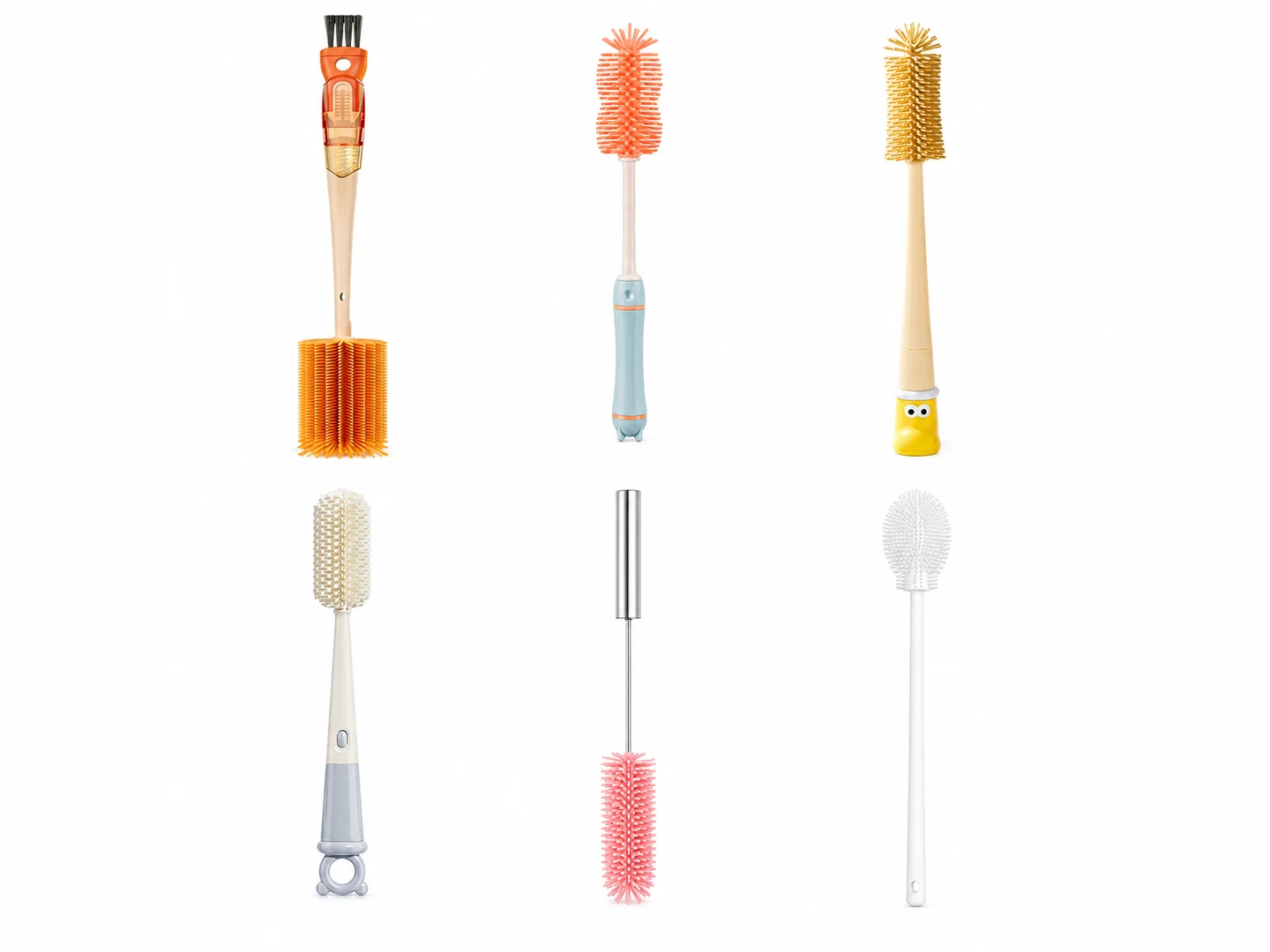
Small brush
500 pcs
Minimum order
Held in one hand: tube, bottle, detail and swab brushes — including long-handled ones with a small head.
Production lead time, once the specification is confirmed
- Up to 500 pcsWithin 7 days
- 501–50,000 pcsWithin 14 days
- Over 50,000 pcsWithin 21 days
Peak season can extend these times; the shipping date is confirmed in writing with your quotation. Sampling and shipping are quoted separately.
A custom-molded silicone bottle brush built for narrow-neck vessels where conventional bristle brushes bind at the opening, miss the shoulder curve, or scratch sensitive interiors. Its flexible silicone head compresses through restricted necks, re-expands to contact the body, and releases liquid film and loose residue without leaving fiber fragments or abrasion marks.
What can this brush do for you?
Flexes Through the Neck Without Binding
The head is molded as a single silicone unit with tapered geometry, so it compresses under light pressure to pass through openings as small as 20 mm (0.79 in). Once inside the bottle body, it returns to its working diameter and contacts the sidewall. This eliminates the common failure of stiff bristle brushes that jam at the neck or fold over without recovering, leaving the lower half of the bottle uncleaned.
Holds Its Shape While You Scrub — Then Rinses Completely Clean
Silicone has no filament roots, crimp points, or porous surfaces where bacteria, powder, or odor compounds lodge. After use, a quick water rinse removes nearly all residue from the brush itself, which reduces cross-contamination risk between batches and makes the tool easier to keep sanitary. The head also resists absorbing cleaning chemicals, so it doesn’t swell or soften like some natural-fiber brushes.
Follows the Shoulder and Base Into the Dead Zones
The flexible tip and finger arrangement allow the brush to bend and maintain contact as you push into the curved transition at the bottom or sweep around the shoulder. Straight tufted brushes can’t make this turn with full contact, leaving a band of residue that becomes a contamination or odor source. This brush reaches those zones with consistent pressure.
Safe for Coated, Polished, and Plastic Interiors
Silicone is non-scratching by nature, and we can adjust the durometer from about 30 Shore A (very soft) to 70 Shore A (firmer) to match the surface. For anodized aluminum, glass with internal coating, PET, or polycarbonate, this eliminates the micro-scratches that a nylon or wire brush would create, preserving the vessel’s finish and extending its service life.
Configurable as a Replaceable Component for OEM Kits
If you supply bottle cleaning kits, wash stations, or retail brush sets, we can build this as a one-piece manual tool, a replaceable head on a universal handle, or a component that mounts into your existing equipment. The stem length, connection type, and handle style are all specified to your assembly.
What is a Silicone Bottle Brush?
A Silicone Bottle Brush is a hand-guided cleaning tool that uses a molded silicone head — rather than a bundle of filaments — to clean the inside of bottles, flasks, and other narrow-neck containers. It is selected when the vessel has a restricted opening, a curved internal shape, or a surface that requires soft, non-marking contact.
During normal use, the operator inserts the head through the neck, then applies push-pull and rotating strokes so the silicone fingers or ridges sweep the sidewall, shoulder, and base. The flexible head conforms to the internal profile, and any residue it loosens is carried out by the cleaning liquid or rinses off the brush afterward.
The right configuration depends on four measurements: minimum neck ID, internal body diameter, internal depth, and the sensitivity of the surface being cleaned. Residue type, cleaning chemistry, and process temperature also drive material selection. This is a precision cleaning tool for routine maintenance and sanitation, not a substitute for aggressive descaling or mechanical stripping. If your residue is hard scale, burnt-on carbon, or heavy industrial fouling, a wire, PBT, or abrasive brush will perform better.
Technical Specifications
| Parameter | Value / Options |
|---|---|
| Head diameter | 22–65 mm (0.87–2.56 in), sized to compress through your neck and contact the body |
| Working length | 100–280 mm (3.94–11.02 in), the portion that enters the vessel |
| Overall length | 180–420 mm (7.09–16.54 in), including handle, matched to reach and grip |
| Silicone hardness | 30–70 Shore A, lower for conformability, higher for firmer scrubbing |
| Head profile | Cylindrical, tapered, dome, bulb, or custom molded geometry |
| Surface pattern | Smooth, ribbed, finger-type, or textured — affects residue release and contact pressure |
| Stem / core material | 304 or 316 stainless steel, nylon-coated wire, PP, or flexible polymer (for metal-free applications) |
| Handle material | PP, ABS, stainless steel, or TPE overmold; can include hanging loop or grip texture |
| Connection type | One-piece, threaded, or press-fit replaceable head |
| Operating temperature | -20°C to 120°C (-4°F to 248°F) for standard assembly; up to 220°C (428°F) for high-temp silicone with metallic core |
| Chemical resistance | Resists common detergents, alcohols, diluted acids and bases; confirm compatibility with specific solvents |
| Color options | Any Pantone color, translucent or opaque |
| Food-contact options | Food-grade silicone compounds available upon request |
| Brush type | Custom Bottle & Container Brushes |
| How it is driven | Hand-guided |
| Cleaning target | reusable water bottle and insulated stainless steel, baby, and laboratory glassware cleaning |
| Surface or part | necks, vessels, shoulders, containers, flasks, sidewalls, profiles, and narrow openings |
| Residue or debris | liquid film, fiber, hard scale, product residue, lint, and carbon |
| Mounting / connection | One-piece, threaded, or press-fit replaceable head |
All dimensions are project-adjustable. The table shows the standard range we manufacture; your final specification will be set from your vessel drawings or sample measurements. We recommend providing actual bottles for fit testing during prototyping.
Where does this brush work best?
- Reusable water bottles and insulated stainless steel tumblers where the neck is narrower than the body and the bottom corner is hard to reach.
- Baby feeding bottles and sippy cups that need thorough cleaning without scratches or lint, and easy rinseability for hygiene.
- Laboratory glassware: Erlenmeyer flasks, media bottles, and reagent containers with narrow openings and curved shoulders.
- Beverage growlers, kombucha bottles, and fermentation vessels where residue is sticky and interior surfaces must not be abraded.
- Cosmetic and personal care containers such as lotion pumps and narrow-mouth jars, where product residue hardens at the shoulder.
- Coated or anodized metal bottles where filament brushes would scratch the interior lining.
- OEM cleaning kits for premium drinkware brands, where the brush is included as an accessory and must match the bottle’s exact geometry.
How do I choose the right one?
Start with the minimum opening
Measure the narrowest internal diameter, usually the neck. The uncompressed head diameter should be 70–90% of that opening so it passes without excessive force but still expands to touch the body. If it binds at the neck, it’s too large. If it slides through without contacting the sidewall, it’s too small.
Match the head profile to the internal shape
For straight-sided vessels, a cylindrical head works well. For bottles with shoulders or a curved base, choose a tapered or bulb profile with flexible fingers that can follow the contour. A custom profile can be designed if your bottle has unusual features like internal threads or a dimpled base.
Set silicone durometer from surface and residue
Softer silicone (30–45 Shore A) conforms better and is safer on ultra-sensitive coatings. Firmer silicone (50–70 Shore A) applies more pressure and removes heavier film or dried-on residue. If the residue is hard scale, carbonized, or mineral deposits, silicone may not be aggressive enough; switch to a PBT, nylon, or wire brush for those tasks.
Select stem and handle for your operating conditions
If the brush will be used by hand, a rigid stem with an ergonomic handle is fine. For deep or angled vessels, a flexible core helps navigate. If it will be autoclaved or used with strong chemicals, choose stainless steel and high-temperature silicone. For food or pharmaceutical settings, specify metal-free options with PP or polymer cores.
Decide whether you need a replaceable head
For retail kits or maintenance programs, a replaceable head reduces waste and cost over time. We can provide threaded, snap-fit, or press-fit head connections. If you’re integrating the brush into an automated wash line, we can adapt the stem end for machine mounting.
Can I customize this brush?
Yes. Every dimension and material can be specified. To start, we need the minimum neck ID, internal body diameter, internal depth, surface material, residue type, cleaning chemical, and operating temperature. A vessel drawing, CAD file, or physical sample speeds up tooling.
- Head geometry: diameter, length, taper, bulb shape, finger count and length, smooth or textured surface.
- Silicone specification: durometer, color, food-grade compound, high-temperature grade, metal-detectable grade.
- Stem / core: length, rigidity, material (stainless steel, coated wire, PP, polymer), connection type, optional bend point.
- Handle: shape, length, grip material, overmold, hanging hole, logo area, ergonomic features.
- Assembly: one-piece, replaceable head, or disposable head design.
- Marking and packaging: custom color coding, laser engraving, pad printing, bulk bags, retail boxes, private label, and barcoding.
- Project support: material certifications, FDA/EU food-contact declarations, RoHS/REACH statements, third-party testing, and inspection reports can be provided as required for your market.
Which filament survives the cleaning and still lasts on a silicone bottle brush?
Can I use this brush with a power drill or automated cleaning system?
The standard silicone bottle brush is designed for manual use. For power or automated applications, we can add a hex shank, quick-connect, or custom mounting end to the stem. We’ll need your RPM range and torque requirements; high-speed rotation may cause the silicone head to wear faster or sling cleaning liquid. For automated lines, a softer durometer and reinforced core are usually recommended.
How do I evaluate a prototype before full production?
Request pre-production samples with your specified dimensions and materials. Test them on your actual bottles using your normal cleaning solution and process. Check for ease of insertion, sidewall contact, coverage of the shoulder and base, residue removal, and head recovery after repeated passes. Send us photos or measurements of any areas that are not cleaned, and we’ll adjust the geometry or durometer.
What is the typical service life of a silicone bottle brush?
Service life depends on frequency of use, cleaning chemicals, temperature, and insertion force. Under normal manual use with compatible detergents, a silicone head can last hundreds of cycles. Signs of wear include permanent deformation, tears at the fingers, loss of spring-back, or faded color indicating chemical degradation. Replace the brush when it no longer recovers its shape after passing through the neck or fails to contact the entire interior.
Can the brush be sterilized or autoclaved?
If you select high-temperature silicone and a stainless steel or heat-tolerant polymer core, the brush can withstand steam autoclaving up to 180°C (356°F). The handle material must also be rated for that cycle; PP handles are typically limited to around 120°C. Specify your sterilization method and cycle parameters, and we will choose materials accordingly.
Is the silicone material food-safe?
We offer food-grade silicone compounds that meet FDA 21 CFR 177.2600 and EU food-contact regulations when required. Indicate your food-contact needs, and we will select the appropriate compound and provide relevant documentation. Note that food safety also depends on the stem and handle materials, so those must be specified as food-grade as well.
How do I clean the brush itself between uses?
Rinse with warm water and a mild detergent after each use. For stubborn residue, soak in a compatible sanitizing solution or diluted detergent, then rinse thoroughly. Avoid abrasive scouring pads or harsh solvents that could damage the silicone surface. Allow the brush to air dry completely before storage. Do not leave it immersed in strong chemicals or high heat for extended periods.
Guides that go deeper on this
Does a Silicone Bottle Brush Survive Chemical Exposure?
Read this guideGuideIs a Silicone Bottle Brush Safe on Scratch-Sensitive Parts?
Read this guideGuideSilicone Bottle Brush: Material and Size for Chemicals
Read this guideGuideSilicone Bottle Brush: Specs for Scratch-Sensitive Parts
Read this guideGuideSilicone or Nylon Bottle Brush for Wet Cleaning: Which Should You Specify?
Read this guideGuideWhen to Use a Silicone Bottle Brush in Wet Cleaning
Read this guideGuideBaby Bottle Brush Mistakes in Home and Pro Kitchens
Read this guideGuideNylon, Sponge or Silicone Bottle Brush for Baby Bottles?
Read this guideCustom Manufacturing RFQ
Describe Your Application
Please share the brush dimensions, working area, residue type, material direction, quantity, and a drawing or photo for quotation.
Drawing or photo optional — it speeds things up, it does not gate the enquiry.
Custom Brush RFQ
Send Your Brush Project
Upload a drawing, product photo, or sample photo and provide the core dimensions and cleaning conditions.
“We need a brush to remove wet residue from a stainless steel conveyor, about 800mm wide. The current brush wears quickly. We can send photos.”
“We sell drinkware and need a cleaning brush to include with the product. Quantity around 5,000 pieces.”