
What Is a Silicone Bottle Brush?
A silicone bottle brush is a cleaning implement whose bristles are made entirely or primarily from silicone rubber. Unlike nylon or animal-hair brushes, silicone bristles are non‑porous, chemically inert within a wide range, and inherently heat‑resistant. They do not rust, corrode, or shed metal particles. In chemical exposure settings, these properties reduce cross‑contamination risk and extend brush life when the tool repeatedly contacts acids, alkalis, solvents, or sanitizers.
Common Types and Material Options
Not all silicone bottle brushes are identical. The main distinctions involve the bristle support structure, handle material, and overall configuration.
- Full‑silicone, one‑piece construction: Bristles, core, and handle are molded as a single silicone part. No metal, no joints. Ideal where no metal contact is allowed.
- Silicone bristles with twisted wire core: Bristles are crimped into a galvanized or stainless‑steel twisted wire. Common for heavy‑duty bottle brushing. The core wire must be chemically compatible.
- Silicone bristles on a plastic core/handle: Bristles are set into a polypropylene or nylon core, often with a removable head. Lighter duty, often for disposable or low‑cost applications.
- Silicone brush with long handle: Extended reach for deep carboys, tanks, or tubes. Handle may be solid plastic, stainless steel, or coated metal.
- Silicone brush set or kit: Multiple diameters and shapes for different container profiles—useful for pilot plants or lab areas with varied glassware.
Silicone vs. Other Brush Materials for Chemical Exposure
The brush material dramatically affects cleaning efficacy and equipment safety. The table below compares silicone with common alternatives in chemical‑exposure scenarios.
| Material | Chemical Resistance | Temperature Limit | Surface Abrasiveness | Shedding Risk | Typical Use |
|---|---|---|---|---|---|
| Silicone (rubber) | Excellent with mild acids, bases, alcohols; swells in some solvents | ~200 °C (continuously) | Very low | Extremely low | Glass, stainless steel, PTFE; low‑residue processes |
| Nylon | Good with alkalis, fair with dilute acids; attacked by phenols & strong oxidizers | ~120 °C | Moderate | Low | General bottle cleaning; can scratch soft plastics |
| Polypropylene (PP) | Excellent with acids and bases; poor with strong oxidizers | ~100 °C | Moderate‑high | Low | Heavy scrubbing where scratching is acceptable |
| Natural bristle (Tampico) | Good with neutral & mild chemicals; degrades in strong acids/alkalis | ~100 °C (dry) | High | Moderate; sheds fibers | Rust removal, rough cleaning; not for hygienic zones |
| Sponge foam (PVA) | Poor with most chemicals; absorbs and degrades | ~60 °C | Very low | Moderate | Gentle, short‑contact wiping |
Key Dimensions and Fit: How to Avoid Mismatched Sizes
An incorrectly sized brush can damage equipment or leave residues. Use this checklist before ordering.
- Measure the narrowest inner diameter of the container (typically the neck or opening). The brush diameter should be 2–5 mm smaller than this opening to avoid jamming.
- For vessels with varying diameters (e.g., round‑bottom flasks), note the maximum and minimum inner diameters. A tapered brush may be needed.
- Compare the total brush length (handle + bristle portion) against the container depth. The bristle section should reach the full interior without forcing the handle inside the opening.
- If cleaning tubes or pipes, select a brush length that allows the bristle section to extend beyond the pipe end for thorough cleaning.
- Confirm the handle diameter fits comfortably in the operator’s grip, especially when wet or gloved.
Stiffness, Core Material, and Handle Selection
Stiffness determines scrubbing power and surface compatibility. Silicone bristles are naturally softer than nylon, but stiffness can be adjusted by bristle length, density, and the underlying core material.
- Soft bristles: Gentle on polished surfaces, delicate glass, and PTFE linings. Suitable for light residues and rinse cycles.
- Firm bristles: Higher bristle density or shorter filaments provide extra scrubbing force for oily films or protein deposits. Still non‑scratching, but can be less flexible in tight bends.
- Core material: A stainless‑steel twisted wire core withstands aggressive chemicals and high mechanical loads. A plastic core avoids metal contact but may warp in hot washdowns. Choose 304 or 316 stainless if halide‑based chemicals are involved.
- Handle options: A non‑slip silicone grip is essential for wet environments. Removable handles simplify autoclave pouch storage. A loop or hanging hole prevents the brush from falling into the vessel.
How to Choose a Silicone Bottle Brush for Chemical Exposure
Narrow the selection by answering these questions in order.
- What chemical families will the brush contact? Check silicone compatibility with your specific cleaning agent or process fluid. Silicone is generally safe with water‑based acids, bases, and alcohols but may swell in ketones or aromatic hydrocarbons.
- What is the process temperature? Standard silicone retains flexibility from -50 °C to 200 °C. Beyond this range, consider PTFE or metal brushes.
- What is the surface material of the vessel? For borosilicate glass or electropolished stainless, silicone’s low abrasiveness prevents micro‑scratches that could harbor bacteria.
- What residue must be removed? Soft, water‑soluble soiling needs only gentle brushing; baked‑on or polymerized films may require a stiffer brush or an alternative material.
- What hygiene standard applies? In CIP (clean‑in‑place) adjunct tools or pharmaceutical zones, the brush should be autoclavable and composed of FDA‑compliant materials. Request full material traceability if required.
Setup and Usage Factors That Affect Performance
Even the best brush fails if used incorrectly in a chemical environment.
- Wet or dry exposure: Silicone performs well when submerged or in wet scrubbing. Prolonged dry rubbing on rough surfaces can wear bristles faster.
- Sterilization method: Autoclave‑safe silicone tolerates repeated steam cycles. Chemical sterilants like peracetic acid must be verified for compatibility with both bristles and core.
- Mounting for automated systems: If attaching the brush to a rotary tool or CIP lance, ensure the handle or shaft end matches the tool interface. A custom drawing review prevents misalignment.
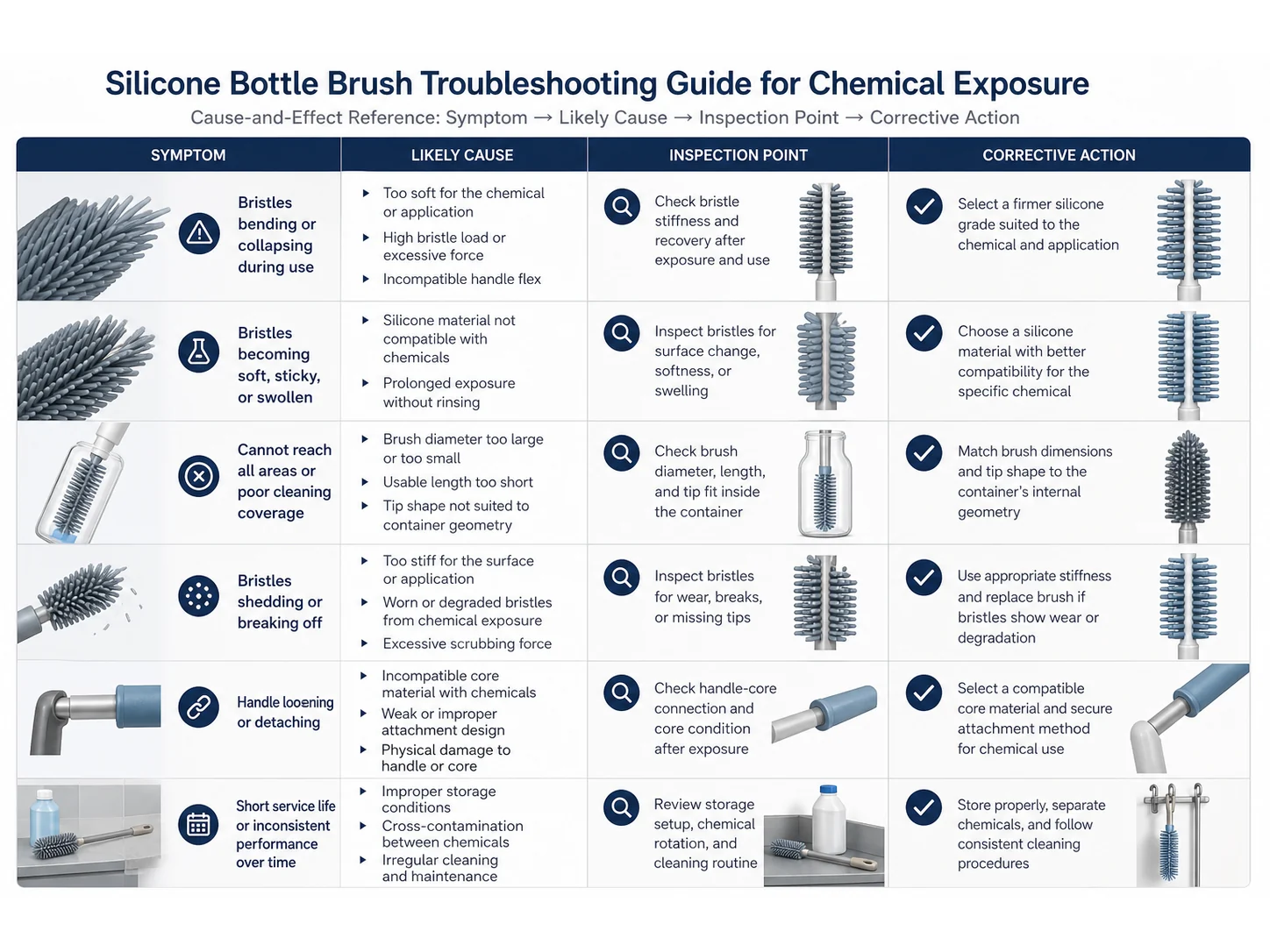
- Replacement frequency: Inspect bristles weekly for signs of swelling, tearing, or loss of resilience. A degraded brush can shed micro‑particles that contaminate the next batch.
Common Mistakes When Specifying or Buying
Many procurement errors are avoidable with simple checks.
- Guessing the diameter: Ordering a brush that “looks about right” often results in a tool that won’t fit or clean effectively. Always use caliper measurements.
- Ignoring handle and core compatibility: A stainless‑steel core may react with the container material if dissimilar metals touch in the presence of an electrolyte. Check galvanic corrosion risk.
- Assuming all silicone is food‑grade: “Silicone” alone does not Help confirm FDA, 3‑A, or USP Class VI compliance. Specify the required certification during inquiry.
- Overlooking handle ergonomics: A short, smooth handle becomes slippery with detergent. Request a textured grip or a handle long enough to stay dry.
- Using the same brush for incompatible chemicals: Even trace solvent left on a brush can react with the next cleaning cycle. Dedicate brushes to chemical families where possible.
- Choosing by cost drivers alone: A low‑cost silicone brush may use fillers that reduce heat resistance or leach out under chemical attack, creating contamination.
When a Silicone Bottle Brush Is the Wrong Choice
Silicone brushes have limits. Recognizing these boundaries prevents process failures.
- Extreme chemical environments: Concentrated nitric acid, strong oxidizers, or some solvents (e.g., toluene, xylene) can degrade silicone. In these cases, PTFE bristles or a purely mechanical scraping tool may be required.
- Hard, baked‑on deposits: Silicone bristles lack the cutting action needed for heavy carbon scale or polymerized films. A stiffer nylon or metal brush, used with appropriate surface protection, often works better.
- Ultra‑high purity processes: In semiconductor or biopharmaceutical applications, even silicone’s minimal shedding may be unacceptable. Single‑use brushes or cleaning techniques without bristles (e.g., ultrasonic, high‑pressure spray balls) should be evaluated.
- Irregular or very small geometries: When container interiors have sharp angles, non‑circular cross‑sections, or diameters under 5 mm, standard silicone brushes may not reach all surfaces. A custom‑molded silicone sponge or a different cleaning method becomes necessary.
- When safety data is incomplete: If the chemical mixture is proprietary or untested, always request a sweep test or sample exposure from the brush supplier. Do not rely on generic compatibility charts.
Final Takeaway
Choose a silicone bottle brush when chemical inertness, surface safety, and hygienic standards are priorities. Start by measuring the container’s smallest internal diameter and note your chemical and temperature boundaries. Match stiffness to the residue without compromising surface finish, and verify that the entire brush—not just the bristles—is compatible. For non‑standard shapes or aggressive agents, involve the supplier early with a drawing and a chemical list. A well‑specified silicone brush gives reliable, repeatable cleaning without contaminating your process.
Frequently Asked Questions
Can a silicone bottle brush be used with acids?
Yes, silicone is generally resistant to dilute and many concentrated acids. However, strong oxidizing acids (e.g., hot nitric acid) may cause swelling or degradation. Always check a compatibility chart for the specific acid concentration and temperature.
Are all silicone bottle brushes food‑safe?
Not automatically. Food‑contact applications require FDA‑compliant silicone. When ordering, request documentation that the bristle material meets 21 CFR 177.2600 or equivalent regional standards.
How do I sterilize a silicone bottle brush?
Most silicone brushes withstand autoclave sterilization at 121–134 °C. Chemical sterilization with hydrogen peroxide or peracetic acid is also common, but you must confirm that the handle and core material tolerate the specific sterilant. After sterilization, allow the brush to dry completely to prevent microbial growth in any crevices.
What diameter brush fits a narrow‑neck flask?
Measure the neck’s inner diameter with calipers. The brush diameter should be 2–5 mm smaller than that measurement to slide in without jamming. For a 20 mm neck, select a brush around 15–18 mm in diameter.
Can I use a silicone brush with hot liquids?
Standard silicone bristles handle continuous temperatures up to 200 °C. If your cleaning solution is below 200 °C and the chemical does not attack silicone, hot liquid use is fine. Verify the handle and core materials as well—plastic handles may soften above 100 °C.
How long does a silicone bottle brush last?
Lifespan depends on usage frequency, chemical exposure, and mechanical stress. In daily industrial use, inspect weekly for tears, loss of flexibility, or swelling. Replace at first sign of degradation to avoid particle shedding. A brush used a few times per shift may last 3–6 months.
Can silicone bottle brushes be ordered to custom sizes?
Yes, many manufacturers offer custom diameters, lengths, and bristle configurations. Provide a drawing with dimensions and the chemical environment. Request a sample for on‑site testing before full production.
Will a silicone brush scratch glass or stainless steel?
No, silicone bristles are non‑abrasive. They clean without scratching borosilicate glass, PTFE, and polished stainless steel surfaces. This makes them suitable for scratch‑sensitive equipment like sight glasses and fermenter viewing ports.
Technical References
- CDC — Preventing Food Poisoning
- eCFR — 21 CFR 177.1500 Nylon Resins
- eCFR — 21 CFR 177.1520 Olefin Polymers
- OSHA — Hazard Communication
- OSHA — Chemical Hazards and Toxic Substances
- FDA — Food Safety in Your Kitchen
Which bristle material fits this job — Silicone, AISI 304 Stainless Steel Wire or Nylon PA?
| Material | Continuous temperature (°C) | Peak temperature (°C) | Water absorption | Hardness |
|---|---|---|---|---|
| Silicone | 200–250 | 280–300 | 0.1–1.0% | Shore A 20–80 |
| AISI 304 Stainless Steel Wire | 400 | 500 | 0% | Rockwell B 70–95 depending on temper and cold work |
| Nylon PA | 93 | 121 | 0.3–9% by PA grade and conditioning | Medium to firm; filament diameter and trim length control bending force. |
| PBT | 120–140 | 160–180 | 0.05–0.20% | Shore D 80–90 |
| Polypropylene PP | 80–100 | 120–140 | ≤0.03% | Shore D 65–75 |
Figures as published by Alleima; Brushtec / DuPont; Perlon. Confirm the exact grade against the supplier datasheet before ordering.
What should replace Bottle & Container Brushes for silicone bottle brush?
- Bottle & Container Brushes — Bottle and container brushes are selected around an opening plus a larger vessel body and bottom geometry; tube and bore brushes are selected mainly around a long diameter-controlled passage. Closest alternative: Tube & Pipe Bore Brushes.
- Silicone — Compare Silicone with PP, TPE, Nylon. Change material when wet stiffness, temperature, chemical resistance, conductivity, particle shedding, or surface marking becomes the limiting factor.
- AISI 304 Stainless Steel Wire — Use AISI 316 stainless steel wire for chloride, marine, dairy, beverage, chemical washdown, or higher pitting-resistance requirements. Use carbon steel for dry aggressive cutting and brass or abrasive nylon for lower marking risk.
- Nylon PA — Compare Nylon PA with PP, PBT, PET. Change material when wet stiffness, temperature, chemical resistance, conductivity, particle shedding, or surface marking becomes the limiting factor.