
Custom Cleaning Brush
Silicone Brush
Industrial silicone brush with flexible non-scratch filaments for machine panels, containers, and equipment.
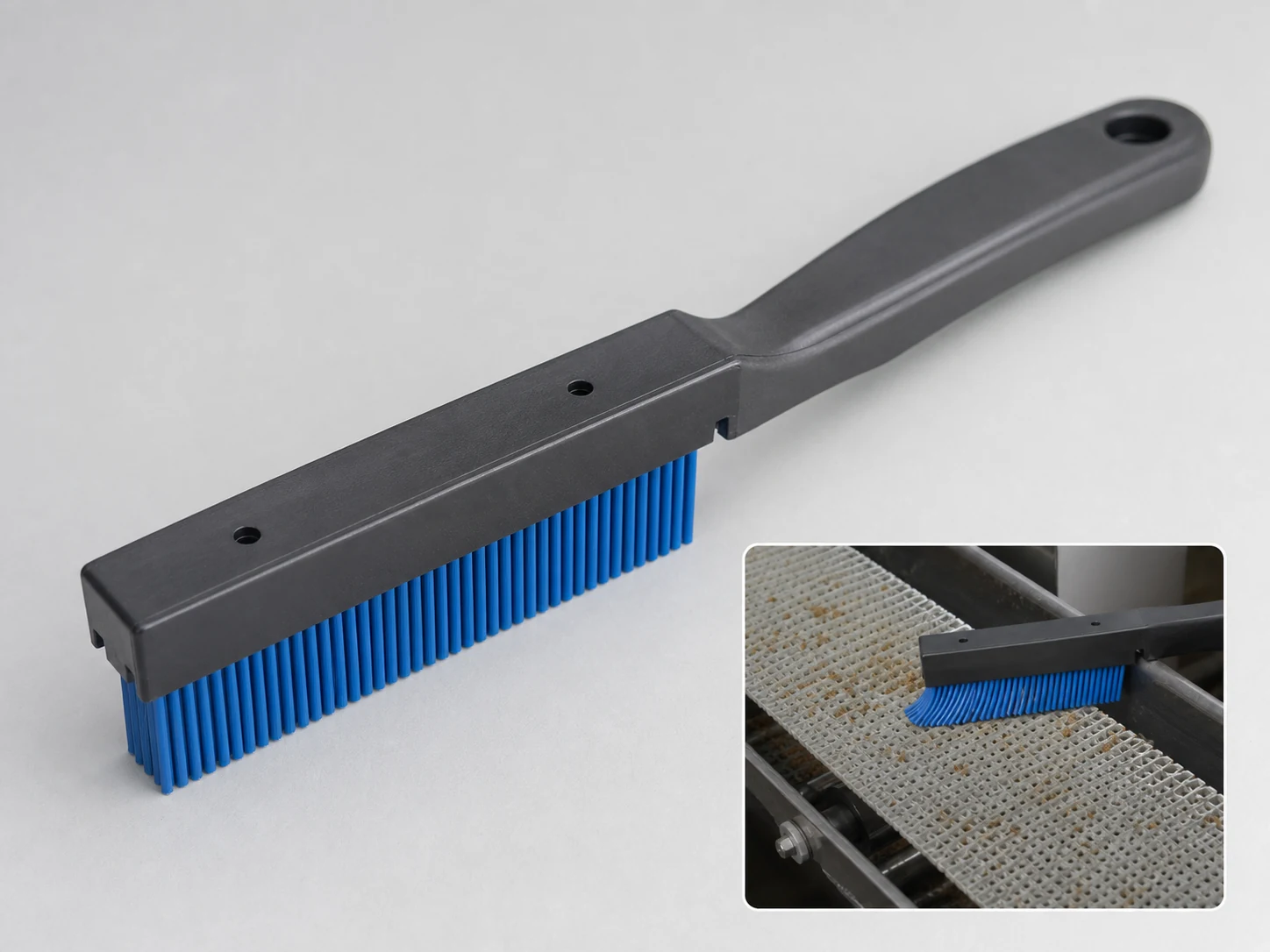
Small brush
500 pcs
Minimum order
Held in one hand: tube, bottle, detail and swab brushes — including long-handled ones with a small head.
Production lead time, once the specification is confirmed
- Up to 500 pcsWithin 7 days
- 501–50,000 pcsWithin 14 days
- Over 50,000 pcsWithin 21 days
Peak season can extend these times; the shipping date is confirmed in writing with your quotation. Sampling and shipping are quoted separately.
A silicone brush is a flexible-contact cleaning tool built with silicone filaments, bristles, or molded contact elements instead of nylon, wire, or natural fiber. It is made for wet and dry surface cleaning on industrial machines, panels, containers, and equipment where non-scratch contact, heat tolerance, and easy rinse-out matter more than aggressive abrasion. Standard designs can be configured from 20 mm to 100 mm wide heads, 5 mm to 100 mm trim lengths, and a range of manual handles or machine-mounting interfaces.
What can this brush do for you?
Non-abrasive contact that protects finished surfaces
Silicone filaments flex and slide rather than cut or embed. The brush removes dust, dry particles, liquid films, and light process residue without scoring anodized panels, acrylic guards, powder-coated covers, or polished metal. If the surface finish must survive routine cleaning, this is the contact you want instead of stiff filament ends that can leave marks.
Operates across a -60°C to 230°C continuous temperature range
The silicone fill stays flexible in freezer or cold-chain areas and does not melt or become brittle on heated equipment, hot rollers, or oven-adjacent surfaces. The complete assembly rating depends on the backing and handle materials, so those are selected for the same temperature window.
Wet and dry performance from the same tool
Silicone is hydrophobic and non-absorbent. The filaments do not swell or hold water, cleaners, or process fluids, so the brush can wipe coolant films, rinse off, and return to dry dusting without a separate set of brushes. One tool covers both sides of a changeover.
Flexible filaments follow uneven surfaces
Because silicone deflects under light pressure, the brush maintains contact across ribs, recesses, edges, and radiused panels instead of skipping over them. More of the surface gets contacted in each stroke, and the operator does not have to reposition the brush constantly.
Chemical tolerance matched to common industrial cleaners
Silicone resists many dilute acids and alkalis, oils, and water-based detergents better than nylon or natural fiber. The brush can go through wipedown chemicals that would harden or embrittle standard bristles, as long as the specific chemical is verified for your concentration and temperature.
Multiple mounting formats for hand or automated use
The same silicone contact can be supplied as a hand brush, mounted on a ferrule or stem, or formed into strip, wheel, plate, or shaft configurations. That makes it possible to use one filament specification across manual maintenance and automated conveyor, rotary, or linear cleaning stations.
What is a Silicone Brush?
A silicone brush is a cleaning tool where the working contact is made from silicone — either round extruded silicone filaments, tapered silicone bristles, molded silicone fingers, or silicone strip segments — set into a backing, handle, ferrule, or machine interface. The silicone does the cleaning work; the backing and mounting transmit the operator’s or machine’s motion.
During use, the brush is drawn or rotated across the surface. The filaments sweep loose particles out of recesses, spread and wipe liquid films, and lift light process residue while flexing to follow the surface profile. It is a contact-cleaning tool, not an abrasive or polishing tool: it removes what is loosely attached, film-like, or easily dislodged, not welded, baked, or mineralized deposits.
Because silicone is naturally non-absorbent, non-scratch, and heat-tolerant, the brush fits maintenance and production environments where surface finish and cleanliness matter. It does not replace a nylon brush when more aggressive scrubbing force is needed, and it does not replace a wire brush for scale or heavy corrosion. The right configuration depends on the contact surface, the residue type, the motion path, and the mounting interface — not just the brush width.
Technical Specifications
| Parameter | Specification / Options |
|---|---|
| Fill material | Silicone (standard solid silicone; food-grade, high-temperature, or static-dissipative grades available by project) |
| Head width | 20–100 mm (wider or narrower possible on request) |
| Trim length | 5–100 mm, selected for reach and flexibility |
| Filament diameter | 0.05–1.20 mm; thinner for contour following and fine dust, thicker for stiffer wiping or heavier films |
| Fill density | 20–200 tufts per 100 cm², adjusted to residue and surface contact |
| Overall length | 100–250 mm for hand-held versions; machine-mounted versions follow the selected interface |
| Mounting / interface | Handle, ferrule, strip, wheel, plate, stem, or shaft |
| Backing / core material | Project-suitable plastic, aluminum, or stainless steel, matched to temperature, chemicals, and mounting |
| Silicone hardness | 30–80 Shore A, softer for delicate surfaces, firmer for stronger wiping pressure |
| Operating temperature | -60°C to 230°C continuous for silicone fill; complete assembly rating depends on backing, adhesive, and handle materials |
| Chemical exposure | Resistant to many dilute acids and alkalis, oils, and water-based detergents; avoid prolonged contact with strong solvents or concentrated oxidizing acids unless verified by sample testing |
| Brush type | Custom Handheld Detail Brushes |
| How it is driven | Hand-guided |
| Cleaning target | machine panel, conveyor belt, and tank cleaning |
| Surface or part | panels, containers, conveyors, guards, roller, frames, hoppers, and recesses |
| Residue or debris | liquid film, particles, process residue, dust, oil, loose particles, fiber, and oil film |
| Mounting / connection | Handle, ferrule, strip, wheel, plate, stem, or shaft |
All dimensions and material combinations are configurable. Share your operating temperature, chemical list, and motion type, and we will specify the backing, mounting, and filament grade to match.
Where does this brush work best?
- Machine panels, guards, and enclosures: wiping dust, fingerprints, and light oil films from painted, powder-coated, or anodized surfaces without scratching.
- Conveyor belts, rollers, and guide rails: removing loose particles, product dust, and process residue from contact surfaces while leaving the surface undamaged.
- Containers, bins, hoppers, and tanks: cleaning interior sidewalls and corners where liquid films or powder residues need to be swept or wiped, and the brush must rinse clean between batches.
- Heated or chilled equipment areas: cold-chain conveyors, freezer frames, bakery oven exteriors, dryer housings, and similar zones within the -60°C to 230°C window.
- Food and beverage processing support areas: non-absorbent contact that can be specified with food-grade silicone for wipe-down of guards, covers, tooling, and surfaces adjacent to product zones.
- Assembly and maintenance benches: a single hand brush that switches between wet wipedown and dry dusting of fixtures, jigs, and precision assemblies.
How do I choose the right one?
Match filament stiffness to residue and surface. Thin filaments (0.05–0.30 mm) flex deeply and are best for fine dust, delicate coatings, and contour following. Medium diameters (0.30–0.60 mm) give balanced wiping and particle removal on painted metal and plastic panels. Thicker filaments (0.60–1.20 mm) press harder and push heavier liquid films, sticky process residue, or coarse particles, but they also exert more force on the surface — choose the largest diameter that still protects the finish.
Set trim length by access and flex. Short trim (5–15 mm) gives firmer contact and better control on flat surfaces and edges. Medium trim (15–40 mm) reaches into shallow recesses and around radiuses. Long trim (40–100 mm) follows deep contours and cleans around obstructions but provides less scrubbing pressure; use long trim only where reach is more important than force.
Choose fill density for residue release and contact coverage. Low density (20–60 tufts/100 cm²) lets debris fall out easily and rinses quickly — ideal for dry dust and loose powder. Higher density (100–200 tufts/100 cm²) gives more wiping surface for liquid films, but it can hold fine particles more readily. For wet cleaning, choose a density that balances wipe coverage with rinse-out.
Select the mounting to match the motion. Manual wipe-down? Use a handle or ferrule design sized for operator reach. Linear cleaning station? A strip or plate mount bolts into the machine frame. Rotary or roller cleaning? Use a wheel or shaft-mount brush. The interface must handle the rotational speed and runout of your equipment, not just the brush dimensions.
Confirm the full assembly temperature rating. The silicone fill is rated to 230°C continuous, but plastic backings, adhesives, and handles may fail sooner. If the brush runs on hot surfaces, select stainless steel or aluminum backing and high-temperature fastening — or specify a no-adhesive mechanical lock.
Test chemical compatibility when cleaners are aggressive. Silicone handles many dilute industrial cleaners, oils, and water-based detergents. Strong solvents, esters, ketones, concentrated acids, and some fuels can swell or degrade the filaments. Sample testing in the actual process fluid at operating temperature is the fastest way to confirm fit.
| Cleaning situation | Recommended configuration |
|---|---|
| Dust on painted guards and panels | 0.2–0.4 mm filaments, 15–30 mm trim, medium density, handled brush |
| Coolant or oil film on rollers | 0.5–0.8 mm filaments, 10–25 mm trim, high density, strip or wheel mount |
| Sticky process residue in hopper or bin | 0.6–1.2 mm filaments or molded silicone fingers, 20–50 mm trim, medium-high density, handle or shaft with rinse access |
| Food-zone wipe-down under heat | Food-grade silicone, 15–40 mm trim, medium density, stainless ferrule or handle |
| Cold-chain conveyor dusting | 0.3–0.5 mm filaments, 20–40 mm trim, low density, strip or plate mount |
Use a nylon, PBT, or abrasive-filament brush when residue is hard, baked, mineralized, or requires aggressive mechanical action. Use a wire brush for scale, weld spatter, or heavy corrosion. Use foam or microfiber contact for very large flat areas where an even liquid film must be absorbed rather than wiped. Silicone is the right contact when surface protection, temperature range, and chemical tolerance are the priorities.
Can I customize this brush?
Silicone brushes are configurable because every surface, residue, and machine interface is different. We will need the surface material and finish, residue type, cleaning chemical list, operating temperature, motion type (manual, linear, rotary), required contact width and reach, and a mounting interface drawing or sample. A sketch or photo of the cleaning area helps us get the geometry right faster.
We can adjust:
- Head geometry — width, length, trim length, filament diameter, tuft pattern, density, and profile (flat, radiused, angled, or formed to a part)
- Silicone compound — standard, food-grade, high-temperature, static-dissipative, or color-specific; hardness 30–80 Shore A
- Backing / core — plastic, aluminum, stainless steel, or other project-suitable material; mechanical or adhesive filament retention
- Mounting — handle (straight, ergonomic, loop), ferrule (threaded or press-fit), strip, wheel, plate, stem, or shaft; special bore, hub, or fastener patterns can be machined
- Color and marking — custom color, molded or pad-printed logo, laser marking, or part number identification
- Packaging — bulk, individual bag, retail-ready, kit, or project-specific labeling
If your project requires material documentation, third-party testing, or compliance support for food-contact or cleanroom requirements, we can assist with those requirements during the customization process.
Which filament survives the cleaning and still lasts on a silicone brush?
What is the difference between silicone filaments and molded silicone bristles on this brush?
Extruded silicone filaments are round, flexible strands set in tufts. They are best for sweeping dust, following contours, and rinsing clean. Molded silicone bristles, fingers, or strip segments are formed in a mold and can have tapered edges, wipers, or custom profiles for pushing liquid films or scraping soft residue. Both are silicone contact, but the shape changes how the brush wipes. We can switch between the two based on your surface profile and residue.
Can the brush be used on surfaces hotter than 230°C?
The silicone fill itself is rated for continuous use up to about 230°C. Above that, silicone gradually degrades — it becomes brittle, loses flexibility, or discolors. If your surface runs hotter, a metal wire or ceramic-fiber brush is more suitable. Also check the backing and handle: a stainless backing can survive high heat, but a plastic handle or adhesive cannot.
How do I test whether the brush’s silicone will survive my cleaning chemical?
Ask your supplier for a small filament or tuft sample. Immerse it in the actual cleaning solution at the actual process temperature for 24–48 hours. Then check for swelling, softening, tackiness, cracking, or weight change. If the sample swells more than about 10% or feels sticky, the chemical is attacking the silicone; choose a different filament material or change the cleaner.
Will the brush shed silicone particles onto the cleaned surface?
A properly cured, well-made silicone brush should not shed under normal use. For ultra-clean or contamination-sensitive applications, specify a post-cured or platinum-cured silicone grade, and pre-clean the brush with the same process fluid before installation. Inspect the brush regularly; if you see small silicone fragments appearing on the product, it is time to replace the fill.
Can I use this brush in a food-contact area?
Yes, when the silicone fill is specified as a food-grade compound and the backing, handle, and any adhesives are also suitable for the zone. Standard industrial silicone may not meet the same requirements. Share your food-safety, cleaning, and temperature requirements with us so the whole assembly is selected, not just the filaments.
Does a silicone brush absorb water or cleaning agents?
No. Silicone is hydrophobic and does not absorb water, detergents, or most process fluids. The filaments rinse clean and dry quickly, which is one of the main reasons silicone is chosen for wet/dry switching. However, if the brush has a wooden backing or an absorbent adhesive layer, those components can hold moisture — specify metal or plastic backing for fully wet environments.
Guides that go deeper on this
We have not written a guide specific to this one yet. The material that covers selection, filament, dimensions, maintenance and sourcing is collected in the technical resources library.
Custom Manufacturing RFQ
Describe Your Application
Please share the brush dimensions, working area, residue type, material direction, quantity, and a drawing or photo for quotation.
Drawing or photo optional — it speeds things up, it does not gate the enquiry.
Custom Brush RFQ
Send Your Brush Project
Upload a drawing, product photo, or sample photo and provide the core dimensions and cleaning conditions.
“We need a brush to remove wet residue from a stainless steel conveyor, about 800mm wide. The current brush wears quickly. We can send photos.”
“We sell drinkware and need a cleaning brush to include with the product. Quantity around 5,000 pieces.”