
Custom Cleaning Brush
Silicone Food Cleaning Brush
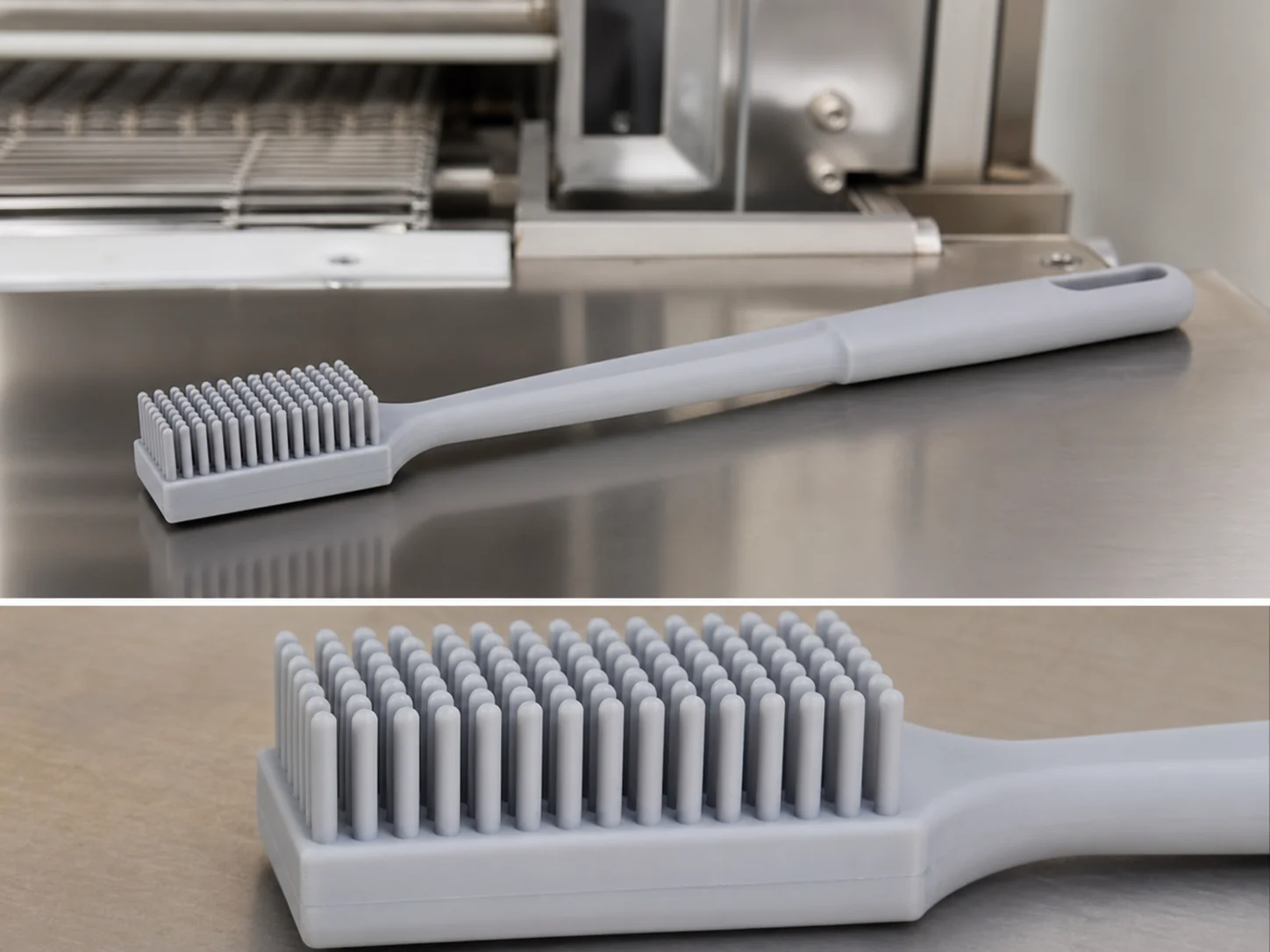
Molded silicone food cleaning brush for conveyors, trays, tanks, and removable food processing parts.
Small brush
500 pcs
Minimum order
Held in one hand: tube, bottle, detail and swab brushes — including long-handled ones with a small head.
Production lead time, once the specification is confirmed
- Up to 500 pcsWithin 7 days
- 501–50,000 pcsWithin 14 days
- Over 50,000 pcsWithin 21 days
Peak season can extend these times; the shipping date is confirmed in writing with your quotation. Sampling and shipping are quoted separately.
A hand-operated silicone cleaning brush built for wet cleaning of food processing equipment — conveyors, trays, tanks, guards, and removable machine parts. Its all-silicone body and insert-molded bristle head remove soft food residue without scratching contact surfaces and handle repeated hot-water washdown.
What can this brush do for you?
Non-scratch contact on stainless and coated equipment
The molded silicone bristle tips flex around edges and glide over stainless steel, coated panels, and plastics without leaving scratches. Scratched equipment surfaces collect product film and become difficult-to-clean harborage points, so using a non-scratch tool directly supports your sanitation routine instead of working against it.
Sticky residue releases instead of loading the brush
Fat, protein film, syrup, and dough cling to natural-fiber and many nylon brushes, but silicone releases these residues quickly under rinse water. The brush returns to service faster between batches, and it does not carry leftover product from one zone to the next.
One-piece insert-molded construction keeps bristles attached
The head is insert-molded to the handle rather than stapled, glued, or socketed, so there is no separate bristle strip that can separate and shed pieces onto the line. That design directly reduces the risk of foreign material contamination in food processing areas.
Handles hot water, steam-related heat, and cold storage
The silicone material tolerates a working range of -20°C to 230°C. The same brush can remove warm residue, go through a hot-water cleaning step, and then be stored in a cold room without becoming stiff, cracked, or brittle.
Rectangular head clears flat and open surfaces faster
The 90 mm long, 35 mm wide rectangular head covers straight runs of conveyor, tray, and tank wall with fewer strokes than a small round head. Rounded corners follow edges and corners without gouging or catching on seams.
What is a Silicone Food Cleaning Brush?
A Silicone Food Cleaning Brush is a manual wet-cleaning tool for open food processing surfaces. It uses a molded silicone bristle head and a solid silicone handle, with the head fused to the handle through insert molding. The brush is designed for push-pull and scrubbing strokes on flat or gently curved equipment surfaces, not for internal bores or fine crevices.
In use, an operator applies the plant’s approved detergent to the equipment and works the bristles across conveyors, trays, tank walls, guards, or removable process parts. The bristles loosen crumbs, flour, fat, protein film, syrup, dough, and washdown residue. A rinse step carries the loosened soil away. Because silicone is non-porous, chemically tolerant, and heat-stable, the brush itself can remain in the washdown environment without absorbing water or detergent.
The standard configuration is sized for open equipment surfaces. It is not a scraper for carbonized deposits, not a wire brush for scale, and not a tube brush for pipe interiors. It performs best where surface protection, residue release, and repeatable manual cleaning matter more than aggressive mechanical force.
Technical Specifications
The table lists the standard configuration. All dimensions and materials can be adjusted to the project.
| Parameter | Standard / Options |
|---|---|
| Head width | 35 mm (adjustable per project) |
| Head length | 90 mm (adjustable per project) |
| Head shape | Rectangular with rounded corners |
| Bristle material | Molded silicone elastomer |
| Bristle pattern | Rows of flexible silicone fingers; spacing, height, and stiffness configurable |
| Bristle hardness | 50–70 Shore A standard; softer or firmer available |
| Temperature resistance | -20°C to 230°C (silicone material rating) |
| Handle material | Solid silicone |
| Handle length | 130 mm (extension available on request) |
| Grip diameter | 25 mm |
| Connection | Insert-molded fixed head (no adhesives or staples) |
| Overall length | Approximately 220 mm (head + handle) |
| Operating environment | Manual wet washdown, hot water, and common food-plant detergents and sanitizers; confirm chemical compatibility per application |
| Color | Project-selectable; zone-coding colors available |
| Brush type | Custom Handheld Detail Brushes |
| How it is driven | Hand-guided |
| Cleaning target | bakery and snack line, dairy equipment, and beverage production cleaning |
| Surface or part | tanks, guards, conveyors, trays, machine parts, tank walls, drums, and panels |
| Residue or debris | dough, fat, protein film, crumbs, flour, syrup, product film, and food residue |
| Mounting / connection | Insert-molded fixed head (no adhesives or staples) |
The temperature range refers to the silicone material itself. Actual service life depends on detergent concentration, exposure time, and whether the brush is subjected to mechanical abuse beyond normal brushing.
Where does this brush work best?
- Bakery and snack lines: conveyor belts, transfer plates, cooling conveyors, and crumb trays where flour, dough, and crumbs collect on open surfaces.
- Meat, poultry, and dairy equipment: trays, molds, hoppers, guards, and removable machine parts covered in fat, protein film, and washdown splatter.
- Sauce, dressing, and beverage production: mixing tank exteriors, filling machine bases, catch trays, and drum lids where syrup and product film build up.
- Packaging and inspection stations: machine covers, guard panels, and polycarbonate windows that need scratch-free removal of splatter and rinse residue.
- Ingredient handling: tote bins, container exteriors, and drum tops where powder, flour, and dust accumulate during transfer.
How do I choose the right one?
Start with the residue and the surface, not just the brush size. For fresh, soft film on stainless steel, the standard 50–70 Shore A silicone works well. For thick, sticky dough or heavy fat, a firmer silicone with shorter bristles transfers more scrubbing pressure. For delicate coated or polished surfaces, choose a lower Shore A silicone with rounded tips.
Then confirm access and surface profile. The 35 mm × 90 mm rectangular head is efficient on open flat runs. If you need to reach under guards, around narrow ribs, or along curved tank walls, a narrower or curved head profile may be the better fit. Measure the smallest clearance the brush must pass through and provide that dimension when requesting a custom configuration.
Handle length should match the operator’s reach and the equipment depth. The standard 130 mm handle suits close scrubbing at bench height. For deep tanks, long conveyors, or overhead surfaces, an extended handle or ergonomic grip reduces operator strain.
Verify chemistry and temperature early. Silicone handles hot water and most food-plant detergents well, but concentrated oxidizers, strong solvents, or continuous steam above 230°C will shorten service life. Provide your sanitation chemical list so the right silicone compound is selected.
Finally, use color coding if your plant separates raw, cooked, allergen, or non-allergen zones. Distinct molded colors are one of the lowest-cost ways to prevent cross-contact and enforce zone discipline.
| Condition | Configuration guidance |
|---|---|
| Fresh, soft film on stainless | Standard silicone, 50–70 Shore A |
| Sticky dough or heavy fat | Firmer silicone, shorter bristle height |
| Delicate coated or polished surface | Lower Shore A, rounded bristle tips |
| Baked-on carbon or mineral scale | Use a scraper or wire brush first, then this brush for residual cleaning |
| Deep tank or long reach | Extended handle or long-handle version |
Can I customize this brush?
Yes. A Silicone Food Cleaning Brush is usually configured to the equipment it will clean and the residues it will remove. To define a custom version, provide the surface material, residue type, cleaning chemicals, wash temperature, access dimensions, color-coding scheme, and preferred handle form. A sketch or sample photo helps us confirm the geometry faster.
We can adjust:
- Head geometry: width, length, rectangular profile, rounded or angled ends, curved face for tank walls, or shaped profiles for guards.
- Bristle layout: row spacing, bristle height, tip profile, molded bristle block, or individual silicone fingers; hardness from soft to firm.
- Handle: length, grip diameter, ergonomic contours, textured grip, hanging hole, extended reach, or two-material grip if preferred.
- Connection: standard insert-molded fixed head; replacement-head designs or removable-head interfaces can be evaluated for your maintenance program.
- Color and marking: custom colors for zone coding, molded-in identification marks, pad printing, or laser marking.
- Detectable option: a metal-detectable additive can be incorporated into the silicone for foreign-body detection programs.
- Packaging: bulk cartons, individual bags, retail sleeves, or project-specific packing.
If your food-safety program requires material documentation, certificates of analysis, third-party testing, or traceability records, we can support those project-specific requirements during the customization process.
Which filament survives the cleaning and still lasts on a silicone food cleaning brush?
How should this brush be cleaned and stored between uses?
Rinse it with the plant’s approved detergent and hot water, remove any visible residue from the bristle tips and handle, then hang it or stand it with bristles facing down to air dry. Avoid prolonged soaking in concentrated sanitizers or solvents. Proper rinsing keeps the silicone bristles flexible and prevents detergent buildup.
What should I check to know when to replace the brush?
Inspect the bristle tips for cuts, flattening, or tears. If many bristles remain bent or lie flat after rinsing, or if the silicone head shows cracks near the insert-molded joint, replace the brush. Any sign of loose material from the head means the brush should be removed from service immediately.
Can this brush remove burnt-on or baked-on food deposits?
It can remove residues that have been softened by presoaking or detergent, but carbonized and mineral-scale deposits usually require a scraper or more aggressive tool first. Silicone is designed to protect surfaces while removing fresh and softened soil, not to grind through hard deposits.
Will the silicone bristles scratch polycarbonate guards or coated surfaces?
Silicone itself is non-scratch under normal hand pressure, but embedded foreign grit between the bristles can abrade clear or coated surfaces. Rinse the brush before use on those surfaces and test in an inconspicuous area first.
Can one brush be used in both raw and cooked zones?
No. If your facility has segregated hygiene zones, use separate color-coded brushes and never move them between zones. We can mold distinct colors and markings to support your zone-control program.
Is this brush suitable for cleaning inside pipes or narrow openings?
The rectangular head is sized for open equipment surfaces. For pipe interiors, narrow bores, or bottle necks, select a tube brush, bottle brush, or pipe brush instead. This brush is intended for external and open-surface cleaning.
Guides that go deeper on this
Custom Manufacturing RFQ
Describe Your Application
To quote this brush accurately, send the size, material, cleaning target, residue, quantity, and any available drawing or sample photo.
Drawing or photo optional — it speeds things up, it does not gate the enquiry.
Custom Brush RFQ
Send Your Brush Project
Upload a drawing, product photo, or sample photo and provide the core dimensions and cleaning conditions.
“We need a brush to remove wet residue from a stainless steel conveyor, about 800mm wide. The current brush wears quickly. We can send photos.”
“We sell drinkware and need a cleaning brush to include with the product. Quantity around 5,000 pieces.”