
Custom Cleaning Brush
Food Processing Brush
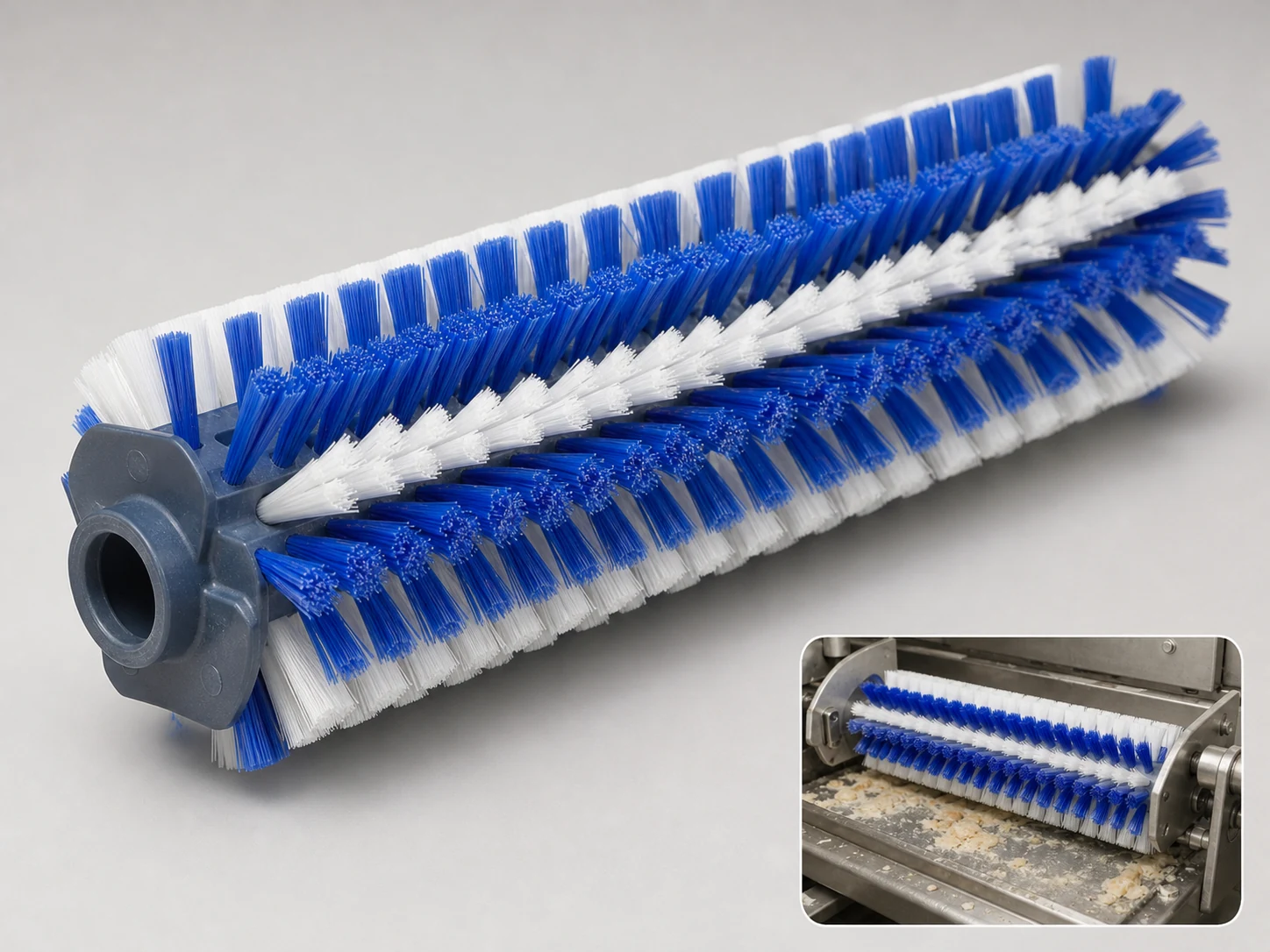
Custom food processing brushes with PBT, PP, or PET filaments for conveyor belts, trays, molds, hoppers and sifters. Open drainable base, custom widths.
Medium brush
100 pcs
Minimum order
Worked with two hands or on a pole: chimney, gutter and pond-filter brushes, discs, cups and tank brushes.
Production lead time, once the specification is confirmed
- Up to 100 pcsWithin 7 days
- 101–5,000 pcsWithin 14 days
- 5,001–50,000 pcsWithin 21 days
- Over 50,000 pcsConfirmed with your quotation
Peak season can extend these times; the shipping date is confirmed in writing with your quotation. Sampling and shipping are quoted separately.
The Food Processing Brush is a food-zone cleaning tool engineered for conveyors, trays, molds, hoppers, sifters, guides and equipment frames that collect flour, crumbs, dough, sugar, chocolate, oil, seasoning or baked residue. Its PBT, PP and PET filaments hold their shape in wet washdown conditions, and the open, drainable base sheds water and debris instead of trapping them.
What can this brush do for you?
Keeps Contact Pressure When Wet or Oily
PBT and PP filaments absorb very little moisture compared with many natural fibers. On a damp line or after detergent rinsing, the brush continues to stand up and press against the belt or tray instead of collapsing into a flat mat. That means consistent residue removal on every pass, not just while the line is dry.
Stiffness That Matches the Soil
PBT provides a firmer scrubbing edge for dried sugar, chocolate film and compacted dough. PP flexes more to protect coated trays, plastic guides and softer belt surfaces. PET offers a middle-ground contact for general food soils. The filament choice changes how hard the brush works, and that choice is part of the design, not an afterthought.
Open Base Design Drains Instead of Collecting
The base is built with open channels and drainage paths, no blind pockets where wash water, crumbs or oil can sit. After sanitation, the brush dries faster and is easier to inspect. That reduces the chance of trapped food residue becoming a microbiological or allergen risk in a food production area.
Trim Length Reaches Corners, Links and Mold Cavities
Short, dense trim delivers concentrated scrubbing on flat belts and smooth tray faces. Longer trim follows radiused guides, recessed mold features and wire belt links. The trim can be balanced so the operator or machine covers the full surface in one pass without leaving residue along the center or edges.
Mounts as a Hand Tool or a Fixed Machine Brush
A hand grip works for sanitation teams, while 1/2 in, M8 or M10 threaded hubs let the same head fit a fixed cleaning station, bracket or automated sweeper. The interface is part of the order, not a separate adapter problem.
What is a Food Processing Brush?
A Food Processing Brush is a brush designed specifically for the product-contact and near-product-contact surfaces of food manufacturing equipment. It is built from plastic filament materials such as PBT, PP or PET on an open base, and it is used to remove process residue before it dries, hardens, or contaminates the next batch.
On a conveyor line, the brush may run against the return side of the belt, the scraper zone, or the guide rails. In a bakery or snack plant, it clears flour, crumbs and dough from trays and transfer points. In chocolate or confectionery production, it lifts cocoa butter and sugar film from mold faces and cooling guides. The same brush family handles hoppers, sifters, filling nozzles and machine frames during scheduled sanitation.
It is not a replacement for chemical sanitation, high-pressure washing, or scraping of burned-on carbon. It works best on loose, lightly adhered, or still-soft process residue, and its value is consistent, controlled contact without damaging the equipment surface.
Technical Specifications
The table below lists the standard engineering ranges for this brush. Final dimensions, filament material and mounting are set against the specific line and residue.
| Parameter | Value / Options |
|---|---|
| Head width | 20–300 mm, selected to cover the contact surface in one pass where possible |
| Trim length | 20–80 mm; shorter for flat surface scrubbing, longer for corners and recesses |
| Overall length | 180–800 mm, matched to reach and mounting position |
| Filament diameter | 0.20–0.80 mm; finer for light films, heavier for dried or sticky residue |
| Filament material | PBT, PP, or PET, selected by stiffness, chemical exposure, and food-contact requirement |
| Base / block | Polypropylene or stainless steel with open, drainable channels and no blind pockets |
| Handle / thread | Hand grip, 1/2 in, M8, M10 threaded hub, or custom bracket |
| Operating temperature | 0–140°C for PBT filament heads; PP and PET configurations rated lower for continuous exposure |
| Washdown | 20–85°C water or detergent cleaning; construction allows water and debris to drain |
| Fill pattern | Row spacing and filament density adjusted to debris size and trim length |
| Brush type | Custom Handheld Detail Brushes |
| How it is driven | Hand-guided |
| Cleaning target | biscuit and snack conveyor line, baking tray, and chute and guide cleaning |
| Surface or part | trays, guides, molds, frames, belts, conveyors, hoppers, and sifters |
| Residue or debris | sugar, mold, chocolate, dough, crumbs, flour, oil, and seasoning |
| Mounting / connection | Hand grip, 1/2 in, M8, M10 threaded hub, or custom bracket |
For hot water over 85°C, steam cleaning, or aggressive caustic detergents, provide the sanitation cycle details so the filament and base material can be selected to survive the actual process.
Where does this brush work best?
- Bakery, biscuit and snack conveyor lines: flour, dough, crumbs and oil on belt returns, transfer points, scraper zones and guide rails.
- Baking trays, pans and molds: oil, shortening, sugar and baked residue before it carbonizes; open face and recessed areas.
- Hoppers, sifters, chutes and guides: flour, sugar and seasoning accumulation on mesh, slide surfaces, corners and discharge areas.
- Chocolate and confectionery lines: cocoa butter, chocolate film and sugar dust on mold faces, cooling tunnel guides and take-off rails.
- Filling and packaging equipment: oil, sauces and seasoning around nozzles, spouts and guide rails before they dry.
- Equipment frames and washdown areas: food splatter and general production soil on machine housings, legs and supports.
How do I choose the right one?
Work through the surface, soil, and environment in that order.
1. Measure the contact surface
Record belt width, tray width, guide spacing, or mold face width. Choose a head width that covers the surface without overhang that catches on neighboring parts. For wide belts, multiple narrower heads in a row often give more even contact than one wide head with uneven pressure.
2. Select the filament material by the soil and surface
- PBT: firmer, heat-tolerant, and less likely to soften under hot wash water. Use for dried sugar, chocolate film, compacted dough, and metal or hard plastic surfaces that can take pressure.
- PP: softer and more flexible, very low moisture pickup, and chemically inert for many wash chemicals. Use for coated trays, thin plastic guides, tender belt surfaces, or when scratching is a concern.
- PET: a balanced filament for general food films on moderate surfaces where PBT is more aggressive than needed and PP gives too little lift.
3. Set trim length and density from the residue
If the residue is a thin film or dust, a shorter, denser trim gives concentrated contact. If the residue is loose crumbs, dough lumps, or sits inside recesses, a longer, more open trim lets debris flow through without jamming. Match trim length to the deepest corner you actually need to reach.
4. Decide hand or machine mounting
A hand grip fits sanitation crews moving from station to station. A threaded hub or custom bracket keeps the brush fixed at the belt return, scraper frame, or cleaning station. For machine use, specify thread size, bracket geometry, and whether the brush is stationary against a moving belt or driven by a shaft.
5. Confirm temperature and washdown conditions
PP and PET have lower continuous temperature limits than PBT. If the line is hosed with 80°C water, steam-cleaned, or exposed to strong alkaline detergents, note it before filament selection. The hardware and base material must handle the same environment.
When this brush is the wrong choice: burned-on carbon, caramelized sugar that has hardened, or thick mineral scale usually need a scraper, abrasive pad, or chemical soaking first. If the cleaning target is the inside of a small tube, pipe bore, or threaded port, a tube brush or internal roller brush may fit better than a block or strip head. This brush targets accessible flat, curved, and open surfaces on food equipment.
Can I customize this brush?
Food Processing Brushes are manufactured to the line, not sold as one fixed stock size. To build the right configuration, share the contact surface dimensions, belt or tray material, residue type, cleaning chemicals, wash and process temperatures, mount geometry, and a drawing or photo if available.
Standard customizable parameters include:
- Head geometry: head width, trim length, overall length, angled face, radiused profile, or multiple rows in one base.
- Filament fill: PBT, PP or PET; filament diameter from 0.20 to 0.80 mm; row spacing and density adjusted to the debris.
- Base and hardware: polypropylene or stainless steel base, open drain holes, stainless fasteners, welded or molded standoffs.
- Mounting: hand grip, loop handle, 1/2 in, M8, M10 threaded hub, quick-release mount, or custom bracket drawing.
- Color and marking: zone or allergen color coding, pad print, laser marking, or molded identification for hygiene-zone separation.
- Packaging: bulk cartons, individual poly bags, labeled reusable packaging, or project-specific retail/private-label packing.
If the project calls for food-contact material documentation, migration testing support, inspection reports, or third-party testing, we can arrange these during the customization process instead of treating them as an afterthought.
How do you confirm a food processing brush has actually cleaned the surface?
How do I know if I should use PBT, PP, or PET on my line?
Run a small test on an off-line surface. If the residue presses off easily with light pressure and the surface is coated or easily scratched, PP is usually the safer choice. If the residue is dry, glossy, or sticky after cooling and the line uses hot washdown, PBT will hold its scrubbing stiffness longer. PET is a reasonable middle option for cold and room-temperature food contact lines with average soils.
Can the same brush be used on the product-contact side of the belt and the return side?
Only if the filament and mounting are specified for product-contact use. A brush running against the return or non-product side during production has different requirements than a brush that touches food or a food-contact surface. Tell us which side the brush will contact and whether it runs while product is present, so the material and design are set correctly.
What should I look for when inspecting a used food processing brush?
Check for permanently bent or curled filaments, trim length reduced by more than 20–30 percent, cracks around the base or thread, and any food residue trapped between rows. If the brush no longer recovers its shape after manual flexing, or if contact pressure has visibly dropped, replace it before the next sanitation cycle.
How can I confirm the brush is cleaning without damaging the belt or tray?
Run a short trial on a clean section. Wipe the surface with a clean white cloth dampened with a food-safe cleaner or water, then inspect the cloth and surface in strong light. Residue streaks mean the trim or material is too soft. Scuff marks, fiber transfer, or surface roughness mean the filament is too stiff or the trim is too short. Adjust before full production use.
Will this brush survive steam sterilization or autoclave cycles?
Not by default. PBT filament heads tolerate temperatures up to about 140°C, but PP and PET configurations are rated lower. Steam sterilization often exceeds those limits and can permanently deform the filament or base. Provide the actual sanitation temperature and cycle when ordering so the brush is not exposed beyond its material limits.
What does open drainable construction look like, and why is it important in food plants?
Open construction means the base has drainage holes, standoffs, or open channels where water and debris can escape, and no blind drilled holes or closed cavities where rinse water sits. When water and food particles cannot collect inside the brush, drying is faster, inspection is easier, and there is less space for microbial growth between cleanings.
Guides that go deeper on this
Custom Manufacturing RFQ
Describe Your Application
Please include the main sizes, application, residue, preferred material, interface, quantity, and any drawing or sample available.
Drawing or photo optional — it speeds things up, it does not gate the enquiry.
Custom Brush RFQ
Send Your Brush Project
Upload a drawing, product photo, or sample photo and provide the core dimensions and cleaning conditions.
“We need a brush to remove wet residue from a stainless steel conveyor, about 800mm wide. The current brush wears quickly. We can send photos.”
“We sell drinkware and need a cleaning brush to include with the product. Quantity around 5,000 pieces.”