
Custom Cleaning Brush
250mm Silicone Tank Wall Brush
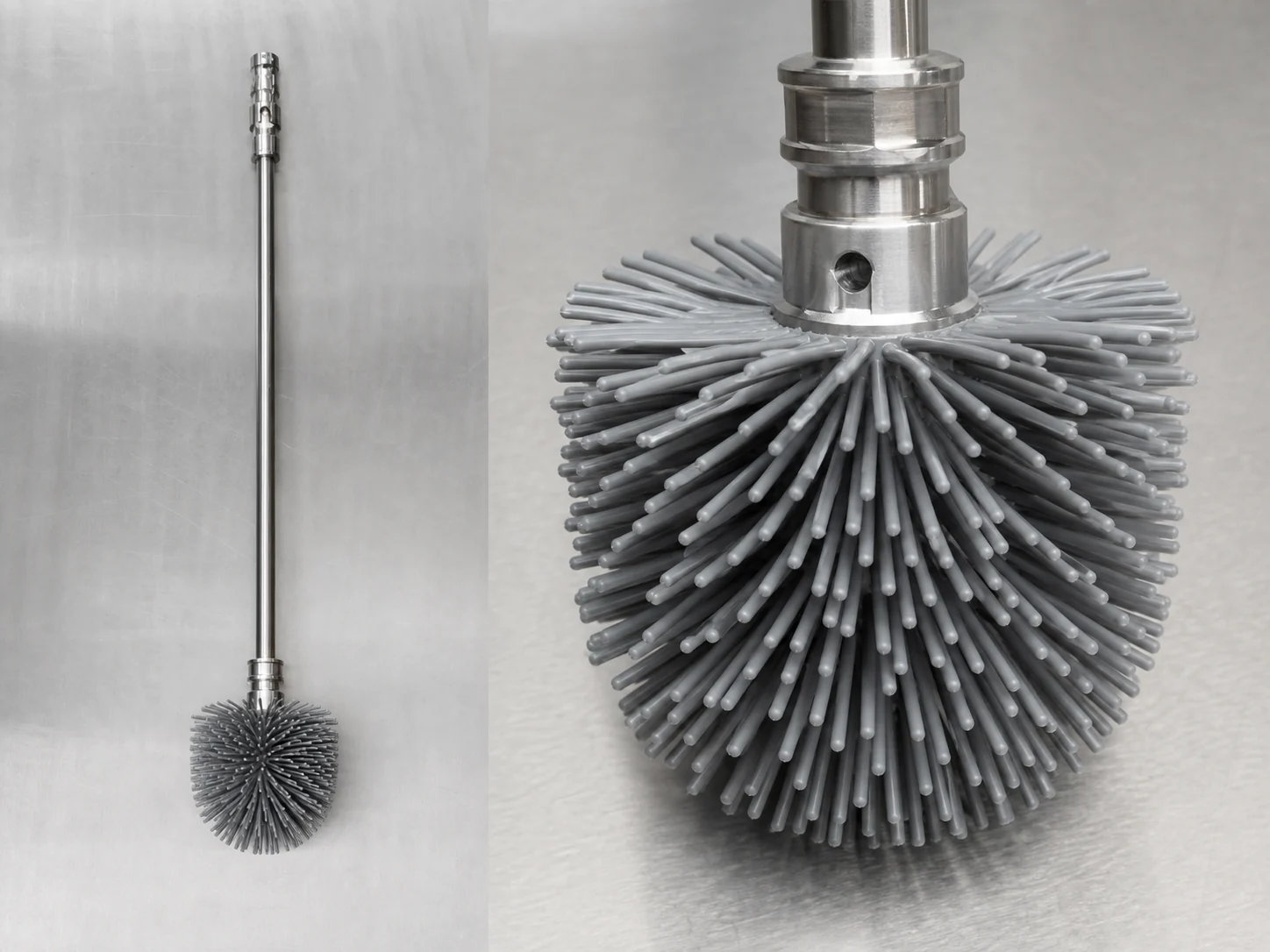
A 250 mm silicone face covers large tank walls in one pass, lifting biofilm and soft residue without scratching stainless, on a quick-change coupling.
Medium brush
100 pcs
Minimum order
Worked with two hands or on a pole: chimney, gutter and pond-filter brushes, discs, cups and tank brushes.
Production lead time, once the specification is confirmed
- Up to 100 pcsWithin 7 days
- 101–5,000 pcsWithin 14 days
- 5,001–50,000 pcsWithin 21 days
- Over 50,000 pcsConfirmed with your quotation
Peak season can extend these times; the shipping date is confirmed in writing with your quotation. Sampling and shipping are quoted separately.
A 250mm silicone tank wall brush for cleaning vertical interior surfaces of storage tanks, fermenters, and mixing vessels. The large contact face removes liquid film, biofilm, and soft product residue without scratching stainless steel or coated walls, while the quick-change coupling accepts extension handles for deep reach.
What can this brush do for you?
Cover large wall areas with one pass
The 250mm round head puts a wide band of silicone bristles against the tank wall, so each stroke cleans far more surface than a hand pad or narrow bottle brush. For a 2-meter diameter vessel, a few vertical passes cover the full circumference without repositioning the ladder or platform.
Remove residue without damaging the wall
Silicone bristles flex on contact and apply even, low-pressure scrubbing. They lift liquid film, yeast deposits, syrup residue, and light biofilms from stainless steel, glass-lined, epoxy-coated, and plastic tank walls while leaving the surface finish intact. No wire ends, no sharp filament tips, no scoring of passivated surfaces.
Reach deep into the tank without climbing inside
The brush mounts to a 1000mm handle with a quick-change coupling, and the coupling accepts compatible extension poles. You can work from the manway or top opening and clean the far wall, side wall, and lower sections while keeping the operator outside the vessel. Confined-space entry stays a last resort instead of a daily routine.
Survive wet, chemical-heavy cleaning environments
The backing plate is AISI 316 stainless steel and the bristles are molded silicone, so the brush tolerates hot water, alkaline detergents, acid rinses, and sanitizer contact that corrode carbon steel or degrade natural fibers. The brush returns to service after CIP-level exposure without rust bleeding onto the tank surface.
Quick-change head keeps changeover simple
A threaded or bayonet quick-change coupling lets an operator swap between a silicone head and a stiffer PBT or nylon head in seconds, using the same handle. That means one handle can support gentle cleaning on finished product tanks and more aggressive scrubbing on raw material vessels without buying a second complete tool.
What is a 250mm Silicone Tank Wall Brush?
A 250mm Silicone Tank Wall Brush is a hand-guided cleaning tool built around a large circular head with silicone bristles arranged on a stainless steel backing plate. It is designed specifically for vertical interior tank walls, where a flat scrub pad is too slow and a narrow brush cannot maintain consistent contact across the curved surface.
In use, the operator stands at the manway or on a platform, attaches the brush to a handle or pole, and works the head up, down, and sideways along the wall. The silicone bristles compress slightly on contact and follow the wall curvature, so the cleaning pressure stays even even when the wall is welded, curved, or has slight surface irregularities. The rotation and stroke motion removes attached residue while the operator controls the pressure by hand.
The brush is intended for routine cleaning between production batches or during washdown. It is not a scraper, a grinder, or a substitute for chemical cleaning. Hard scale, polymerized carbon, mineral deposits, or baked-on residue require a different tool — typically a wire brush, abrasive pad, or chemical pre-treatment — before the silicone brush can be used for final cleaning or light residue removal.
Technical Specifications
The values below represent the standard configuration. Dimensions, bristle length, hardness, and coupling type can be adjusted to your tank and process. All materials are selected for compatibility with typical food, beverage, and chemical washdown environments.
| Parameter | Value / Option |
|---|---|
| Head diameter | 250 mm (±2 mm) |
| Head shape | Round, flat face with radial bristle pattern |
| Bristle material | Silicone (Shore A 40–80, project selected) |
| Bristle length | 30–60 mm, adjusted to residue and wall finish |
| Backing plate material | AISI 316 stainless steel |
| Handle length | 1000 mm custom lengths available |
| Grip diameter | 35 mm |
| Connection | Quick-change coupling (thread or bayonet, project selected) |
| Overall weight | Approx. 1.8 kg (head + 1000 mm handle) |
| Operating temperature | -20°C to +120°C continuous (silicone bristles) |
| Chemical compatibility | Resists common alkaline cleaners, acid rinses, sanitizers, and hot water |
| Color | Natural white silicone; custom colors on request |
| Brush type | Custom Handheld Detail Brushes |
| How it is driven | Hand-guided |
| Cleaning target | beverage and brewery tank, and pharmaceutical and cosmetic mixing vessel cleaning |
| Surface or part | tanks, walls, tank walls, vessels, pads, and thread |
| Residue or debris | biofilm, liquid film, syrup, oil, product residue, carbon, cream, and yeast |
| Mounting / connection | Quick-change coupling (thread or bayonet, project selected) |
The quick-change coupling is the interface point to check first: it must match the thread or bayonet fitting on your existing poles, handles, or automated cleaning arms. If you do not have a standard fitting, we can build the brush around your specified connection.
Where does this brush work best?
- Beverage and brewery tanks: Fermenters, bright beer tanks, and blending vessels where yeast, protein film, and hop residue collect on vertical walls. Silicone bristles clean without damaging passivated stainless steel or mirror finishes.
- Dairy processing tanks: Milk silos, cheese vats, and cream tanks with film and butterfat buildup. The brush removes soft residues during washdown before CIP, reducing the load on the chemical cycle.
- Pharmaceutical and cosmetic mixing vessels: Stainless steel or coated tanks holding creams, gels, and suspensions. Gentle silicone contact preserves the interior coating and prevents scratches that could harbor contamination.
- Food ingredient and syrup tanks: Storage tanks for syrups, oils, sauces, and liquid sweeteners. The brush cleans walls between product grade changes without leaving bristle fragments behind.
- Water and chemical storage tanks: Large water storage tanks, brine tanks, and mild chemical holding vessels where biofilm and mineral film form on walls. The silicone head is safe for potable water contact and does not corrode.
How do I choose the right one?
Start with the tank opening and access
Measure the manway, top port, or opening through which the brush must pass. A 250mm head needs a clear opening of at least 260mm unless the bristles can be compressed during insertion. If the opening is smaller, a reduced head diameter or a foldable design may be required. Also confirm that the operator can reach the farthest wall section with the handle length you plan to use.
Match bristle stiffness to the wall surface and residue
Softer silicone (40–50 Shore A) is best for delicate coatings, glass linings, and polished stainless steel where preserving the surface finish is critical. Firmer silicone (60–80 Shore A) applies more scrubbing pressure for thicker films and works faster on standard stainless steel. If the residue is heavy, dried, or mineralized, consider a PBT or nylon bristle version instead — silicone is a gentle cleaner, not an aggressive scrubber.
Verify chemical and temperature compatibility
Silicone bristles resist most cleaning chemicals that are safe for stainless steel, but the backing plate and coupling must also be selected for the same environment. 316 stainless steel handles alkaline cleaners, acid rinses, and sanitizers well. If the process uses solvents, chlorinated chemicals, or temperatures above 120°C, confirm material compatibility before ordering.
Decide on the coupling and handle configuration
The quick-change coupling must match the thread or bayonet on your existing poles or automated arms. Standard thread sizes are available, but your plant may use a proprietary fitting. Also decide whether you need a straight handle, a D-grip, or a different grip diameter. A 35mm grip is comfortable for extended manual work, but some operators prefer a thicker or ergonomic grip.
When a different tool may be better
If the residue is hardened scale, polymerized oil, or carbon deposits, use a wire brush, abrasive pad, or scraper first. If the tank wall has complex internal structures — baffles, agitator shafts, or narrow corners — a smaller round brush or a bent-neck brush may reach where the 250mm face cannot. If the goal is automated cleaning without an operator, a rotating spray head or CIP system is more appropriate than a manual wall brush.
Can I customize this brush?
Yes. The 250mm silicone tank wall brush is built to your tank, your access, and your process. To define a custom configuration, we need the tank internal diameter, the opening size, the wall surface material, the residue type, your cleaning chemicals and temperature, and the coupling type on your existing handles or poles. A photo or drawing of the tank and the current cleaning tool helps us match the design faster.
Customization options include:
- Head diameter — from 150mm to 400mm, in any increment, to match tank curvature and opening size.
- Bristle configuration — silicone hardness (40–80 Shore A), bristle length (20–80mm), bristle shape (straight, conical, flagged, or molded fingers), and density or pattern (radial rows, full coverage, outer ring only).
- Backing plate — 316 stainless steel, 304 stainless steel, or polymer backing for metal-free applications.
- Handle and grip — length from 500mm to 3000mm, straight or ergonomic grip, grip diameter, foam or TPE overmold, loop or hanging feature.
- Connection — thread size and type, bayonet, spring clip, magnetic coupling, or a custom interface to fit your existing extension poles or automated arm.
- Color and marking — custom silicone color, laser marking on the backing plate, pad printing, or molded identification for color-coded zone cleaning.
- Packaging — bulk, individual bag, retail box, or project-specific labeling and barcoding.
If your project requires material declarations, third-party testing, or documentation for food contact or specific regulatory requirements, we can assist with those during the customization process.
Which filament survives the cleaning and still lasts on a 250mm silicone tank wall brush?
How do I confirm the 250mm head will pass through my tank opening?
Measure the narrowest point of the manway, port, or access opening. The head must fit through that opening without forcing. Allow at least 10mm clearance on each side unless the bristles are highly compressible. If the opening is tighter than 260mm, request a smaller head diameter or a bristle length that compresses more easily during insertion.
Can this brush be used with automated cleaning arms or rotary machines?
The quick-change coupling can be designed to interface with a threaded stud, bayonet mount, or clamped connection on an automated arm. However, the brush applies its cleaning pressure through manual force and controlled strokes. If you need a powered rotary scrubbing action, we can build a compatible head, but the motor, torque, and rotation speed must be specified in advance so the bristles and backing plate are reinforced appropriately.
How do I clean and store the brush after use?
Rinse the head with clean water to remove loosened residue, then hang it to dry. Do not leave the brush soaking in strong acid, chlorinated solutions, or solvent for extended periods, as this can degrade silicone over time. Store in a dry, ventilated area away from direct sunlight and ozone sources (such as electric motors) to extend bristle life.
How do I know when the silicone bristles need replacement?
Inspect the bristles before each shift. Look for permanent flattening, tears, or bristles that no longer spring back when pressed. If the brush leaves streaks after a normal stroke, or if the operator must press much harder to achieve the same cleaning result, the bristles are worn. The head can be replaced independently while reusing the handle and coupling.
Is the brush suitable for tanks used with food products?
Silicone bristles and 316 stainless steel are widely accepted for food contact applications, but the exact food-grade compliance depends on the silicone compound used and your local regulations. Specify that the tank handles food, pharmaceutical, or potable water so we can select the correct silicone grade and provide material documentation for your audit trail.
Can I use this brush while the tank is still partially filled?
No. The brush is intended for use on empty tanks after draining. Cleaning a partially filled tank creates operator safety risks and reduces brushing effectiveness because the residue remains suspended in the liquid. Drain the tank, follow lockout procedures, and ensure adequate ventilation before entering or reaching into the vessel.
Guides that go deeper on this
Custom Manufacturing RFQ
Describe Your Application
Send the key measurements, cleaning requirement, residue, material direction, mounting method, quantity, and drawing or photo.
Drawing or photo optional — it speeds things up, it does not gate the enquiry.
Custom Brush RFQ
Send Your Brush Project
Upload a drawing, product photo, or sample photo and provide the core dimensions and cleaning conditions.
“We need a brush to remove wet residue from a stainless steel conveyor, about 800mm wide. The current brush wears quickly. We can send photos.”
“We sell drinkware and need a cleaning brush to include with the product. Quantity around 5,000 pieces.”