
Custom Cleaning Brush
Water Treatment Tank Brush
PP or nylon water treatment tank brush for walls, baffles, drains, and bottom transitions. Broad heads from 100–300 mm with extension-handle mounting.
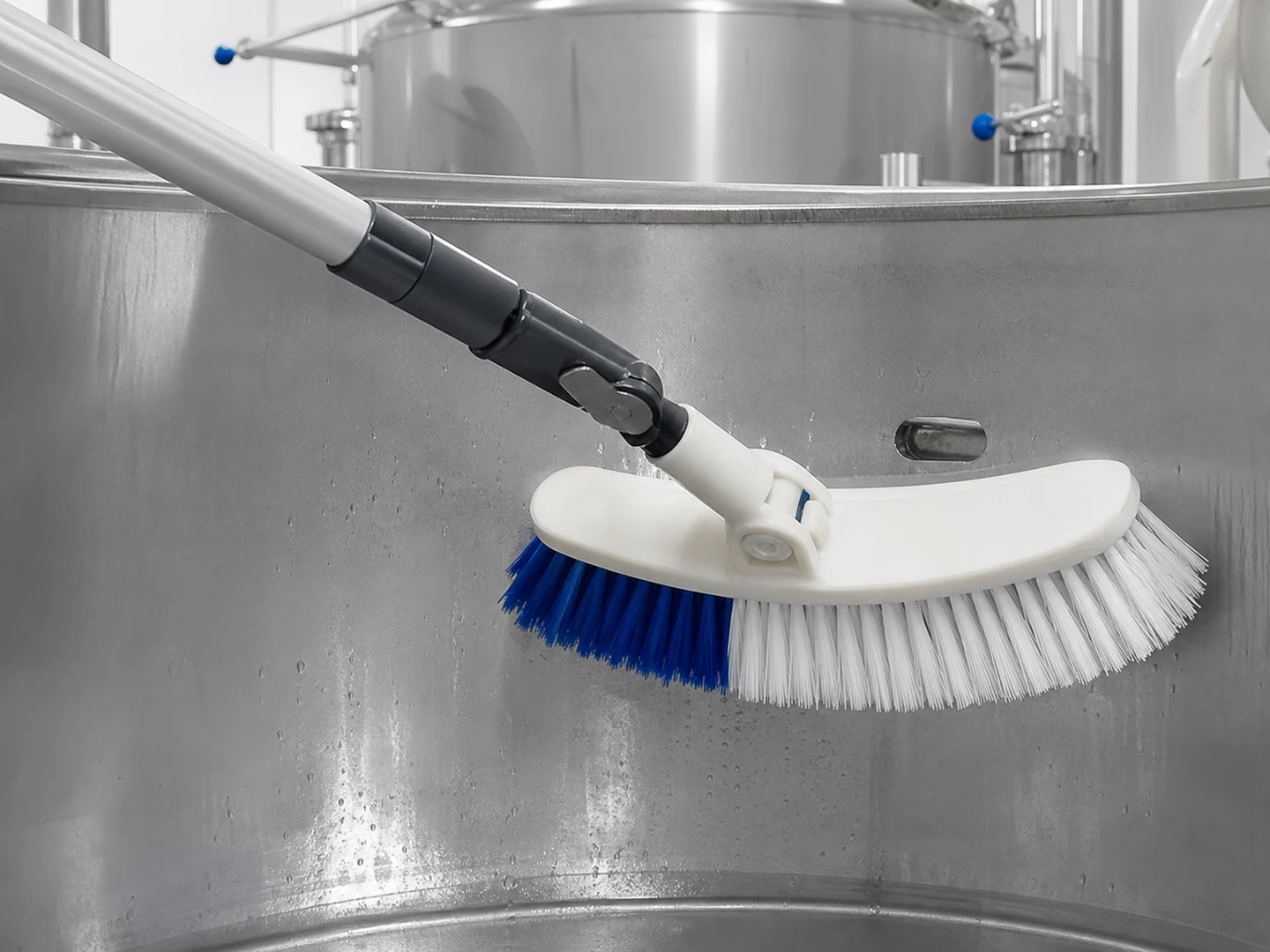
Medium brush
100 pcs
Minimum order
Worked with two hands or on a pole: chimney, gutter and pond-filter brushes, discs, cups and tank brushes.
Production lead time, once the specification is confirmed
- Up to 100 pcsWithin 7 days
- 101–5,000 pcsWithin 14 days
- 5,001–50,000 pcsWithin 21 days
- Over 50,000 pcsConfirmed with your quotation
Peak season can extend these times; the shipping date is confirmed in writing with your quotation. Sampling and shipping are quoted separately.
A hand-guided cleaning brush built for interior surfaces of water treatment tanks and vessels. Broad polypropylene or nylon heads reach walls, baffles, and bottom transitions through access openings while extension-handle mounting keeps the operator outside the tank.
What can this brush do for you?
Wide head covers tank walls faster
Head widths from 100 to 300 mm put a large filament contact area against vertical walls and floors. Each stroke removes biofilm and sludge from a broad strip, cutting the number of passes needed to clean a tank interior compared with narrow brushes or handheld scrapers.
Extension-handle operation keeps the crew out of the vessel
The brush head mounts on a threaded extension-handle connection. Operators can scrub walls, baffles, and bottom transitions from outside the manway or hatch, which reduces the time spent in confined-space entry conditions and lets one person cover a larger surface without climbing inside.
Filament length follows curved and uneven surfaces
Trim lengths from 20 to 60 mm let the fill conform to curved vessel walls, weld seams, and the transition where the sidewall meets the floor. Longer trim bends into contours; shorter trim transfers more pressure to flat areas where attached residue is harder to lift.
Wet-service fill that resists water and chemical film
Polypropylene and nylon filaments are selected for water treatment environments. PP is hydrophobic and does not swell after repeated immersion; nylon brings higher stiffness and wear resistance. Both stand up to continuous wet use and common cleaning chemicals, and the brush sheds water quickly so it dries clean between uses.
Companion tube brush covers drains and narrow ports
The same fill material can be built into a separate tube brush sized to the pipe or drain ID. That combination covers the large open tank surfaces and the restricted fittings where wall heads cannot fit, without switching between incompatible materials.
What is a Water Treatment Tank Brush?
A water treatment tank brush is a manual scrubbing tool designed for interior surfaces of clarifiers, storage tanks, filter vessels, chemical dosing tanks, and similar water-treatment equipment. It is not a small bottle brush or a general-purpose scrub brush: the head is built wide enough to clean large wall areas, and the mount accepts an extension pole so the operator can work the brush from outside the vessel.
During use, the brush is pushed or pulled against the wall, sidewall-to-floor transition, baffle face, or accessible internal fitting. The filaments contact the attached layer — biofilm, settled sludge, mineral film, or chemical residue — and mechanically dislodge it, while the tank’s down-drain or rinse step carries the loosened material away.
This is a maintenance and turnaround cleaning tool, not a replacement for chemical disinfection or pressure washing. It is most effective when the residue is attached but removable by mechanical action; it is not intended to break calcified scale or remove embedded grit from concrete or steel.
Two forms are typically used together: a broad deck or tank head for open surfaces, and a separate tube brush for drains, sample ports, and narrow pipes. Both use the same PP or nylon fill family so chemical compatibility and cleaning behavior stay predictable across the job.
Technical Specifications
| Parameter | Value / Options |
|---|---|
| Brush form | Broad tank/deck head for walls and baffles; separate tube brush for drains and narrow ports |
| Head width | 100–300 mm, selected to pass the access opening and match coverage needs |
| Trim length | 20–60 mm, longer for curved surfaces, shorter for more scrubbing pressure |
| Fill materials | Polypropylene (PP) or Nylon (PA), chosen for chemical exposure and residue type |
| Filament diameter | 0.3–1.2 mm typical, finer for biofilm film, coarser for sludge and settled solids |
| Fill density | Standard wall-cleaning density; higher density available for heavier residue |
| Head profile | Flat, curved, angled, or custom-matched to vessel radius and baffle geometry |
| Mount / connection | Threaded handle connection or matched extension-pole interface; thread size supplied by buyer |
| Handle / pole length | Selected from tank depth and reach; extension sections available |
| Operating environment | Wet service, typical water-treatment chemicals; specify pH and temperature for material confirmation |
| Color / marking | Available for zone coding or brush identification |
| Brush type | Custom Handheld Detail Brushes |
| How it is driven | Hand-guided |
| Cleaning target | potable water storage tank and clearwell, wastewater treatment basin, and chemical dosing and day tank cleaning |
| Surface or part | tanks, walls, vessels, baffles, bottom transitions, floors, tubes, and drain |
| Residue or debris | sludge, biofilm, scale, sediment, and chemical residue |
| Mounting / connection | Threaded handle connection or matched extension-pole interface; thread size supplied by buyer |
Head width and handle length are chosen from tank access dimensions; pipe and drain brushes are sized separately to the port or pipe ID.
Where does this brush work best?
- Potable water storage tanks and clearwells where biofilm and sediment settle on walls and floors between inspection cycles.
- Wastewater treatment basins — clarifier walls, weirs, scum baffles, launder channels, and accessible internal fittings.
- Chemical dosing and day tanks where treatment chemicals leave film or crystalline residue on wetted surfaces.
- Filter vessels and media tanks during changeouts, when settled media and sludge must be brushed free before rinse.
- RO/DI and pre-treatment storage vessels where regular manual cleaning is part of the maintenance schedule.
In all cases, access through a manway, hatch, or top opening determines the maximum head width that can be inserted and maneuvered. If the tank can be reached from outside with an extension pole, the same head can cover full wall height and the bottom transition.
How do I choose the right one?
Start with access and reach
Measure the narrowest opening the head must pass through. The head width must clear the manway or hatch with enough margin to angle the pole. Then measure the deepest wall or floor point the operator needs to reach from the working position. Those two numbers set the head width and the handle length.
Match the fill material to the chemistry, not just the residue
PP is the default choice when the tank sees acids, alkalis, oxidizers, or potable water: it is hydrophobic, chemically tolerant, and low-cost. Nylon is the better mechanical choice when the residue is thick, sludgy, or abrasive enough to flatten or break PP filaments; nylon has higher stiffness and wear resistance. If the tank is cleaned with aggressive solvents or operates above 80°C, confirm the material grade before ordering — neither standard PP nor nylon fits every chemical or temperature.
Pick trim length and filament diameter together
Long trim with fine filament follows curved or rough surfaces and is good for biofilm film; short trim with coarse filament applies more concentrated scrubbing force on flat walls and floors where sludge is compacted. Match the combination to the surface finish: coated or lined tanks generally need softer contact than bare steel or concrete.
Consider the head profile and the bottom transition
Flat heads suit long vertical wall runs. Curved heads fitted to the vessel radius reduce missed contact where the wall rolls into the floor. Angled heads reach the underside of baffles and weirs. If the drain or a narrow port also needs cleaning, plan the companion tube brush at the same time so both tools share the same fill material.
When a different tool is the better answer
Use a wire or abrasive brush first if the tank has calcified scale, embedded rust, or concrete that needs scarifying — nylon and PP are not hard enough for that work. Use a pressure washer with a rotary floor nozzle when the surface is flat, fully accessible, and loose sludge must be moved quickly. Use a small tube brush for pipe interiors below about 25 mm where the tank head cannot enter. And for frequent, repeatable cleaning with minimal labor, consider automated CIP or spray systems; the manual tank brush fits scheduled maintenance, shutdowns, and areas CIP hardware does not cover.
Can I customize this brush?
Water treatment tank brushes are configured from the tank, not sold as a single off-the-shelf size. To define your brush, provide the access opening dimensions, tank diameter and depth, surface material and coating, residue type, cleaning chemicals, wash temperature, and the handle thread or pole system you already use. A sketch or phone photo of the manway and bottom transition is enough to start.
Common adjustments include:
- Head width — matched to the manway or hatch, from 100 mm up to 300 mm or wider for special access doors.
- Fill material — PP or nylon, with filament diameter and density selected for the residue and surface.
- Trim length — shorter for flat walls, longer for curved bottoms and weld seams.
- Head profile — flat, curved, angled, or matched to vessel radius and baffle geometry.
- Mount and handle — threaded connection size, extension-pole interface, or a custom quick-release fitting.
- Drain/tube brush — separate brush sized to the drain or port ID, built in the same fill material.
- Color and marking — zone colors, molded-in ID, or pad-printed labeling for chemical-area control.
- Packaging — bulk crates, individual bags, or project-specific kits with both tank head and tube brush.
If your project requires material documentation, inspection reports, or third-party testing for the tank-cleaning program, we can support those requirements during the customization review.
When is a water treatment tank brush worn out rather than just dirty?
How can I tell whether the tank brush is reaching the bottom transition?
After brushing, inspect the wall-to-floor curve with a flashlight from the access point. If residue remains in the curve, the head is likely too flat or the pole angle is wrong. Wet the surface and make one pass; if the bristles do not leave visible contact marks in the curve, ask for a curved head profile matched to your radius.
Will the brush hold up in continuous wet use?
PP and nylon are selected for wet service and do not rot or rust. Nylon absorbs a small amount of moisture and may soften slightly after long immersion; PP remains hydrophobic. If the brush will be stored submerged or in contact with aggressive oxidizers, specify that condition so the fill material and any metal core are selected accordingly.
How often should the brush head be replaced?
Check before each tank entry cycle. Replace the head when the trim has shortened by about one-third, when bristles are permanently bent or matted, or when the head no longer covers its original width. A worn head increases stroke count and can leave streaks that look clean but still carry biofilm.
Can brushing replace chemical disinfection?
No. Brushing loosens and removes attached biofilm and sludge, but it does not kill microorganisms or remove dissolved contaminants. Chemical disinfection, rinse, and any required verification steps must still be performed after mechanical cleaning.
What do I need to check when attaching the extension pole?
Confirm the pole thread matches the brush mount and that the threads engage fully. A partially engaged connection can strip under push load or separate inside the tank. Do not use a pole rated for lighter loads; the pole must handle the push and pull force of scrubbing without flexing into the tank wall.
Guides that go deeper on this
Custom Manufacturing RFQ
Describe Your Application
Please share the brush dimensions, working area, residue type, material direction, quantity, and a drawing or photo for quotation.
Drawing or photo optional — it speeds things up, it does not gate the enquiry.
Custom Brush RFQ
Send Your Brush Project
Upload a drawing, product photo, or sample photo and provide the core dimensions and cleaning conditions.
“We need a brush to remove wet residue from a stainless steel conveyor, about 800mm wide. The current brush wears quickly. We can send photos.”
“We sell drinkware and need a cleaning brush to include with the product. Quantity around 5,000 pieces.”