
Custom Cleaning Brush
Square Tank Cleaning Brush
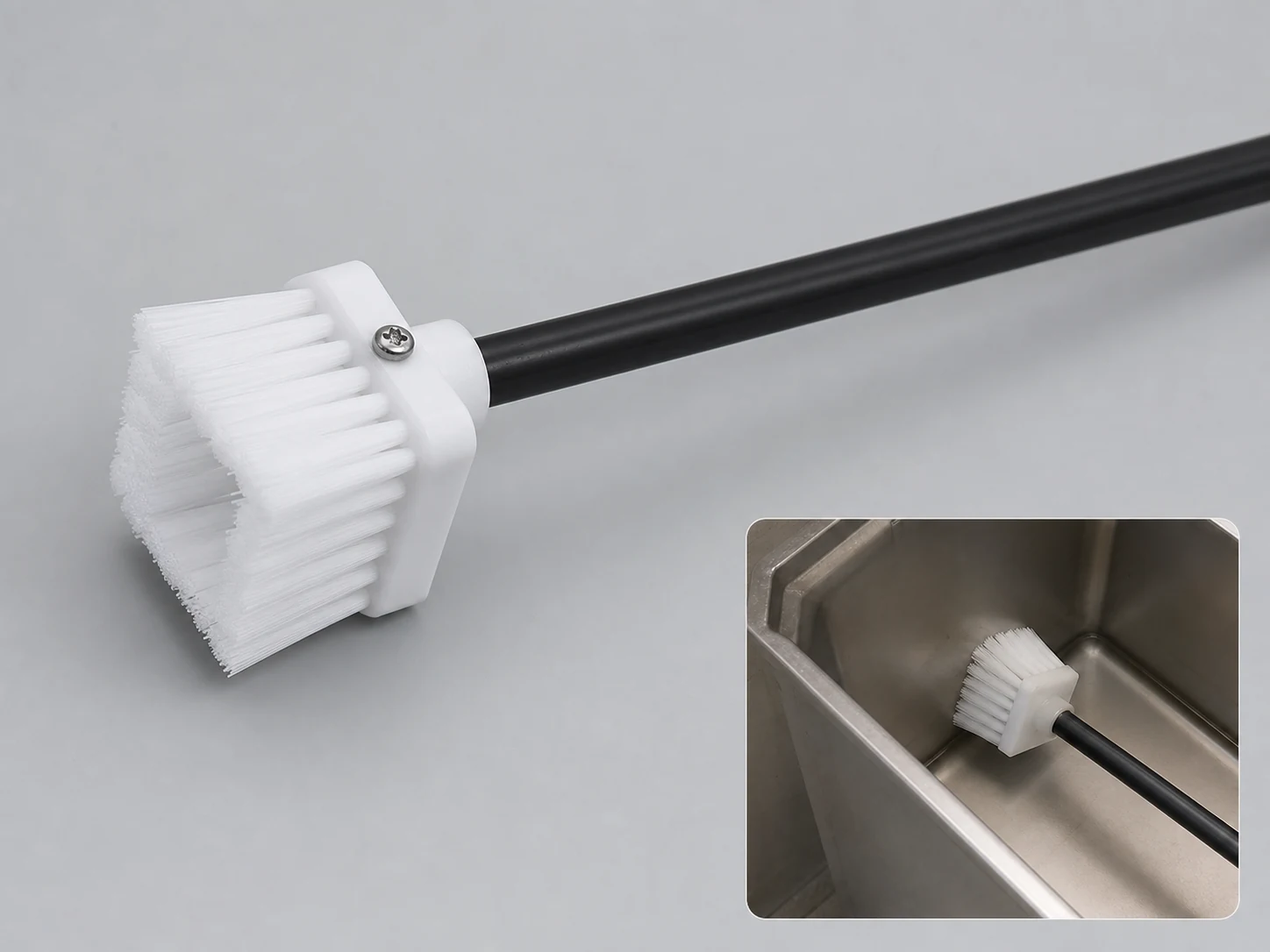
Square tank cleaning brush with nylon PA fill for flat walls, 90° corners, weld seams, and drains. Threaded for extension handles.
Small brush
500 pcs
Minimum order
Held in one hand: tube, bottle, detail and swab brushes — including long-handled ones with a small head.
Production lead time, once the specification is confirmed
- Up to 500 pcsWithin 7 days
- 501–50,000 pcsWithin 14 days
- Over 50,000 pcsWithin 21 days
Peak season can extend these times; the shipping date is confirmed in writing with your quotation. Sampling and shipping are quoted separately.
A square-faced industrial tank cleaning brush with nylon PA bristles that reaches flat walls, 90-degree corners, weld seams, and bottom transitions a round head passes over. Standard threaded or extension-handle mounting puts the same controlled brushing on deep open tanks and sumps without operator entry.
What can this brush do for you?
Corner contact that a round head leaves behind
The square head profile holds bristle rows against both walls of a 90-degree corner and pushes the corner rows into the root of the seam. Biofilm, sludge, chemical film, and product residue build exactly where the wall meets the floor or the next panel, and that is where a round tank brush cannot seat its bristles. With this head, the corner is cleaned in the same stroke as the flat wall.
Wide coverage that shortens the cleaning pass
A 100–150 mm wide face with 30–50 mm trim covers large flat panels per push, so operators finish sidewalls and bottoms with fewer strokes. On big storage and mixing tanks, fewer passes mean shorter open time, less worker fatigue, and more even contact across long weld lines and baffle surfaces.
Nylon PA fill that keeps working when wet
Nylon PA bristles stay stiff through repeated wet/dry cycles and resist the alkaline cleaners and hot-water rinses common in food, beverage, and industrial tank cleaning. Because the filaments do not soften or collapse when saturated, the pressure you start the shift with is close to the pressure you end with on the same residue.
Threaded head that reaches without entering
The head carries a threaded socket for a standard tank-brush handle or threaded extension pole. In tanks that are deeper than arm reach, the operator can mount a pole outside the manway and guide the head across walls, baffles, and bottom corners while staying out of the tank and off the product-contact surface.
One system for the tank and its connected lines
The broad square head is for open surfaces. Drains, outlet ports, and narrow piping are cleaned with a separate tube brush sized to the pipe ID. Both can be supplied together, but each is selected to its own geometry rather than forcing the wall brush into a port it cannot fit.
What is a Square Tank Cleaning Brush?
A Square Tank Cleaning Brush is a manually operated tank-cleaning tool with a square or rectangular head block and dense nylon PA bristles around the face and edges. It is built for the flat panels, 90-degree corners, weld seams, and bottom transitions of square and rectangular tanks, vessels, sumps, and basins.
The head is pushed or pulled across the tank wall with a short handle or an extension pole. The operator works in straight passes along each panel, then turns the tool to seat the corner rows into the right-angle intersections where round brushes cannot maintain contact. On welds, the bristle tips follow the seam line and work the root of the joint, not just the surface beside it.
This is a manual spot and finish-cleaning tool, not a rotary machine brush and not a replacement for CIP or high-pressure washing when those processes are validated for the tank. It is typically used to scrub residues that automated washing misses or to pre-clean heavily soiled surfaces before a wash cycle. After brushing, the loosened residue is rinsed away separately.
The square block design is the distinction. Round tank and deck brushes roll against flat walls but leave a curved dead zone at the corner. The square head presents a straight bristle edge to each wall and a squared corner row into the seam, so the cleaning profile matches the tank geometry.
Technical Specifications
The table shows the standard production values. Every parameter can be adjusted to the tank, residue, chemical, and access conditions of a specific project.
| Parameter | Value / Options |
|---|---|
| Head profile | Square block; rectangular or corner-chamfered profiles available |
| Head width | 100–150 mm |
| Head depth | 100–150 mm (square default; matched to corner reach) |
| Trim length | 30–50 mm |
| Fill material | Nylon PA (PA6 or PA6.6); PBT and PP options for chemical exposure or cost |
| Bristle diameter | 0.4–0.8 mm, selected by residue and contact surface |
| Bristle tip | Square cut standard; flagged or feathered tips available |
| Block material | PP or glass-filled PA |
| Mount | Threaded socket, 3/4″-5 UNC or M16 standard; project-specific thread available |
| Overall length with handle | 200–300 mm standard; extension poles add working reach |
| Operating temperature | -20 to 80 °C continuous for nylon PA; 90 °C short exposure |
| Chemical exposure | Standard alkaline and neutral detergents; PBT or PP recommended for sustained acid or solvent contact |
Drain and port cleaning require a separately sized tube brush; the drain brush diameter and length are selected from the pipe ID, bends, and access points, not from the dimensions of this head.
Where does this brush work best?
- Square and rectangular storage, mixing, and process tanks in food, dairy, beverage, brewery, chemical, and water/wastewater plants where flat walls meet at right angles and residue collects in the seams.
- Welded stainless steel or coated steel vessels where internal weld lines, stiffeners, and baffle plates hold sludge that automated spray balls or rotary CIP devices pass over.
- Agitator zones and bottom transitions around shafts, supports, and the wall-to-floor corner where organic material and mineral scale settle after product transfer.
- Open-top basins, sumps, and receiving pits that are cleaned manually with a pole or handheld brush and need broad wall contact plus corner reach.
- CIP pre-clean and post-clean touch-up on tank interiors where validated automated washing leaves a corner film or weld-line residue that must be removed manually before sanitizing.
- Drains, outlet ports, and narrow piping connected to the tank, cleaned with the companion tube brush sized to the line ID.
How do I choose the right one?
Start with three numbers: the tank opening the brush must pass through, the width of the flat panel you need to cover, and the radius or sharpness of the corners. The brush head and handle then follow from these.
- Confirm access before head size. The head, block, and trim must pass through the manway or opening without forcing. A 150 mm head needs roughly 170 mm or more of clear opening, depending on trim flex. If the opening is smaller, drop the head width or use a two-piece configuration.
- Match the head profile to the corner. Sharp 90-degree corners need a square head with corner rows trimmed to reach the root. Tanks with large radius or chamfered corners can use a wider square or rectangular head and may need less corner-specific trim. The goal is full fillet contact, not just panel contact.
- Select the filament material from the cleaning chemistry and temperature. Nylon PA is the standard for alkaline detergents and hot water. Choose PBT when the tank sees repeated acid cycles, hydrolysis-prone conditions, or aggressive sanitizers. Choose PP for lighter biofilm duties and cost-sensitive projects with lower temperatures.
- Set trim length and bristle diameter from the residue. Soft biofilm and product film call for 0.4–0.5 mm fibers and longer trim (40–50 mm) so the bristles conform around welds. Sludge, mineral scale, and chemical film call for 0.6–0.8 mm fibers and shorter trim (30–40 mm) so the head holds pressure without folding over.
- Check the thread and handle before ordering. The head socket must match the existing tank-brush handle or extension-pole thread. A loose or cross-threaded connection turns the head and changes the stroke angle. Specify both thread form and handedness if the operation turns the pole during cleaning.
- Size the drain brush separately. Use the pipe ID, length, elbow count, and access point to select the companion tube brush. Never try to force the wall head into a drain port.
Use a different tool when the deposit is baked-on carbon, hard crystalline scale, or requires aggressive mechanical removal. A wire tank brush, rotary machine brush, or high-pressure washing will work faster in those cases. This nylon PA square head is the right choice when the surface can be cleaned by steady bristle action and the problem is residue that automation leaves in the corners.
Can I customize this brush?
Yes. Square tank brushes are usually produced to the tank, not picked from a fixed chart. To define the right configuration, provide the tank dimensions, corner radius, wall material and finish, residue type, cleaning chemicals and temperature, manway opening, and the handle or pole thread you use. A photo or drawing of the tank and the worst residue area speeds up the design.
- Head geometry — square or rectangular block, head width and depth, chamfered or rounded outside corners, and corner trim angle.
- Bristle fill — nylon PA, PBT, or PP; filament diameter; trim length; trim cut (square, flagged, feathered); density; and face/edge row layout.
- Block and construction — PP or glass-filled PA block, solid or hollow core, and mechanical or overmolded bristle retention.
- Mounting — threaded socket size and form, adapter for your existing extension pole, locking collar, or handle-mount position.
- Color and marking — color-coded block or filament for zone separation, laser marking, pad printing, or identifying banding.
- Packaging — bulk, individual polybag, bundle packing, or project-specific labeling and kit assembly with the companion tube brush.
We can also support documentation, material declarations, inspection requirements, and third-party testing where your project or end-market requires them. Those requirements are handled at the customization stage, not as a default property of the stock brush.
Which filament survives the cleaning and still lasts on a square tank cleaning brush?
How do I check that the brush really cleans the 90-degree corner?
Run a controlled test on a representative soiled corner. Brush the seam with normal stroke pressure, rinse, and wipe the root of the corner with a clean white cloth before the tank dries. If the cloth picks up film or color, the corner trim is not reaching the root. Adjust trim length, head width, or corner profile, then repeat the test.
Will nylon PA bristles mark a polished stainless tank surface?
Nylon PA is much softer than stainless steel and will not gouge or score a smooth surface under normal hand pressure, but repeated brushing with heavy pressure can haze a mirror finish. If the tank has a high-polish or electropolished interior where surface appearance matters, test on a coupon or a hidden area first, or use flagged bristle tips and a reduced trim length.
Can the head be soaked in detergent or sanitizing solution after use?
Short contact with compatible cleaners is acceptable, but long soaking attacks the block material and the adhesive or mechanical retention that holds the bristles. Rinse the head with clean water after each shift, let it drain with the bristles down, and store it dry. Confirm chemical exposure against the block, bristle, and mounting materials before any extended soak.
How do I know when to replace the head?
Set the brush on a flat surface and look at the working face. If the bristles no longer spring back to their original height, if more than one-third of the trim is bent flat, or if the corner rows no longer contact the seam root, the head has stopped doing the corner work even though it still looks like a brush. Cracks in the block or a worn thread are also replacement triggers.
Can I use this square head in a round tank?
It will clean flat wall areas, but the square profile cannot follow the full interior curvature of a round vessel, and the corner rows will wear unevenly without a seam to support them. For round tanks and vessels, a round or curved tank brush gives more consistent wall contact. Select the shape that matches the vessel.
Do I still need a separate brush for the drain after using this head on the walls?
Yes. The broad head is too large to enter drain ports and narrow lines. Order a companion tube brush sized to the port ID and pipe length, including elbows and any vent or overflow branches. The two tools are complementary; neither replaces the other.
Guides that go deeper on this
Custom Manufacturing RFQ
Describe Your Application
To prepare the correct quotation, provide the dimensions, cleaning task, residue, material, mounting details, quantity, and a drawing or photo.
Drawing or photo optional — it speeds things up, it does not gate the enquiry.
Custom Brush RFQ
Send Your Brush Project
Upload a drawing, product photo, or sample photo and provide the core dimensions and cleaning conditions.
“We need a brush to remove wet residue from a stainless steel conveyor, about 800mm wide. The current brush wears quickly. We can send photos.”
“We sell drinkware and need a cleaning brush to include with the product. Quantity around 5,000 pieces.”