
Custom Cleaning Brush
Brewery Tank Cleaning Brush
Radial fill contacts rounded tank walls without dead zones, lifting yeast film, beerstone and CIP residue from welds and manways with no metal contact.
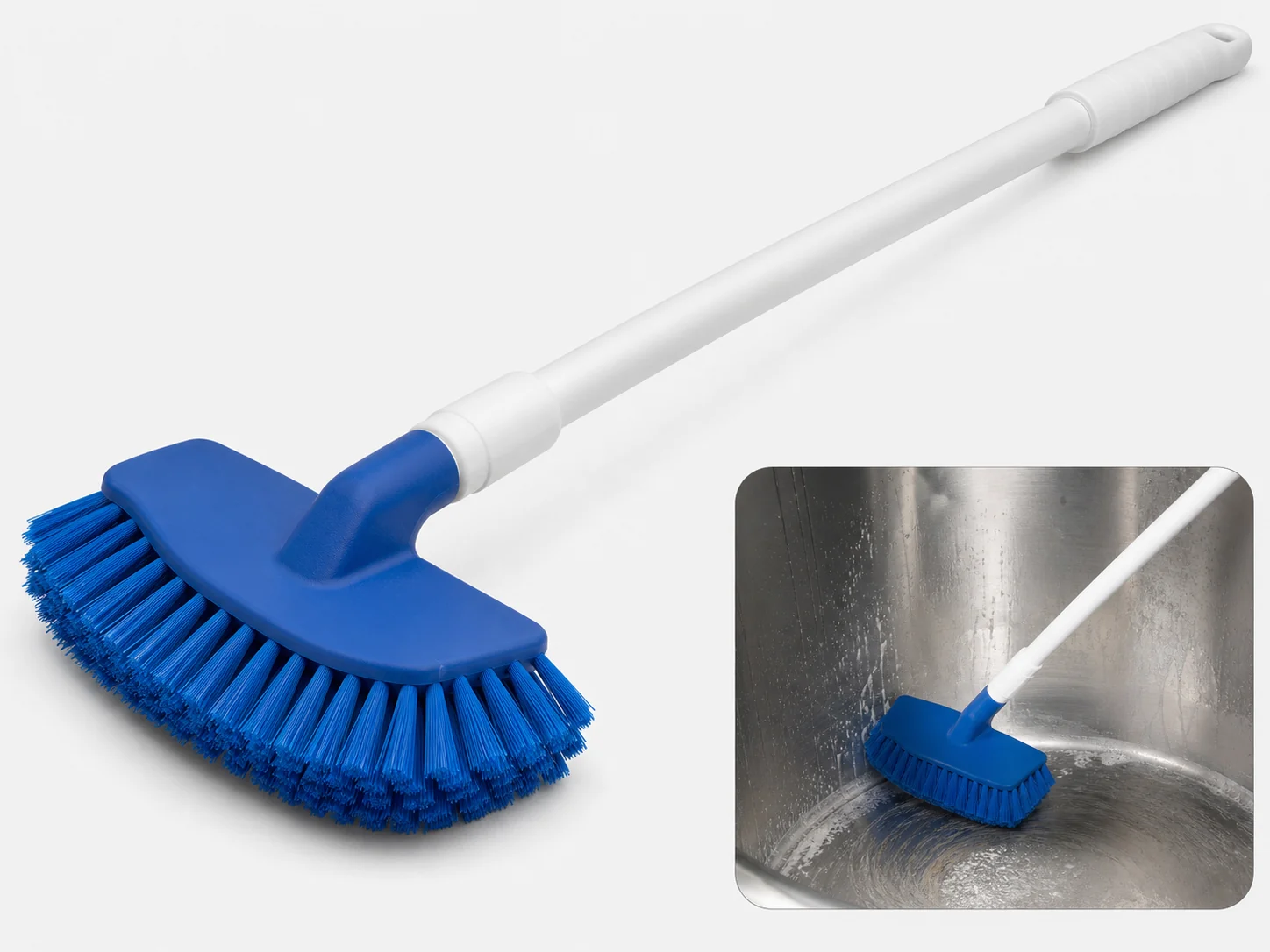
Medium brush
100 pcs
Minimum order
Worked with two hands or on a pole: chimney, gutter and pond-filter brushes, discs, cups and tank brushes.
Production lead time, once the specification is confirmed
- Up to 100 pcsWithin 7 days
- 101–5,000 pcsWithin 14 days
- 5,001–50,000 pcsWithin 21 days
- Over 50,000 pcsConfirmed with your quotation
Peak season can extend these times; the shipping date is confirmed in writing with your quotation. Sampling and shipping are quoted separately.
A radial-fill tank brush for manual and extension-pole cleaning of fermentation and brite tank interiors. Nylon PA, polypropylene, or boar bristle fills are configured to lift yeast and protein film, biofilm, beerstone, and CIP residue from walls, welds, manway areas, and accessible fittings without abrasive metal contact.
What can this brush do for you?
Contacts rounded tank walls without leaving dead zones
The bristles project from a central core, so the same stroke works the vertical sidewall, the shoulder curve, and the bottom radius of a cylindrical tank. A flat brush or scouring pad only touches the tangent point on a curved wall; this head keeps bristle tips engaged through the arc of the vessel and reduces the number of passes needed to cover the full circumference.
Reaches into welds, manway rims, and fitting shadows
Trim lengths between 20 and 80 mm allow the filament tips to enter circumferential welds, gasket seats, racking-arm shadows, and thermowell pockets. The core stays recessed behind the bristle line, so contact force is carried by the filament ends rather than by a hard edge that can slide over the depression.
Removes organic film and light beerstone without embedded abrasives
Nylon PA supplies the stiffness needed to break dried yeast rings and protein film. Boar bristle and softer PP grades offer a gentler contact for polished tanks or for final residue removal after chemical cleaning. The fill contains no metal or mineral abrasive, so the scrubbing action comes from the filament itself rather than from grit that can score passivated stainless steel.
Holds up through brewery-wash chemicals and heat
Fill and block materials are matched to the caustic, acid, and sanitizer in the cleaning program plus the actual wash temperature. PP tolerates repeated chemical exposure, while nylon and PBT handle higher-temperature cycles. A 304 stainless core or PP block keeps the brush rigid through hot, wet handling without softening or corroding.
Mounts for reach beyond hand length
A molded hand grip works for surfaces an operator can reach directly. Threaded interfaces — 1/2 in, M8, M10, or a custom adapter — connect the same head to an extension pole or holder so deep tank sections can be scrubbed from the manway without leaning into the vessel.
Keeps its bristles in place
Filaments are mechanically clamped or epoxy-set into the core and trimmed to a controlled length. The fill is built to stay set through repeated flexing and chemical exposure, reducing the risk of a shed bristle ending up in the tank.
What is a Brewery Tank Cleaning Brush?
A Brewery Tank Cleaning Brush is a radial-fill cleaning tool for the interior surfaces of fermentation, brite, and serving tanks. Bristles project outward from a central core or block, so the brush contacts the vessel wall even while the handle stays in the operator’s hands at the manway.
In most breweries, the brush is used alongside or after CIP. Caustic and acid cycles remove the bulk of soil, but spray patterns can leave a ring at the liquid level, a shadow behind the racking arm or carbonation stone, and buildup at the manway gasket seat or cone transition. Operators use this brush to scrub those specific areas before the final rinse and sanitizer.
This is a manual and local-cleaning tool. It is not a substitute for spray-ball coverage, and it is not an abrasive descaler for hard, glassy beerstone. It complements chemical cleaning on surfaces an operator can reach and visually inspect.
Technical Specifications
Dimensions and materials below are configured to the tank, access opening, and cleaning program rather than fixed for every order.
| Parameter | Value / Options |
|---|---|
| Head profile | Radial cylindrical, disc, or contoured head matched to tank diameter and weld geometry |
| Head diameter / working width | 20–300 mm, selected to pass the manway and maintain sidewall contact |
| Bristle trim length | 20–80 mm, adjusted for welds, depressions, and fitting shadows |
| Overall length | 180–1200 mm, extendable through a threaded handle or adapter |
| Filament diameter | 0.20–0.80 mm, chosen for tip stiffness and surface pressure |
| Fill material | Nylon PA6/PA66, polypropylene PP, boar bristle, or PBT for high-temperature washdown |
| Core / block material | 304 stainless steel core; PP or chemical-resistant block; metal-free option on request |
| Handle / mounting | Molded hand grip; 1/2 in thread; M8; M10; custom adapter |
| Operating temperature | PP up to 80–90°C continuous; nylon and PBT for intermittent exposure up to 140°C |
| Chemical exposure | Material grade matched to caustic, acid, and sanitizer used in the tank cleaning program |
| Filament retention | Mechanical clamp or epoxy-set fill with core recessed behind the bristle tips |
| Brush type | Custom Handheld Detail Brushes |
| How it is driven | Hand-guided |
| Cleaning target | fermentation tank and unitank, bright beer tank and manway area, and dairy, wine and food mixing vessel cleaning |
| Surface or part | tanks, vessels, walls, welds, stone, metal, ports, sidewalls, and bottom transitions |
| Residue or debris | protein, yeast, protein film, biofilm, haze, scale, sludge, chemical film, and product residue |
| Mounting / connection | Molded hand grip; 1/2 in thread; M8; M10; custom adapter |
Where does this brush work best?
- Fermentation tanks and unitanks: sidewall film, the yeast and protein ring at the liquid level, and the cone or dish transition after racking.
- Brite and serving tanks: residual beerstone, protein haze, and deposits around carbonation stones, sample ports, and gauge connections that survive spray-ball coverage.
- Manway and door areas: gasket seats, hinge-side shadows, and weld crevices that collect soil but receive indirect spray.
- Yeast propagation and storage vessels: light film and residue removal before inspection or passivation checks.
- Brewhouse and open-top vessels during manual cleaning when the operator has direct access and controlled chemical exposure.
How do I choose the right one?
Start with tank geometry and access
Measure the narrowest clear opening at the manway or top port, the internal tank diameter, the depth to the bottom, and any baffles, pipes, or fittings inside. The head must pass the opening without forcing and still keep the bristle tips engaged against the wall. A head that is too wide will either bind or leave the outer bristles permanently folded; one that is too small will increase the number of passes and the operator’s time in the tank.
Match the filament to residue and surface finish
- Nylon PA: firm tips for dried yeast rings, protein film, and light beerstone on standard 2B or mill stainless.
- Polypropylene PP: broad acid and caustic compatibility with less water absorption; use when chemical exposure dominates and the residue is moderate.
- Boar bristle: soft, absorbent contact for polished or passivated tanks and final film removal where scratch visibility is a concern.
- PBT: higher temperature capability for hot washdown cycles where nylon softens too much.
Confirm the chemical and temperature environment
Specify the caustic concentration, acid type, sanitizer, and peak wash temperature. Nylon absorbs water and can lose stiffness in sustained hot caustic. PP holds up in many acid and caustic cycles but has a lower continuous-temperature limit. For cycles above 90°C, PBT or shorter exposure windows should be considered.
Select the interface for manual or mounted use
Use a molded hand grip for zones the operator can reach from the manway. Use a threaded adapter for extension poles or machine holders when the deposit is beyond hand length. The thread size must match the extension already in use, or a custom adapter can be specified.
When this brush is not the right tool
If the deposit is hard, glassy beerstone or thick mineral scale, acid descaling should come first; brushing alone will wear the filament without removing the scale. For deposits inside racking ports, tubes, or narrow passages, a tube brush is a better fit. If the area cannot be reached from the manway with a reasonable extension, a CIP spray ball or automated tank cleaning system is likely the more effective method.
Can I customize this brush?
Brewing tank brushes are configured around the vessel rather than offered only as stock sizes. To define the build, provide the tank type, minimum manway opening, internal diameter, tank depth, residue description, cleaning chemical and temperature, surface finish, and how the brush will be held or mounted. A drawing or photo of the tank interior helps resolve geometry faster.
Common configuration points include:
- Head geometry: radial diameter, working width, trim length, end shape, or a multi-diameter head for mixed surfaces.
- Fill: material, filament diameter, bristle stiffness, fill density, color coding, or a combination of materials in separate zones.
- Core and block: 304/316 stainless, PP, or chemical-resistant block; metal-free option for specific tank requirements.
- Handle and mounting: hand grip, extension adapter, 1/2 in, M8, M10, or custom thread and end fitting.
- Marking and packaging: laser marking, color identification, bulk packing, individually bagged, or project-specific packaging.
We can also support project-specific material declarations, inspection records, and third-party testing requirements when those are part of your supplier specification.
Which filament survives the cleaning chemicals a brewery tank cleaning brush meets?
How do I confirm the brush head will pass through the manway without binding?
Measure the narrowest clear opening, including the gasket lip and any edge reduction. Choose a head diameter that passes with the bristles flexing inward but not folding flat. If the brush requires forcing, the head is too wide or the trim is too long; a forced pass leaves the outer bristles permanently set and reduces sidewall contact.
Will nylon bristles leave scratches on a polished stainless tank?
Nylon itself generally does not scratch standard 2B or mill finishes, but embedded grit in a dirty brush can. For mirror-polished or highly polished tanks, use boar bristle or a softer PP grade and rinse the bristles after every use so they do not carry abrasive particles back into the tank.
What should I check before every entry and after each cleaning shift?
Check the head for loose, missing, or melted bristles; inspect the core and thread for cracks, bends, or corrosion; and confirm no debris is embedded in the fill. A single lost bristle in a fermenter can become a contamination event, so damaged brushes should be removed from service immediately. Rinse and hang the brush to dry after use.
How can I verify that the surface is actually clean after brushing?
Rinse the area with clean water and inspect under bright light at a low angle. For biofilm and protein film, an ATP swab or a visual wipe check on the weld and manway areas gives a quick indication. If residue remains in the same pattern after brushing, the fill stiffness, head profile, or chemical step may need adjustment.
Can this brush replace a CIP or sanitizing step?
No. The brush removes localized film and deposits that spray patterns miss. Chemical cleaning, rinse, and sanitizing steps are still required for tank hygiene. The brush is an adjunct for difficult-to-reach areas, not a substitute for the full cleaning sequence.
When should I stop brushing and use a different cleaning method?
If the deposit is hard, glassy beerstone or thick mineral scale, acid descaling should loosen it before any brush work; brushing alone can wear the filament without removing the scale. For deposits inside racking ports, tubes, or other narrow passages, use a tube brush. If the area cannot be reached from the manway with a reasonable extension, a CIP spray ball or automated tank cleaning system is likely the better tool.
Guides that go deeper on this
Brewery Tank Brush Mistakes to Avoid
Read this guideGuideBrewery Tank Brush vs Standard: Small Beverage Channels
Read this guideGuideHow to Choose Brewery Tank Brush for Milk Residue
Read this guideGuideWater Treatment Tank Brush: Sludge, Biofilm and Wet Access
Read this guideGuideWhen to Use a Brewery Tank Brush in a Brewery Tank
Read this guideGuideWhen to Use a Brewery Tank Brush in Small Beverage Channels
Read this guideGuideTank and Vessel Cleaning Brush Design
Read this guideCustom Manufacturing RFQ
Describe Your Application
For an accurate quotation, please provide the main dimensions, material preference, working surface, residue, quantity, and a drawing or photo.
Drawing or photo optional — it speeds things up, it does not gate the enquiry.
Custom Brush RFQ
Send Your Brush Project
Upload a drawing, product photo, or sample photo and provide the core dimensions and cleaning conditions.
“We need a brush to remove wet residue from a stainless steel conveyor, about 800mm wide. The current brush wears quickly. We can send photos.”
“We sell drinkware and need a cleaning brush to include with the product. Quantity around 5,000 pieces.”