
What Is a Brewery Tank Brush?
A brewery tank brush is a brush engineered for manual or mechanical cleaning of interior tank surfaces in a brewery environment. Unlike generic cleaning brushes, it must withstand frequent exposure to hot water, caustic and acid cleaners, and repeated mechanical stress while protecting the tank’s passivated stainless-steel finish. The right brush matches tank geometry, cleaning chemical compatibility, and the type of soil being removed without scratching or embedding contaminants.
Common Types of Brewery Tank Brushes
Choosing the right brush starts with understanding the main options:
- Hand brushes with long handles: Straight or curved handles for reaching deep into tanks through manways. Handle materials include stainless steel, polypropylene, or fiberglass.
- Cylinder brushes: Designed to clean straight sections of piping or narrow tank necks, often mounted on a rod or cable.
- Conical or tapered brushes: For cone-bottom fermenters, the brush shape follows the cone angle to scrub yeast and trub from the sloped walls.
- Flared or wide brushes: Disk-shaped or wide-faced brushes for cleaning large flat areas and tank domes.
- Custom brushes: Built to match specific tank dimensions, port sizes, or automation interfaces when off-the-shelf options won’t work.
Comparing Key Brush Features
| Feature | Option A (Soft Polyester/PBT) | Option B (Medium Nylon) | Option C (Abrasive-Impregnated) |
|---|---|---|---|
| Surface compatibility | Safe for polished stainless steel | Safe for standard finishes; may dull high-polish over time | Only for very stubborn deposits; risk of micro-scratching |
| Chemical resistance | Excellent in pH 2–14 | Good; avoid strong acids above 80°C | Variable; binder often less resistant |
| Typical soils | Light yeast, hop residue, general cleaning | Moderate trub, protein soils, beerstone | Heavy beerstone, hardened scale |
| Flexibility | High; good for irregular shapes | Moderate; holds shape well | Stiff; may not reach corners |
| Cost profile | Economical for frequent replacement | Moderate; durable with proper care | Higher; used only when necessary |
How to Choose a Brewery Tank Brush
Match the brush to the job by evaluating these factors:
- Residue type and hardness: Soft yeast cakes need flexible bristles; hardened beerstone requires stiffer or abrasive options, but never at the cost of surface damage.
- Surface sensitivity: Electropolished or highly polished tanks demand non-abrasive, soft bristle materials like polyester or PBT.
- Equipment interface: Does your process use a standard manway? Do you need a handle length that allows one-person operation? Will the brush attach to a CIP arm or a rotating device?
- Chemical and temperature exposure: Confirm bristle and handle materials withstand your cleaning chemical concentration, temperature, and contact time without degrading or swelling.
- Hygiene expectations: Brushes used in cold-side environments (post-fermentation) should be dedicated, easy to clean, and not contribute to microbial harborage. Solid, sealed handles and non-absorbent bristles reduce risk.
- Maintenance frequency: Brushes are consumables. Track wear and replace bristles before they splay, lose stiffness, or shed. Set a schedule based on tank turnover.
- Custom size requirements: If your tank has non-standard geometries, a custom brush drawing or sample may be needed. Engage your supplier early with exact tank dimensions and cleaning goals.
Placement and Usage Factors That Affect Brush Performance
Even a well-chosen brush can fail if used incorrectly. Consider:
- Dipping angle and reach: A brush that is too short forces the operator to overextend, missing the top dome or the cone center. A brush that is too long can bottom out and bend, damaging the bristles or tank.
- Wet vs. dry cleaning: Always use a brush with water or cleaning solution. Dry brushing stainless steel with even medium nylon can leave micro-scratches.
- CIP vs. manual touch-up: Brewery tank brushes are not replacements for a properly designed CIP system; they are for manual removal of soils that sprays miss, such as below shadowed racking arms or near gasket grooves.
- Storage: Hang brushes bristle-down to drain. Storing in a soiled bucket or laying flat can contaminate the brush and transfer bacteria into the next tank.
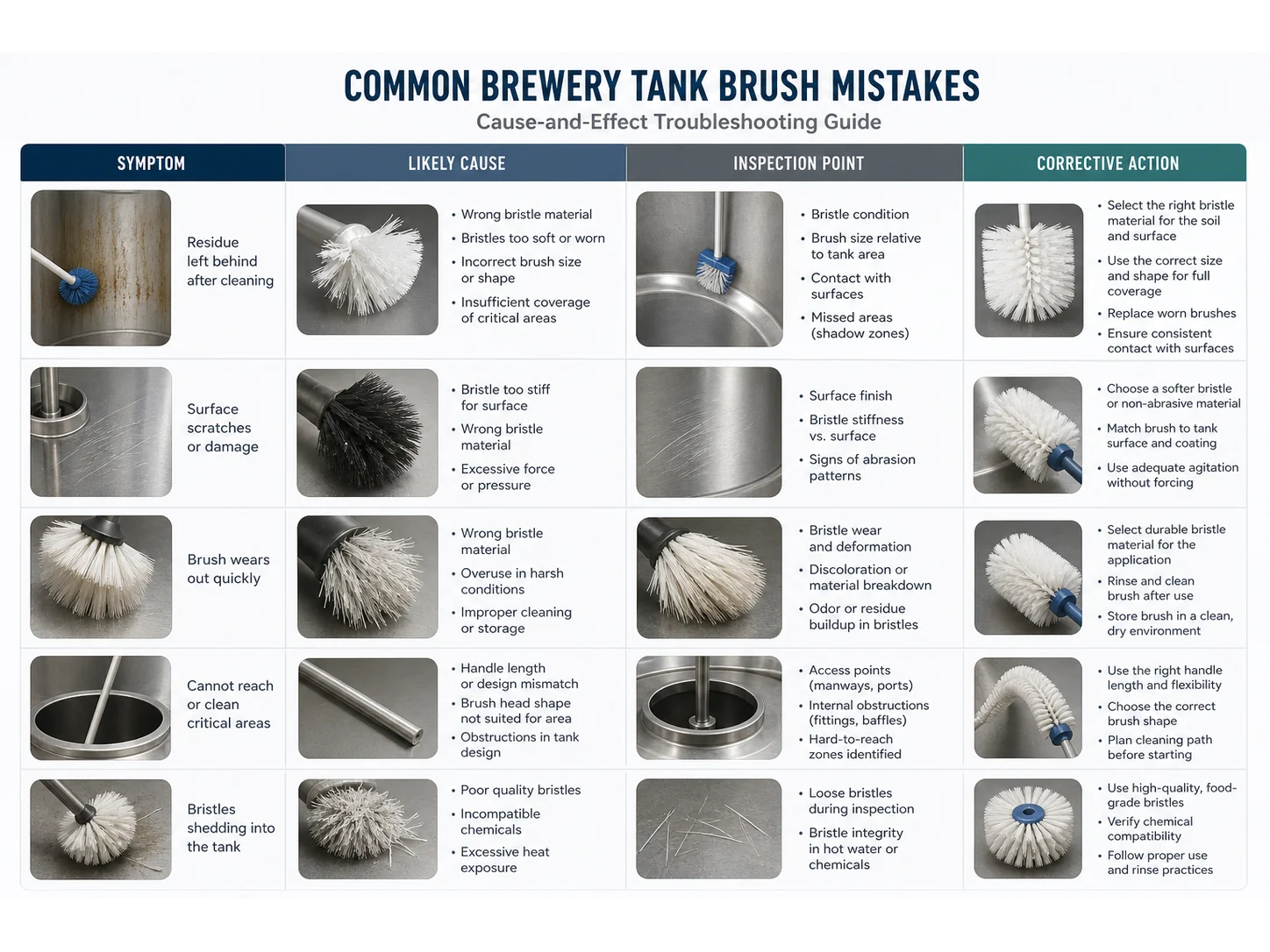
Common Brewery Tank Brush Mistakes
- Using a wire brush or stiff steel wire: This is the most damaging error. Wire brushes scratch stainless steel, destroy the passivation layer, and create crevices for microbial growth. Never use metal-bristle brushes on brewery tanks.
- Choosing by cost drivers or generic “tank brush” label: A low-cost brush may have bristles that dissolve in caustic or a core that corrodes. Verify material specifications with the supplier.
- Ignoring brush diameter relative to tank opening: A brush too wide to fit through the manway is useless. Measure the narrowest clearance point.
- One brush for all tanks: Cross-contamination risk is real. Assign brushes by beer style (or at least by clean vs. soiled side) to avoid flavor carryover or infection.
- Skipping a wear and bristle-loss check: Bristles that fall out can end up in the next batch. Replace brushes that show loose, fraying, or melted bristles.
- Forgetting the handle material: A wooden handle splinters and absorbs moisture, becoming a hygiene risk. Choose sealed stainless steel, polypropylene, or fiberglass handles.
- Using abrasive-impregnated brushes as the everyday brush: These should only be used for occasional heavy beerstone removal, followed by a separate rinse and passivation step.
When a Brewery Tank Brush Is the Wrong Choice
A brush is a targeted manual tool. It will not replace:
- An underperforming CIP system—if spray balls or rotating jets are leaving large areas dirty, the CIP cycle time, flow, or chemistry needs adjustment.
- Passivation treatments—a brush alone cannot restore chemical passivation after deep scratches or iron contamination.
- Borescope inspection—if you cannot verify the cleaning result after brushing, you risk buildup in hidden spots. Consider a borescope survey for hard-to-reach areas.
- Supplier drawing review—when ordering a custom brush, a simple dimension sketch is often enough, but for complex tank internals (cooling jackets, internal welds), a supplier drawing review ensures the brush won’t get stuck or damage features.
Final Takeaway: Match the Brush to the Tank, Not Just the Job
Prevent mistakes by defining your cleaning task precisely: tank type, surface finish, residue, access, and chemical environment. Share these with your brush supplier as a requirements list. Start with a soft, chemically resistant brush for routine cleaning and keep a specific, slightly more aggressive brush for occasional buildup—never defaulting to metal or abrasive options. Test a sample brush on a sacrificial test plate or a small tank area first if you’re uncertain.
Frequently Asked Questions
Can I use the same brush for fermenters and brite tanks?
It is not recommended. Fermenters contain yeast and trub, while brite tanks should be virtually sterile. Using a single brush risks cross-contamination. Dedicate a brush for cold-side, post-fermentation vessels and another for pre-fermentation or heavily soiled tanks.
What bristle material is safest for stainless steel?
Polyester, PBT, or soft polypropylene are among the safest. They are non-abrasive, chemically resistant, and will not scratch passivated stainless steel under normal use. Always confirm with your brush supplier that the material is suitable for your cleaning temperature and pH.
How often should I replace a brewery tank brush?
Inspect bristles before each use. Replace the brush when bristles become permanently bent, show signs of melting or chemical degradation, or if you notice bristle loss. A high-quality brush used correctly may last several months in moderate production, but heavy use can shorten life to a few weeks.
What handle length do I need?
Measure from the outside of the manway to the farthest interior point you need to reach, then add 6–12 inches to ensure comfortable grip and control. For deep conical fermenters, a stiff, non-flexing handle helps apply even pressure at the cone bottom.
Can I use a brewery tank brush to clean kegs?
Yes, but ensure the brush diameter matches the keg opening. Many brewers use a smaller dedicated brush for kegs to avoid scratching the spear area. Avoid using the same brush for fermenters and kegs unless you have a validated cleaning and sanitization process between uses.
What if I need a brush that fits a very narrow opening?
Look for brushes with a compact head and a flexible, small-diameter neck. Some suppliers offer custom configurations. Always test that the brush can be inserted and removed without forcing, as a stuck brush can halt production and require tank entry.
How do I clean and store a brush to prevent contamination?
Rinse the brush thoroughly with hot water after use, then soak or spray with a compatible sanitizer. Hang bristles downward in a clean, dry area. Never store wet in a closed container. Dedicated brush hangers near the wash area help keep them clean and easily accessible.
Technical References
- eCFR — 21 CFR 178.1010 Sanitizing Solutions
- FDA — Food Code
- eCFR — 21 CFR 177.1500 Nylon Resins
- eCFR — 21 CFR 177.1520 Olefin Polymers
- eCFR — 21 CFR 177.1630 Polyethylene Phthalate Polymers
- eCFR — 21 CFR Part 117 Human Food CGMP and Preventive Controls
Which bristle material fits this job — AISI 304 Stainless Steel Wire, Nylon PA or PBT?
| Material | Continuous temperature (°C) | Peak temperature (°C) | Water absorption | Hardness |
|---|---|---|---|---|
| AISI 304 Stainless Steel Wire | 400 | 500 | 0% | Rockwell B 70–95 depending on temper and cold work |
| Nylon PA | 93 | 121 | 0.3–9% by PA grade and conditioning | Medium to firm; filament diameter and trim length control bending force. |
| PBT | 120–140 | 160–180 | 0.05–0.20% | Shore D 80–90 |
| Polypropylene PP | 80–100 | 120–140 | ≤0.03% | Shore D 65–75 |
| Boar Bristle | 60–80 | 100–120 | 10–18% | — |
Figures as published by Alleima; Brushtec / DuPont; Perlon. Confirm the exact grade against the supplier datasheet before ordering.
What should replace Handheld Detail Brushes for brewery tank brush?
- Handheld Detail Brushes — Handheld detail brushes cover general precision cleaning; auto-detailing brushes impose tighter controls for painted, polished, leather, display, and trim surfaces.
- AISI 304 Stainless Steel Wire — Use AISI 316 stainless steel wire for chloride, marine, dairy, beverage, chemical washdown, or higher pitting-resistance requirements. Use carbon steel for dry aggressive cutting and brass or abrasive nylon for lower marking risk.
- Nylon PA — Compare Nylon PA with PP, PBT, PET. Change material when wet stiffness, temperature, chemical resistance, conductivity, particle shedding, or surface marking becomes the limiting factor.
- PBT — Compare PBT with Nylon, PP, PET. Change material when wet stiffness, temperature, chemical resistance, conductivity, particle shedding, or surface marking becomes the limiting factor.