
Custom Cleaning Brush
Water Bag Cleaning Brush
Flexible water bag cleaning brush for hydration reservoirs. Reaches bladder seams, corners, drink tubes, and bite valves with soft nylon PA filament.
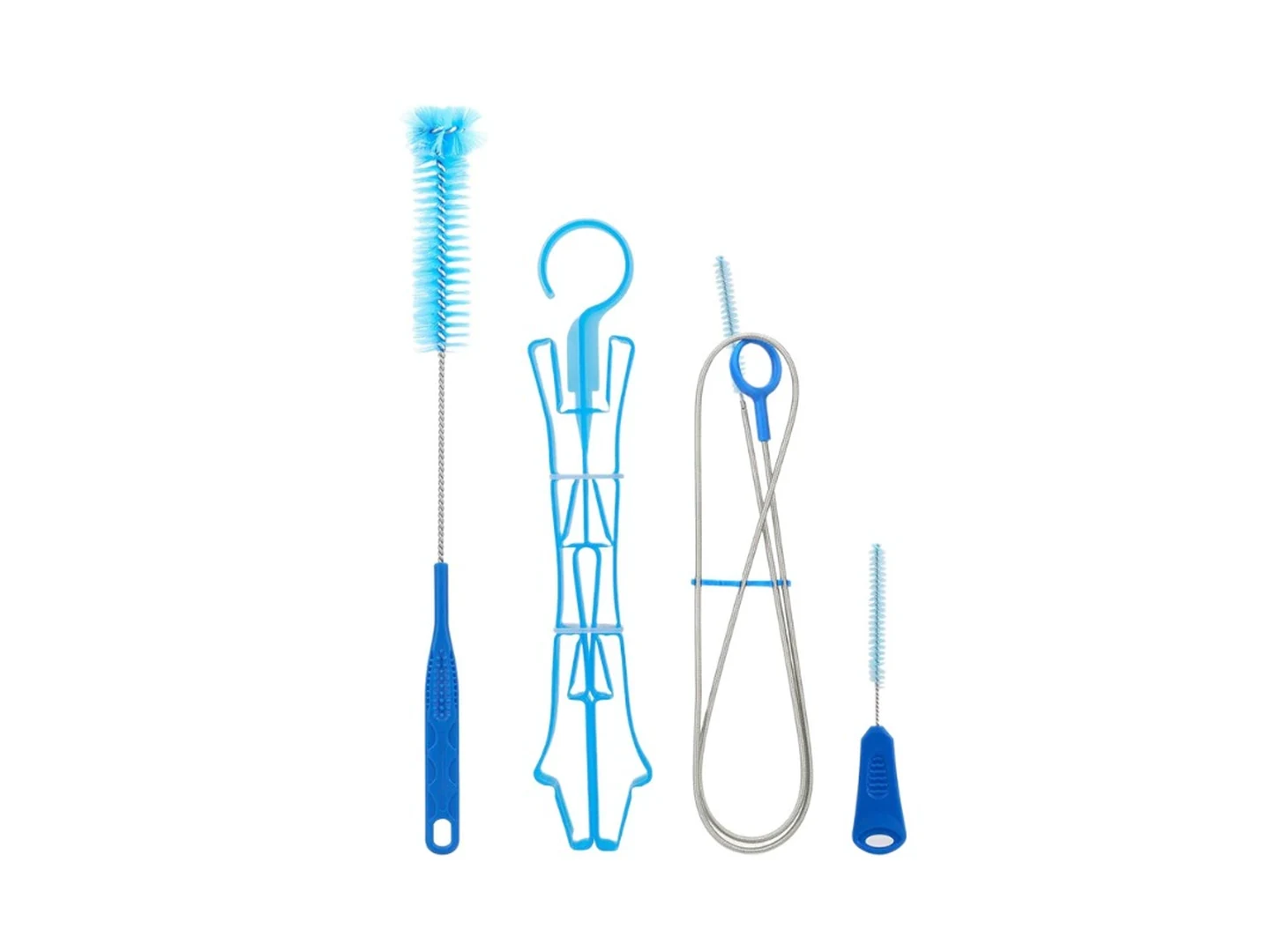
Small brush
500 pcs
Minimum order
Held in one hand: tube, bottle, detail and swab brushes — including long-handled ones with a small head.
Production lead time, once the specification is confirmed
- Up to 500 pcsWithin 7 days
- 501–50,000 pcsWithin 14 days
- Over 50,000 pcsWithin 21 days
Peak season can extend these times; the shipping date is confirmed in writing with your quotation. Sampling and shipping are quoted separately.
A flexible hydration reservoir cleaning brush designed to reach the inner walls, welded corner seams, fill opening, drink tube, and bite valve of soft water bags and hydration bladders. Soft nylon PA filament and a bendable stem remove beverage film, biofilm, and odor-causing residue without cutting or scratching the bladder film.
What can this brush do for you?
Bends through the fill opening, then reaches the seam corners
The flexible stem compresses to pass through hydration reservoir openings down to about 15 mm, while the wide head flexes to follow the bladder’s welded top and bottom seams. That keeps the brush in contact with the narrow folds where biofilm starts, instead of only wiping the flat center of the bag.
Removes beverage film and slime without damaging the bladder film
Medium-soft nylon PA filament in the 0.20–0.60 mm range removes sugar film, protein residue, electrolyte deposits, and early biofilm from TPU or polyurethane surfaces. The filament is stiff enough to lift attached film but pliable enough not to score or poke pinholes in the reservoir wall.
Covers the reservoir, drink tube, and bite valve with one tool
The wide head works the main body and bottom; the narrow bristled stem section travels through the drink tube, and the tapered tip reaches into the bite-valve recess and cap threads. One brush follows the entire fluid path instead of forcing operators to switch between a separate reservoir brush and tube brush.
Long reach keeps hands clear and supports drying
Overall lengths from 450 to 1200 mm let an operator control the brush from the fill opening while reaching the far bottom corner. A hang hole or loop on the polypropylene handle lets the reservoir and brush dry face-down between uses, which reduces the moisture that encourages regrowth.
What is a Water Bag Cleaning Brush?
A Water Bag Cleaning Brush is a two-zone brush built for hydration reservoirs: a wide filament head for the main body and a narrow flexible bristled stem for the drink tube and bite valve. It is a hand tool, not a powered device, used with push-pull and rotating strokes inside a partially filled reservoir and with straight rotary strokes through the tube.
During use, the operator inserts the head through the fill opening, works the side walls, bottom corners and seams, then runs the narrow tail from the reservoir end to the bite-valve end of the tube. Warm water and a mild detergent or cleaning tablet loosen residues while the brush removes the attached film. After cleaning, the bag is rinsed and hung to dry completely.
This brush is designed for removable soft residue and biofilm, not for baked-on mineral scale, adhesive residue, or sterilizing. Disinfection is a separate step.
Technical Specifications
The values below are typical project ranges. Head size, stem length, filament stiffness, and handle can be matched to your reservoir geometry and drink-tube dimensions.
| Parameter | Specification |
|---|---|
| Brush head diameter | 30–120 mm, selected to the reservoir body and fill opening |
| Brush head length | 150–350 mm, adjusted to the cleaning area of the main body |
| Overall length | 450–1200 mm, including head, flexible stem, and handle |
| Filament material | Nylon PA, water-resistant, medium-soft to medium stiffness |
| Filament diameter | 0.20–0.60 mm, chosen by surface sensitivity and residue load |
| Flexible stem diameter | 2–8 mm, matched to the drink-tube inner diameter |
| Minimum opening clearance | 15–100 mm, depending on head and stem configuration |
| Handle / body material | Polypropylene (PP), with drying hang hole |
| Operating environment | Warm water and mild detergents; rinse after exposure to cleaning solutions |
| Brush type | Custom Handheld Detail Brushes |
| How it is driven | Hand-guided |
| Cleaning target | outdoor hydration bladder, reservoir, and hydration pack cleaning |
| Surface or part | tubes, seams, valves, walls, corners, ports, traps, and thread |
| Residue or debris | biofilm, scale, mineral scale, beverage film, protein, and adhesive residue |
| Mounting / connection | Fixed |
We adjust these parameters at the project stage. Provide the reservoir model, opening ID, internal depth, drink-tube ID and length, and bite-valve type, and we will specify the matching configuration.
Where does this brush work best?
This brush fits hydration bags and reservoirs where soft wall surfaces and narrow fluid paths need complete contact without abrasion. Typical installations and uses include:
- Outdoor hydration bladders from roughly 1L to 3L and larger, with top or side fill openings.
- Reservoirs used with electrolyte mixes, energy drinks, fruit infusions, or protein shakes, where film builds up faster than with plain water.
- Hydration packs with welded side or bottom seams and internal baffles that trap residue at the corners.
- Drink tubes from reservoir port to bite valve, including quick-release fittings and angled connectors.
- Bite valves, caps, and fill-opening threads where mouth-contact or spill residue accumulates.
It is intended for regular post-use cleaning between hydration sessions. It is not the tool for heavy mineral scale removal or for recovering a bladder with failed film or pinholes.
How do I choose the right one?
Start with the fill opening and the reservoir interior.
Measure the narrowest internal opening diameter first. The head has to pass through it and still expand enough inside to contact the side walls. A head that is too large will buckle at the opening; one that is too small will only polish a narrow strip and leave the seams untouched.
Match filament stiffness to the residue, not just the surface.
For plain water, light sports drink, and daily post-use cleaning, a smaller filament diameter, around 0.20–0.40 mm, gives sufficient contact and the softest action. For syrupy, sticky, or protein-heavy residues, a firmer 0.50–0.60 mm filament with a denser fill works faster while remaining safe for TPU and polyurethane film. Do not move to wire or abrasive filament on a hydration bladder; that can create pinholes and odor traps.
Set the stem and tail to the drink tube.
The flexible stem section should be 1–2 mm smaller than the tube ID so it slides without jamming. If the tube has a tight bend near the reservoir port, choose a 2–4 mm stem that can follow the curve. The overall length must let the operator hold from the fill end and still pass the tail completely through the tube and bite valve.
Consider the cleaning routine before ordering.
If the team uses cleaning tablets or diluted sanitizing solutions, nylon PA and PP handle the short contact fine, but the brush should be rinsed afterward and hung to dry. If the reservoir will be stored wet or packed immediately after use, emphasize drying features and corrosion-free materials.
Use a different tool when the problem is not removable film.
Heavy mineral deposits, calcium scale, or adhesive residue need a descaling or solvent step before brushing. A bladder with film delamination, pinholes, or deep cracks should be replaced, not scrubbed. For very rigid, wide-mouth water containers, a conventional bottle brush with a rigid stem may transfer more scrubbing force than this flexible tool provides.
Can I customize this brush?
Yes. This brush is built to reservoir and drink-tube dimensions rather than sold as a fixed retail size. We will need the fill opening ID, internal depth and width, seam geometry, drink-tube inner diameter and length, bite-valve model, residue type, and cleaning chemicals used.
Common adjustable elements include:
- Brush head and shape: width, length, taper, rounded or angled profile, single or double head
- Filament: nylon PA diameter, stiffness, trim length, fill density, and bristle arrangement
- Flexible stem: diameter, length, stiffness, and bristled tail section for tube cleaning
- Handle: polypropylene shape, grip length, hang loop, or color coding
- Color and marking: custom color, printed logo, molded mark, or identification band
- Packaging: bulk polybag, individual bag, retail card, or project-specific packing list
If your project requires material declarations, third-party testing, inspection support, or documentation for a specific customer or market, these requirements can be covered during the customization process.
When is a water bag cleaning brush worn out rather than just dirty?
How do I confirm the brush reaches the bottom corner seams?
Measure the distance from the fill opening to the deepest bottom corner and compare it to the brush’s working length. Then run a dry insertion test in the empty reservoir: the head should reach the far bottom seam without forcing, and the sides of the head should still touch the walls when partially compressed.
Can this brush be used with cleaning tablets or a diluted bleach solution?
Yes for short contact cycles. Nylon PA and PP tolerate typical diluted tablet and bleach concentrations long enough for cleaning, but the brush should be rinsed with clean water immediately after and hung dry. Do not soak the brush in concentrated disinfectants or leave it in solution overnight; prolonged exposure can embrittle the filament and handle.
What is the correct motion for the drink-tube section?
Insert the narrow tail from the bite-valve end or the reservoir port, then use slow rotation with short push-pull strokes. If the tail is bristled, the rotation should make the filament sweep the full inner circumference. Detach the bite valve and clean its recess separately rather than forcing the tail through the valve body.
Why does the reservoir still smell after brushing?
Persistent odor usually means biofilm remains in a seam, the cap threads, the drink tube, or the bite valve. Clean each zone separately, then rinse until no foam or film remains and hang the reservoir and brush fully open to dry. If the odor continues after complete mechanical cleaning, run the sanitizing or sterilization step required by your hygiene plan; the brush alone does not kill all microorganisms.
What signs indicate the brush should be replaced?
Replace the brush when the filament is bent, flattened, matted, or no longer springs back, when the flexible stem has a permanent kink, or when the PP handle shows cracks. A worn head that does not recover its shape cannot maintain contact with the bladder walls and will leave residue behind.
Does this brush work for rigid hydration reservoirs?
It can clean smooth rigid reservoirs if the opening and internal dimensions fit, but it becomes less effective when the user needs heavy scrubbing pressure. A rigid-handle bottle brush is usually the better choice for hard plastic or glass containers with tough residue.
Guides that go deeper on this
We have not written a guide specific to this one yet. The material that covers selection, filament, dimensions, maintenance and sourcing is collected in the technical resources library.
Custom Manufacturing RFQ
Describe Your Application
An accurate custom quote starts with the dimensions, working surface, residue, material choice, connection, quantity, and reference files.
Drawing or photo optional — it speeds things up, it does not gate the enquiry.
Custom Brush RFQ
Send Your Brush Project
Upload a drawing, product photo, or sample photo and provide the core dimensions and cleaning conditions.
“We need a brush to remove wet residue from a stainless steel conveyor, about 800mm wide. The current brush wears quickly. We can send photos.”
“We sell drinkware and need a cleaning brush to include with the product. Quantity around 5,000 pieces.”