
Custom Cleaning Brush
Food Grade Silicone Baby Milk Bottle Nipple Brush
Food grade silicone nipple brush for baby bottle nipples, vent channels, and narrow openings. Custom head, tip size, and handle.
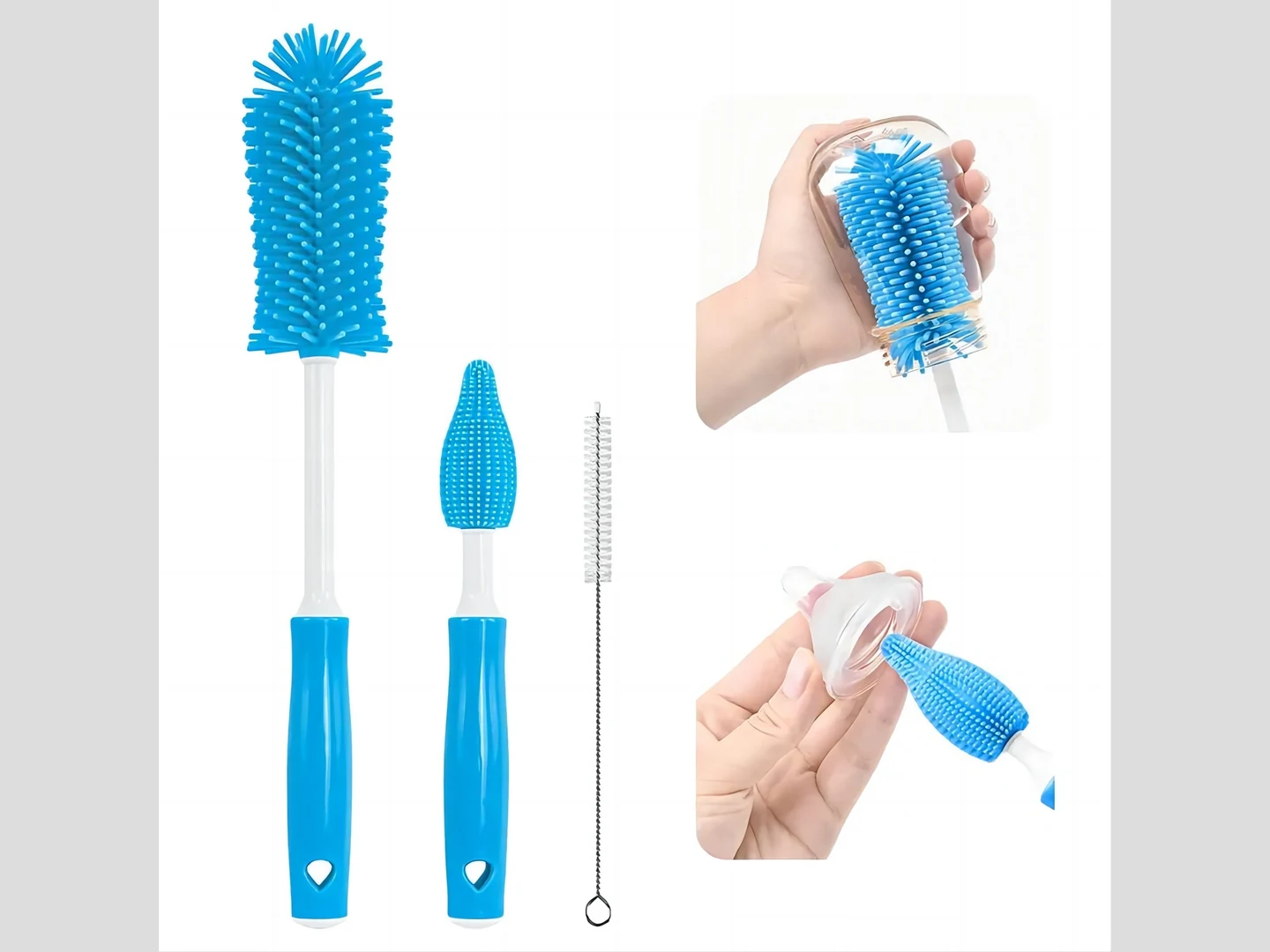
Small brush
500 pcs
Minimum order
Held in one hand: tube, bottle, detail and swab brushes — including long-handled ones with a small head.
Production lead time, once the specification is confirmed
- Up to 500 pcsWithin 7 days
- 501–50,000 pcsWithin 14 days
- Over 50,000 pcsWithin 21 days
Peak season can extend these times; the shipping date is confirmed in writing with your quotation. Sampling and shipping are quoted separately.
Food Grade Silicone Baby Milk Bottle Nipple Brush is a small, soft-detail brush engineered to clean the inside of baby bottle nipples, vent channels, and narrow openings where milk film and odor-causing residue collect. The tapered silicone head reaches the nipple tip and inner walls without scratching or tearing silicone or latex, and the handle keeps fingers out of detergent and rinse water.
What can this brush do for you?
Reach the nipple tip and vent path that other brushes miss
The head tapers to a small tip that passes into the nipple opening and follows the curved interior down to the base. This lets the operator sweep milk residue from the area where odor develops, instead of only wiping the outer surface.
Clean without scratching or tearing the nipple
Silicone filaments are rounded and compliant, so they transfer scrubbing pressure without cutting into soft silicone or latex. The nipple keeps its shape, seal, and surface finish through repeated cleaning cycles.
Fit the internal profile of standard, wide-neck, and anti-colic nipples
Head diameter, taper angle, and bristle length can be matched to the nipple’s internal geometry, including narrow vent channels and under-rim grooves. One brush can be configured to cover several nipple styles in the same feeding kit or daycare set.
Rinse quickly and dry with no trapped residue
The open silicone construction has no filament bundles that soak up milk or hold biofilm. Warm water and a mild detergent rinse away the residue, and an integrated hang hole lets the brush air dry between uses.
Hold up through normal bottle sterilization routines
The food-grade silicone contact parts withstand repeated boiling and steam cycles within their operating temperature range. Core and handle materials can be selected to match the sterilization method you actually use, so the brush does not warp or degrade in normal use.
Include a clearing tip for clogged nipple holes when needed
A two-ended configuration adds a solid silicone nub for pushing dried milk out of small nipple holes or vent slits without using pins or metal tools. This is the configuration many feeders reach for when a nipple stops flowing.
What is a Food Grade Silicone Baby Milk Bottle Nipple Brush?
A Food Grade Silicone Baby Milk Bottle Nipple Brush is a hand-guided detail brush made specifically for cleaning the interior surfaces of infant bottle nipples and other small, soft feeding parts. Unlike a general bottle brush, which is sized for the bottle body, this tool is built around the nipple’s small tip opening, curved inner wall, base flare, and vent channels.
During use, the brush is inserted through the nipple opening or from the base, then moved with short push, pull, and twist strokes so the silicone bristles sweep all internal surfaces. For nipples with a base opening, the brush may be inserted from either end. The brush cleans milk film, formula residue, dried deposits, and the biofilm that can form in vented nipples and valves.
It is not a replacement for a bottle body brush and is not an abrasive tool. It is a soft-contact, detail-cleaning instrument for the most contamination-sensitive parts of the feeding system.
Technical Specifications
Standard values shown below can be adjusted to your nipple geometry and process.
| Parameter | Specification |
|---|---|
| Contact material | Food-grade silicone, 30–60 Shore A |
| Brush head diameter | 6–18 mm at the widest section |
| Tip diameter | 1.5–4 mm, sized to enter the nipple hole without stretching |
| Bristle / filament length | 2–6 mm |
| Bristle / filament diameter | 0.10–0.50 mm |
| Overall length | 150–220 mm |
| Handle length | 70–110 mm |
| Head profile | Tapered, cylindrical, rounded-end, tufted-end, or dual-end with clearing nub |
| Stem / core | PP, food-grade silicone overmolded PP, or 304 stainless steel (metal-free available) |
| Handle | PP, TPE-overmolded, silicone, or stainless steel with hang hole |
| Operating temperature | Silicone contact parts: -40°C to 200°C; assembled brush rated for repeated boiling at 100°C when handle and stem materials are heat-rated |
| Washdown / hygiene | 20–85°C water or baby-safe detergent cleaning; open drainable design for air drying |
| Brush type | Custom Bottle & Container Brushes |
| How it is driven | Hand-guided |
| Cleaning target | standard and wide-neck baby bottle nipple, nipple collar, and breast pump membrane and small silicone valve cleaning |
| Surface or part | vents, channel, walls, valves, holes, narrow openings, grooves, and spouts |
| Residue or debris | milk, milk film, milk residue, odor deposits, powder residue, biofilm, and dried deposits |
| Mounting / connection | Fixed |
Dimensions and hardness are project-selectable; the table shows the standard range we build from.
Where does this brush work best?
Use this brush for parts with small internal openings and soft, heat-sensitive materials:
- Standard and wide-neck baby bottle nipples made of silicone or latex — clean the entire interior from tip to base flare.
- Anti-colic and vented nipples — reach the internal vent channel, slit, and valve pocket where milk residue hides.
- Nipple collars, caps, and sealing rings — scrub the grooves and threads where milk pools and dries.
- Breast pump membranes and small silicone valves, when the geometry is compatible.
- Sippy cup spouts and narrow straw components that share similar internal dimensions.
Typical residues removed include milk film, formula powder residue, lipid films, and odor deposits.
How do I choose the right one?
Start with the nipple opening and internal bore
Measure the smallest hole and the widest internal diameter. The tip must pass through the hole without stretching it; the widest head section should contact the inner walls lightly. If the tip is too large, the nipple will deform. If the head is too small, it will not scrub the wall.
Match stiffness to the nipple material and residue
Softer silicone (lower Shore A) is safer for latex and very soft silicone nipples. Firmer silicone (higher Shore A) applies more pressure to dried formula film. For daily milk residue, a medium softness usually removes the film without leaving marks. For hardened mineral or burnt deposits, a soaking step or a different filament may be needed.
Consider the vent configuration
Vented and anti-colic nipples have narrow channels that need a small tapered tip or a clearing nub. If the nipple has a cross-cut or Y-cut opening, the clearing end should match that geometry so it can push residue out without enlarging the hole.
Decide between single-end and dual-end
A single-end brush is simpler and often less expensive. A dual-end brush adds a solid clearing nub on the opposite end for unclogging small holes. For a complete kit covering bottle, nipple, and vents, combine this brush with a larger bottle brush.
Confirm sterilization compatibility
If the brush will be boiled, steamed, or placed in a UV sterilizer, the handle and core materials must withstand the same cycles as the silicone head. Specify the method so we can select heat-rated PP, stainless steel, or metal-free options correctly.
When this brush is not the right tool
For cleaning the inside of the bottle body, choose a bottle brush with a longer handle and larger head. For hard scale, mineral deposits, or heavy abrasion, use a different filament or chemical cleaning step. For single-use hygienic workflows, a disposable applicator may be more appropriate.
Can I customize this brush?
Nipple brushes are geometry-driven, so the useful way to customize is to define the nipple or part profile first. Provide the nipple brand and model, internal dimensions, hole style, vent configuration, sterilization method, and preferred handle length. A sample or drawing speeds up tooling.
- Head geometry — tip diameter, taper angle, widest diameter, head length, profile, and optional dual-end clearing nub.
- Silicone contact — hardness, bristle length, bristle diameter, density, surface finish, and color.
- Stem and core — PP, overmolded silicone, stainless steel, or metal-free construction; stiffness and length.
- Handle — length, shape, grip texture, hang hole, overmold, or molded logo and identifier.
- Marking — pad printing, laser marking, or color coding for SKU separation and brand identification.
- Packaging — bulk, individual bag, retail card, set with bottle brush, or project-specific packing.
If your feeding product project needs material documentation, migration testing support, or third-party verification, we can assist during customization.
When is a food grade silicone baby milk bottle nipple brush worn out rather than just dirty?
How can I check whether the brush head fits my nipple without damaging it?
Insert the tip through the nipple opening and rotate the brush gently. The tip should pass without visibly stretching the hole, and the widest section should lightly touch the inner walls. If you need to force the tip or the nipple bulges around it, the head is too large. If the brush slides in with no wall contact, it is too small.
Can the entire brush be boiled or steam-sterilized with the nipples?
The food-grade silicone contact parts are safe for repeated boiling and steam cycles within their normal temperature range. The handle and stem materials must also be heat-rated; PP handles generally tolerate boiling but prolonged exposure can cause warping or stress cracking. If your process uses a UV sterilizer or chemical disinfection, confirm the assembled brush material before relying on it.
How should the brush be cleaned and dried after use?
Rinse the head under warm running water, apply a small amount of baby-safe liquid detergent, work the bristles between your fingers, and rinse until the water runs clear. Shake off excess water and hang the brush by the hang hole with the head down or upright to air dry. Do not store a wet brush in a closed container; trapped moisture creates the same biofilm problem the brush is meant to remove.
How can I tell when the brush needs to be replaced?
Replace the brush if the silicone bristles are bent, flattened, splayed, cracked, or permanently discolored; if the tip has lost its shape; or if a detectable odor remains after thorough washing and drying. A worn brush loses contact with the inner walls and can leave milk residue behind.
Can the clearing nub unclog a nipple that is completely blocked with dried milk?
A solid silicone clearing nub can push out dried deposits from many small holes and vent slits, but first soak the nipple in warm soapy water to soften the residue. Do not use metal pins or sharp tools, which can enlarge the hole and create a choking or flow hazard. If the nipple cannot be cleared without force, replace it.
Is this brush safe to use with latex nipples?
Yes, when configured with a soft or medium silicone filament grade. The rounded, compliant contact does not scuff or tear latex in normal hand use. Specify the nipple material during selection so the correct silicone hardness is chosen; very stiff brushes intended for dried residue can be too aggressive for thin latex.
Guides that go deeper on this
Custom Manufacturing RFQ
Describe Your Application
For an accurate quotation, please provide the main dimensions, material preference, working surface, residue, quantity, and a drawing or photo.
Drawing or photo optional — it speeds things up, it does not gate the enquiry.
Custom Brush RFQ
Send Your Brush Project
Upload a drawing, product photo, or sample photo and provide the core dimensions and cleaning conditions.
“We need a brush to remove wet residue from a stainless steel conveyor, about 800mm wide. The current brush wears quickly. We can send photos.”
“We sell drinkware and need a cleaning brush to include with the product. Quantity around 5,000 pieces.”