
Custom Cleaning Brush
PP Antibacterial Water Bottle Cleaning Brush Long Handle
Custom PP antibacterial water bottle brush with long handle and antimicrobial nylon bristles. Reaches tall bottles and scrubs walls, shoulders, and base.
Small brush
500 pcs
Minimum order
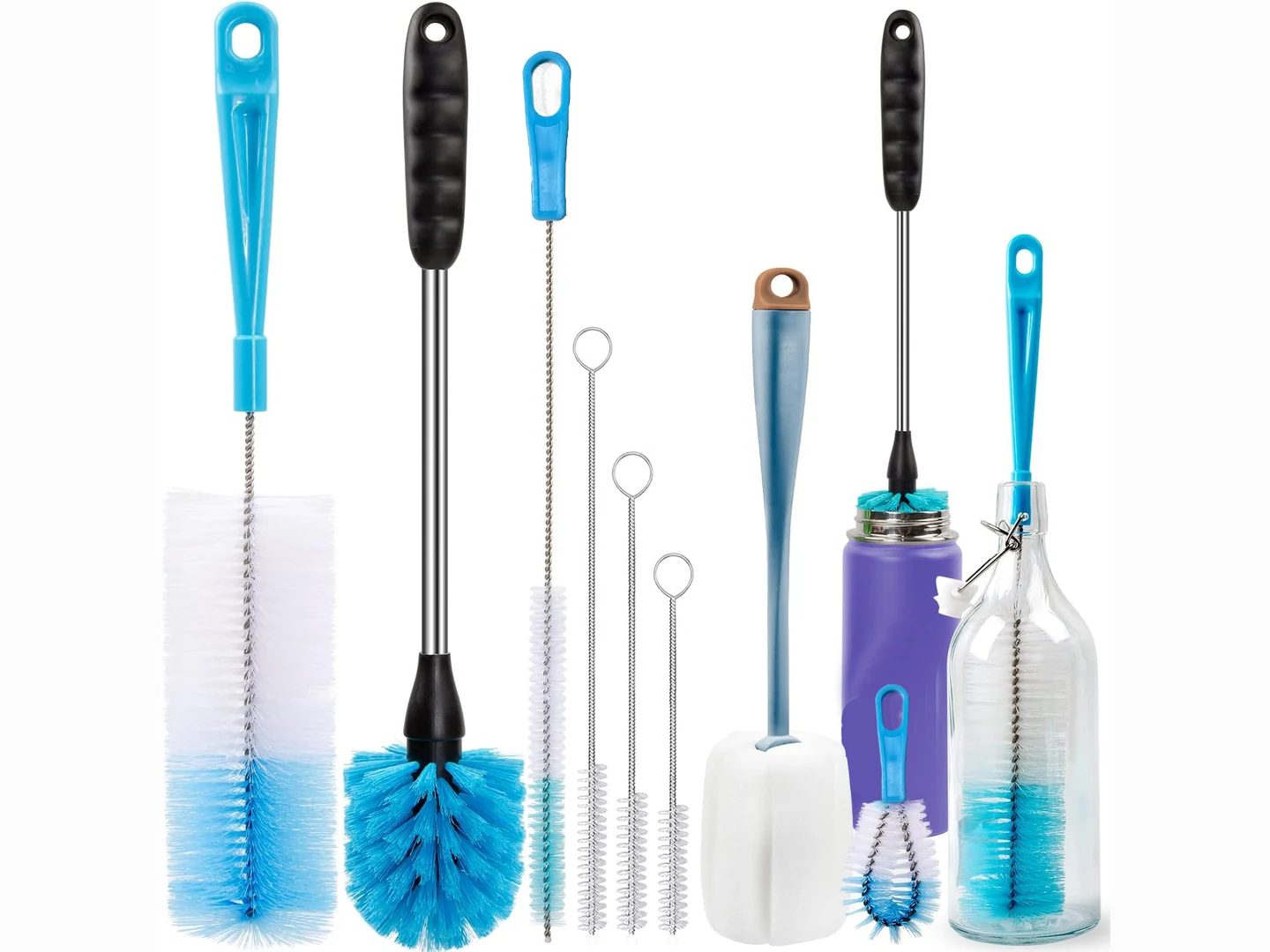
Held in one hand: tube, bottle, detail and swab brushes — including long-handled ones with a small head.
Production lead time, once the specification is confirmed
- Up to 500 pcsWithin 7 days
- 501–50,000 pcsWithin 14 days
- Over 50,000 pcsWithin 21 days
Peak season can extend these times; the shipping date is confirmed in writing with your quotation. Sampling and shipping are quoted separately.
This long-handle PP water bottle cleaning brush combines an antibacterial handle and Nylon PA bristles to reach the base of tall drinkware while inhibiting microbial growth on the brush between uses. It is built for daily interior cleaning of reusable bottles, mugs, and containers.
What can this brush do for you?
Antibacterial protection built into the polymer, not a wash-off coating
The polypropylene handle and Nylon PA bristles contain an antibacterial additive compounded directly into the resin. Unlike surface treatments, the additive stays present as the material wears, helping prevent odor-causing bacteria from colonizing the brush itself between cleaning sessions. A cleaner brush means fewer odor transfers back into the bottle.
Long handle reaches tall and deep bottles without hand insertion
The extended PP handle lets the operator scrub the bottom of a tall sports bottle or insulated mug while keeping their hand outside the opening. Overall length can be set from 200 to 450 mm, so the brush matches the bottle depth instead of forcing the user to wedge their hand into the neck.
Tufted Nylon bristles scrub sidewalls, shoulders, and bottom corners
The tufted-end head holds dense nylon filaments that flex into curved interior surfaces and dig into the base transition. Nylon’s stiffness and recovery provide enough mechanical action to lift beverage film, protein residue, and soft biofilm without requiring aggressive pressure.
Open brush head drains and dries quickly
The filament arrangement and non-porous PP stem allow water to drain away after rinsing. When hung by the handle loop, the brush air-dries rapidly, reducing the damp conditions that support microbial growth. This supports the antibacterial function and extends the useful life of the brush.
No exposed metal in standard configuration
The handle and stem are molded polypropylene, and the bristles are nylon, so there is no metal core to rust or scratch interior coatings. This makes the brush suitable for stainless steel, glass, and coated plastic bottles where metal contact is undesirable.
What is a PP Antibacterial Water Bottle Cleaning Brush Long Handle?
The PP Antibacterial Water Bottle Cleaning Brush Long Handle is a hand-operated cleaning tool for the interior of reusable drinkware. It consists of a one-piece polypropylene handle and stem with a bristle head at the working end. The bristles are Nylon PA filament, and both materials incorporate an antibacterial additive that is part of the polymer matrix rather than a topical coating.
During use, the operator passes the brush through the bottle opening and uses push-pull and rotating strokes to scrub the sidewalls, shoulders, and base. The long handle and flexible bristles allow the brush to follow internal contours while keeping the operator’s hand clear of the opening. The tufted end concentrates filament at the bottom where residue tends to collect.
This brush is intended for routine removal of beverage films, soft deposits, protein residue, and odor-causing layers from containers that are washed by hand. It is not designed for baked-on carbon, hardened mineral scale, or aggressive chemical stripping. Operating temperatures should stay below 80°C (176°F), and the brush should be rinsed and air-dried after each use.
Technical Specifications
The table below lists the standard parameter ranges for the PP Antibacterial Water Bottle Cleaning Brush Long Handle. Final dimensions and materials are confirmed per project.
| Parameter | Value / Options |
|---|---|
| Overall length | 200 – 450 mm (customizable to bottle depth) |
| Working length | 120 – 300 mm |
| Head diameter | 20 – 70 mm (selected for opening and interior diameter) |
| Filament diameter | 0.10 – 0.50 mm (choose for stiffness) |
| Neck clearance | 10 – 60 mm (gap between stem and bottle neck) |
| Handle / stem material | Polypropylene (PP) with antibacterial additive |
| Bristle material | Nylon PA with antibacterial additive |
| Head form | Tufted-end (standard), cylindrical, tapered, or sponge tip |
| Core / stem construction | Molded PP stem (standard); optional stainless steel twisted wire for extra stiffness |
| Operating temperature | Up to 80°C (176°F) intermittent; do not autoclave |
| Chemical compatibility | Suitable for mild detergents and warm water; avoid strong acids, solvents, and oxidizing agents |
| Brush type | Custom Bottle & Container Brushes |
| How it is driven | Hand-guided |
| Cleaning target | reusable water bottle, baby, and smoothie container cleaning |
| Surface or part | containers, sidewalls, shoulders, corners, thread, necks, valve recesses, and valves |
| Residue or debris | protein, mineral scale, beverage film, protein residue, soft deposits, carbon, and beverage residue |
| Mounting / connection | Fixed |
Where does this brush work best?
- Reusable water bottles with moderate to wide mouths where the sidewalls and base need daily manual scrubbing.
- Sports and gym bottles with internal threads, shoulder curves, and valve recesses that collect residue.
- Travel mugs and insulated bottles with tall bodies that short-handled brushes cannot reach.
- Baby and feeding bottles when material documentation and hygiene testing are provided for the project.
- Juice, protein shaker, and smoothie containers where sticky films adhere to curved surfaces and bottom corners.
- Laboratory and sample bottles requiring a dedicated manual cleaning brush, provided the cleaning chemicals are compatible.
How do I choose the right one?
Start with the bottle opening. Measure the internal neck diameter. The brush head diameter should be slightly smaller than the opening so it inserts without forcing, but large enough that the bristles contact the sidewall when compressed. A head that is too large will bend bristles permanently; too small will leave unscrubbed areas in the middle. Use neck clearance to ensure the stem does not scrape the bottle threads.
Set the length by bottle depth. The overall length should let the operator hold the handle comfortably outside the bottle while the bristle head touches the base. Too short means the hand goes into the opening; too long reduces control. For very deep containers, choose a stiffer handle or optional stainless steel core.
Match bristle stiffness to the residue. Soft films and daily beverage residue need softer filaments (0.10–0.25 mm) to avoid scratching coated interiors. Dried protein, pulp, or mineral film require stiffer filaments (0.30–0.50 mm) for effective scrubbing. Nylon PA provides good mechanical action and recovery.
Check the cleaning environment. Water temperature, detergent pH, and any sanitizing step affect material selection. PP and Nylon are fine for warm water and mild detergents but not for boiling, autoclaving, strong acids, or oxidizing chemicals. Specify the actual wash conditions so the brush is built to match them.
When to use a different brush. If the interior has a delicate coating that nylon tips might mar, choose a silicone head brush. If the opening is very narrow (under 20 mm), use a tube brush or cleaning swab. If hard mineral scale or burned-on residue is present, use a wire brush or chemical descaling process instead. This brush is for routine beverage residue, not aggressive descaling.
| Condition | Recommended configuration |
|---|---|
| Narrow opening (20–30 mm) | Smaller head diameter, softer filaments, longer flexible stem |
| Wide opening (50–70 mm) | Larger head diameter, stiffer filaments, tufted end for corners |
| Deep bottle (>300 mm) | Extended overall length, stiffer handle or stainless steel core |
| Scratch-sensitive interior | Softer nylon (0.10–0.15 mm) or consider silicone head |
| Heavy soft residue | Stiffer filaments (0.30–0.50 mm), possibly stronger core |
Can I customize this brush?
The PP Antibacterial Water Bottle Cleaning Brush Long Handle is configurable for production runs. To quote a custom brush, provide the bottle’s internal neck diameter, interior depth, interior diameter, surface material, residue type, wash temperature, detergent, and any hygiene or material documentation needs. A sample bottle or drawing speeds up the process.
We can adjust the following:
- Handle and stem: length, diameter, cross-section, hanging loop, ergonomic grip, color, and molded branding.
- Brush head: diameter, working length, filament diameter, filament stiffness, tuft density, and head shape (tufted-end, cylindrical, tapered, sponge tip).
- Materials: PP for handle/stem and Nylon PA for bristles, both with antibacterial additive at your specified concentration. Optional stainless steel twisted wire core for extra stiffness.
- Antibacterial system: additive type and loading can be selected based on your hygiene targets and supported by material safety data.
- Packaging: bulk, individual polybag, retail card, private label branding, and barcode.
If your project requires material declarations, migration testing, or third-party antimicrobial test reports, we can coordinate those during development.
Which filament survives the cleaning and still lasts on a PP antibacterial water bottle cleaning brush long handle?
How do I know the antibacterial additive is still effective after repeated washing?
The additive is compounded into the polymer, not applied as a coating, so it remains present as the material wears. However, surface abrasion can reduce the exposed active layer over time. Replace the brush when bristles are frayed or the handle shows deep scratches, typically after 3–6 months of daily use.
What is the maximum water temperature for cleaning this brush?
PP and Nylon are rated for intermittent exposure up to about 80°C (176°F). Do not boil, autoclave, or run through a high-heat sanitize cycle, as this can warp the handle or soften the bristles permanently.
Can I soak the brush in disinfectant solution between uses?
Not recommended. Prolonged contact with chlorine, quaternary ammonium, or oxidizing disinfectants can degrade both PP and Nylon. If disinfection is required, use a compatible solution for short contact and rinse thoroughly, then air-dry.
How can I check that the brush head is still making full contact with the bottle walls?
Insert the brush into a clean, dry bottle and rotate. If the bottle is transparent, look for even bristle contact around the circumference. For opaque bottles, feel for uniform resistance. If some areas feel loose or the bristles are permanently bent, the head is undersized or worn and should be replaced.
Will this brush clean the drinking spout, cap, and valve threads?
The main head may be too large for small components. A separate small brush or a customized version with a smaller detail tip at the handle end can be configured. For standard projects, consider a two-brush set to cover bottle body and cap parts separately.
What should I do if bristles start to shed?
Shedding usually indicates filament fatigue from harsh chemicals or excessive bending. Stop using the brush to prevent loose bristles from contaminating the bottle. Replace it with a configuration using stiffer or more chemically compatible filaments.
Guides that go deeper on this
Custom Manufacturing RFQ
Describe Your Application
To quote this brush accurately, send the size, material, cleaning target, residue, quantity, and any available drawing or sample photo.
Drawing or photo optional — it speeds things up, it does not gate the enquiry.
Custom Brush RFQ
Send Your Brush Project
Upload a drawing, product photo, or sample photo and provide the core dimensions and cleaning conditions.
“We need a brush to remove wet residue from a stainless steel conveyor, about 800mm wide. The current brush wears quickly. We can send photos.”
“We sell drinkware and need a cleaning brush to include with the product. Quantity around 5,000 pieces.”