
What Is a Bottle Brush Set?
A bottle brush set is a collection of brushes with elongated handles and specialized bristle heads used to clean the interior surfaces of bottles, carboys, vials, pipes, and other containers that have restricted access. The set typically includes multiple brush sizes and sometimes different bristle materials to handle a range of neck diameters, residue types, and surface sensitivities. In industrial, laboratory, and food‑grade environments, a well‑chosen bottle brush set helps maintain hygiene, prevent cross‑contamination, and extend the service life of reusable containers.
Common Types of Brushes in a Bottle Brush Set
Most sets contain two to five brushes with differing head diameters, bristle materials, and handle shapes. The most common variants include:
- Standard straight brushes – a stem with a central tufted or coil‑wound bristle head, used for straight‑neck bottles.
- Offset or bent‑neck brushes – angled handles that help clean around shoulders and curved interiors.
- Soaker brushes – extra‑long stems to reach deep containers, often with a looped handle for hanging.
- Mini brushes or detail brushes – small diameters (6–15 mm) for vials, pipettes, and very narrow openings.
- Foam or sponge tips – often used in bio labs for gentle wiping without scratching.
Materials and Design Comparison
The table below compares common bristle and core materials used in bottle brush sets for narrow mouth applications. Material choice affects chemical compatibility, temperature tolerance, stiffness, and risk of scratching or shedding.
| Feature | Natural Fiber (Tampico, Horsehair) | Nylon / Polyester | Silicone | PTFE (Teflon) |
|---|---|---|---|---|
| Common use cases | General scrubbing, organic residue | Chemical resistance, stiffness | Delicate surfaces, high‑purity needs | Aggressive chemicals, low surface friction |
| Stiffness (typical) | Soft to medium | Medium to stiff | Soft, flexible | Soft to medium |
| Chemical resistance | Limited; degrades in strong acids/alkalis | Good against many solvents and cleaners | Excellent; inert to most chemicals | Outstanding; nearly universal resistance |
| Temperature limit | ~80-100°C (water sets, loses shape) | 90-120°C depending on grade | Up to 200°C continuous, autoclavable | Up to 260°C |
| Scratch risk | Low on glass; can scratch soft plastics | Moderate; hard bristles can scratch | Very low; non‑abrasive | Low; soft and non‑marring |
| Particle shedding | Can shed fibers | Low to none | None (solid silicone) | None |
| Handle/core material | Often twisted wire (stainless/galvanized) | Wire, plastic, or coated wire | Stainless wire or plastic core | Usually stainless wire core |
| Relative cost trend | Low | Low to moderate | Moderate | High |
How to Choose the Right Bottle Brush Set for Your Application
Selecting a bottle brush set for narrow mouth containers requires matching the brush to the residue, surface, and operating environment. Use the following decision factors:
- Neck inner diameter: The brush head must pass through the neck freely without excessive force, then expand to contact inner walls. A good rule is head diameter = 1.0–1.2 × neck ID for soft bristles, and 0.8–1.0 × neck ID for stiff bristles.
- Residue type: Soft, tacky biofilms need stiffer bristles; abrasive pastes or residues risk scratching with hard nylon. Silicone or Tampico may be better for sensitive surfaces.
- Surface sensitivity: Glass and stainless steel can tolerate nylon; soft plastics, coated surfaces, or polished parts call for silicone, foam, or natural fiber.
- Chemical exposure: If the brush will contact strong acids, bases, or solvents, choose chemically inert materials like PTFE or silicone. Nylon and natural fibers degrade quickly in harsh environments.
- Hygiene and cleaning protocol: For CIP (clean‑in‑place) compatibility or autoclave sterilization, select brushes that can withstand the temperature and chemicals used. Silicone and PTFE are often preferred in biotech and pharma.
- Handle length and flexibility: For deep containers, measure the maximum depth and ensure the handle is at least 20% longer. For curved containers, a flexible wire core is necessary.
- mounting or tool interface: Some industrial processes require brushes that fit onto rotating equipment or extensions. Confirm stem end type (looped, threaded, or plain).
Setup, Usage, and Maintenance Factors
Even the best bottle brush set will fail early if used incorrectly. Pay attention to these practical operating conditions:
- Wet vs. dry cleaning: Many natural fibers lose stiffness when soaked. Nylon and PTFE maintain shape. Silicone can become slippery.
- Cleaning agent compatibility: Verify the brush material data sheet against your cleaner. For example, strong oxidizers like hydrogen peroxide can embrittle nylon over time.
- Sterilization method: Autoclave, gamma, ETO, or chemical sterilant may change bristle properties. Silicone generally tolerates steam autoclaving; some nylons do not.
- Storage: Hang brushes to dry and prevent deformation. Do not compress bristle heads in tight spaces. Natural fibers must dry completely to avoid mold.
- Inspection and replacement schedule: Inspect for bent stems, loose bristles, or fraying. A worn brush can leave fibers inside the container, creating a contamination risk. Establish a replacement interval based on cycles or visual check.
Common Specification Mistakes
When sourcing a bottle brush set for narrow mouth containers, these mistakes lead to cleaning failure, equipment damage, or unnecessary cost:
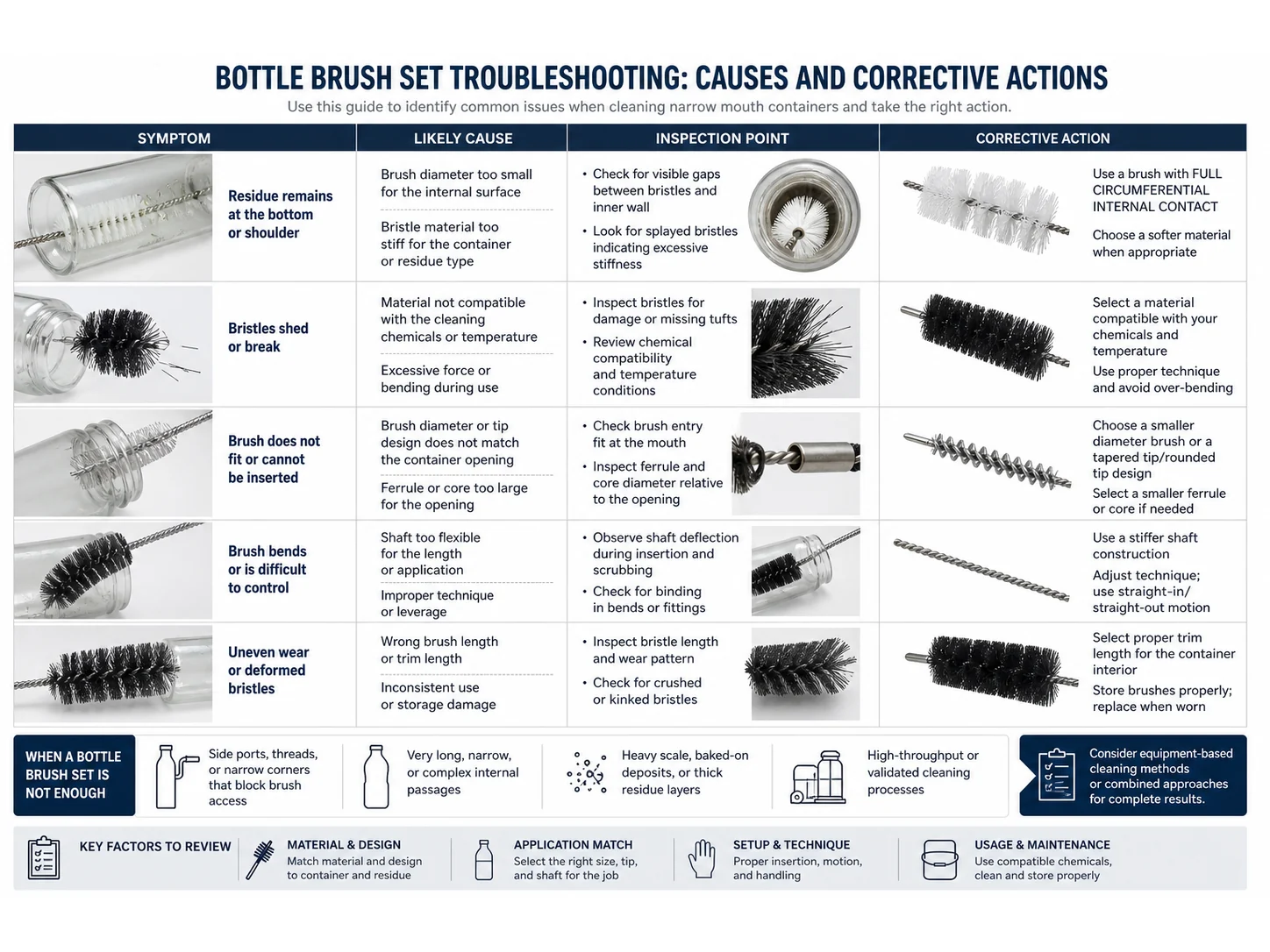
- Choosing by overall length only: A brush long enough to reach the bottom may have a head too thick to enter the neck or too stiff to follow curves.
- Assuming “stiff is better”: Overly stiff bristles can scratch glass, create micro‑abrasions that harbor bacteria, or deform soft plastic walls.
- Ignoring core material: A twisted galvanized wire core can rust and contaminate the container. Stainless steel (304 or 316) is often required for washdown or food areas. Plastic cores may snap under torque.
- Using one brush for all chemicals: A brush that survived a mild detergent may degrade rapidly in a sanitizing acid bath. Always match the brush material to the full chemical cycle.
- Overlooking brush head attachment: Brushes with glued tufts can shed bristles into the product. For high‑purity processes, choose mechanically crimped or fully molded heads.
- Forgetting to test on actual containers: Nominal dimensions on a data sheet may not reflect the real neck ID when threads, lips, or slight tapers are present. Always test a sample brush on your exact container.
When a Bottle Brush Set Is the Wrong Choice
A bottle brush set is a manual or semi‑manual cleaning tool. It is not a replacement for:
- Automated Clean‑in‑Place (CIP) systems: If your process requires validated, repeatable cleaning with turbulent flow, spray balls, and chemical dosing, a brush cannot match the consistency.
- Sanitary welds and dead legs: Internal crevices, tri‑clamp gaps, and sharp internal corners may trap residue beyond brush reach. CIP or disassembly may be required.
- High‑purity semiconductor or pharma environments: For parts with sub‑micron cleanliness specs, brushing may introduce particulates. Ultrasonic cleaning, megasonics, or specialized cleanroom wipes are more appropriate.
- Complex internal geometries: Bottles with internal tubes, baffles, or side ports often need a custom‑designed brush. A standard set will rarely clean these fully.
- When you lack supplier drawings or samples: If you cannot get an engineering drawing of the brush, you risk purchasing a tool that does not fit. For critical applications, ask for a sample or send your container to the brush manufacturer for a recommendation.
Final Takeaway
Choosing a bottle brush set for narrow mouth containers is not about finding the lowest-cost or most popular option; it is about matching bristle material, head diameter, core construction, and chemical compatibility to the specific residue, surface, and hygiene requirements of your process. Start by measuring the smallest neck ID, list the cleaning chemicals, and identify any surface sensitivity. Then use the comparison table to short‑list materials, test a sample brush on one container, and build a simple inspection and replacement schedule. This systematic approach avoids the three most expensive mistakes: scratching expensive containers, leaving behind contamination, and selecting a brush that simply does not fit.
Frequently Asked Questions
Can I use a silicone bottle brush set with strong solvents?
Yes, solid silicone is highly resistant to many solvents, but check the specific chemical compatibility chart. Prolonged exposure to aggressive hydrocarbons like toluene or chlorinated solvents may cause swelling. For universal solvent resistance, a PTFE brush set is a safer choice.
What size bottle brush do I need for a 20mm neck?
For a 20 mm inside diameter neck, begin with a brush head diameter of 16–20 mm for soft bristles (silicone, Tampico) or 14–18 mm for stiff bristles (nylon). The brush head should pass through the neck without forcing, then spring back to contact the walls. Always test physically, as thread profiles can reduce the true clearance.
Is a wire core or plastic core handle better?
It depends on the application. Twisted stainless steel wire cores offer durability, chemical resistance, and a certain flexibility. Plastic cores are lighter, non‑conductive, and will not rust, but they can break under heavy torque. For food contact or cleanroom use, a plastic core (polypropylene or PTFE) may be preferred to avoid metal contamination risk.
How often should I replace bottle brushes in a production line?
There is no universal rule. Establish a visual inspection interval. Replace the brush when you see: – bent or permanently deformed stems – loose or flattened bristles – signs of corrosion on metal cores – bristle shedding or wear. In high‑purity environments, some teams set a fixed cycle (e.g., every 100 washes) to prevent degradation risk. Document your own data.
Can a bottle brush set be autoclaved?
Some materials can, others cannot. Silicone brushes can typically be autoclaved at 121°C. PTFE‑bristle brushes can also be autoclaved. Nylon may warp or soften. Natural fibers can be sterilized but will lose shape if wet‑autoclaved. Always verify the manufacturer’s maximum temperature rating before autoclaving.
What should I do if the brush head is too large for the neck?
Do not force it. Forcing can bend the stem, splay bristles, or scratch the neck. Instead, measure the neck ID accurately and select a smaller head diameter. Some manufacturers offer custom sizes. Remember, the cleaned bottle diameter is often wider than the neck, so the brush head must pass through the neck then expand inside — a head that fits the bottle body may be too large for the neck.
How do I clean and store a bottle brush set to prevent cross‑contamination?
Rinse the brush immediately after use with water or a compatible solvent to remove residue. Periodically wash the brush with a mild detergent and rinse thoroughly. Disinfect according to your protocol if needed. Hang the brush by its handle loop to air dry completely; do not store wet in a closed space. Assign separate brush sets for incompatible chemical or product families to avoid cross‑contamination.
Is a portable or travel bottle brush set suitable for industrial use?
Portable sets are convenient for field maintenance or small labs but rarely withstand harsh chemicals or autoclaving. For regular production use, choose a dedicated industrial bottle brush set with known material certifications and a documented replacement schedule. A travel set can serve as a backup but not a primary production tool.
Technical References
- CDC — Preventing Food Poisoning
- eCFR — 21 CFR 177.1500 Nylon Resins
- eCFR — 21 CFR 177.1630 Polyethylene Phthalate Polymers
- FDA — Food Safety in Your Kitchen
- NIST — Metric SI
Which bristle material fits this job — Silicone, Nylon PA or AISI 304 Stainless Steel Wire?
| Material | Continuous temperature (°C) | Peak temperature (°C) | Water absorption | Hardness |
|---|---|---|---|---|
| Silicone | 200–250 | 280–300 | 0.1–1.0% | Shore A 20–80 |
| Nylon PA | 93 | 121 | 0.3–9% by PA grade and conditioning | Medium to firm; filament diameter and trim length control bending force. |
| AISI 304 Stainless Steel Wire | 400 | 500 | 0% | Rockwell B 70–95 depending on temper and cold work |
| Horsehair | 60–80 | 100–120 | 8–15% | — |
| Polypropylene PP | 80–100 | 120–140 | ≤0.03% | Shore D 65–75 |
Figures as published by Brushtec / DuPont; Alleima; Perlon. Confirm the exact grade against the supplier datasheet before ordering.
What should replace Bottle & Container Brushes for bottle brush?
- Bottle & Container Brushes — Bottle and container brushes are selected around an opening plus a larger vessel body and bottom geometry; tube and bore brushes are selected mainly around a long diameter-controlled passage. Closest alternative: Tube & Pipe Bore Brushes.
- Silicone — Compare Silicone with PP, TPE, Nylon. Change material when wet stiffness, temperature, chemical resistance, conductivity, particle shedding, or surface marking becomes the limiting factor.
- Nylon PA — Compare Nylon PA with PP, PBT, PET. Change material when wet stiffness, temperature, chemical resistance, conductivity, particle shedding, or surface marking becomes the limiting factor.
- AISI 304 Stainless Steel Wire — Use AISI 316 stainless steel wire for chloride, marine, dairy, beverage, chemical washdown, or higher pitting-resistance requirements. Use carbon steel for dry aggressive cutting and brass or abrasive nylon for lower marking risk.