
Custom Cleaning Brush
PTFE Brush
Custom PTFE brush for chemical, high-temperature, and non-marking cleaning. Hand, strip, roller, wheel, and stem-mount forms for process and lab lines.
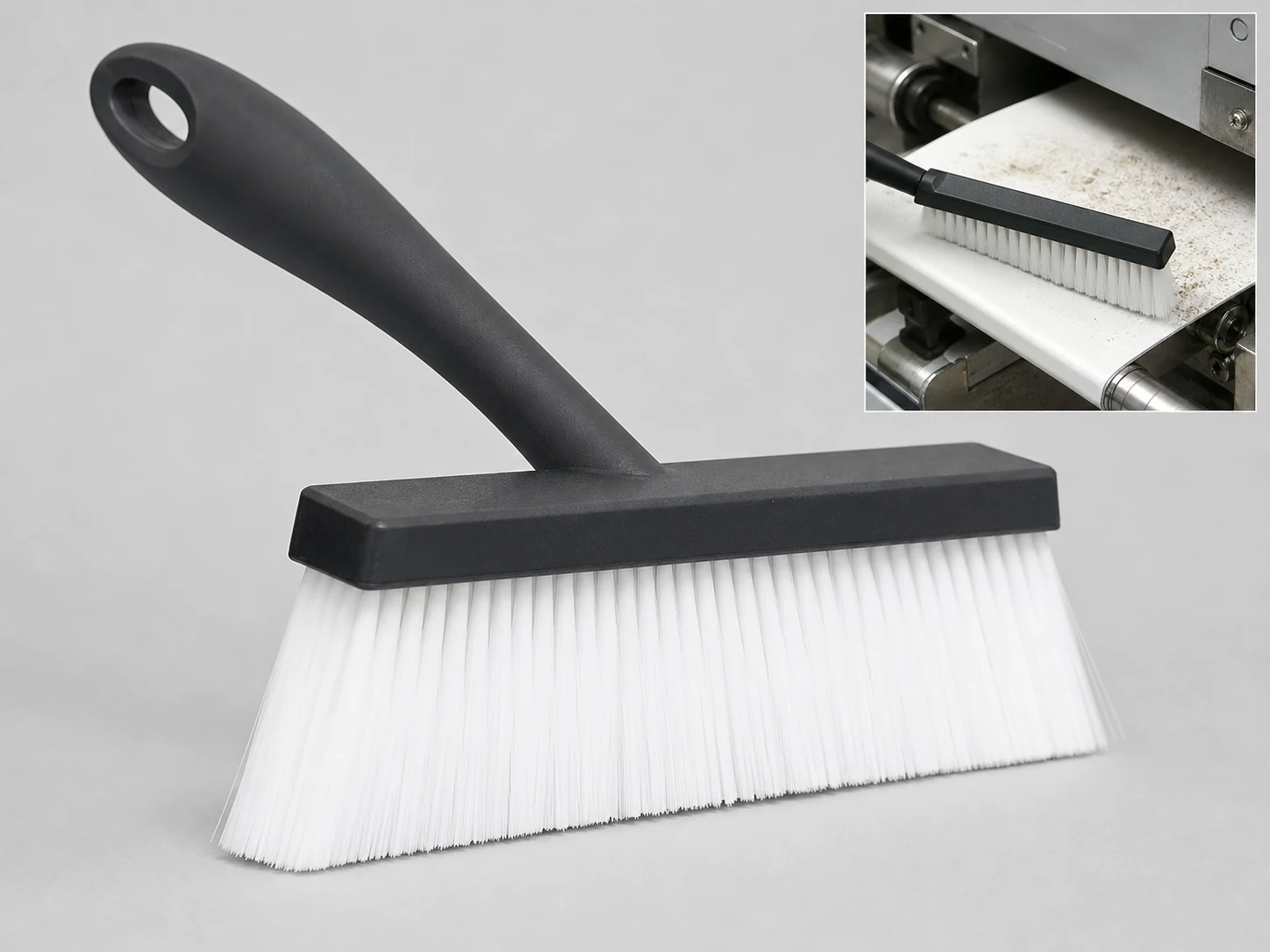
Medium brush
100 pcs
Minimum order
Worked with two hands or on a pole: chimney, gutter and pond-filter brushes, discs, cups and tank brushes.
Production lead time, once the specification is confirmed
- Up to 100 pcsWithin 7 days
- 101–5,000 pcsWithin 14 days
- 5,001–50,000 pcsWithin 21 days
- Over 50,000 pcsConfirmed with your quotation
Peak season can extend these times; the shipping date is confirmed in writing with your quotation. Sampling and shipping are quoted separately.
A chemical-resistant cleaning brush built around virgin PTFE filament for scrubbing, wiping, and residue release on sensitive or high-temperature surfaces where conventional filaments degrade, shed, or mark the substrate. Configurable as a hand brush, strip brush, roller, wheel, or stem-mounted tool for semiconductor, medical, food, and chemical processing lines.
What can this brush do for you?
Stays stable in aggressive chemical wash lines
Virgin PTFE filament is inert to most acids, alkalis, solvents, and oxidizing agents. The filaments do not absorb process fluids, so the brush keeps its trim length, stiffness, and contact pattern in baths and spray lines where nylon or PBT would swell, soften, or lose recovery.
Works at temperatures that destroy standard polymer brushes
PTFE retains useful mechanical properties from about -70°C to 260°C continuous. This allows the brush to stay in hot wash zones, near heated tooling, or on oven and weld-adjacent surfaces without the bristle set, embrittlement, or fusion seen with lower-temperature filaments.
Low-shedding, non-marking contact for sensitive surfaces
PTFE’s low coefficient of friction and non-stick nature mean the tips slide across coated, plated, polished, or machined surfaces without leaving filament marks, plastic smears, or color transfer. The filament also resists mechanical breakdown, so fewer bristle fragments enter the product or the process.
Releases residue instead of loading up
Soft films, powder, adhesive residues, and chemical precipitates have little ability to weld onto PTFE tips. The brush discharges much of what it picks up during the stroke or a quick rinse, which keeps the contact surface fresher through longer runs.
Tunable contact pressure from wiping to light scrubbing
Filament diameter, trim length, and fill density are selected to match the job. Fine diameters and longer trim provide gentle wiping contact; heavier diameters and shorter trim create firmer but still non-abrasive scrubbing. The brush applies controlled pressure without digging into the substrate.
What is a PTFE Brush?
A PTFE Brush is a cleaning brush whose working surface is made from polytetrafluoroethylene monofilament rather than nylon, PBT, polypropylene, stainless steel, or natural fiber. The filaments are mechanically set into a backing, channel, ferrule, handle, or hub and trimmed to the required length and profile.
In use, the brush tips contact the surface directly. The low-friction filaments push across a liquid film or lift loose and soft particles. Because PTFE is hydrophobic and does not absorb chemicals, it remains dimensionally stable through wet and dry cycles, solvent exposure, and high-temperature wash steps.
Since PTFE has lower bending stiffness than nylon or PBT, the brush is usually designed with dense fill, shorter trim, or heavier filament diameters when more contact force is needed. It is not a heavy-cutting brush. The most common configurations include hand brushes for manual wiping, strip brushes mounted along fixed edges, rollers or wheels for rotating contact, and stem or ferrule builds for bores, channels, or machine-mounted holders.
The entire assembly must be compatible with the process. Even if the PTFE filament is stable, the backing, fasteners, and handle materials must also tolerate the chemical and thermal environment. We specify the full assembly, not just the filament.
Technical Specifications
The following ranges cover typical configurations for this product. Dimensions, density, and mounting are adjusted to the cleaning line and contact area.
| Parameter | Value / Options |
|---|---|
| Fill material | Virgin PTFE monofilament; filled or project-specific grades available on request |
| Filament diameter | 0.05–1.20 mm, selected for contact force and surface sensitivity |
| Trim length | 5–100 mm; shorter trim for firmer contact, longer for conformability |
| Head width | 10–400 mm, matched to the contact face |
| Overall length | 100–800 mm, matched to handle, roller, strip, or stem configuration |
| Fill density | 20–200 tufts per 100 cm²; denser fill for smoother wiping, open fill for rinse-through |
| Mounting | Handle, ferrule, strip/channel, wheel/roller, plate, stem, or shaft |
| Backing / hub material | 304 stainless steel, 316 stainless steel, aluminum, PP, POM, or project-specified material |
| Operating temperature | -70°C to 260°C continuous for the PTFE fill; backing and hardware limit the full assembly |
| Chemical exposure | Inert to most acids, alkalis, solvents, and oxidizing agents; avoid molten alkali metals and elemental fluorine |
| Surface contact | Low-friction, non-marking, non-stick; no color or plasticizer transfer |
| Brush type | Custom Handheld Detail Brushes |
| How it is driven | Hand-guided |
| Cleaning target | semiconductor wet processing, medical and laboratory equipment, and food and beverage process line cleaning |
| Surface or part | roller, substrates, belts, channel, bores, webs, conveyors, and plastic |
| Residue or debris | powder, product residue, dust, liquid film, adhesive, fiber, and particles |
| Mounting / connection | Handle, ferrule, strip/channel, wheel/roller, plate, stem, or shaft |
For applications near the top of the temperature or chemical range, confirm the backing and mounting hardware before ordering, because the full assembly may have a lower limit than the PTFE filament itself.
Where does this brush work best?
These are the situations where PTFE filament solves the problem that other filament materials create:
- Semiconductor wet processing: cleaning wafer cassettes, carriers, spin bowls, wet benches, and clamp rings with DI water, solvents, and aggressive chemistries that degrade standard polymer brushes and where shedding must be controlled.
- Medical and laboratory equipment cleaning: wiping trays, instrument holders, manifolds, and autoclave racks where repeated chemical and thermal cycles plus low-particulate contact matter.
- Food and beverage process lines: cleaning conveyor belts, guides, fill-head surrounds, and transfer surfaces in hot washdown or high-humidity zones where the brush face must not absorb product residue or transfer color.
- Chemical processing and plating equipment: cleaning rollers, mixer shafts, reactor ports, and dip-tank fixtures that are rinsed with acids, solvents, or oxidizing solutions.
- Hot-air and hot-plate plastic welding stations: wiping heated tooling or cleaning soft flash and residue where a low-friction non-stick tip prevents material from sticking to the brush itself.
- Conveyor and web wiping: stationary strip or rotary roller contact that removes light debris, dust, powder, or liquid carryover from belts and moving surfaces without scratching the substrate.
How do I choose the right one?
Start with contact geometry and motion.
- If the brush is hand-held over an irregular or localized area, choose a handle-mounted brush with a width that spans the area in a few passes.
- If the contact is on a moving belt, web, or panel edge, a strip or channel-mounted brush that stays fixed while the surface moves is usually easier to control.
- If the contact is inside a bore, between rollers, or on a rotating component, choose a stem, shaft, wheel, or roller configuration matched to the shaft diameter and drive.
Then set the contact force through filament diameter and trim length.
- Delicate coatings, polished metal, wafer edges, or plated parts: use 0.10–0.30 mm filament with longer trim. The fine filaments bend more, so contact pressure stays low.
- Soft films, powder, light adhesives, or process residue: use 0.40–0.70 mm filament with medium trim and medium-to-high fill density.
- Stubborn but still removable soft deposits where PTFE remains acceptable: use 0.70–1.20 mm filament and shorter trim to create a firmer but still non-abrasive scrub.
Match fill density to the residue type.
- Dense fill (100–200 tufts per 100 cm²) gives a more uniform wiping line and better support for soft filaments.
- Open fill (20–80 tufts per 100 cm²) rinses through more easily and is easier to clear when the process carries particulate or thicker deposits.
Verify the whole brush against the environment, not only the filament. A PTFE face in a stainless channel with stainless fasteners works in aggressive wet chemistry and high temperature; an aluminum or polymer backing may reduce cost but will limit the chemical or thermal window.
When a PTFE brush is not the right tool
PTFE is a soft filament. If the contaminant is hard mineral scale, rust, carbonized or baked residue, or requires aggressive mechanical cutting, use a PBT, nylon, or abrasive-filled brush, or a stainless steel wire brush. If static dissipation is critical, standard PTFE is not conductive; discuss an anti-static or alternative filament material. Use PTFE when surface preservation, chemical inertness, high temperature, and non-stick release matter more than aggressive cutting power.
Can I customize this brush?
Yes. PTFE brushes are built around a specific contact line, mounting, and operating condition, so most orders start from your process data rather than a stock drawing. To define the configuration, provide the surface material, contaminant type, wet or dry process, chemical list and concentration, continuous operating temperature, contact area dimensions, motion type, and preferred mounting or a photo or drawing of the machine interface.
Adjustable parameters include:
- Filament: diameter, trim length, straight PTFE monofilament, filled grades, and density to change stiffness and contact pressure
- Brush body: hand brush, strip/channel, roller/wheel, plate, ferrule, stem, or shaft mounting; width, overall length, and trim profile
- Backing and hub: 304/316 stainless steel, aluminum, PP, POM, or other process-compatible material; fasteners and finishing matched to the environment
- Handle and interface: handle shape, grip material, shaft bore, keyway, set-screw, or quick-change features
- Identification and color: natural white PTFE is standard; custom color, marking tags, batch labels, or laser marking can be added where the process allows
- Packaging: bulk, individually bagged, cleanroom-compatible wrapping, or project-specific unit packaging
If your project requires food-contact documentation, material declarations, inspection reports, or third-party testing support, we can assist with those requirements during the customization and production process.
Which filament survives the cleaning chemicals a PTFE brush meets?
How do I know whether a PTFE brush will remove my residue?
Try a simple bench test: press a sample of the PTFE filament against the residue with the same motion and pressure the brush will use. If the residue loosens or wipes away without the filament bending completely flat, PTFE may work. If the residue does not move with realistic hand pressure, it probably needs a stiffer filament such as PBT, nylon, or an abrasive material.
Will PTFE filament withstand steam and autoclave cycles?
The PTFE filament itself tolerates repeated high-temperature steam exposure within the stated -70°C to 260°C range. However, the complete brush must be checked because the backing, handle, adhesive if used, and hardware may have a lower rating. Specify the exact steam temperature, pressure, and cycle count when ordering.
Can this brush be used on polished or coated surfaces without leaving marks?
PTFE filaments are softer and smoother than nylon or metal filaments, so they do not normally leave braid marks, smears, or color streaks on polished metal, glass, ceramic, or coated surfaces. If the brush has already been used on heavy contamination, rinse and inspect the tips before moving to a cleaner surface, or contaminated tips may transfer particles.
Does PTFE work in dry cleaning processes?
It can, especially for wiping light dust, dry powder, or loose debris. Because PTFE does not absorb moisture, dry use is no problem for the filament itself, but static may build up during dry wiping. If the process is static-sensitive, discuss grounding, anti-static packaging, or an alternative material before finalizing the design.
How do I inspect a PTFE brush during routine maintenance?
Check the trim face for bent, matted, or permanently compressed filaments, especially if the brush sits against a surface while not in motion. Look at the backing for corrosion or loose tufts, and confirm the mounting is not worn. PTFE does not degrade chemically the way nylon does, but mechanical set and physical wear still end the service life.
When should I switch to a different brush type?
Switch when the job needs cutting action rather than gentle displacement: hard scale, baked-on carbon, rust, or heavy molded flash call for PBT, abrasive-filled, or wire brushes. Also switch when the passage is too small for a practical PTFE fill or when static discharge control outweighs the need for chemical inertness. PTFE remains the right choice when chemistry, temperature, and surface preservation drive the decision.
Guides that go deeper on this
We have not written a guide specific to this one yet. The material that covers selection, filament, dimensions, maintenance and sourcing is collected in the technical resources library.
Custom Manufacturing RFQ
Describe Your Application
Please share the brush dimensions, working area, residue type, material direction, quantity, and a drawing or photo for quotation.
Drawing or photo optional — it speeds things up, it does not gate the enquiry.
Custom Brush RFQ
Send Your Brush Project
Upload a drawing, product photo, or sample photo and provide the core dimensions and cleaning conditions.
“We need a brush to remove wet residue from a stainless steel conveyor, about 800mm wide. The current brush wears quickly. We can send photos.”
“We sell drinkware and need a cleaning brush to include with the product. Quantity around 5,000 pieces.”