
Custom Cleaning Brush
120mm PTFE Solvent Vessel Brush
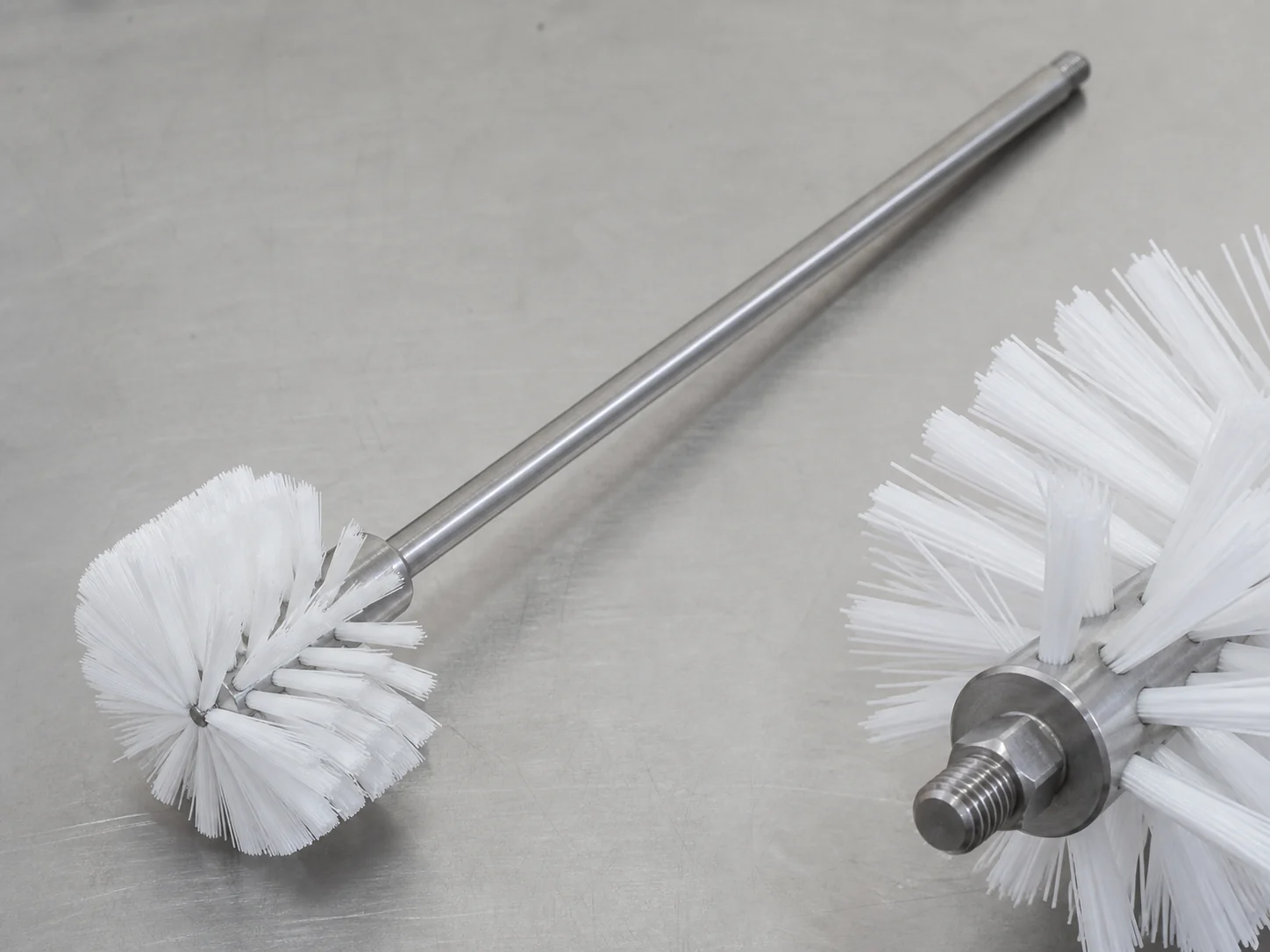
Chemically inert PTFE vessel brush with 120mm round head, 316 stainless steel handle, threaded removable head. For solvent tanks, reactors, drums.
Small brush
500 pcs
Minimum order
Held in one hand: tube, bottle, detail and swab brushes — including long-handled ones with a small head.
Production lead time, once the specification is confirmed
- Up to 500 pcsWithin 7 days
- 501–50,000 pcsWithin 14 days
- Over 50,000 pcsWithin 21 days
Peak season can extend these times; the shipping date is confirmed in writing with your quotation. Sampling and shipping are quoted separately.
This 120 mm diameter PTFE vessel brush provides a chemically inert, non-contaminating scrub surface for internal walls and bottoms of solvent storage tanks, process vessels, and drums. Its AISI 316 stainless steel handle with threaded head connection offers rigid reach and economical head replacement in aggressive solvent environments.
What can this brush do for you?
Resists aggressive solvents without contaminating the product
PTFE filaments are largely unaffected by ketones, esters, aromatics, chlorinated solvents, alcohols, and many acids and bases. Unlike nylon or natural fibers, they do not swell, soften, or shed particles into the batch, so the cleaning tool itself does not become a source of product contamination.
Releases dried films instead of carrying them
The low surface energy of PTFE prevents most solvent-based resins, coatings, and adhesive films from bonding to the filaments. Residue lifts off the vessel wall, then rinses free from the brush rather than lodging between bristles and hardening during storage.
Scrubs large vessel surfaces efficiently
The round head provides a 120 mm outer diameter with a 300 mm bristle-covered working length. Each push-pull or rotary stroke contacts a broad band of the vessel wall and bottom transition, cutting manual cleaning time on tanks and reactors compared with small-diameter or hand-held scrub pads.
Keeps the operator back from vapor and splash
The rigid 316 stainless steel handle extends 450 mm beyond the head connection, and the 22 mm grip gives a secure hold even with gloved hands. Operators can scrub open-top vessels and tanks while keeping hands and face further from solvent vapors and liquid splash.
Replaces only what wears out
The brush head threads onto the handle, so when PTFE filaments flatten, wear, or lose stiffness, the head can be changed without discarding the handle or re-purchasing the entire assembly. This lowers consumable cost on repeated vessel cleaning cycles.
What is a 120mm PTFE Solvent Vessel Brush?
A 120mm PTFE Solvent Vessel Brush is a hand-guided industrial cleaning tool built around a cylindrical brush head with PTFE (polytetrafluoroethylene) filaments. The head is mounted on a removable threaded connection to a rigid AISI 316 stainless steel handle. It is designed for manual scrubbing of the internal walls, bottoms, and lower sidewall transitions of vessels that hold or process solvents, solvent-based coatings, resins, inks, adhesives, or similar chemical systems.
In use, the operator lowers the brush through a manway, open top, or other access point and applies push-pull, rotating, or sweeping strokes. The PTFE filaments do the mechanical work of breaking the bond between the residue film and the metal or lined vessel surface, while the 316 stainless handle transmits force without bending or corroding in most solvent environments.
This is a residue-removal tool for soft to moderately adherent films. It is not an abrasive descaling brush, and it is not intended for removing hard scale, rust, carbonized deposits, or fully cured coatings that require metal or abrasive filaments.
Technical Specifications
Standard dimensions are shown below. Head geometry, filament configuration, handle length, and connection details can be adjusted to the vessel and process.
| Parameter | Standard Specification |
|---|---|
| Brush head diameter | 120 mm nominal outer diameter |
| Head shape | Round / cylindrical |
| Head working length | 300 mm bristle-covered length |
| Bristle material | PTFE (virgin; filled grades available on request) |
| Filament diameter | 0.3–0.5 mm, selected for stiffness requirement |
| Bristle trim length | 15–25 mm, configurable to vessel clearance |
| Handle / core material | AISI 316 stainless steel |
| Handle length | 450 mm from connection to grip end |
| Grip diameter | 22 mm |
| Connection | Threaded removable head (thread size specified per order) |
| Maximum continuous operating temperature | 260°C (PTFE filament limit; confirm full assembly rating for process) |
| Overall working length | Approximately 750 mm including head and handle |
| Brush type | Custom Handheld Detail Brushes |
| How it is driven | Hand-guided |
| Cleaning target | solvent storage tank and day tank, mixing and dispersion vessel, and reactor and process kettle cleaning |
| Surface or part | vessels, walls, tanks, drums, internal walls, profiles, thread, and containers |
| Residue or debris | resin, adhesive, pigment, product contamination, rust, scale, cured coating, and hard scale |
| Mounting / connection | Threaded removable head (thread size specified per order) |
The PTFE filaments are chosen for chemical inertness, not abrasion resistance. If the application requires stiffer contact or higher temperature tolerance, specify a filled PTFE grade, a different filament material, or an alternative brush design during the quotation stage.
Where does this brush work best?
- Solvent storage tanks and day tanks where dried solvent films, settled pigments, and resin build-up accumulate on interior walls and bottoms.
- Mixing and dispersion vessels in coating, ink, adhesive, and sealant production where cross-batch color or product contamination must be minimized.
- Reactors and process kettles handling solvent-based intermediates that require a non-metallic, non-sparking, non-contaminating scrub contact.
- Drums, totes, and intermediate bulk containers after solvent or resin transfer, especially when residues can harden and interfere with the next batch.
- Pharmaceutical and fine chemical vessels where PTFE is already part of the material compatibility profile and a cleanable, chemical-resistant hand brush is needed.
How do I choose the right one?
Use the following checks to confirm this brush fits the vessel and the cleaning job.
Check the access opening first
The 120 mm head cannot pass through an opening that is smaller than the head unless the bristles compress significantly, which accelerates wear and may damage filaments. For clean insertion, the vessel opening should be at least 130–135 mm in diameter. If the opening is closer to 120 mm, choose a smaller head diameter or plan for more frequent head replacement.
Compare the vessel internal diameter to the brush contact envelope
With 120 mm head OD and 15–25 mm bristle trim, the brush effectively contacts surfaces up to roughly 160–170 mm in diameter. In a much larger vessel, the brush only touches one side at a time and must be worked around the circumference. For tanks above about 200 mm ID, consider a larger head, a double-headed configuration, or a powered rotary brush to reduce cleaning time.
Match filament stiffness to the residue
Standard PTFE works well on solvent-swellable films, soft resins, pigment pastes, and uncured deposits. If the film is harder or more adherent, a carbon/graphite-filled PTFE filament can increase stiffness while retaining most of the chemical resistance. For heavy scale, rust, or fully cured coatings, PTFE is the wrong material—use stainless steel, brass, or abrasive-impregnated filaments instead.
Confirm handle reach and stiffness
The standard 450 mm handle plus 300 mm head gives about 750 mm of working reach. Measure the vessel depth from the access point to the bottom; if the operator needs to reach deeper, specify a longer handle or an extension. Ensure the handle diameter and wall thickness are stiff enough that pushing against the bottom does not cause excessive flex or bending.
Check chemical and temperature exposure
PTFE is chemically compatible with nearly all organic solvents and many inorganic acids and bases, but always test against the actual process mixture, especially if it contains strong oxidizers at elevated temperature. The PTFE filament itself is rated to 260°C continuous, but the handle, connection, and any grip material must also be suitable for the operating temperature.
Decide on connection and replacement strategy
The threaded removable head allows the filament section to be replaced independently. Specify the thread size, direction, and any anti-seize requirement. If heads will be changed frequently, consider a quick-release connection or keep spare heads on hand to avoid vessel downtime.
When to consider a different brush
Use a smaller diameter brush or a tube brush if the vessel opening is under about 100 mm. Use a wire or abrasive brush if the deposit is hard scale, cured polymer, rust, or carbon. Use a single-use swab or disposable brush if cross-contamination risk cannot be managed by cleaning and inspection.
Can I customize this brush?
The 120mm PTFE Solvent Vessel Brush can be adjusted in almost every load-bearing and contact dimension. Provide the vessel opening ID, internal diameter, depth, residue description, solvent or cleaning chemical, operating temperature, and preferred handle configuration, and we will build the brush to those inputs.
Typical customization options include:
- Head geometry: head diameter, working length, end profile (flat, crowned, tapered, or machined), and core diameter.
- Filament configuration: PTFE grade (virgin, carbon/graphite filled, anti-static), filament diameter from 0.2 to 0.5 mm, trim length, fill density, straight or crimped filaments, and color coding.
- Handle: overall length, shaft diameter, grip diameter and material, knurling or smooth finish, hanging hole, and optional extension threads.
- Connection: thread size and pitch, left-hand or right-hand thread, welded one-piece construction, or quick-release interface.
- Marking and packaging: laser marking, pad printing, embossing, color-coded grips or filaments, individual bags, bulk packing, or project-specific labeling.
For regulated or high-purity applications, we can also support material certifications, lot traceability, inspection reports, solvent compatibility documentation, and third-party testing as part of the project definition.
Which filament survives the cleaning and still lasts on a 120mm PTFE solvent vessel brush?
Can this brush pass through a 120 mm manway opening?
Only with significant bristle compression, which shortens filament life and can permanently deform the PTFE. A 120 mm head should be used with an opening of at least 130–135 mm, or the head diameter should be reduced to match the actual opening.
What residues will PTFE filaments actually remove?
PTFE removes solvent-softened films, partially dried resins, pigment pastes, sludge, and loosely bonded deposits. It will not cut through fully cured epoxy, hard mineral scale, or carbonized material; for those, choose a wire or abrasive brush.
How do I know when the brush head needs replacement?
Inspect the filaments before each shift. Replace the head when filaments are flattened, matted, broken, or no longer spring back after bending; when the outer diameter has decreased noticeably; or when there is any sign of chemical attack such as discoloration, brittleness, or crumbling.
Will the 316 stainless steel handle resist my solvent mixture?
316 stainless handles most organic solvents and many mild acids and bases. For chloride-containing solvents at elevated temperature, pitting can occur; in those cases specify an alternative alloy or a PTFE-coated handle. Always validate with a coupon test in the actual cleaning fluid.
Can I use this brush with a rotary power tool?
The standard handle is designed for manual use. A powered rotary drive is possible if the threaded connection is retained and rotational speed is controlled, but PTFE generates friction heat and can melt or degrade if run dry at high RPM. Contact us if a powered configuration is required.
What is the best way to store the brush between batches?
Rinse with a compatible solvent to remove residue from between filaments, allow to dry, and store vertically or hanging by the grip. Do not rest the brush on the bristle side, because PTFE filaments can take a permanent set and lose their original shape.
Guides that go deeper on this
Custom Manufacturing RFQ
Describe Your Application
Send the key measurements, cleaning requirement, residue, material direction, mounting method, quantity, and drawing or photo.
Drawing or photo optional — it speeds things up, it does not gate the enquiry.
Custom Brush RFQ
Send Your Brush Project
Upload a drawing, product photo, or sample photo and provide the core dimensions and cleaning conditions.
“We need a brush to remove wet residue from a stainless steel conveyor, about 800mm wide. The current brush wears quickly. We can send photos.”
“We sell drinkware and need a cleaning brush to include with the product. Quantity around 5,000 pieces.”