
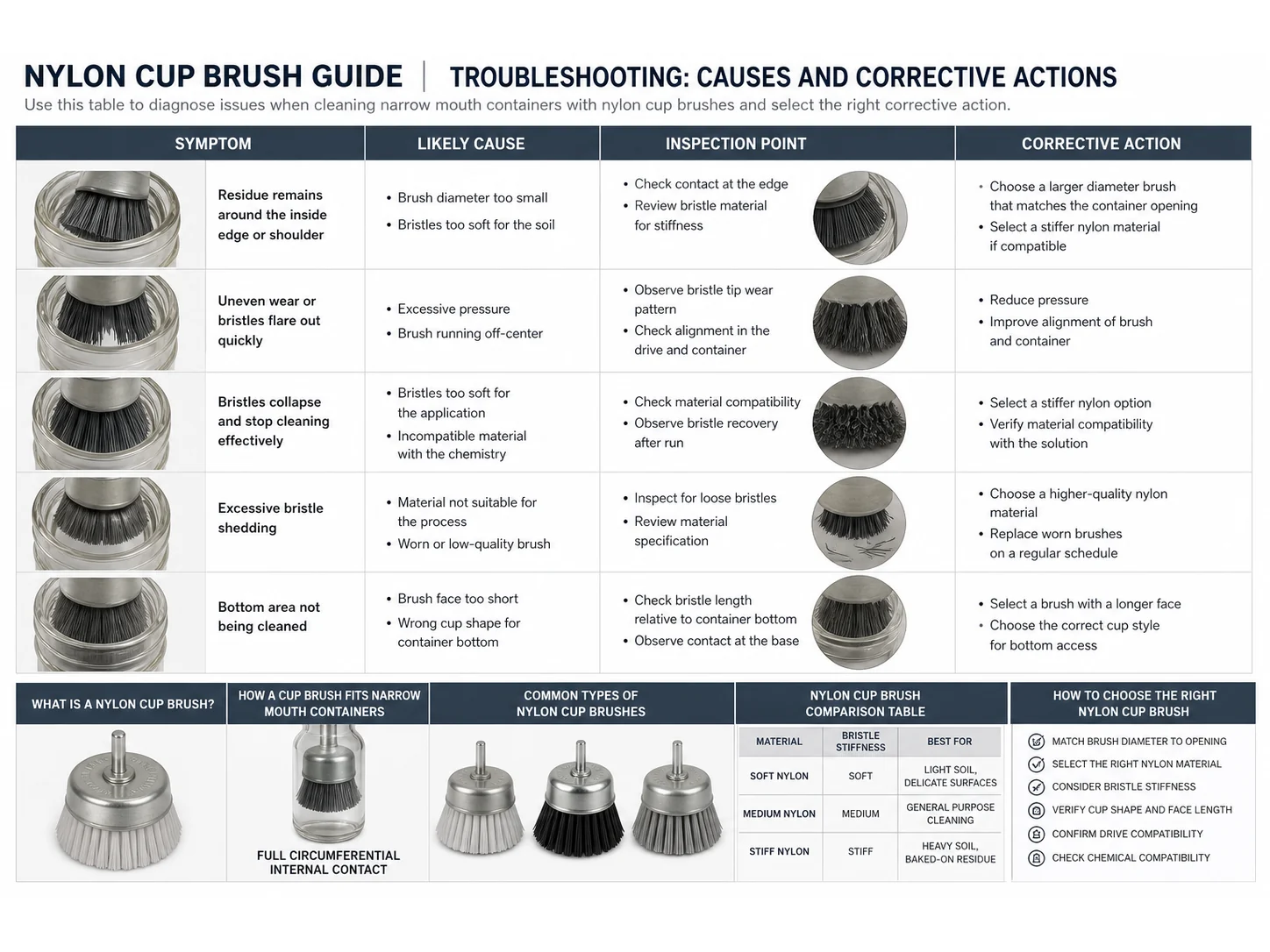
What Is a Nylon Cup Brush?
A nylon cup brush is a brush with nylon filaments radiating outward from a central core or hub, forming a cup-like profile. It is typically used on rotary tools, drills, or bench machines to clean, polish, deburr, or surface-prep the interior of cylindrical objects. The cup design allows the bristles to contact inside walls evenly, even in restricted spaces where a standard straight brush would miss spots or fail to enter.
How a Cup Brush Fits Narrow Mouth Containers
Narrow mouth containers—such as reagent bottles, water bottles, small tanks, and laboratory glassware—have openings much smaller than their body diameters. A cup brush enters the neck and expands inside to scrub the walls. The effectiveness depends on the brush diameter relative to the container’s inner diameter, bristle length, and the flexibility of the filaments. For deep containers, extended handles or arbor-mounted designs keep the brush centered and prevent shaft wear.
Common Types of Nylon Cup Brushes
Nylon cup brushes vary by filament material, stiffness, abrasive fill, and mounting. The main categories are:
- Non-abrasive nylon: For light cleaning and polishing without scratching. Common in food, beverage, and pharmaceutical applications.
- Abrasive nylon: Impregnated with silicon carbide or aluminum oxide grit for light deburring, surface texturing, and removal of tenacious soils.
- Crimped vs. straight bristles: Crimped filaments create a softer, more flexible brush face; straight bristles are stiffer and more aggressive.
- Standard vs. heat- or chemical-resistant nylon: Nylon 6/6 is typical; for higher temperatures or harsh chemicals, specialty nylons or blends are used.
- Color-coded bristles (e.g., blue nylon): Some manufacturers color-code by grit, stiffness, or application, but color alone is not a reliable specification method.
Nylon Cup Brush Comparison Table
| Material / Style | Typical Diameter Range | Bristle Stiffness | Mount Type | Best For | Residue Compatibility | Surface Sensitivity |
|---|---|---|---|---|---|---|
| Non-abrasive Nylon (straight) | 1″–6″ | Medium to firm | Drill shank, threaded arbor | General cleaning, light scrubbing | Water-based soils, dust, light oils | Painted, coated, plastic, glass |
| Non-abrasive Nylon (crimped) | 1″–6″ | Soft to medium | Drill shank, wire loop handle | Polishing, gentle cleaning | Delicate residues, fine powders | Highly sensitive, optical, thin-walled |
| Abrasive Nylon (P80–P320 grit) | 2″–6″ | Firm to stiff | Threaded arbor, 1/4″ hex shank | Deburring, scale removal, surface prep | Cured residues, light rust, paint prep | Metal, hard plastics, ceramics |
| Heat-resistant Nylon | 2″–5″ | Firm | Arbor, drill shank | Autoclave cleaning, hot wash environments | Protein, baked-on soils | Stainless steel, glass |
| Chemical-resistant Nylon | 1″–4″ | Medium | Custom arbor, extended shaft | Acid/alkali tank cleaning | Chemical residues, fluxes | Chemical-grade polymers, specialty alloys |
How to Choose the Right Nylon Cup Brush
Match the brush to the cleaning task by evaluating these factors:
- Residue type: Light dust or powder needs a soft, non-abrasive brush; sticky or cured residues require abrasive grit or stiffer bristles.
- Surface sensitivity: For coated or polished surfaces, choose non-abrasive, crimped bristles. For uncoated metals or ceramics, abrasive nylon can be safe if the grit grade is appropriate.
- Equipment interface: Always check the brush’s shank or arbor size. Common drill chucks accept 1/4″ hex or round shanks; bench grinders and rotary tools may need a specific thread or mount.
- Wet or chemical exposure: If cleaning with water, detergents, or chemicals, verify that the nylon compound resists swelling, softening, or chemical attack. Standard nylon 6/6 can absorb moisture and lose stiffness.
- Hygiene expectations: Food, pharmaceutical, or medical applications may require brushes with FDA-compliant filaments, metal-free construction, or autoclavable designs.
- Maintenance frequency: High-volume cleaning demands brushes that resist bristle fatigue and maintain shape; look for dense filament packing and reinforced hubs.
- Custom size requirements: For non-standard narrow mouth containers, provide the opening diameter, body diameter, and depth to a brush manufacturer for a true fit. Standard off-the-shelf sizes (e.g., 2″, 3″, 6″) may not always work optimally.
Common Mistakes When Specifying a Nylon Cup Brush
- Choosing the wrong bristle stiffness: Too soft won’t clean; too stiff can scratch or gouge the interior.
- Ignoring diameter tolerance: A brush that is too small leaves residues on the walls; too large may jam or require excessive force, damaging the container or brush hub.
- Neglecting chemical compatibility: Some cleaning agents degrade nylon, causing brittleness or swelling. Always check material data sheets.
- Selecting abrasive nylon for sensitive surfaces: Even fine grit can dull reflective surfaces or remove thin coatings. Test on a sample or scrap container first.
- Assuming a standard size fits all narrow mouth containers: A 2″ cup brush designed for a 2″ opening may not pass through a bottleneck under 2″. Measure the minimum restriction, not just the body diameter.
- Overlooking arbor or mount limitations: A brush with a 1/4″ shank won’t fit a collet-type rotary tool without an adapter. Confirm tool compatibility before purchase.
- Not considering hygiene standards: Metal wire twists or center nuts can harbor bacteria in food or medical settings; look for sealed, one-piece plastic hubs.
- Skipping a residue test: Residue adhesion varies widely. Before ordering large quantities, test a single brush on your specific residue and container material.
When a Nylon Cup Brush Is the Wrong Choice
Nylon cup brushes are excellent for interior cleaning and finishing, but they have limits. If you encounter any of the following, consider an alternative or expert guidance:
- Heavy scale or thick rust: Abrasive nylon may only polish the surface; aggressive wire cup brushes or chemical descaling may be required first.
- Extremely fragile surfaces: Thin glass, ceramic coatings, or delicate optical finishes may need foam swabs, microfiber, or ultrasonic cleaning instead of any brush.
- Deep, narrow blind holes: Cup brushes may not reach the bottom effectively. A specialty plug brush or double-spiral design could be more suitable.
- Non-cylindrical cavities: Irregular interior shapes can cause uneven bristle contact and incomplete cleaning. Custom brush designs with shaped heads are often necessary.
- When no off-the-shelf size fits: Always consult a brush manufacturer’s drawing or submit a container sample for a custom-designed brush that matches your exact dimensions and cleaning requirements.
Final Takeaway
Selecting a nylon cup brush for narrow mouth containers comes down to three core decisions: match the filament material and stiffness to the residue type and surface sensitivity, match the brush diameter and shape to the container’s internal dimensions, and match the mounting style to your tool or cleaning station. Always verify chemical and temperature resistance, and whenever possible, run a sample test before specifying a large order. Avoid common errors like ignoring the neck restriction or skipping grit compatibility, and you’ll achieve consistent, safe cleaning results.
Frequently Asked Questions
Can I use a nylon cup brush with a standard drill?
Yes, many nylon cup brushes come with 1/4″ round or hex shanks designed for common drill chucks. Ensure the brush’s maximum RPM rating exceeds your drill’s speed, and always secure the container properly to prevent spinning or injury.
What’s the difference between abrasive and non-abrasive nylon bristles?
Non-abrasive nylon bristles are pure polymer filaments that clean without scratching. Abrasive nylon bristles have grit particles—silicon carbide or aluminum oxide—embedded throughout the filament, allowing them to remove material, deburr, or texture surfaces. They feel rougher and wear down more predictably.
How do I measure my container to order the right cup brush size?
Measure the smallest inside diameter of the neck or opening, the widest inside diameter of the body, and the depth from opening to bottom. The brush diameter should be slightly smaller than the neck restriction to pass through, yet large enough to expand and contact the body walls. Provide these three measurements to your supplier.
Can nylon cup brushes handle hot water or chemical cleaners?
Standard nylon 6/6 absorbs moisture and can soften above 180°F (82°C). For continuous hot water or aggressive chemicals, ask about heat-stabilized nylon grades or chemical-resistant filaments. Always test a sample under actual operating conditions.
How often should I replace a nylon cup brush?
Replacement depends on bristle wear, loss of shape, or contamination. Inspect brushes regularly: if the working diameter shrinks noticeably, bristles break, or cleaning performance drops, replace the brush. Many food and medical facilities schedule replacement based on cycle counts for hygiene consistency.
Can I use a nylon cup brush to remove grout?
While an abrasive nylon cup brush can be used on a drill or angle grinder to remove grout haze or thin residues, it is not the ideal tool for heavy grout removal from tile joints. A purpose-built grout removal tool or wire brush designed for flat grout lines typically works faster and more effectively. For narrow bottle interiors, stick to brushes designed for interior wall contact.
What safety precautions should I take when using a rotary cup brush?
Always wear eye protection and secure the workpiece. Do not exceed the brush’s maximum RPM. Ensure the brush is correctly mounted and centered. Let the bristles do the work—excessive pressure can cause breakage or injury. For wet cleaning, use ground fault protected outlets.
Technical References
- CDC — Preventing Food Poisoning
- eCFR — 21 CFR 177.1500 Nylon Resins
- OSHA — 1910.242 Hand and Portable Powered Tools
- OSHA — 1910.215 Abrasive Wheel Machinery
- OSHA — Personal Protective Equipment
- FDA — Food Safety in Your Kitchen
Which bristle material fits this job — Nylon PA, Abrasive Nylon or AISI 304 Stainless Steel Wire?
| Material | Continuous temperature (°C) | Peak temperature (°C) | Water absorption | Hardness |
|---|---|---|---|---|
| Nylon PA | 93 | 121 | 0.3–9% by PA grade and conditioning | Medium to firm; filament diameter and trim length control bending force. |
| Abrasive Nylon | 120 | 150 | 0.1–1.0% | Abrasive filament; stiffness and cutting level is controlled by PA base, grit type, grit size, filament diameter and trim height. |
| AISI 304 Stainless Steel Wire | 400 | 500 | 0% | Rockwell B 70–95 depending on temper and cold work |
| Boar Bristle | 60–80 | 100–120 | 10–18% | — |
| PBT | 120–140 | 160–180 | 0.05–0.20% | Shore D 80–90 |
Figures as published by Brushtec / DuPont; Perlon; Alleima. Confirm the exact grade against the supplier datasheet before ordering.
What should replace Bottle & Container Brushes for narrow mouth bottles?
- Bottle & Container Brushes — Bottle and container brushes are selected around an opening plus a larger vessel body and bottom geometry; tube and bore brushes are selected mainly around a long diameter-controlled passage. Closest alternative: Tube & Pipe Bore Brushes.
- Nylon PA — Compare Nylon PA with PP, PBT, PET. Change material when wet stiffness, temperature, chemical resistance, conductivity, particle shedding, or surface marking becomes the limiting factor.
- Abrasive Nylon — Compare Abrasive Nylon with PP, PBT, PET. Change material when wet stiffness, temperature, chemical resistance, conductivity, particle shedding, or surface marking becomes the limiting factor.
- AISI 304 Stainless Steel Wire — Use AISI 316 stainless steel wire for chloride, marine, dairy, beverage, chemical washdown, or higher pitting-resistance requirements. Use carbon steel for dry aggressive cutting and brass or abrasive nylon for lower marking risk.