
What Is a Narrow Mouth Bottle Brush?
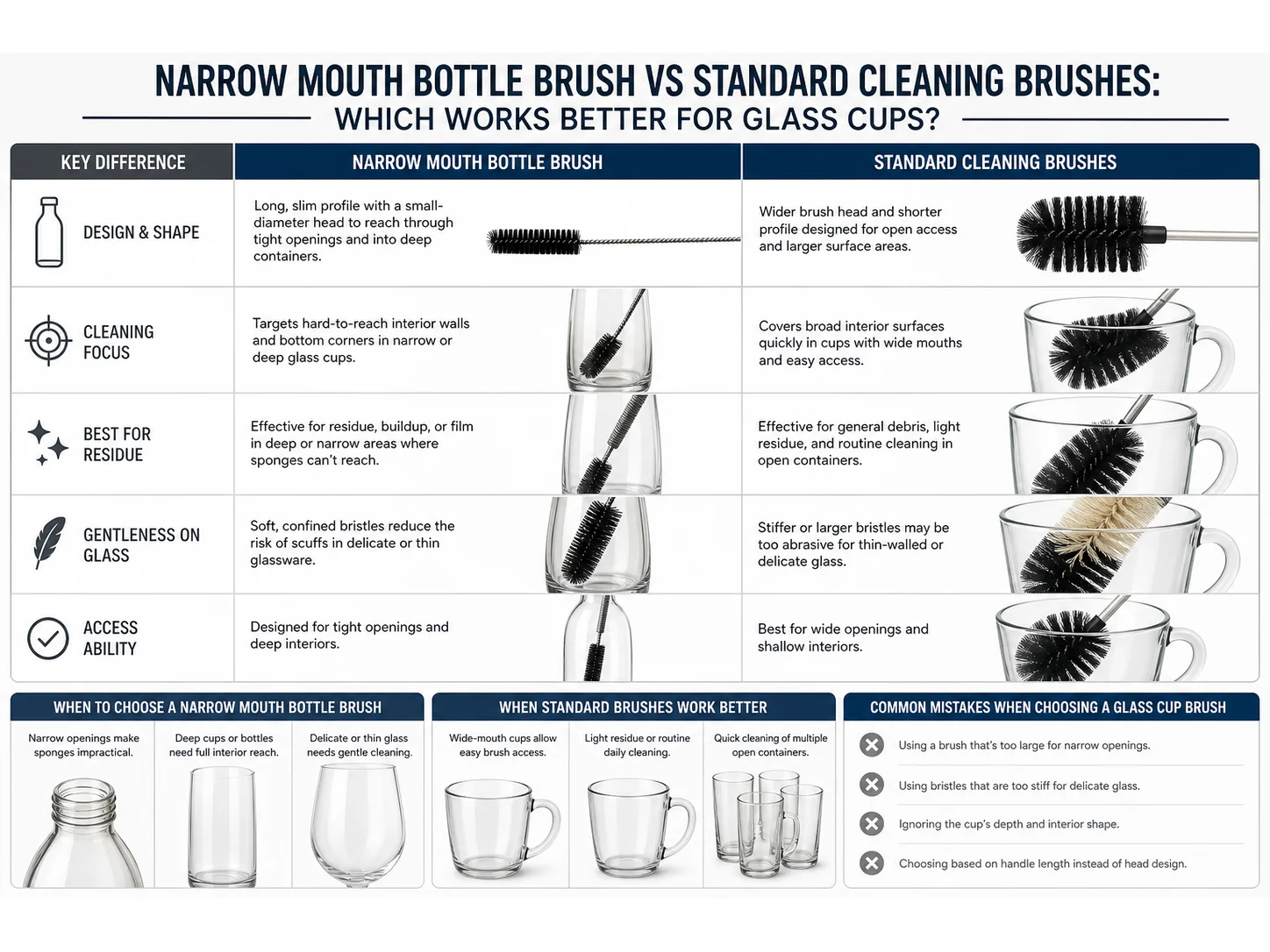
A narrow mouth bottle brush features a bristle tip that is smaller than the opening of a typical narrow-neck container—often between 15 mm and 40 mm in diameter. Its wire core is twisted to hold bristles in a spiral pattern and is flexible enough to bend into curved glassware without snapping. Bristle materials vary from nylon to polyester to natural fibers, each offering a different balance of scrubbing power and surface safety. The long, twisted wire handle allows the brush to reach the bottom of tall cups while keeping the user’s hand away from moisture or cleaning chemicals.
What Are Standard Cleaning Brushes?
Standard bottle brushes generally have a wider bristle head (40 mm to 70 mm or more) and a stiffer, less flexible handle or wand. They may come as sponge-tipped wands, foam heads, or bulb-shaped bristle clusters. While effective for wide-mouth jars, open cups, and general kitchen scrubbing, these brushes often cannot enter narrow glass openings without forcing, which risks cracks, incomplete coverage, or damage to the rim.
Narrow Mouth Bottle Brush vs Standard Brushes: Key Differences
| Factor | Narrow Mouth Bottle Brush | Standard Cleaning Brush |
|---|---|---|
| Bristle Reach | Designed to pass through small openings (≤40 mm) and follow curved interiors. | Usually too wide for narrow necks; may only clean the upper portion of a glass. |
| Scrubbing Force | Moderate; depends on bristle stiffness and wire tension. Can be customized. | Often higher due to larger head and firmer handle, but may be too aggressive for thin glass. |
| Glass Surface Safety | Soft bristle options (e.g., nylon, natural Tampico) minimize scratching. Wire core is typically double-twisted to prevent exposed metal ends. | Foam or sponge heads are safe but may not remove dried residues. Coarser bristles can scratch if misapplied. |
| Residue Removal | Excellent for dried coffee, tea, lab stains, and biofilm in tight spaces. Bristle pattern can be tailored to residue type. | Good for light soiling on large surfaces; struggles with caked-on residue in corners. |
| Handle Ergonomics | Long, flexible wire handle (often 250–400 mm). Requires careful grip; may fatigue hands during high-volume cleaning without an ergonomic grip. | Often features a solid plastic or wooden handle with a grip, suitable for repetitive use on open cups but cannot reach deep narrow interiors. |
| Typical Use Cases | Wine glasses, champagne flutes, travel mugs, narrow-neck water bottles, flask-shaped laboratory glassware, Nalgene bottles. | Wide-mouth mason jars, tumblers, mixing glasses, open pitchers, decorative glasses with no neck restriction. |
When to Choose a Narrow Mouth Bottle Brush
Opt for a narrow mouth bottle brush when your cleaning routine involves one or more of these conditions:
- Residue type: Dried coffee, tea tannins, protein shakes, or laboratory stains that adhere to glass interior walls and require targeted mechanical scrubbing.
- Glass opening: Mouth diameter less than about 40 mm. Forcing a standard brush can score the rim or fail to clean the bottom.
- Surface sensitivity: The glass cup is thin, high-clarity, or used for presentation (e.g., wine tasting) where scratches are unacceptable. Choose bristle material that matches: soft nylon or Tampico for delicate surfaces, stiffer polyester for tougher residues.
- Wet or chemical exposure: The brush will be used with cleaning agents; all components (bristles, wire, handle) must resist degradation. Stainless steel wire cores are preferable for repeated chemical contact.
- Hygiene expectations: Use in food or lab environments requiring a brush that can be sanitized, autoclaved, or replaced frequently. Look for smooth, crevice-free construction to avoid bacterial harborage.
- Maintenance frequency: High-volume cleaning of many identical glass cups daily justifies a durable, purpose-fit brush that reduces breakage rate and ensures consistent results.
When Standard Brushes Work Better
A standard brush is often the right choice when:
- The glass cup has a wide opening (>50 mm) and no inward taper that would block a larger brush head.
- Residue is light or non-sticking, such as wine rinse or water spots, and foam or sponge cleaning is sufficient.
- Scrubbing speed matters more than precision—e.g., quickly washing open tumblers in a bar.
- The cost per brush is a primary constraint, and the glasses are robust enough to tolerate occasional mild scratching.
- Hand fatigue is a concern: standard brushes with ergonomic grips are better for extended manual cleaning of shallow glassware.
Common Mistakes When Choosing a Glass Cup Brush
- Ignoring bristle material in favor of cost drivers: A low-cost brush with hard plastic bristles can scratch fine glass irreparably. Match bristle type to residue and surface.
- Assuming all narrow brushes are safe for glass: Even a small-diameter brush can have exposed wire ends or overly stiff bristles. Look for double-twisted wire and looped ends.
- Overlooking handle length: A handle that is too short forces hands into cleaning solution; too long may be unwieldy. Measure cup depth + grip distance.
- Not testing on a sample glass: When ordering in bulk, always request a sample or drawing to confirm fit, bristle contact, and surface safety before committing.
- Using one brush for all resinous or colored residues: Cross-contamination between coffee and tea stains or between lab chemicals can affect taste, odor, or safety. Dedicate brushes per residue type or implement a validated cleaning protocol.
- Neglecting brush storage: Hanging a wet brush bristles-up can harbor mold; store horizontally or bristles-down in a dry, ventilated area.
When a Narrow Mouth Bottle Brush Is the Wrong Choice
Even the best-designed narrow mouth bottle brush has limits. Recognize when an alternative approach is needed:
- Stubborn baked-on or polymerized residues: For example, pyrolysis marks in laboratory glassware or hardened protein deposits. Mechanical brushing alone may not suffice; pre-soaking with an appropriate detergent or using ultrasonic cleaning may be required.
- Extremely fragile or heirloom glass: Very thin-walled antique or decorative pieces may require only a soft lint-free cloth or a specialized foam plug, never a bristle brush.
- High-throughput operations: A manual brush is impractical for cleaning thousands of cups per hour. Consider automated brush systems, spray washers, or CIP (clean-in-place) solutions.
- Uniquely shaped glassware: A cup with a sharply angled neck, an internal baffle, or a very long narrow stem may need a custom brush profile. Request a drawing review or sample from the supplier to verify geometry and bristle coverage.
- Sanitary validation requirements: In pharmaceutical or food-grade settings, cleaning efficacy must be documented. A brush alone may need to be part of a validated cleaning procedure with rinse water testing and visual inspection. The brush design must support consistent, reproducible results.
Final Takeaway
Choose a narrow mouth bottle brush when the glass cup’s opening restricts access, residues are tough, and surface preservation is critical. Standard brushes serve well for open, robust glassware with light soiling. The decision hinges on three measurable factors: the minimum neck diameter, the most challenging residue you routinely encounter, and the acceptable risk of micro-scratches on your glass surfaces. When ordering for commercial or laboratory use, request material datasheets, brush drawings, and samples to validate performance before bulk purchase.
Frequently Asked Questions
Are silicone bristles better than nylon for glass cups?
Silicone bristles are non-porous, resist bacterial growth, and are very gentle on glass, making them a good choice for simple rinsing. However, they often lack the mechanical scrubbing power needed for dried or sticky residues. Nylon offers a better balance of softness and effective cleaning for most glass cup applications.
Can a narrow mouth bottle brush scratch glass?
If the brush has exposed metal wire tips or overly stiff bristles, it can scratch glass. Always select a brush with a double-twisted wire core where bristles are tightly captured and the tip is folded or looped. Match bristle stiffness to the glass hardness and residue type.
What bristle diameter is best for a standard wine glass?
For most wine glasses with a bowl diameter of 2–4 inches (50–100 mm) and a narrow stem opening, a brush head diameter of 25–35 mm usually works well. It should be small enough to pass the neck without force and flexible enough to conform to the bowl’s curve.
How often should a narrow mouth bottle brush be replaced?
In commercial or laboratory settings, inspect brushes daily. Replace when bristles become matted, bent, or show signs of shedding; when the wire core kinks permanently; or when cleaning becomes less effective despite proper technique. For food service, a typical replacement cycle is every 1–3 months with heavy use.
Can I use a narrow mouth bottle brush for cleaning laboratory glassware?
Yes, provided the brush is made of chemically resistant materials (e.g., polyester or nylon bristles, stainless steel wire). Avoid natural fibers that may degrade in solvents. Ensure the brush size matches the glassware ID and that residue compatibility is verified.
Is a long handle important for cleaning glass cups?
A long handle (at least 10–12 inches / 250–300 mm) keeps your hands out of cleaning solutions and allows you to reach the bottom of tall flutes or travel mugs without tilting the glass dangerously. For ergonomic cleaning stations, handle length should match the operator’s reach and sink depth.
Can a narrow mouth brush clean the entire inside of a curved glass?
Yes, if the wire core is flexible enough to follow the contour. A stiff core may only clean the center line, leaving residue on the sides. Look for brushes described as “conformable” or request a sample to verify complete contact in the glass type you use most.
What is the best cleaning method for dried coffee stains in a narrow glass?
The best approach combines a pre-soak with warm water and mild detergent, followed by scrubbing with a narrow mouth bottle brush that has medium-stiff nylon bristles. For stubborn stains, a short soak with a diluted oxygen-based cleaner before brushing breaks down tannins without harming the glass.
Technical References
- CDC — Preventing Food Poisoning
- eCFR — 21 CFR 177.1500 Nylon Resins
- eCFR — 21 CFR 177.1630 Polyethylene Phthalate Polymers
- EPA — Safer Choice
- FDA — Food Safety in Your Kitchen
Which bristle material fits this job — Nylon PA, AISI 304 Stainless Steel Wire or Silicone?
| Material | Continuous temperature (°C) | Peak temperature (°C) | Water absorption | Hardness |
|---|---|---|---|---|
| Nylon PA | 93 | 121 | 0.3–9% by PA grade and conditioning | Medium to firm; filament diameter and trim length control bending force. |
| AISI 304 Stainless Steel Wire | 400 | 500 | 0% | Rockwell B 70–95 depending on temper and cold work |
| Silicone | 200–250 | 280–300 | 0.1–1.0% | Shore A 20–80 |
| Polypropylene PP | 80–100 | 120–140 | ≤0.03% | Shore D 65–75 |
| Boar Bristle | 60–80 | 100–120 | 10–18% | — |
Figures as published by Brushtec / DuPont; Alleima; Perlon. Confirm the exact grade against the supplier datasheet before ordering.
What should replace Bottle & Container Brushes for bottle brush?
- Bottle & Container Brushes — Bottle and container brushes are selected around an opening plus a larger vessel body and bottom geometry; tube and bore brushes are selected mainly around a long diameter-controlled passage. Closest alternative: Tube & Pipe Bore Brushes.
- Nylon PA — Compare Nylon PA with PP, PBT, PET. Change material when wet stiffness, temperature, chemical resistance, conductivity, particle shedding, or surface marking becomes the limiting factor.
- AISI 304 Stainless Steel Wire — Use AISI 316 stainless steel wire for chloride, marine, dairy, beverage, chemical washdown, or higher pitting-resistance requirements. Use carbon steel for dry aggressive cutting and brass or abrasive nylon for lower marking risk.
- Silicone — Compare Silicone with PP, TPE, Nylon. Change material when wet stiffness, temperature, chemical resistance, conductivity, particle shedding, or surface marking becomes the limiting factor.