
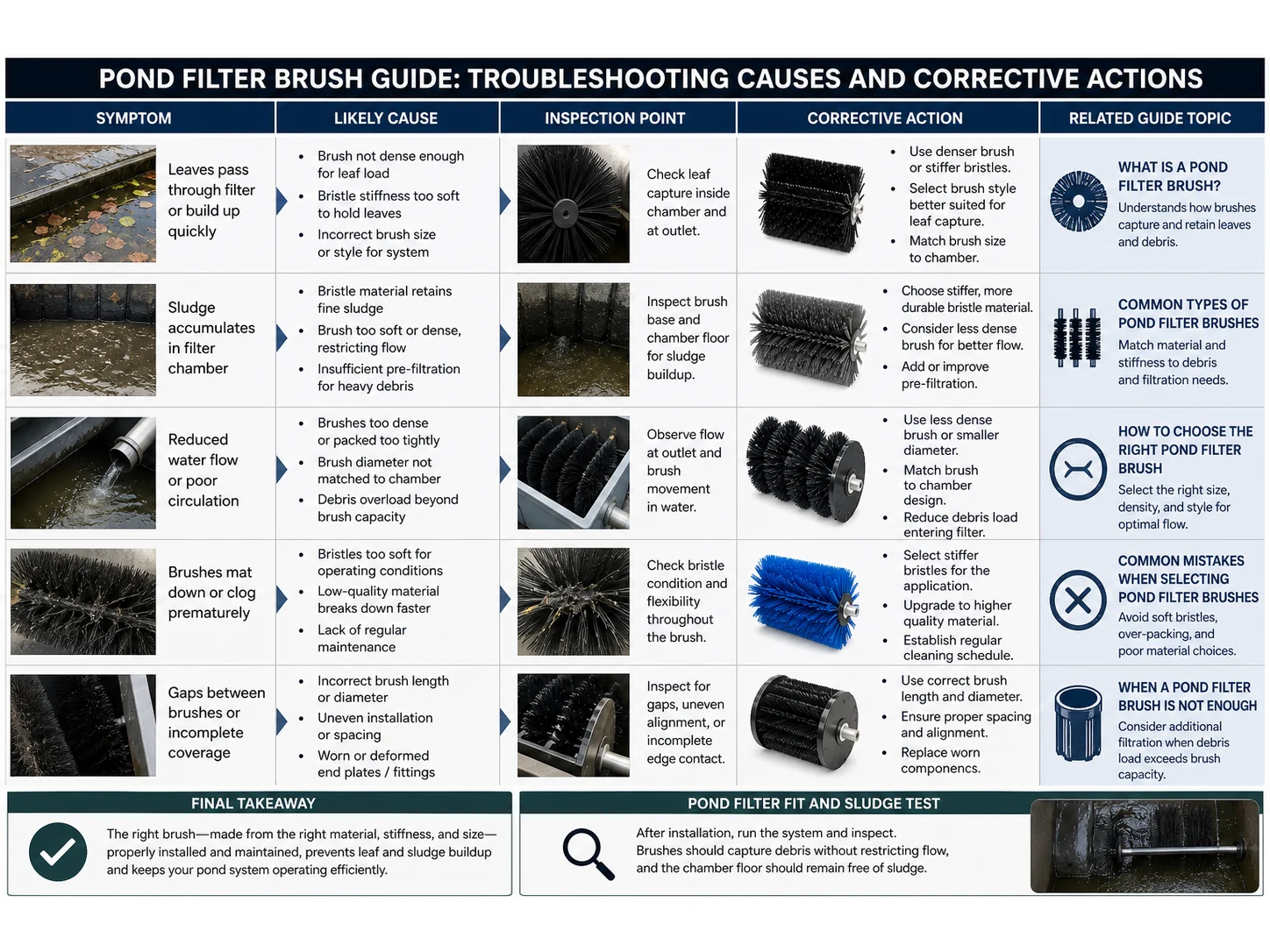
What Is a Pond Filter Brush?
A pond filter brush typically functions in one of two ways: as a mechanical filtration medium (often arranged in static arrays inside settlement chambers) or as a handheld brush for scrubbing pond surfaces, filter media, and equipment. In filtration, bristles capture solids while allowing water to flow through; in cleaning, they dislodge sludge, algae, and debris from liners, pipes, and filter pads. The brush’s effectiveness depends heavily on its material, stiffness, and how well it fits the intended interface.
Common Types of Pond Filter Brushes
The table below compares typical pond filter brush options based on material, stiffness, diameter, mounting style, and best-use scenarios. Use it as a starting point to match a brush to your pond’s needs.
| Feature | Polypropylene (PP) | Nylon | Stainless Steel | Natural Bristle (Tampico) |
|---|---|---|---|---|
| Typical Stiffness | Medium, flexible | Medium to stiff | Very stiff | Soft |
| Common Diameters | 2″ – 6″ | 1″ – 4″ | 0.5″ – 2″ | 1″ – 3″ |
| Handle / Core | Plastic or stainless steel | Plastic or wire | Metal | Wood or plastic |
| Mounting Style | Threaded, clamp-on | Twist-lock, friction fit | Threaded, quick-connect | Hand-held, slip-on |
| Best For | General sludge, algae, and leaf removal in ponds with sensitive liners | Scrubbing filter pads, chambers, and tough algae | Heavy-duty industrial tanks, concrete surfaces | Delicate cleaning of plants, ornaments, and liners |
| Key Considerations | Resistant to most pond chemicals; ensure UV stabilization for outdoor use | Excellent chemical resistance; can be abrasive if too stiff for delicate surfaces | Not for pond liners; risk of scratching plastic or fiberglass; can rust if not dried | Absorbs water; can harbor bacteria; requires thorough drying after use |
How to Choose the Right Pond Filter Brush
Matching a brush to your pond means evaluating several real-world factors beyond size alone. Consider the following before making a purchase:
- Residue type: Soft, loose sludge calls for flexible bristles that won’t compact debris. Caked-on algae or mineral deposits need stiffer bristles that can scour without excessive effort.
- Surface sensitivity: EPDM and PVC liners are easily scratched by metal or overly stiff bristles. Plastic filaments (PP or soft nylon) are safer. Concrete, fiberglass, and some rigid plastics can withstand stiffer or metal brushes.
- Equipment interface: Will the brush be inserted into a filter housing or attached to a handle? Check existing thread types (NPT, BSP), bayonet fittings, or clamping points. A brush that doesn’t mount securely can waste flow or fall apart.
- Wet or chemical exposure: Pond treatments, dechlorinators, and pH adjusters can affect brush materials. PP and nylon resist most pond chemicals; natural fibers and certain metals may degrade or react.
- Hygiene expectations: In ponds with high-value fish like koi, a brush that traps organic matter and resists rinsing may become a bacteria factory. Non-porous synthetic bristles are easier to sanitize.
- Maintenance frequency: If you clean brushes daily, a simple rinse-and-go material works. Less frequent cleaning may require a brush that doesn’t retain moisture or develop odors.
- Custom size requirements: Standard diameters may not fit proprietary filter chambers. In those cases, work with a supplier that can produce a technical drawing and confirm tolerances before ordering.
Common Mistakes When Selecting Pond Filter Brushes
Avoid these pitfalls to save time, money, and pond-health headaches:
- Choosing by cost drivers alone. A low-cost brush may use low-quality plastics that snap or shed bristles, creating a choking hazard for fish.
- Ignoring bristle stiffness. Using a stiff metal brush on a rubber liner can puncture it, leading to leaks and costly repairs.
- Wrong diameter fit. A brush that’s too wide jams in filter housings; one that’s too narrow leaves gaps where debris bypasses filtration.
- Assuming all plastics are equal. Not all PP or nylon is UV-stabilized. Untreated plastics become brittle and break after one season under sunlight.
- Overlooking handle/core material. Wood handles swell and rot in constant moisture; plain steel cores rust without protective coating.
- Mismatched mounting style. Thread standards vary (NPT is common in North America, BSP in other regions). Forcing an incompatible thread can damage both brush and equipment.
When a Pond Filter Brush Is the Wrong Choice
Even the best brush has limits. Recognize these boundaries and supplement with additional tools or approaches when needed:
- Fine suspended particles (green water): Brushes cannot capture microscopic algae cells. You’ll need a fine mechanical filter (sand, bead, or drum filter) for water clarity.
- Large debris loads: During autumn leaf fall, a brush can clog within hours. A skimmer or net is a more practical first line of defense.
- Pressurized systems: Most pond filter brushes are not rated for high pressure. In pressurized applications, look for reinforced brushes designed for that environment, or consider alternative filtration media.
- Automated self-cleaning setups: A static brush assembly won’t dislodge enough debris in systems that rely on rotation or backwash. Rotary brush modules or spray bars may be required.
- Custom one-off designs: If your filter chamber lacks standard dimensions, request a sample brush or detailed drawing before committing to a bulk order. A small mismatch can cripple flow and filtration efficiency.
Final Takeaway
Start by understanding your pond’s dominant residue type and surface sensitivity, then match brush material, stiffness, and diameter accordingly. Don’t let a bargain brush become the weak link in your filtration—verify chemical compatibility, mounting style, and core material against your actual pond conditions. When the application pushes past what a typical pond filter brush can do, step up to the right supplemental equipment or custom solution.
Frequently Asked Questions
What material is safest for a pond liner?
Polypropylene and soft nylon bristles are generally safe for EPDM, PVC, and other flexible liners. Avoid metal brushes and stiff, sharp-tipped bristles that can cause punctures or abrasions.
Can I trim a pond filter brush to fit my filter?
It depends on the brush design. Some brushes with solid cores and threaded ends can be cut if you sacrifice the mounting feature. Most pre‐made filter brushes should not be trimmed because doing so may expose inner wire, unravel bristles, or ruin the thread. If you need a custom length, talk to a supplier about made‐to‐order options.
How do I clean a pond filter brush?
Rinse with pond water or a gentle hose spray. For heavy sludge, soak in a diluted pond‐safe cleaner and use another soft brush to work debris free. Avoid high‐pressure washers that can bend or break bristles. Dry thoroughly before storage if using natural bristle brushes.
Are metal bristles ever safe for pond use?
Stainless steel bristles can be used on concrete, fiberglass, or metal tanks, but they are almost never safe for flexible pond liners. Even then, ensure the metal is truly stainless (316 grade resists fresh and saltwater) to prevent rust streaks and contamination.
How often should pond filter brushes be replaced?
Replacement intervals depend on usage and material quality. Well‐maintained PP or nylon brushes can last several years. Replace when bristles begin breaking off, become permanently matted, or lose their stiffness—these failures reduce cleaning efficiency and can release debris back into the pond.
What’s the difference between a pond filter brush and a bottle brush?
While they look similar, pond filter brushes are engineered for consistent flow resistance and chemical compatibility in aquatic environments. Bottle brushes or generic tube brushes often use thinner bristles and weaker cores not designed for constant submersion, UV exposure, or the mechanical demands of pond filtration.
How do I determine the correct diameter for a static filter brush?
Measure the inner diameter of the housing or chamber where the brush will sit. Choose a brush diameter that is about 10–15% larger than the chamber to ensure a snug fit without restricting water flow. If the brush is too small, debris bypasses around it; too large, and it may buckle or break during insertion.
Technical References
Which bristle material fits this job — Nylon PA, AISI 304 Stainless Steel Wire or PVC?
| Material | Continuous temperature (°C) | Peak temperature (°C) | Water absorption | Hardness |
|---|---|---|---|---|
| Nylon PA | 93 | 121 | 0.3–9% by PA grade and conditioning | Medium to firm; filament diameter and trim length control bending force. |
| AISI 304 Stainless Steel Wire | 400 | 500 | 0% | Rockwell B 70–95 depending on temper and cold work |
| PVC | 50–70 | 75–90 | 0.04–0.40% | Shore A 70–95 or Shore D 70–85 |
| Polypropylene PP | 80–100 | 120–140 | ≤0.03% | Shore D 65–75 |
| Galvanized Steel Wire | 150–200 | 250–300 | 0% | Rockwell B 70–100 |
Figures as published by Brushtec / DuPont; Alleima; Perlon. Confirm the exact grade against the supplier datasheet before ordering.
What should replace Filter Brushes for pond filter?
- Filter Brushes — Filter brushes use an open radial structure in a flowing chamber; tube and bore brushes actively scrub a defined internal wall or passage. Closest alternative: Tube & Pipe Bore Brushes.
- Nylon PA — Compare Nylon PA with PP, PBT, PET. Change material when wet stiffness, temperature, chemical resistance, conductivity, particle shedding, or surface marking becomes the limiting factor.
- AISI 304 Stainless Steel Wire — Use AISI 316 stainless steel wire for chloride, marine, dairy, beverage, chemical washdown, or higher pitting-resistance requirements. Use carbon steel for dry aggressive cutting and brass or abrasive nylon for lower marking risk.
- PVC — Compare PVC with PE board, PP, elastomer, aluminum holder. Change material when wet stiffness, temperature, chemical resistance, conductivity, particle shedding, or surface marking becomes the limiting factor.